
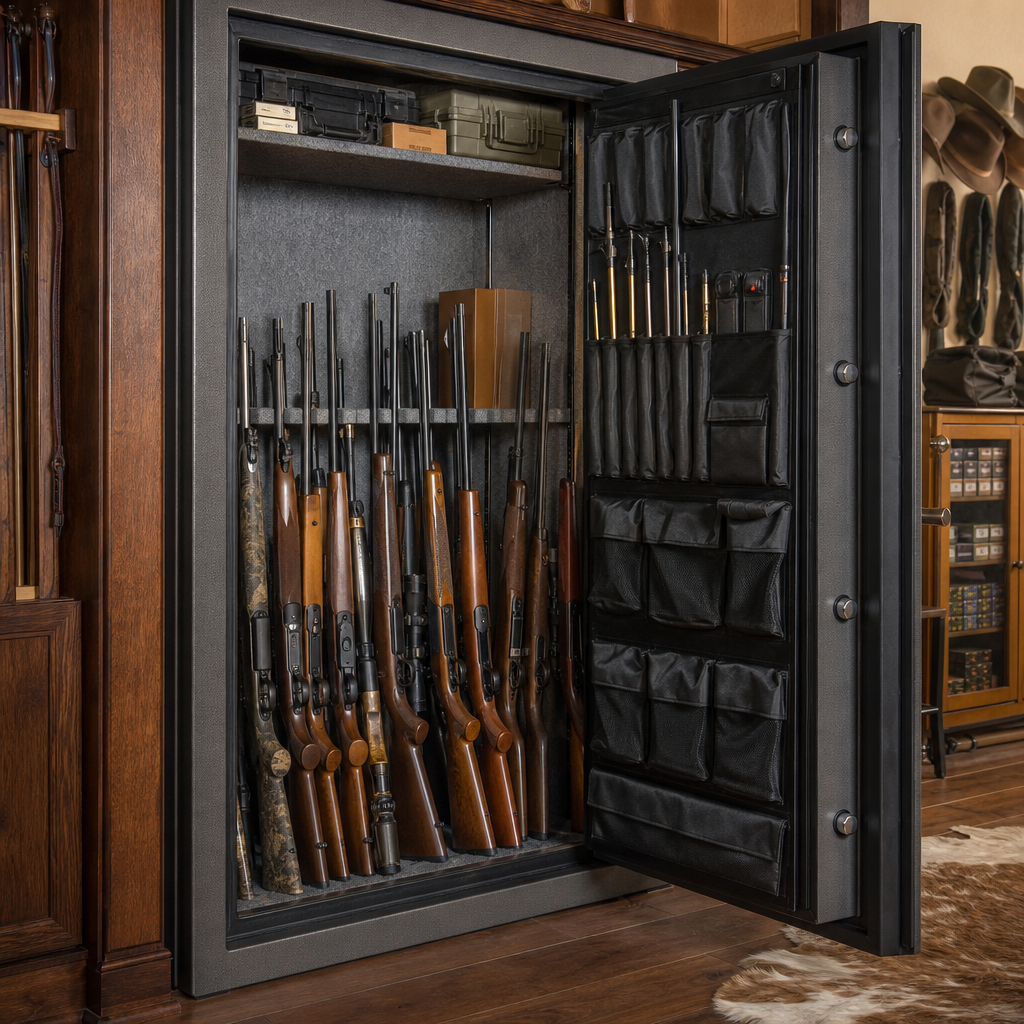
If you own an extensive rifle collection, choosing the right gun safe is not a basic storage decision. It is a long-term risk management choice that affects firearm security, home safety, insurance compliance, preservation of optics and wood stocks, and how efficiently you can access specific rifles when you need them. In practice, the best gun safe for a large rifle collection is rarely the one with the biggest number on the door. It is the one sized, constructed, organized, and installed for your collection profile, your household, and your threat level.
Gun safe buyer personas are useful because rifle owners do not all store firearms for the same reasons. A competitive shooter with precision rifles, a hunter with seasonal long guns, a collector of vintage lever actions, and a ranch owner with hard-use utility rifles can each need a very different safe, even if they own the same number of guns. A persona is simply a practical profile that combines storage volume, firearm type, access needs, budget, and risk tolerance. When I help buyers compare safes, persona-based planning consistently prevents the two most common mistakes: underbuying interior space and overpaying for features that do not fit actual use.
For an extensive rifle collection, key terms matter. “Capacity” is the manufacturer’s estimated number of firearms a safe can hold, usually measured under ideal conditions with slim, unscoped guns placed tightly together. “Fire rating” refers to how long the safe maintains an internal temperature below a set threshold during a standardized heat exposure, though testing methods vary by brand. “Burglary resistance” covers steel thickness, door construction, hard plate, relockers, bolt design, hinge security, and anchor strength. “Environmental control” means managing humidity and condensation with desiccants, dehumidifier rods, and insulation. These terms shape whether a safe works well for twenty years or becomes an expensive compromise in twelve months.
This matters more when the collection is extensive because growth changes everything. Scopes add width. Bipods steal shelf depth. Suppressor-ready rifles and chassis systems consume vertical room. Ammunition, paperwork, magazines, and accessories migrate into the safe unless you deliberately plan separate storage. The result is that many owners who think they need a “36-gun safe” actually need a premium 50- to 60-gun model, or two coordinated safes with different access priorities. The smart approach is to match the safe to the owner persona first, then to the rifle count, and finally to the house, budget, and installation constraints.
Start With the Right Buyer Persona, Not the Marketing Capacity
The fastest way to narrow options is to identify which buyer persona best matches your collection and habits. In the field, I usually see five core personas for large rifle collections. The first is the expanding enthusiast: someone whose collection has grown from a few hunting rifles into a mixed rack of AR-platform rifles, bolt guns, shotguns, and scoped carbines. This buyer needs flexible shelving and should prioritize future growth over current count. The second is the serious hunter: fewer tactical accessories, more long barrels, and seasonal access patterns. This buyer benefits from soft-lined barrel rests, good humidity control, and practical organization for slings, optics, and documents.
The third persona is the precision or competition shooter. These collections often include heavy-barrel rifles, adjustable chassis, muzzle devices, and expensive optics. True usable capacity drops sharply here, so interior depth and modularity matter more than published gun count. The fourth is the collector or heirloom owner. Preservation becomes central, especially for blued steel, walnut stocks, and older finishes sensitive to moisture swings. The fifth is the defensive or working-rifle owner, who values fast retrieval for a few front-line rifles while still needing secure storage for the full collection. That persona often benefits from pairing a large traditional safe with a smaller quick-access unit elsewhere in the home.
What does this persona approach change in real buying decisions? It tells you where to spend money. For a collector, thicker steel and climate management usually matter more than an electronic gadget package. For a competition shooter, adjustable interiors and wide door clearance can be worth paying for. For the expanding enthusiast, oversized capacity is the best value because replacement costs of upgrading later are high. Delivery, stair navigation, reinforcement of flooring, and anchoring can add hundreds of dollars, so getting the persona right before purchase protects both budget and usability.
How Much Safe Capacity a Large Rifle Collection Really Needs
Manufacturer capacity numbers are optimistic. A “40-gun” safe may hold forty slim rifles with iron sights, but that is not how most serious collections look. Add scopes, oversized bolt handles, slings, bipods, chassis stocks, magazine couplers, or soft sleeves, and real capacity may fall to twenty-two or twenty-eight long guns. In my experience, buyers with extensive rifle collections should assume usable capacity of roughly 50 to 70 percent of the listed number, depending on how many rifles wear optics and accessories. If your current count is thirty scoped rifles, a listed 50- or 60-gun safe is often the realistic starting point.
Interior geometry matters as much as the headline count. Measure the tallest rifle with optic attached. Then measure rifles with the bulkiest profile, not just barrel length. Pay attention to shelf intrusion, door organizer thickness, and the angle created by barrel rests. Some safes advertise deep door storage but lose enough interior room that scoped rifles no longer fit cleanly on the main rack. If you own precision rifles with 26-inch barrels, muzzle brakes, and tall turrets, check internal height and center-divider placement carefully. A safe can be technically tall enough while still being awkward to load without bumping optics.
Buyers also overlook collection growth rate. If you have added six rifles in the past two years, your next safe should fit at least five years of likely expansion. Firearms collections rarely shrink for long. Models from Liberty Safe, Fort Knox, Browning, Rhino Metals, and American Security each offer large-capacity lines, but comparing listed numbers alone is misleading. Focus on interior cubic efficiency, rack flexibility, and whether shelving can convert from mixed storage to full-rifle mode later. The best value is often the safe that feels oversized on day one and properly filled by year three.
Security Features That Actually Matter for Rifle Owners
When comparing gun safes, security starts with steel, not cosmetics. Thicker body steel resists pry attacks and slows cutting tools. Many residential gun safes use 14-gauge to 12-gauge steel bodies, while more robust models step into 10-gauge or heavier. Doors may use composite construction to increase rigidity. A secure door should include active locking bolts on multiple sides, a reinforced frame, and relockers that engage if the lock is punched or tampered with. Hard plate protecting the lock area adds meaningful resistance against drilling. These are not luxury details; they are core features that determine how much time a burglar needs.
Lock choice matters, but less than many buyers think. A quality mechanical dial lock from a reputable maker such as Sargent and Greenleaf is durable and proven, while a well-made electronic lock offers faster access and easier code changes. Poorly made electronic locks are the problem, not the category itself. For extensive rifle collections, I advise buyers to focus on UL-listed lock components, reliable relockers, and a strong door system before worrying about flashy keypad extras. Also remember that anchoring is part of security. A safe that is not bolted down can be tipped, moved, or attacked more easily, especially if it is in a garage or outbuilding.
The installation environment changes the threat model. A 900-pound safe in a hidden interior closet on a slab is a very different target than the same safe in a visible garage corner. Alarm integration, camera coverage, reinforced doors, and layered home security increase the safe’s effectiveness by reducing attack time. That is why burglary resistance should be evaluated as a system, not a spec sheet line. For many owners, spending slightly less on decorative finish and more on heavier steel, anchoring hardware, and monitored security creates a stronger real-world result.
Fire Protection, Humidity Control, and Long-Term Preservation
Fire ratings are useful, but they require careful reading. Brands may cite 30, 60, 90, or 120 minutes at temperatures ranging from roughly 1,200 to 1,800 degrees Fahrenheit, yet testing protocols are not uniform across the industry. That means comparing labels without understanding the test can create false confidence. For a large rifle collection, fire protection should be viewed as delay time that improves survival odds, especially when combined with sprinkler systems, smoke detection, and favorable placement within the home. Interior drywall-based insulation is common, while some premium safes use proprietary layered systems to limit heat transfer and smoke intrusion.
Humidity control is equally important, especially for collectors and anyone storing rifles with wood stocks, leather slings, or fine optics. Corrosion often starts from small environmental failures, not dramatic neglect. Basements, garages, and exterior walls create condensation risk as temperatures shift. A dehumidifier rod such as a GoldenRod helps maintain stable air temperature inside the safe, while rechargeable desiccants absorb residual moisture. Use a hygrometer and aim for stable relative humidity rather than guesswork. As a rule, large collections deserve active monitoring because one missed season of moisture exposure can damage bluing, rust screws, haze lenses, and swell wood.
| Buyer persona | Top storage priority | Best safe focus | Common mistake |
|---|---|---|---|
| Expanding enthusiast | Future capacity | Oversized interior and modular shelving | Buying to current count only |
| Serious hunter | Seasonal organization | Humidity control and soft interior protection | Ignoring optic clearance |
| Precision shooter | Accessory-heavy rifles | Depth, height, and flexible rack spacing | Trusting advertised capacity |
| Collector | Preservation | Climate stability and stronger fire protection | Storing in damp garage conditions |
| Defensive owner | Access to select rifles | Large main safe plus quick-access secondary unit | Expecting one safe to do both jobs |
Placement affects preservation. Avoid direct contact with concrete, use shims or manufacturer-approved barriers if needed, and keep the safe away from repeated exterior moisture exposure. If the safe must go in a garage, choose a sealed, insulated model, elevate where appropriate, and monitor humidity year-round. Preservation is not complicated, but it is disciplined. For extensive collections, climate control should be budgeted as part of the purchase, not treated as an optional accessory later.
Interior Layout, Installation Planning, and Smart Buying Decisions
A large rifle safe succeeds or fails on interior layout. Rifle owners need a plan for long guns, handguns, bolts, magazines, documents, suppressor paperwork, and accessories before delivery day. Adjustable shelving, barrel racks, door organizers, and removable center sections create flexibility, but they can also interfere with practical rifle spacing if poorly designed. I recommend sketching your actual collection by type: scoped hunting rifles, AR-pattern rifles, precision chassis guns, shotguns, and overflow items. This immediately reveals whether you need dedicated shelves, wider rack intervals, or a second safe for non-rifle gear. Accessories consume more usable space than most buyers expect.
Installation planning is just as important. Measure doorways, stairs, hallway turns, and final room dimensions. Check floor load limits, especially in older homes or upstairs installations. A safe weighing 1,000 to 1,500 pounds can usually be placed safely on many ground-floor locations, but concentrated loads and joist direction still matter. Professional delivery crews use stair climbers, pallet jacks, and safe skates for a reason. This is not a DIY move unless conditions are very simple. Proper anchoring into concrete or substantial wood framing materially improves resistance to tipping and removal, and it can also satisfy insurer expectations.
Finally, buy with a system mindset. Separate ammunition if local law, household conditions, or available space make that practical. Keep serial records and photos stored securely off-site or in encrypted digital form. Review warranty terms, lock support, and replacement-part availability before choosing a brand. A sub-pillar hub on gun safe buyer personas should lead to the same conclusion every time: the right gun safe for an extensive rifle collection is the one that fits your persona, exceeds your realistic capacity needs, delivers meaningful steel and fire protection, and supports preservation for decades. Define your collection profile, measure honestly, and choose a safe built for the rifles you already own and the ones you will add next.
Frequently Asked Questions
How large should a gun safe be for an extensive rifle collection?
If you own a large number of rifles, the most important sizing rule is simple: buy significantly larger than your current collection suggests. Manufacturer capacity ratings are often based on tightly packed long guns without scopes, slings, bipods, oversized bolts, or upgraded stocks. In real-world use, a “24-gun” safe may hold far fewer rifles once you account for optics, modern sporting rifles, lever guns with wider profiles, and the need to avoid stock and finish damage from overcrowding.
A better approach is to evaluate your collection by actual dimensions and intended growth. Count your longest rifles, note which ones wear large scopes, and think about whether you want room for suppressor-ready setups, documents, handguns, ammunition storage, and accessories. It is also wise to leave open space for easier retrieval. If your rifles are packed too tightly, access becomes slow and awkward, and the risk of bumping optics or scratching wood stocks goes up. For most serious collectors, internal layout matters just as much as total size. Adjustable shelving, modular racks, and door storage can make a safe much more functional than a larger but poorly organized model.
In practical terms, many owners of extensive rifle collections end up happier with a safe rated well above their current needs, or even with multiple safes divided by firearm type, value tier, or use pattern. Choosing more capacity at the beginning usually costs less than replacing an undersized safe later. The right safe should fit your collection today, accommodate what you are likely to acquire tomorrow, and still allow safe, efficient access without forcing rifles into a cramped space.
What security features matter most when choosing a gun safe for many rifles?
When you are protecting an extensive rifle collection, focus on construction quality before marketing language. The core security features that matter most include the steel thickness of the body and door, the strength of the locking mechanism, pry resistance, hard plate protection around the lock, relockers, internal hinge design or reinforced hinge-side protection, and the ability to bolt the safe securely to the floor. A large rifle collection represents a substantial financial investment, which means the safe should be treated as a serious physical security device, not just a locking cabinet.
Body thickness is especially important because many break-ins are attacks against the safe walls, not just the door. Heavier steel generally provides better resistance against cutting, peeling, and forced entry. Door design also matters. A thick door with robust locking bolts can help, but bolt count alone should not impress you if the surrounding construction is weak. Look for overall engineering quality, including reinforced door frames and anti-pry features. A quality lock is equally critical. Both mechanical and electronic locks can be reliable if they come from reputable manufacturers, but they should be paired with tamper-resistant components and installed on a safe built to resist attack.
For a large collection, installation is part of security. Even a well-built safe can be compromised if it can be tipped, moved, or removed from the home. Bolting it down to concrete and positioning it in a location that limits pry-bar access can substantially improve protection. If the collection is particularly valuable, many owners also combine the safe with layered security such as alarm systems, surveillance, reinforced entry points, and controlled room access. The safest approach is to think beyond the lock itself and evaluate how the safe performs as one part of a complete risk management strategy.
How important is fire protection for a rifle safe, and what should I look for?
Fire protection is extremely important, especially for collectors storing high-value rifles, wood-stocked firearms, optics, documents, and related accessories. Heat, smoke, moisture, and the efforts used to extinguish a fire can all damage firearms even if the safe is not physically breached. However, fire ratings can be confusing because different manufacturers use different testing methods, temperature thresholds, and time claims. That means you should not rely on a single sticker or advertised number without understanding what it represents.
Look for clear information about the fire rating, including the duration, the external temperature used during testing, and ideally whether the rating comes from a recognized third-party standard rather than only an in-house test. Also consider that internal temperatures matter differently depending on what you are storing. Wood stocks, lubricants, optics, and important paperwork can all be affected by prolonged heat exposure. Door seals that expand during high heat can help block smoke and heat intrusion, and better insulation design can improve performance, but no safe should be viewed as absolute protection against every fire scenario.
For rifle collectors, fire protection should be balanced with humidity control after installation. Many fire-lined safes can trap moisture if the environment is not managed properly. Adding a dehumidifier rod or desiccant system is a smart step, particularly if you store blued steel, collectible wood stocks, or expensive glass. The best choice is a safe with credible fire protection, proper installation in the safest practical area of the home, and active moisture management afterward. In other words, fire resistance is not just a sales feature; it is part of preserving the long-term condition and value of your collection.
How should the interior of a gun safe be organized for a large rifle collection?
Interior organization is one of the most overlooked factors when people shop for a safe, yet it has a huge impact on daily usability and long-term firearm preservation. With a large rifle collection, a poor interior layout can turn a big safe into a frustrating and inefficient storage box. The goal is not just to fit rifles inside. The goal is to store them in a way that protects optics, prevents stock damage, preserves finishes, and allows you to identify and remove specific rifles without disturbing half the collection.
Adjustable shelving and modular rack systems are especially valuable because extensive collections usually include rifles with different barrel lengths, stock shapes, and optic heights. Scoped precision rifles, AR-pattern rifles, hunting rifles, lever guns, and collectible wood-stocked firearms do not all store equally well in a fixed-layout interior. A flexible system allows you to create zones for different categories and leave enough clearance between rifles. Door organizers can also free up interior space for handguns, magazines, documents, and small accessories, but they should not interfere with long-gun fit when the door closes.
Collectors should also think in terms of access priority. Place the rifles you use most often where they can be reached without shifting other firearms around. More delicate, collectible, or rarely used rifles may be better positioned in lower-traffic areas of the safe with added spacing. If the collection is large enough, multiple safes may actually be the best organizational solution. For example, one safe can be dedicated to everyday-use rifles and another to collector-grade firearms. A well-organized interior reduces handling mistakes, improves convenience, and helps ensure the safe works as a practical system rather than just a large locked container.
Where should a gun safe be installed, and does placement affect security and performance?
Yes, placement has a major effect on both security and long-term performance. A gun safe should be installed in a location that supports the floor load, allows the safe to be anchored properly, limits visibility to visitors or potential intruders, and reduces exposure to moisture and environmental extremes. Basements, garages, utility spaces, and interior rooms are all common locations, but each has tradeoffs. The best installation point is the one that strengthens security while also helping preserve the condition of your rifles.
From a security standpoint, discreet placement is usually preferable. A safe that is not easily seen or reached is harder for a thief to target quickly. Corner placement can also help reduce access to pry points on the sides and back. Bolting the safe to a concrete slab or another suitable structural surface is one of the most effective ways to improve real-world security, particularly for large safes that might otherwise be tipped or moved with enough time and tools. You should also confirm that the surrounding structure can support the safe’s loaded weight, since a large rifle collection can add substantial mass.
Environmental conditions are equally important. Areas with high humidity, temperature swings, or water intrusion risk can threaten metal finishes, optics, stocks, and internal safe materials. If you install the safe in a basement or garage, moisture control becomes even more important. Use dehumidification, monitor the environment, and avoid locations prone to flooding if possible. In many cases, the best placement is an anchored safe in a low-visibility, climate-stable part of the home that still allows you enough clearance to open the door fully and access the interior comfortably. Good placement makes the safe harder to attack, easier to use, and better suited to preserving a valuable rifle collection over time.