
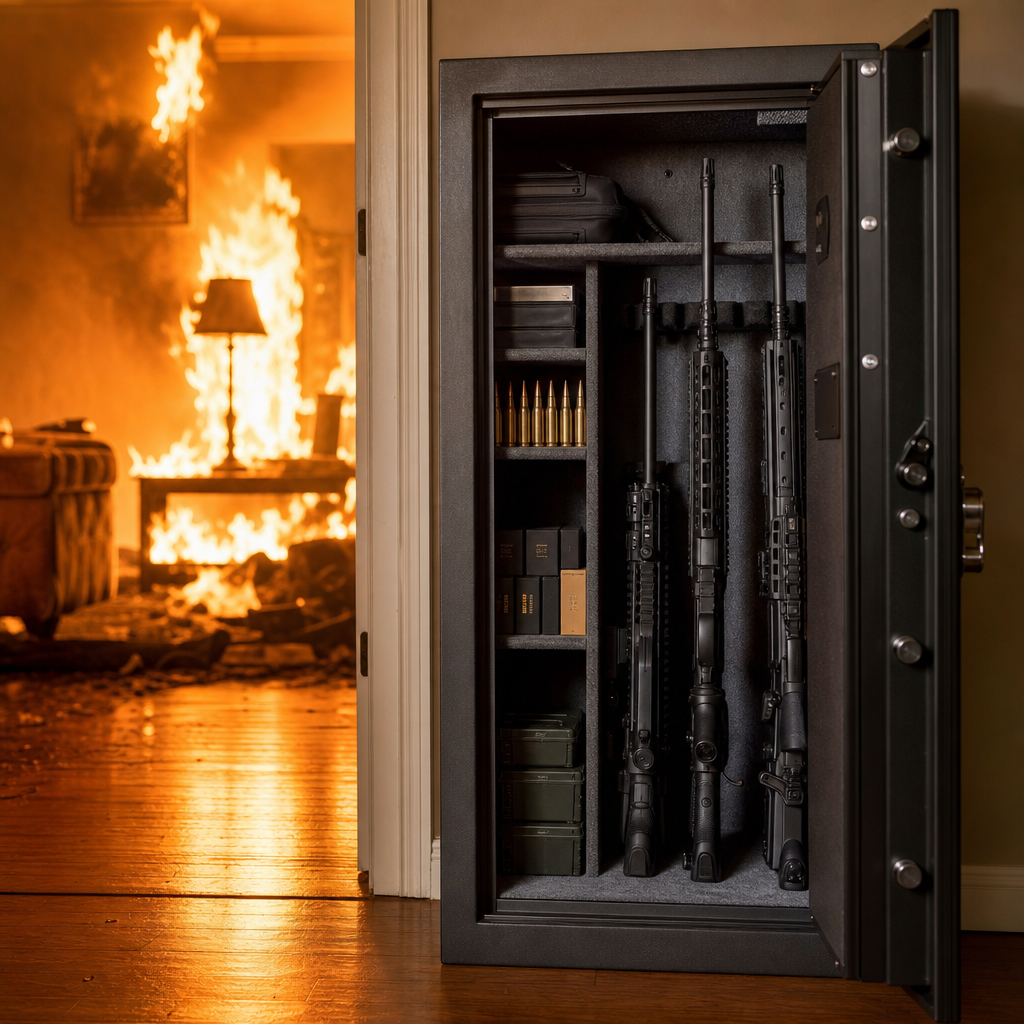
Fireproof and disaster-resistant firearm storage is the practice of protecting guns, ammunition, optics, documents, and related accessories from extreme heat, smoke, water, impact, and unauthorized access during a house fire or other emergency. For gun owners, this topic matters because a fire can destroy steel temper, melt polymers, ignite ammunition packaging, warp wood stocks, erase serial-number records, and leave surviving firearms unsafe to use until they are inspected. I have helped owners evaluate safes after kitchen fires, garage fires, and wildfire evacuations, and the pattern is consistent: the people who recover best planned for heat, water, and retrieval before the emergency, not during it. Good storage is not just about buying a “fireproof” box. It means understanding fire ratings, placement, anchoring, sealing, humidity control, inventory documentation, insurance requirements, and realistic evacuation limits. It also means recognizing that no consumer safe is literally fireproof forever. Every product has a time-and-temperature threshold, and every home has unique risks based on construction type, room location, fuel load, and response time from the local fire department. This hub explains how to choose, place, and maintain firearm storage that can survive a fire emergency with the highest practical margin of safety.
What fire-resistant firearm storage actually protects against
The first question most owners ask is simple: what does a fire-rated gun safe protect against? A good answer starts with the threat profile. In a typical residential structure fire, room temperatures can exceed 1,100 degrees Fahrenheit, and localized conditions can rise much higher near flashover. Firefighters also pour large volumes of water into the structure, ceilings may collapse, smoke carries corrosive residues, and a safe can be dropped, struck, or buried under debris. A storage solution for firearms therefore needs layered protection: thermal insulation to slow heat transfer, a door seal that expands to resist smoke and water intrusion, a body and frame strong enough to remain closed under impact, and hardware that still functions after exposure. Ratings matter here. Many gun safes cite a factory test such as 30, 60, 90, or 120 minutes at a stated temperature, often around 1,200 to 1,700 degrees Fahrenheit. Those numbers are useful, but they are not identical. A safe tested independently to a recognized burglary or fire standard carries more weight than a marketing label without a protocol. For firearms, internal temperature is the real issue. Even if the steel shell survives, internal heat can damage optics, lubricants, plastics, adhesives, and wood finishes long before metal parts melt.
That is why experienced buyers treat “fireproof” as shorthand for “fire-resistant for a defined duration.” The best approach is to match the safe’s protection level to your actual risk. If you live in a dense suburb with a short fire department response time, a verified 60-minute rating may be reasonable. If you live rurally, store firearms in a detached shop, or face wildfire risk where exposure can be prolonged, moving up to a higher-rated safe or a true vault room may be justified. Water resistance deserves equal attention. During one post-fire assessment I saw two rifles survive heat because they were in a quality safe, yet both needed extensive remediation because water entered through the door gap after suppression. Fire survival is not one variable. It is the combination of heat resistance, smoke sealing, structural integrity, and post-event recoverability.
How to choose a gun safe for fire and disaster resistance
When selecting a safe, start with construction details rather than paint, branding, or interior lighting. Steel thickness affects security and structural stability. Heavier-gauge bodies resist deformation better than thin cabinets, especially if debris falls on the safe. Door design matters too: a reinforced door edge, robust locking bolts, and quality hinges help the door remain aligned under stress. Insulation is the core of fire performance. Many consumer gun safes use layers of gypsum-based fireboard because chemically bound water in the material slows heat transfer as it turns to steam. Better designs add multiple layers, thermal barriers at critical seams, and door seals that expand when heated. Composite safes may combine steel and poured insulation materials for improved performance. Lock selection is another important tradeoff. Mechanical dial locks are simple and proven, while electronic locks offer speed and user codes but rely on components that can be more vulnerable to heat, moisture, or battery neglect. Neither type is universally best; reliability depends heavily on quality and maintenance.
Capacity should be oversized from the beginning. A “24-gun” safe rarely stores 24 scoped rifles in real use. Tight packing increases the chance of stock damage, slows emergency access, and makes it harder to include pistols, suppressors where legal, documents, and dehumidifier devices. Interior layout should support your actual collection and leave space for records such as purchase receipts, appraisals, trust paperwork, and photos stored in a separate fire-rated document pouch or media container. Pay attention to the fine print on fire ratings. Ask who performed the test, what temperature curve was used, whether the safe was heated from all sides, and what internal temperature threshold defined a pass. Independent certification from a recognized laboratory is stronger than an unverified house brand claim. Also ask about replacement warranties after a fire and whether the manufacturer covers shipping, locksmith work, and lock replacement. Those details become important after a loss.
| Feature | What to look for | Why it matters in a fire emergency |
|---|---|---|
| Fire rating | 60 to 120 minutes with defined test temperature and protocol | Longer, documented resistance improves survival odds during delayed response or wildfire exposure |
| Insulation | Multiple fireboard layers or composite fill | Slows internal temperature rise that damages optics, wood, plastics, and lubricants |
| Door seal | Expanding intumescent gasket | Helps block smoke and some water during suppression efforts |
| Steel thickness | Heavier body and reinforced door | Resists warping, impact, and debris loads |
| Lock type | Quality mechanical or electronic lock from a known maker | Improves post-event access and daily reliability |
| Anchoring | Bolted to slab or structurally sound floor | Reduces tip-over, movement, and theft during evacuation chaos |
Where to place the safe inside the home
Safe location has a direct effect on survivability. The ideal spot balances lower fire exposure, structural support, theft resistance, and practical access. In most homes, a garage seems convenient, but garages often contain fuel, solvents, batteries, and vehicles that can intensify fire conditions. Detached garages also may have weaker climate control, increasing rust risk. Upper floors are generally the worst place for a heavy safe because fire can compromise joists and send the safe crashing into a burn zone below. A ground-floor interior location, especially on a concrete slab, is often the most resilient choice. Basements can be good from a thermal standpoint because surrounding earth moderates temperature, but they bring water intrusion risks from hose runoff, burst pipes, and flooding. If you place a safe in a basement, raise it slightly on a manufacturer-approved plinth or steel spacers and pay attention to drainage and dehumidification.
Keep the safe away from direct fuel loads such as stored paint, propane cylinders, furnace rooms, or overloaded electrical panels. Exterior walls are a mixed case. In a wildfire, exterior-facing placement can increase exposure to radiant heat and ember intrusion if nearby materials ignite. In an interior house fire, a central location may experience slightly less direct flame contact than a perimeter room with windows that fail early. Think structurally as well. A corner on a slab can be excellent because corners are strong, and nearby walls can help conceal and support the installation. I also recommend planning the swing of the door and the path needed to remove firearms safely after an event. If the safe is wedged into a cramped closet, inspection and recovery become harder. Placement is part of disaster planning, not just interior design.
Preparing firearms, documents, and accessories for maximum survival
The safe is only one layer. How you prepare the contents greatly affects the outcome after a fire emergency. Start by cleaning and lightly lubricating firearms with a product suited to long-term storage; this helps protect exposed metal if humidity spikes or small amounts of water enter. Use silicone-treated gun socks or soft sleeves for certain firearms, but avoid materials that trap moisture if your environment is already damp. Optics, night-vision devices, suppressors where legal, and serialized parts should be organized so they are not pressed tightly together. Heat-softened foam can imprint finishes and trap water, so choose interior materials carefully. Ammunition should usually be stored according to manufacturer guidance and local law, often in a separate locked container rather than crammed around firearm stocks. While modern cartridges in a fire do not explode like a chambered round in a firearm, heat can still rupture packaging, contaminate contents, and complicate suppression and cleanup.
Documentation is just as important as metal. Store printed copies of serial numbers, purchase dates, appraisals, and photos in a rated document pouch inside the safe, and keep encrypted digital copies off-site in cloud storage or a secure drive at another location. If firearms are held in a trust, maintain signed copies and a contact list for your attorney, insurer, and any co-trustees. Insurance should be reviewed before disaster strikes. Standard homeowners policies may limit firearm coverage or require scheduled riders for higher-value collections, custom builds, or collectibles. Ask specifically whether optics, suppressors, stocks, and accessories are covered and whether smoke and water damage are included even when the safe survives. Add a hygrometer and either desiccant packs or an electric dehumidifier rod if the safe supports one. Fire resilience is stronger when rust prevention, records management, and claims readiness are built into the setup from day one.
What to do before, during, and after a fire emergency
Preparation before an emergency should be routine, not dramatic. Test the lock, replace batteries on schedule for electronic units, inspect the door seal, and verify that anchor bolts remain tight. Review your inventory at least annually, especially after purchases, sales, or modifications. In wildfire areas, maintain defensible space around the home, clean gutters, and avoid stacking combustible materials against exterior walls near the room where firearms are stored. During an active fire, the rule is clear: do not stay behind to open the safe or remove guns unless law enforcement or fire personnel direct you and conditions are unquestionably safe. Time lost inside a structure kills people. If evacuation is possible early in a wildfire scenario and your plan allows safe, legal transport, then pre-cased priority firearms and documents may be removed according to your predetermined checklist. In a fast-moving house fire, assume the safe must do its job without you.
After the fire, treat every firearm as potentially compromised. Heat can alter springs, optics seals, stock bedding, and barrel temper in ways that are not obvious. Do not load or fire a recovered gun until a qualified gunsmith or manufacturer service center has inspected it. Photograph the safe before opening if possible, then document the condition of contents as they are removed for insurance. If the safe was submerged or heavily wetted, open it as soon as authorities allow to reduce corrosion, but use gloves and caution around soot, damaged ammunition, and unstable shelving. Separate guns by condition, tag them, and begin controlled drying and conservation rather than aggressive scrubbing. Restoration may involve ultrasonic cleaning, rust neutralization, stock refinishing, optic replacement, or total loss determination. A calm, documented process protects safety and makes insurance recovery faster.
Building a complete disaster-resistant storage plan
The strongest solution is a system, not a single product. For many owners, that system includes a properly rated and anchored safe on a slab, interior placement away from obvious fuel loads, humidity control, duplicated records, scheduled maintenance, and insurance tailored to the collection. Owners with large collections, rare firearms, or rural properties should also consider higher-end composite safes, dedicated safe rooms, or concrete-encased vault spaces. Those options cost more, but they provide better thermal mass, stronger burglary resistance, and more predictable performance in prolonged incidents. Redundancy helps too. Keep irreplaceable paperwork in a separate rated document container, maintain off-site backups, and pre-plan temporary storage options with a trusted dealer or family member if a disaster displaces you from the home. This subtopic connects directly to related decisions on gun safe sizing, moisture control, anchoring, lock selection, and insurance, because fire protection fails when any one of those pieces is neglected.
Storing firearms to survive a fire emergency comes down to realistic expectations and disciplined preparation. Choose a safe with credible fire resistance, install it in a smart location, prepare the contents so they can survive heat and water, and know exactly what steps to follow before and after an incident. No residential setup can promise perfect protection in every fire, but a well-planned system can dramatically improve the odds that your firearms, records, and investment remain recoverable and safe to evaluate. Use this hub as your starting point, then review your current setup room by room and identify the weakest link you can fix this month.
Frequently Asked Questions
What is the safest way to store firearms so they have the best chance of surviving a house fire?
The safest approach is layered protection rather than relying on a single product or storage habit. Start with a quality fire-rated safe designed for burglary resistance as well as heat protection. Look for a tested fire rating that specifies both temperature and duration, because not all ratings mean the same thing. A safe that performs well in a short laboratory test may not protect contents during a fully involved house fire, especially if the structure collapses or firefighters soak the area with water. In practical terms, a heavier safe with solid door seals, multiple locking points, and proper anchoring usually offers better real-world protection than a light cabinet advertised with vague “fireproof” claims.
Placement matters almost as much as the safe itself. Firearms are generally better protected on the lowest occupied level of the home, away from rooms with higher ignition risk such as kitchens, garages, furnace rooms, and workshops. Avoid storing guns in attics or upper floors where heat rises fastest and where a collapsing structure can drop the safe through burned framing. If possible, place the safe on a concrete slab or other noncombustible surface, and leave enough clearance around it so moisture does not stay trapped after an emergency. Many owners also add a raised plinth or moisture-resistant barrier under the safe to reduce water intrusion from sprinkler discharge or firefighting runoff.
Inside the safe, organize firearms so they are not tightly packed together. Use racks, sleeves, or separators that will not melt easily onto metal or optics under heat. Important paperwork such as serial-number lists, purchase records, trust documents, and photographs should go into a separate fire-rated document container or media-rated box inside the safe, because paper and digital media are often damaged at temperatures lower than those required to visibly ruin a firearm. For optics, suppressor paperwork, spare magazines, and ammunition, use dedicated containers rather than piling everything together. The more structured the storage setup, the less likely items are to suffer impact damage if the safe is knocked over or shifted during a fire response.
Are firearms still usable after a fire if they look mostly intact?
Not automatically. A firearm can survive visually and still be unsafe to fire. Heat exposure can change the metallurgy of critical components, weaken springs, damage temper in barrels and receivers, distort optics, and compromise polymer frames, stocks, grips, magazine bodies, and internal parts. Smoke residue and corrosive byproducts can also settle into mechanisms, and water used to extinguish the fire can quickly trigger rust in places the owner cannot easily inspect. Even if the gun opens, closes, and appears normal on the outside, hidden damage may have altered headspace, lockup, or structural integrity.
This is why any firearm exposed to fire, heavy heat, smoke, or firefighting water should be treated as potentially unsafe until it has been inspected by a qualified gunsmith or the manufacturer. That includes firearms stored near the fire rather than directly inside it. Temper loss and heat stress do not always leave obvious discoloration. Some owners make the mistake of cleaning a fire-exposed gun, seeing that it looks acceptable, and assuming it is fine. That is risky. A professional evaluation is the right next step, and in severe cases the firearm may need to be retired, replaced, or returned to the manufacturer for assessment.
The same caution applies to ammunition and magazines. Loose ammunition, boxed rounds, and loaded magazines may have been exposed to heat cycles that make them unreliable or dangerous. Packaging may ignite or degrade before cartridges visibly fail, and moisture contamination after suppression efforts can further compromise performance. If a fire has affected the storage area, document everything for insurance and avoid using any questionable ammunition until you receive clear guidance from a knowledgeable professional or the manufacturer.
Should ammunition be stored in the same fire-resistant safe as firearms?
It can be, but it should be done thoughtfully. Many owners keep some ammunition in the same safe for security and convenience, yet separating ammunition from firearms often improves organization, reduces clutter, and may limit damage if one category of contents is exposed to moisture or impact. Ammunition should be stored in stable, labeled containers that protect it from humidity and allow you to rotate stock. Avoid creating a packed, overloaded environment inside the gun safe, because that can trap moisture, make access difficult, and increase the chances of damage to firearms and optics.
From a fire-survival standpoint, the best practice is usually to store primary firearms in a fire-rated gun safe and keep larger ammunition quantities in separate, cool, dry, locked storage appropriate for local laws and manufacturer guidance. This also helps preserve usable interior space for long guns, handguns, suppressors, paperwork, and sensitive accessories. If you do store ammunition in the same safe, keep it organized in dedicated ammo cans or containers with clear labels, and avoid stacking it in a way that blocks access or places excess weight on shelves not designed for it.
There is also a records issue many owners overlook. During a disaster, being able to identify what was stored, how much was present, and what was damaged can make insurance documentation much easier. A written inventory, backed by photos and digital copies stored off-site or in the cloud, is just as important as the physical storage method. In other words, the most resilient setup protects not just the firearm and ammunition themselves, but also your ability to prove ownership and recover financially after a loss.
What should be kept with firearms in a fire-resistant storage setup besides the guns themselves?
A complete emergency-minded storage plan should include more than just firearms. At minimum, store serial-number records, purchase receipts, appraisal documents for higher-value items, trust or registration paperwork where applicable, photos of each firearm, and contact information for your insurer. If you own optics, night vision, suppressors, heirloom guns, or customized builds, detailed documentation becomes even more important because replacement value and proof of configuration can be difficult to establish after a fire. Keep hard copies in a protected document container and digital copies in secure off-site storage.
It also makes sense to include basic protective items that help after the emergency, such as silicone-treated gun socks where appropriate, desiccant packs, humidity monitoring devices, and clearly labeled containers for bolts, magazines, suppressor mounts, tools, and small parts. The goal is not to turn the safe into a junk drawer. It is to create a controlled environment where every essential item has a place and can be accounted for after a crisis. A well-laid-out safe also makes it easier for a gunsmith or insurance adjuster to assess what happened if a loss occurs.
For especially valuable collections, consider creating a parallel off-site record system. That can include encrypted digital inventories, scanned receipts, photographs showing serial numbers, and video walk-throughs of the collection. If a fire destroys the room or the safe is heavily damaged, those outside records may be the only reliable proof of ownership left. Owners who prepare this way recover faster, file cleaner claims, and reduce the chance of permanently losing the history and identity of irreplaceable firearms.
How often should I check and upgrade my firearm storage for fire and disaster readiness?
You should review your setup at least once or twice a year, and any time something significant changes in the home, collection, or local risk environment. Seasonal checks are a smart habit because humidity, temperature swings, storm exposure, and household renovations can all affect storage performance. During these reviews, inspect door seals, locking mechanisms, anchor points, interior organization, dehumidification tools, and the condition of records. Replace saturated desiccants, test electronic locks according to manufacturer instructions, and make sure nothing inside the safe is resting in a way that could cause scratches, pressure damage, or difficult retrieval during an emergency.
It is also worth reassessing whether your current safe still matches the value and size of your collection. Many owners start with a cabinet or entry-level safe and outgrow it. As more firearms, optics, ammunition, and documents are added, protection often gets worse because the safe becomes overcrowded. Upgrading before that happens is much better than trying to force a larger collection into inadequate storage. If you move homes, finish a basement, add a security system, or change insurance coverage, that is another good time to revisit location, anchoring, and fire strategy.
Finally, think beyond fire alone. True disaster-resistant storage should account for smoke, water, debris impact, and theft during the confusion after an emergency. A fire may be followed by flooding, structural collapse, or a period when contractors, adjusters, and responders enter the property. Strong physical security, clear records, and a safe positioned in a low-risk area all work together. The owners who fare best are usually the ones who treat firearm storage as an ongoing preparedness system, not a one-time purchase.