
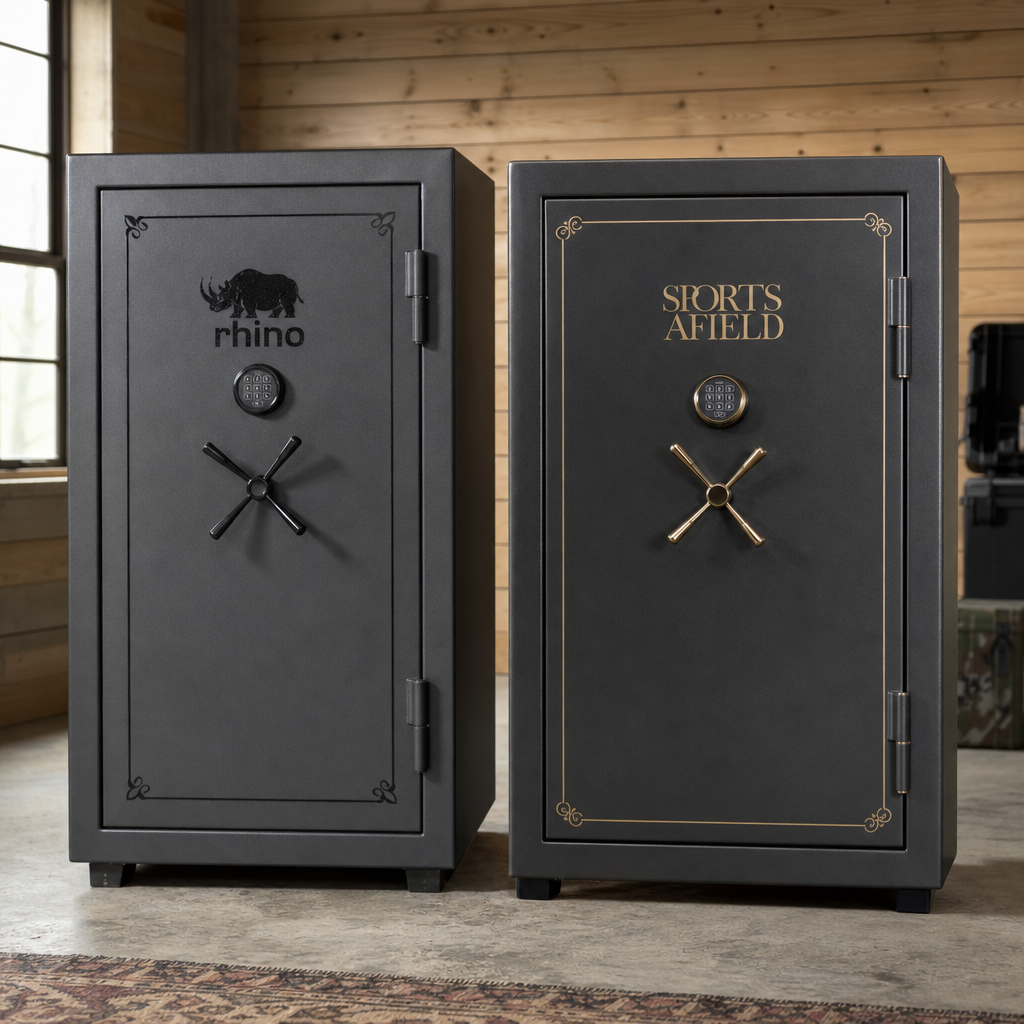
Choosing between Rhino and Sports Afield is not just a brand preference; it is a decision about burglary resistance, fire protection, long-term reliability, interior flexibility, and overall value in a gun safe comparison that many buyers get wrong. In the gun safes and safety category, these two names appear often because they target mainstream buyers who want more security than a cabinet, but they approach the market differently. Rhino has built its reputation around heavier construction, upgraded hardware, and a more premium fit and finish, while Sports Afield focuses on accessible pricing, broad retail availability, and feature-packed models aimed at first-time safe owners. Understanding that split matters because “best” depends on what threat you are trying to defend against. A gun safe is not a vault door in a hardened safe room. It is a residential security container or safe-like enclosure designed to slow theft, organize firearms, protect documents, and add some level of fire resistance. When I evaluate safes for homeowners, I look at steel thickness, door design, bolt work, lock type, fire seal, concrete or composite fill, anchor options, warranty support, and whether the stated capacity is realistic. I also ask practical questions buyers usually miss: Will long guns with optics actually fit? Can the interior be reconfigured without wasting space? Is the safe heavy enough to resist tipping but still movable into a home? Rhino vs. Sports Afield is a useful matchup because it highlights the key tradeoffs in this entire subtopic: price versus build quality, convenience versus robustness, and entry-level value versus long-term ownership confidence.
Brand Positioning and Product Philosophy
Rhino and Sports Afield serve overlapping customers, but they are not built around the same philosophy. Rhino typically competes in the midrange and premium end of the market. Its catalog includes gun safes, long-gun vaults, and higher-security models with thicker steel, stronger external hinges, and more decorative finishes. In stores and field inspections, Rhino units generally feel overbuilt compared with mass-market alternatives. Doors tend to shut with more authority, interiors are better trimmed, and hardware choices suggest the company expects owners to keep the safe for decades rather than replace it after a move or a collection upgrade.
Sports Afield, by contrast, has been successful because it lowers the barrier to ownership. The brand is common at warehouse clubs, sporting-goods chains, and online retailers. Buyers often encounter Sports Afield while moving up from a locking cabinet or adding a second safe for overflow storage. The company emphasizes broad capacity ratings, electronic locks, fire claims that resonate on the sales floor, and price points that fit normal household budgets. That strategy works because many buyers need immediate secure storage for a handful of rifles, handguns, passports, and cash, not a luxury finish or thick-plate body.
As a hub topic for gun safe comparisons and brand spotlights, this difference is the first lens to apply. If you are comparing American Security, Liberty, Winchester, Browning, Cannon, Rhino, and Sports Afield, the meaningful question is not which logo is more popular. The meaningful question is where each brand sits on the spectrum between consumer-friendly affordability and truly robust construction. Rhino usually leans toward the latter. Sports Afield usually leans toward the former.
Security Construction: Steel, Bolts, and Real Burglary Resistance
If you want the direct answer on security, Rhino generally makes the better gun safe. The reason is simple: in most comparable tiers, Rhino tends to offer heavier bodies, stronger doors, and more confidence-inspiring bolt work. Steel thickness matters because most residential break-ins are quick attacks using pry bars, screwdrivers, wedges, and body weight. A safe with thinner sheet steel can be peeled, flexed, or attacked around the door frame more easily than a unit with heavier-gauge construction and reinforced returns.
Sports Afield models vary by line, and some are better than others, but many are designed to hit aggressive retail price targets. That usually means lighter steel than premium competitors. Lighter steel does not make a safe useless; it makes anchoring, placement, and layered security more important. A bolted-down Sports Afield safe in a closet corner can still defeat a smash-and-grab thief who expected an unlocked case. However, against a determined intruder with time and leverage tools, thicker material and stronger door geometry matter a great deal.
Rhino also benefits from design cues that experienced buyers notice quickly: better door fitment, more rigid frames, and hardware that appears selected for repeated use. Some Rhino lines use internal structures and anti-pry features that improve resistance where many attacks begin, at the door edge. This is why spec-sheet comparisons alone can mislead. Two safes can advertise similar bolt counts, but oversized active bolts mean less if the door skin, frame, and bolt support are weak. The whole system matters.
| Comparison Point | Rhino | Sports Afield |
|---|---|---|
| Typical market position | Midrange to premium | Entry-level to midrange |
| Perceived steel robustness | Usually heavier and stiffer | Often lighter to meet price goals |
| Door and frame strength | Generally stronger anti-pry feel | Adequate for basic home security |
| Retail pricing | Higher upfront cost | More budget-friendly |
| Best fit buyer | Long-term owner prioritizing security | Value buyer needing immediate storage |
For many households, the practical takeaway is this: if burglary resistance is your top criterion, buy the heaviest Rhino model your budget and floor structure can reasonably support. If your budget only reaches Sports Afield, anchor it correctly, hide it well, and support it with an alarm, cameras, and controlled access to the room.
Fire Protection Claims and What They Really Mean
Fire ratings sell safes, but they are often misunderstood. Both Rhino and Sports Afield advertise fire protection, yet buyers should interpret those numbers carefully. Fire resistance in the residential safe market depends on insulation material, door seals, body gaps, exposure time, and test conditions. There is no single universal test that makes all ratings equal. Some manufacturers rely on independent laboratory protocols, while others use proprietary testing. The result is that a “60-minute” safe from one brand may not perform identically to a “60-minute” safe from another.
In my experience, Rhino tends to inspire more confidence because its heavier construction supports better overall thermal performance, especially when paired with quality door seals and substantial insulation packages. Heavier safes often have an advantage in thermal mass and structural integrity during heat exposure. Sports Afield often publishes attractive fire numbers for the price, and those ratings may be sufficient for many suburban homes where the goal is to protect contents until fire crews arrive. But if you live in a rural area with longer response times or are protecting irreplaceable paper records, a stronger build and a more conservative reading of marketing claims are wise.
It is also important to define what you are protecting. Paper chars around 451 degrees Fahrenheit, digital media can fail at much lower temperatures, and firearm finishes, lubricants, and optics can be damaged well before a safe’s interior reaches catastrophic levels. A gun safe is not automatically a media safe. If you store external drives, family photos, or backup documents, add dedicated fire-rated document pouches or a smaller media container inside the safe. In this comparison, Rhino generally earns the edge for buyers who treat fire protection as more than a checkbox, while Sports Afield remains competitive for budget-conscious homes that need a balanced feature set.
Locks, Interiors, and Day-to-Day Ownership
A safe can have respectable specs and still be frustrating to own. That is why daily usability deserves equal weight in any gun safe brand spotlight. Both Rhino and Sports Afield commonly offer electronic locks, and some models may include mechanical dial options depending on line and dealer configuration. Electronic locks are convenient, especially for frequent access, but quality matters. Reputable lock platforms from established names such as SecuRam, Sargent and Greenleaf, or La Gard are generally preferable to anonymous components. Before buying, confirm the exact lock brand, relocker presence, battery access method, and override policies.
Rhino typically does better on fit and finish. Interiors are often more thoughtfully arranged, with better upholstery, shelving support, and a more premium feel. This matters because stated gun capacity is almost always optimistic. A “24-gun” safe may realistically hold 12 to 16 scoped rifles if stocks are thick and optics are mounted. Rhino interiors often make that reality easier to manage. Sports Afield interiors can be perfectly serviceable, but some models prioritize headline capacity over genuinely comfortable spacing.
Door organization is another overlooked factor. Handgun holsters, magazine pouches, and document pockets can meaningfully expand useful storage, especially in smaller footprints. Lighting, outlet kits, and dehumidifier routing also affect satisfaction over time. A safe placed in a garage in the South has different moisture challenges than one in a climate-controlled basement in Arizona. Rhino owners often report a more polished ownership experience, while Sports Afield owners tend to be happiest when expectations are aligned with the price: practical, functional, and good enough for everyday residential use.
Value, Warranty, and Which Brand Should You Buy?
Value is not the same as low price. Value is the combination of security, longevity, support, and usable features you receive for the money. On pure purchase price, Sports Afield often wins easily. For new gun owners, apartment renters moving into a house, or families that need compliant firearm storage without stretching the budget, that matters. A decent safe today is better than waiting years for a premium model while firearms remain underprotected. Sports Afield fills that role well, particularly when purchased in a size larger than you think you need and installed properly with anchor bolts into concrete.
Rhino, however, usually wins the long-term value argument. If you upgrade once instead of twice, avoid outgrowing the interior, and gain better confidence against pry attacks and fire, the higher initial cost can be justified over a decade or more. This is especially true for collectors, households with multiple long guns and optics, and owners storing jewelry, legal papers, or cash alongside firearms. Better construction also tends to hold resale appeal more effectively, though moving any safe is expensive and should not be underestimated.
Warranty language deserves careful reading. Many brands advertise lifetime warranties covering fire and attempted break-in, but the practical difference lies in freight, locksmith service, documentation requirements, and responsiveness. Ask who pays for opening a failed lock, whether replacement covers finish damage, and how claims are handled after a residential fire. Dealer support also matters. A strong local safe dealer can provide delivery, placement, anchoring, service coordination, and honest guidance on model differences in a way big-box retail rarely can.
The final verdict is straightforward. Rhino makes the better gun safe for most buyers who prioritize security construction, stronger fit and finish, and long-term ownership confidence. Sports Afield makes the better choice for buyers whose first priority is budget, basic residential protection, and easy availability. Neither brand exists in a vacuum, and this hub page should help you branch into deeper comparisons across gun safe brands, lock types, fire ratings, and installation best practices. Start by defining your threats, measuring your space, and setting a realistic budget. Then buy the largest, heaviest safe you can properly place and anchor, because the best gun safe is the one that matches your risks and is installed correctly from day one.
Frequently Asked Questions
1. Is Rhino actually better than Sports Afield, or does it depend on what you need in a gun safe?
It depends on what you expect the safe to do, but for many buyers, Rhino stands out when burglary resistance, heavier construction, and long-term durability matter most. Rhino has built much of its reputation around sturdier bodies, stronger door designs, upgraded locking features on many models, and a more premium overall feel. That does not mean every Rhino safe automatically beats every Sports Afield safe, but it does mean Rhino is often the better fit for buyers who want to step above entry-level protection and invest in something that feels more substantial over time.
Sports Afield, on the other hand, tends to appeal to value-focused buyers who want a real gun safe at a more approachable price point. For many households, that can be a practical decision. If the goal is to move up from a thin metal cabinet into a locking safe with basic fire protection, organized storage, and mainstream residential security, Sports Afield may offer enough protection for the money. The key is understanding that “best” is not just about brand reputation. It is about matching the safe to your risk level, your budget, and what you are storing inside.
If you live in an area where burglary risk is a major concern, store high-value firearms, or want a safe that feels more confidence-inspiring in terms of steel thickness, door rigidity, and hardware quality, Rhino usually deserves the stronger look. If your main priority is getting decent fire protection and better-than-cabinet security at a lower cost, Sports Afield may provide better short-term value. In other words, Rhino is often the better premium choice, while Sports Afield is often the more budget-conscious choice.
2. How do Rhino and Sports Afield compare for burglary resistance and overall security?
Burglary resistance is one of the most important parts of this comparison, and it is also where buyers often oversimplify things. A gun safe is not just a metal box with a lock. Real security comes from the combination of steel thickness, door construction, locking bolt design, hinge protection, relockers, hard plates, anchor capability, and the amount of time and noise required for an intruder to force entry. In many comparisons, Rhino has the advantage because it tends to emphasize heavier construction and more robust anti-pry characteristics across much of its lineup.
Rhino safes are frequently viewed as the better option for buyers who want stronger resistance to pry attacks and forced entry attempts. Heavier safes are generally harder to move, harder to tip, and more difficult to compromise quickly. That matters because many residential burglaries are fast. Criminals usually do not spend hours attacking a properly installed safe if it is well anchored and difficult to breach. A safe with a stronger door edge, better bolt coverage, and thicker steel can create enough delay to make an intruder give up or leave before getting in.
Sports Afield safes can still provide meaningful protection, especially when compared with unsecured storage or lightweight cabinets, but they are often aimed more at mainstream affordability than at maximizing anti-theft construction. For many owners, that level of protection is acceptable, particularly if the safe is bolted down in a low-visibility area and paired with a home alarm system. But if your question is which brand more often gets the nod from buyers focused specifically on burglary resistance, Rhino usually has the stronger reputation.
That said, installation matters almost as much as brand. Even a good safe performs poorly if it is left unanchored in an easy-to-access room. The smartest approach is to evaluate the exact model, verify body and door specifications, and plan for proper placement and anchoring. In a real-world security setup, the better safe is the one that combines solid construction with smart installation and realistic expectations.
3. Which brand offers better fire protection: Rhino or Sports Afield?
Fire protection is an area where buyers need to look beyond marketing numbers. A fire rating printed on the door can be helpful, but it does not tell the whole story unless you understand how it was achieved, what temperature was tested, how long the safe was exposed, and whether the test standard is truly comparable from one brand to another. Both Rhino and Sports Afield offer fire-rated models, but the value of those ratings depends heavily on the specific product and the credibility of the testing method behind it.
Rhino often appeals to buyers who want a more premium all-around safe, and that can include stronger confidence in build quality and sealing systems on certain models. Sports Afield also promotes fire protection as a major selling point and has attracted many buyers who want a blend of residential security and heat resistance without moving into a much higher price bracket. On paper, some Sports Afield models may show competitive fire numbers, but the smart buyer compares not just the duration claim, but the overall construction quality supporting that claim.
In practical terms, fire protection should be viewed as a layered system. The safe’s insulation, door seal, fit and finish, and overall build quality all affect how well it performs in a real house fire. It is also important to remember that no gun safe is a substitute for a true media safe if you are protecting highly sensitive items like digital storage, delicate documents, or collectibles that can be damaged by heat and humidity before the interior reaches extreme temperatures. Fire ratings help, but they are not magic.
Between the two brands, the better fire-safe choice comes down to the exact model and how balanced its protection is. If you are already leaning toward Rhino for stronger anti-theft construction, you may find that it delivers the better overall security package. If you are comparing specific models and Sports Afield offers a compelling fire rating at a significantly lower price, it may represent good value. The safest conclusion is that Rhino often wins on premium build confidence, while Sports Afield can look attractive for budget-minded buyers who still want fire resistance in the mix.
4. Are Rhino safes worth the extra money compared with Sports Afield?
For many buyers, yes, Rhino safes are worth the extra money if security, build quality, and long-term ownership experience are top priorities. The biggest mistake people make when shopping for gun safes is focusing too heavily on sticker price and not enough on what they are actually buying. A safe is a long-term security product, not a disposable home accessory. If paying more gets you thicker steel, stronger door construction, better locking components, more confidence against break-ins, and a more durable design overall, then the premium can be justified very quickly.
Rhino generally makes the strongest case for buyers who do not want to outgrow their safe after a few years. That includes gun owners with expanding collections, people storing valuables beyond firearms, and homeowners who see the safe as part of a broader security plan. A better-built safe may hold up better over time, inspire more confidence every time you lock it, and reduce the chance that you will want to replace it later with something heavier and more secure. In that sense, the higher upfront cost can become the better long-term value.
Sports Afield makes sense for buyers who need to stay within a tighter budget and still want a functional, more secure alternative to a cabinet or basic locker. If you are storing a modest collection, live in a lower-risk setting, and want organized storage with some fire protection at a more accessible price, Sports Afield can be a reasonable purchase. Not everyone needs to pay for the heaviest construction available, and there is nothing wrong with choosing value if it realistically matches your needs.
The real question is not whether Rhino costs more. It is whether the extra cost buys benefits that matter in your home. If you want stronger burglary resistance and a more premium safe overall, Rhino is often worth it. If your goal is sensible protection without stretching the budget too far, Sports Afield may be the more practical buy. Value is not just low price; it is getting the right level of protection for the money you spend.
5. What should you look at besides brand name when comparing Rhino and Sports Afield gun safes?
Brand name is only the starting point. The smartest buyers compare the actual specifications and design details that influence performance in daily use and during an emergency. First, look closely at steel thickness in both the body and the door. This is one of the clearest indicators of burglary resistance, yet many shoppers skip it and focus only on exterior size or advertised gun capacity. A larger safe is not automatically a stronger safe.
Second, inspect the lock type and security features. Find out whether the model uses a mechanical dial or electronic lock, whether it includes relockers or drill-resistant hard plates, and how the boltwork is arranged. Third, evaluate fire protection realistically. Compare the published fire rating, but also study the safe’s construction quality, door seals, and whether the brand explains its testing standards in a credible way. Fourth, look at interior flexibility. Adjustable shelving, door organizers, rifle barrel supports, and usable storage space matter more than inflated capacity claims that assume every long gun is slim and unscoped.
Fifth, consider weight and anchoring. Heavier safes usually offer security advantages, but only if they can be installed correctly in your space. Measure doorways, floors, and final placement areas before you buy. Sixth, think about long-term reliability and ownership