
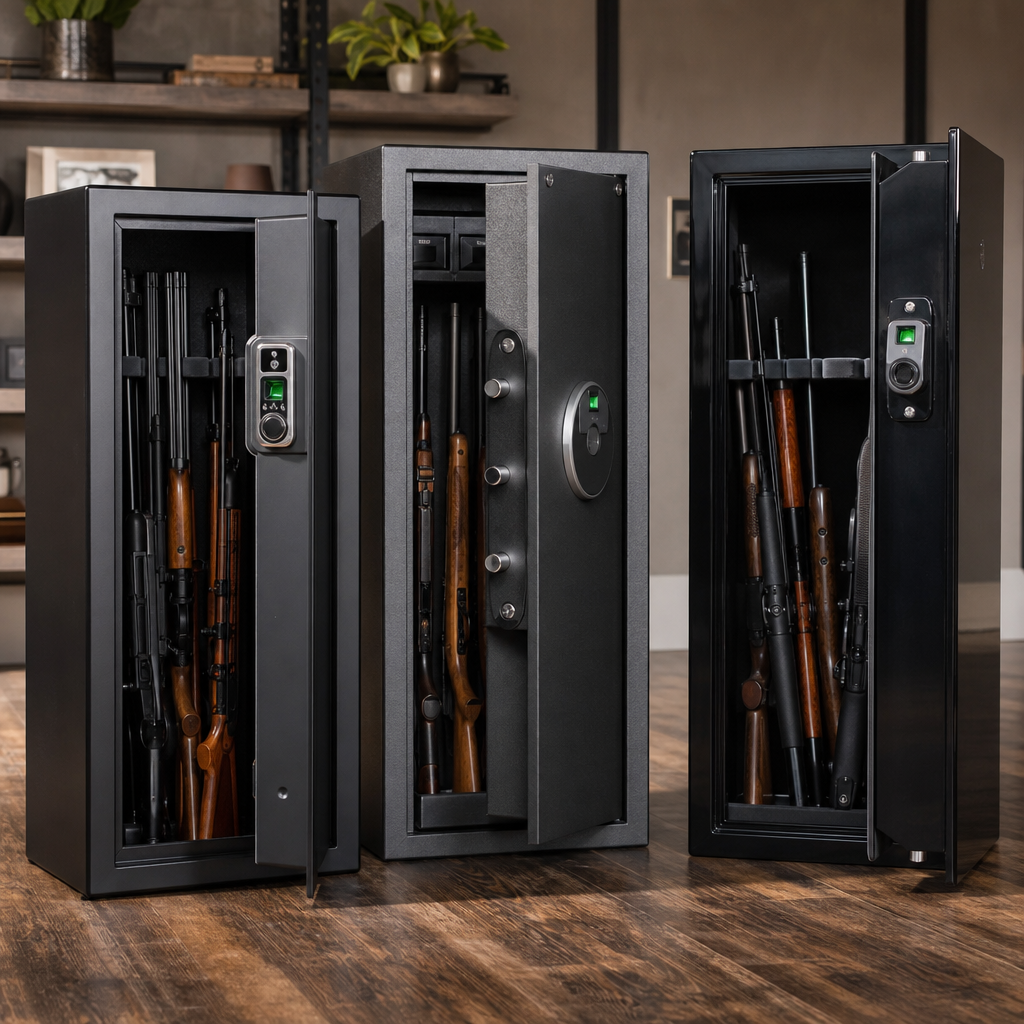
Biometric gun safes promise fast access, secure storage, and a simpler daily routine for firearm owners who need both readiness and control. In this guide, I compare the most secure biometric gun safes by brand while also explaining how to evaluate the category as a whole, because the best model is never just the one with the fastest fingerprint reader. Security, reliability, construction quality, lock design, tamper resistance, battery management, and real-world fit for your firearm matter just as much. For readers building out a broader gun safe buying plan, this page also serves as a hub for gun safe comparisons and brand spotlights, connecting handgun vaults, bedside safes, vehicle safes, and larger long-gun storage into one decision framework.
A biometric gun safe uses a fingerprint scanner as its primary or secondary access method. Most consumer models also include a keypad keycode, backup key, or both. The scanner usually stores between 20 and 100 fingerprints, allowing access for a primary owner and selected household members. In practice, the scanner is only one layer. The real security of a biometric handgun safe depends on steel thickness, lid and door overlap, internal hinges or protected external hinges, pry-resistant design, anti-impact construction, anchoring points, and the quality of the locking bolts or latch.
This matters because handgun safes solve two different problems at once: preventing unauthorized access and preserving rapid access under stress. I have tested enough bedside and closet-mounted biometric vaults to know that many buyers overfocus on sensor speed and underweight how the lid flexes under prying, how the keypad behaves when batteries are low, or whether the unit can be defeated by carrying it away. The most secure biometric gun safes balance electronic convenience with mechanical strength. That is the standard that separates marketing claims from dependable protection.
Industry testing also helps clarify what “secure” should mean. California Department of Justice roster requirements, where applicable, address baseline standards for approved firearm safety devices. UL-listed ratings are less common in small handgun vaults than in full-size residential security containers, but construction principles still apply: thicker steel generally resists attack better, recessed doors reduce pry points, and well-designed lock housings make tampering harder. Any serious comparison should also consider whether the safe can be cabled or bolted down, because an unanchored safe is often just a portable box for a thief.
What makes a biometric gun safe truly secure
The most secure biometric gun safes combine six features: dependable fingerprint recognition, rigid steel construction, pry-resistant geometry, redundant access methods, secure mounting options, and consistent power management. If one of those elements is weak, the entire product is weaker than it appears in product photos. A fast scanner does not compensate for thin steel. A heavy steel shell does not help if the electronics fail without warning and there is no practical backup entry method.
Start with the lock system. Good biometric safes use semiconductor or capacitive fingerprint sensors rather than cheap swipe-style readers that are less tolerant of inconsistent finger placement. Enrollment quality matters too. The best units allow multiple scans of the same finger from slightly different angles, which improves recognition in dim light or under stress. Backup access should include an illuminated keypad or a high-quality tubular or laser-cut mechanical key. I prefer safes that do not force the owner to rely on a hidden key every time batteries dip below optimal voltage.
Construction is next. In this category, 12-gauge steel is generally stronger than 14-gauge, and 16-gauge is lighter duty. Many compact handgun safes use 14- to 16-gauge shells; premium models often reinforce the lid, frame, or latch area to offset size constraints. Look closely at the opening seam. A deep lid lip or overlapping door makes prying more difficult than a flat edge with visible gap. Gas struts and spring-assisted openings add convenience, but the lock engagement point and frame stiffness matter more than opening speed.
Placement and anchoring are equally important. A bedside biometric safe should be bolted to furniture, floor, or wall framing when possible, or secured with a heavy cable in vehicle and travel applications. Quick-access safes are often attacked by removal first, opening second. If a burglar can carry the box away, your lock strength becomes less relevant. For that reason, mounting hole placement, included hardware, and the ability to open cleanly after installation should all factor into brand comparisons.
Brand comparison: where the leading names stand out
Vaultek is one of the strongest brands in the biometric handgun safe market because it combines modern electronics with well-thought-out anti-tamper features. Models such as the VT20i, MX Series, and Lifepod 2.0 Biometric emphasize app-connected monitoring, impact detection, and multiple entry methods. In my experience, Vaultek’s user interface is among the easiest to live with day to day. The downside is price. You pay more for the electronics package, and not every buyer needs Bluetooth management. Still, for buyers who want premium features and polished execution, Vaultek remains a benchmark.
Fort Knox approaches security from a more old-school perspective. Its pistol boxes and handgun safes often prioritize thick American steel, Simplex mechanical pushbutton locks, and straightforward durability over sleek digital features. While not every Fort Knox model is biometric, the brand is important in any secure gun safe comparison because it defines the upper end of physical build quality for compact handgun storage. Buyers choosing between biometric convenience and maximum mechanical simplicity often use Fort Knox as the baseline for what a robust quick-access safe should feel like.
Hornady has built a strong reputation with the RAPiD line, especially for nightstand and wall-mount use. The company’s RFID-focused systems are well known, but several models incorporate keypad and biometric functionality depending on the configuration. Hornady products tend to do well when buyers want practical home-defense access without stepping fully into app-based smart-safe territory. The best Hornady safes are not the heaviest in the category, yet they are thoughtfully designed, easy to stage in a bedroom, and backed by a major firearms industry brand with broad dealer support.
Barska helped popularize biometric safes for mainstream buyers, and the brand still occupies an important budget-to-midrange position. Some Barska models offer generous fingerprint capacity and simple programming at a lower cost than premium competitors. The tradeoff is that consistency can vary more by model. I recommend Barska when budget is tight but only after checking steel thickness, lock backup, and mountability on the exact unit. As a brand spotlight, Barska is relevant because it shows how affordable biometric access can work, but buyers must screen carefully for construction quality.
Winchester and Sports Afield, often associated with larger home safes and residential security containers, also matter in this hub because many shoppers want a unified brand strategy across handgun and long-gun storage. Their biometric offerings are usually aimed at practical household use rather than tech-forward innovation. The advantage is familiarity, retail availability, and broad product ranges. The limitation is that the most advanced compact biometric engineering often comes from specialist quick-access brands rather than legacy names extending into the segment.
| Brand | Best Known For | Strength | Potential Drawback | Best Fit |
|---|---|---|---|---|
| Vaultek | Premium biometric and smart features | Strong access options, app tools, polished design | Higher price | Bedside or modern home-defense setups |
| Fort Knox | Heavy steel construction | Exceptional physical durability | Fewer biometric-centric models | Buyers prioritizing brute-force resistance |
| Hornady | Rapid-access home defense safes | Practical layouts and trusted brand support | Not always the heaviest steel | Nightstand and closet deployment |
| Barska | Accessible biometric pricing | Affordable entry point | Model-by-model quality variation | Budget-conscious handgun owners |
| Winchester/Sports Afield | Broad safe portfolios | Easy retail access and family-brand familiarity | Less specialized compact innovation | Shoppers comparing whole-home storage options |
How to compare biometric safes across the full gun safe category
A strong hub page should not stop at brand names. It should explain the comparison criteria that carry across every subtopic in gun safes and safety. For biometric handgun safes, those criteria include access speed, false rejection rate, false acceptance resistance, steel gauge, lock redundancy, interior capacity, mounting method, noise signature, and long-term maintenance. When I evaluate a unit, I check how it performs with dry fingers, slightly dirty fingers, and a hurried thumb placement in the dark. That is more realistic than a clean showroom demo.
Capacity is often misunderstood. A safe advertised for two pistols may technically fit them, but not with mounted optics, weapon lights, spare magazines, or suppressor-height sights. Brands that provide dimensional drawings rather than vague capacity language are more trustworthy. Vaultek and Hornady generally do a better job than some lower-cost sellers at presenting usable interior measurements. If you run a full-size handgun with a red dot and light, interior height becomes as important as width.
Noise and usability also deserve more attention. Some biometric safes produce loud confirmation beeps or sharp spring-assisted openings that can be undesirable in a defensive scenario. Better models allow muted operation or at least a reduced audio profile. Interior lighting can be useful, but only if it does not compromise battery life significantly. Likewise, USB-C charging, low-battery indicators, and accessible battery compartments reduce the odds of finding the safe unavailable at the wrong time.
For this hub, related comparison articles naturally branch into bedside biometric safes, car gun safes, biometric vs keypad gun safes, RFID vs fingerprint access, pistol safe mounting methods, and premium versus budget handgun vault brands. Those are separate deep dives, but the central lesson remains the same: compare the whole security system, not just the opening method. Biometric access is one feature in a larger risk-management decision.
Common mistakes buyers make when choosing a biometric gun safe
The first mistake is buying on scanner speed alone. A one-second unlock claim means little if the latch area bends under prying or the safe can be removed in seconds. The second mistake is ignoring enrollment practices. Many failures blamed on “bad biometrics” actually come from poor fingerprint setup. Every authorized user should enroll the same finger multiple times and test entry from realistic positions. Third, buyers often skip mounting because they want flexibility. That convenience creates a major security gap.
Another common mistake is treating backup keys as a complete safety net. Backup keys are necessary, but key control becomes its own risk. If the emergency key is hidden in an obvious drawer near the safe, the biometric lock has been undermined. I also see buyers choose a safe that barely fits their current handgun, leaving no room for future optics or accessories. Finally, many people assume a compact biometric safe replaces a full-size safe. It does not. Quick-access handgun vaults are part of a layered storage plan, not the entire plan.
Best use cases and the right next step
The most secure biometric gun safes are best for owners who need immediate access to a defensive handgun while still preventing unauthorized handling by children, guests, or service workers. They are especially effective in bedrooms, home offices, and other controlled locations where a full-size safe is not practical. The right brand depends on your priorities. Choose Vaultek for advanced features and refined user experience, Fort Knox when physical strength is the top concern, Hornady for dependable home-defense layouts, and Barska when budget matters but careful model selection is possible.
As the hub for gun safe comparisons and brand spotlights, this page should guide your next research step rather than end it. Compare exact models, verify construction details, measure your firearm with accessories attached, and plan your mounting location before you buy. The main benefit of a well-chosen biometric gun safe is not convenience alone; it is secure, repeatable access you can trust under pressure. Use this framework to narrow your shortlist, then move on to the specific comparison articles that match your space, firearm type, and security goals.
Frequently Asked Questions
What should I look for when comparing the most secure biometric gun safes by brand?
Start with the understanding that true security is never defined by the fingerprint scanner alone. The best biometric gun safes combine fast access with strong physical protection, dependable electronics, and smart backup options. When comparing brands, pay close attention to steel thickness, lid or door construction, internal hinge protection, pry resistance, and whether the safe can be securely bolted down. A biometric safe with a quick scanner but thin metal, weak seams, or a flimsy latch system is not a truly secure option.
You should also evaluate lock design. Some brands use a single-point latch, while better-built models use reinforced locking bars or stronger engagement points that resist forced entry more effectively. Look for anti-tamper features, concealed hinges where possible, and evidence that the brand has designed the unit to withstand real-world attacks rather than just look impressive in product photos. Interior fit matters too. A secure safe is only useful if it properly accommodates your firearm, mounted accessories, spare magazine, and preferred orientation for rapid access.
Reliability is another major factor. A quality biometric gun safe should read enrolled fingerprints consistently under normal daily conditions, not just in ideal showroom testing. Brands differ widely in scanner quality, fingerprint memory capacity, error rates, and how well the system performs with dry fingers, minor angle changes, or rushed access. It is also important to consider battery management, low-battery warnings, and whether the safe includes a dependable override key or external power option in case the electronics fail.
Finally, compare the brand’s track record for customer support, replacement parts, warranty coverage, and long-term durability. The most secure biometric gun safe is usually the one that balances physical security, access speed, dependable operation, and practical fit for your home or vehicle use. In other words, brand comparison should be based on the full security package, not marketing claims about scan speed alone.
Are biometric gun safes reliable enough for quick access in an emergency?
They can be, but reliability depends heavily on build quality, scanner technology, and how the safe is set up and maintained. A well-made biometric gun safe from a reputable brand can provide very fast access and simplify your routine, especially when compared with manually dialing a combination under stress. That said, no biometric system should be treated as infallible. Even high-quality fingerprint readers can occasionally struggle with wet hands, dirty sensors, poor finger placement, cuts, calluses, or depleted batteries.
This is why the best brands do not rely on biometrics as the only entry method. A secure and practical safe should include a backup keypad, mechanical key override, or both. The strongest models also wake quickly from standby, store multiple fingerprint scans, and allow you to enroll the same finger more than once from slightly different angles to improve recognition speed. In real-world use, that matters much more than a brand’s advertised unlock time.
For emergency readiness, user habits are just as important as hardware. You should test the safe regularly, replace batteries on a schedule instead of waiting for them to drain completely, keep the scanner clean, and practice opening it in low light and under mild stress. Many owners discover that the biometric system works very well once they fine-tune enrolled prints and establish a routine, but that confidence should come from repeated testing, not assumption.
So yes, biometric gun safes can be reliable enough for quick access, but only if you choose a well-engineered model and treat it like a critical piece of safety equipment. The best brands understand that emergency access and dependable security must work together, which is why they invest in better readers, backup entry methods, and stronger overall design.
How important are construction quality and tamper resistance compared with fingerprint reader speed?
They are more important, and in many cases they are what separate a genuinely secure biometric gun safe from a convenience box with a scanner attached. Fingerprint reader speed is useful, but it should never be the primary measure of security. If a safe can be pried open, bent, defeated at the hinge, or removed easily because it lacks proper mounting capability, then a fast biometric reader does not offer much real protection.
Construction quality tells you how the safe will perform when someone tries to force it open. Better brands typically use heavier-gauge steel, stronger welds, reinforced door edges, more secure hinge designs, and improved locking mechanisms. Tamper resistance may include anti-pry lips, recessed doors, internal hinges, or locking tabs that prevent simple screwdriver attacks. These are the features that matter when the safe is tested outside of controlled demonstrations.
Another overlooked factor is the difference between storage security and access convenience. Some brands market biometric safes heavily around speed because that is easy to advertise, but a truly strong design must also account for unauthorized access by children, guests, thieves, or anyone with time and tools. A safe intended for bedside use should still offer meaningful resistance to tampering, especially if it contains a loaded defensive firearm.
In practical terms, the best biometric gun safes strike a balance. They provide fast access for the authorized owner while also offering enough construction strength and lock integrity to prevent casual or determined intrusion. If you are comparing brands, treat scanner speed as one feature among many. Build quality, lock strength, mounting security, and tamper resistance are what turn a biometric product into a serious security solution.
Do battery life and backup access options really matter that much in biometric gun safes?
Yes, they matter a great deal, because every biometric safe is ultimately an electronic device supporting a critical security role. Even an excellent fingerprint scanner becomes a liability if the batteries fail unexpectedly or the electronics stop responding when you need access. Reliable battery performance, clear low-battery warnings, and a sensible backup entry system are not minor extras. They are core buying criteria.
The strongest brands usually design their safes with predictable power management. That may include efficient standby operation, audible or visual low-battery alerts, and enough reserve power to avoid sudden failure. Some models also provide external power support so you can energize the keypad or scanner temporarily without damaging the safe. Others include mechanical override keys, though the quality and security of those backup key systems vary by brand and design.
When comparing safes, think beyond the sales page and consider real-world ownership. How easy is it to change batteries? Are they common household batteries or specialized types? Can you access the battery compartment without compromising security? Does the brand provide clear maintenance guidance? These details affect long-term reliability far more than most buyers expect. A biometric gun safe should be easy to keep ready without requiring constant guesswork.
Backup access is equally important because no electronic system is perfect forever. A safe intended for defensive firearm storage should never leave the owner dependent on a single point of failure. The best designs give you a secure, practical fallback method while still protecting against unauthorized entry. In short, battery management and backup access are not secondary concerns. They are part of what makes a biometric gun safe truly trustworthy.
Is the best biometric gun safe always the one with the highest price or most advanced features?
No. The best biometric gun safe is the one that matches your actual firearm, storage location, access needs, and security priorities without compromising on core protection. A higher price can reflect stronger materials, better engineering, more durable electronics, or a more reputable brand, but it can also reflect premium styling or features you may never use. Likewise, a long list of features does not automatically mean the safe is more secure.
For example, one brand may offer advanced app controls, interior lighting, and multiple access modes, while another focuses more on steel strength, lock durability, and stable biometric performance. Depending on your goals, the simpler model may actually be the better buy. If your top priorities are bedside access, child safety, and resistance to pry attacks, you may value rugged construction and reliable fingerprint recognition far more than smart connectivity.
Fit is another major reason the most expensive option is not always the best. Some safes work beautifully for a compact handgun but become awkward with a full-size pistol, optic, weapon light, or spare magazine. Others may be excellent for home use but poorly suited for a vehicle, closet shelf, or nightstand drawer. The best choice is the model that gives you fast, repeatable access while securely accommodating your specific setup.
When comparing brands, focus first on non-negotiables: solid construction, dependable biometrics, secure mounting, backup entry, battery reliability, and practical interior design. Once those are covered, then consider convenience features and price. The most secure biometric gun safe is not necessarily the flashiest or most expensive model. It is the one that performs consistently, protects effectively, and fits your real-world use case better than the alternatives.