
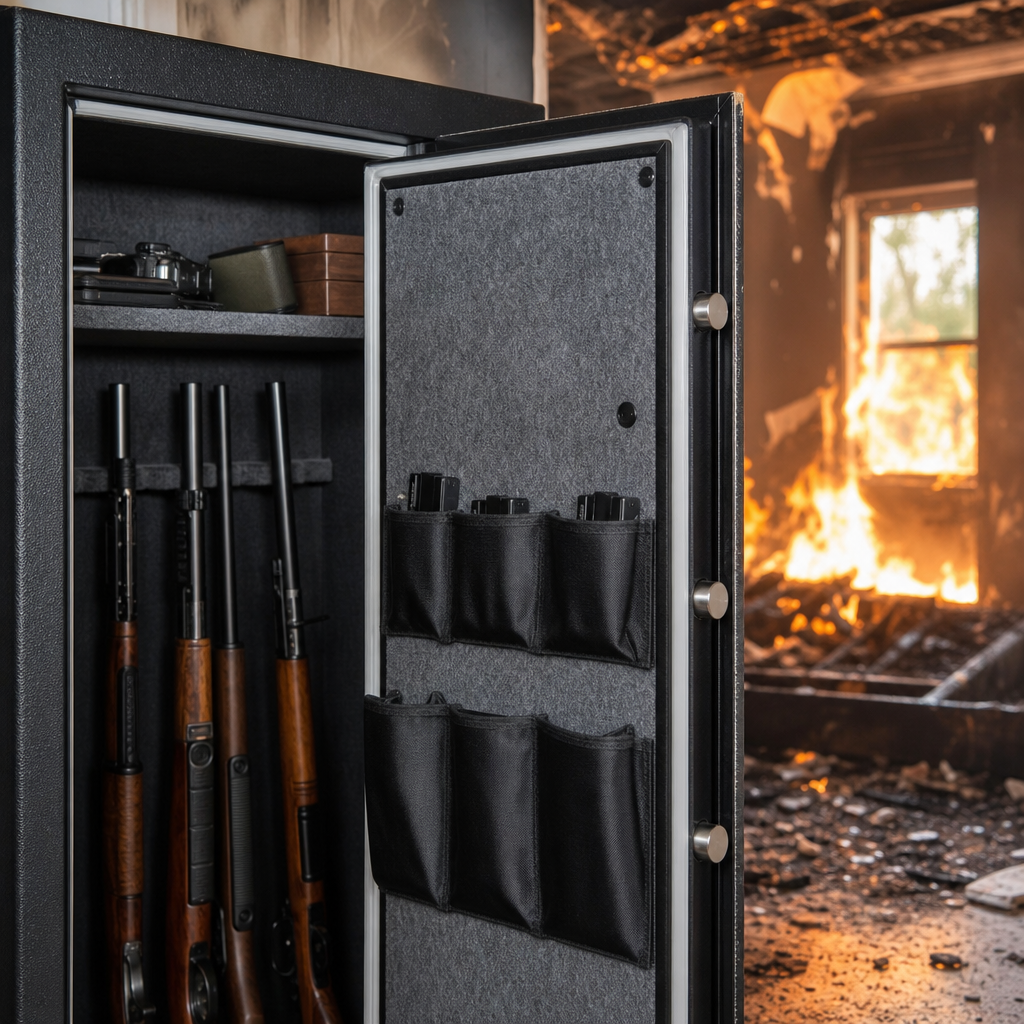
Fire seals are one of the most misunderstood components in a gun safe, yet they often decide whether the contents face survivable temperatures or catastrophic heat damage during a house fire. In practical terms, a fire seal is the barrier system around the door and body seams that limits the movement of hot gases, flames, and superheated smoke into the safe. For owners researching fireproof and disaster-resistant storage, understanding how these seals work is essential because published fire ratings alone never tell the whole story. I have inspected safes after structure fires, compared failed door gaskets with intact intumescent systems, and seen a clear pattern: when the seal design is robust and properly maintained, interior protection improves dramatically. This hub article explains the role of fire seals in protecting gun safes from heat damage, how they fit into broader disaster resistance, what specifications actually matter, and where this topic connects to related storage decisions such as humidity control, placement, anchoring, and insurance documentation.
A gun safe marketed as fire resistant usually relies on several layers working together. The steel shell resists impact and slows flame exposure, insulation reduces heat transfer, locking bolts help keep the door aligned under stress, and fire seals protect the vulnerable gaps where heat wants to enter first. Heat damage inside a safe is rarely caused only by direct flame. More often, damage occurs because temperatures rise enough to degrade wood stocks, soften adhesives, harm optics, cook lubricants, tarnish metal finishes, and push humidity to destructive levels as materials off-gas. Ammunition, paper records, passports, heirloom jewelry, hard drives, and cash all have different temperature tolerances, so the safe must control both peak temperature and exposure time. That is why a buyer evaluating fireproof and disaster-resistant storage should think beyond a simple “30-minute” or “60-minute” label and look closely at door construction, seal material, test standards, and real installation conditions.
How fire seals work inside a gun safe
Most quality fire seals in gun safes are intumescent, meaning they expand when exposed to elevated temperatures. When heat reaches a trigger point, often in the range used by commercial door systems and fire-rated enclosures, the material swells many times its original thickness and closes the narrow clearance around the door. That expansion matters because the door gap is the easiest path for heat, smoke, and combustion gases. In a fire, the outside temperature can rise rapidly, but the interior can remain below critical thresholds longer if the seal closes early and remains adhered under stress. Some safes pair an intumescent seal with a smoke gasket or additional barrier strip to improve performance in the early phase of a fire, before the expanding material fully activates.
Fire seals do not work alone. They depend on precise door fitment, stable hinges, and a frame that stays square while the safe heats and cools. A thick seal on a poorly built door can still fail if warping creates a gap. Conversely, a well-engineered door with multiple locking points and continuous contact around the perimeter gives the seal a better chance to expand evenly. In field evaluations, the strongest performers generally combine intumescent door seals, layered gypsum or proprietary fireboard insulation, reinforced door edges, and welds that do not open under thermal stress. This is why experienced buyers compare the full fire containment system rather than treating the seal as a stand-alone feature.
Why heat damage happens even when a safe survives the fire
Many owners assume that if the safe remains closed and structurally intact, the guns inside are unharmed. That is not how fire loss typically works. Internal temperatures can rise enough to damage bluing, optics coatings, polymer components, scope seals, slings, and document sleeves without producing obvious external failure. Moisture is another hidden factor. As insulation and interior materials heat, they can release water vapor; after the fire is extinguished, that vapor condenses on cooler metal surfaces and starts corrosion. Fire seals reduce the initial intrusion of hot gases, but they also help moderate the internal environment by slowing the pressure-driven movement of steam and smoke into the cabinet.
The severity of heat damage depends on fuel load, room location, fire duration, and suppression methods. A safe in a garage may face longer burn times because firefighters often prioritize occupied living areas first. A safe in a basement can benefit from lower ambient temperatures, but floodwater becomes a bigger concern after suppression. In wildfire zones, radiant heat and prolonged exposure can be more important than short, intense flame contact. During post-loss reviews, I have seen safes with acceptable exterior paint blistering but interior temperatures high enough to ruin paper records and warp wood grips. Fire seals cannot make a gun safe indestructible, yet they are one of the few components specifically designed to protect the most vulnerable entry point against this kind of thermal breach.
What to look for when comparing fire-resistant gun safes
Buyers should evaluate fire seals alongside test methodology, insulation type, steel thickness, door design, and the manufacturer’s stated internal temperature target. A meaningful fire rating identifies duration and external temperature, and better manufacturers explain whether testing was independent and whether the safe was allowed to cool naturally afterward. Cooling matters because contents can continue absorbing heat after flames are out. If a company only advertises “up to” language without naming the test conditions, treat that claim cautiously. The presence of multiple door seals, a stepped door profile, and reinforced frame contact surfaces usually indicates more serious fire engineering than a single adhesive strip applied to a basic cabinet door.
Placement and installation also affect seal performance. A safe bolted to a concrete slab on a lower level generally experiences different thermal behavior than one placed on a wood-framed upper floor surrounded by combustible furniture. Clearance from exterior walls, direct sunlight, HVAC vents, and sources of chronic moisture changes how the seal ages over time. Disaster-resistant storage means thinking beyond fire alone: water intrusion, smoke contamination, theft during evacuation, and tip-over risk after structural collapse all influence the total outcome. For a sub-pillar hub under gun safes and safety, these related decisions matter because the most reliable protection comes from a system, not a single advertised feature.
| Feature | Why it matters | What to verify |
|---|---|---|
| Intumescent fire seal | Expands to block door gaps from heat and smoke | Continuous perimeter coverage and secure adhesion |
| Independent fire rating | Shows tested duration and temperature conditions | Named lab, test standard, internal temperature limit |
| Insulation system | Slows heat transfer into the safe interior | Layer count, material type, and cooling protocol |
| Door construction | Supports seal compression and limits warping | Step door design, multiple bolts, rigid frame |
| Water resistance | Protects contents after sprinklers or firefighting | Gasket design, threshold lip, manufacturer claim details |
| Anchoring and placement | Reduces theft, tipping, and extreme exposure | Concrete anchoring, room location, floor load limits |
Fire seals as part of disaster-resistant storage planning
Fireproof and disaster-resistant storage is broader than surviving open flame. The same event that exposes a gun safe to heat often brings water, corrosive residue, impact, and delayed access. After suppression, standing water can wick into carpets and attack the base of the safe. Smoke residue can penetrate small openings and deposit acidic contaminants on firearms. If the safe is not anchored, a weakened floor can shift it, compromising the door alignment that the fire seal depends on. For that reason, the best storage plans combine a fire-rated safe with a dehumidifier or desiccant strategy, elevated placement when flooding is possible, documented serial numbers, and a retrieval plan that does not require forcing a hot door open prematurely.
This hub topic also connects directly to what owners store alongside firearms. Paper deeds, tax records, NFA documents, estate papers, photos, and digital backups often need different temperature protection than metal guns. Standard media can fail at lower temperatures than many gun safe interiors are rated to maintain, which is why some owners use a secondary document chest inside the main safe. In wildfire-prone or hurricane-prone areas, layered storage is often the most rational approach: a heavy anchored gun safe for theft resistance and firearm protection, plus specialized containers for documents, data, and irreplaceable small valuables. Fire seals remain central in this system because they help preserve the interior buffer zone that all of those items rely on.
Maintenance, inspection, and common mistakes
Even a well-built fire seal can underperform if it is neglected. Owners should inspect door seals at least annually for cracking, separation, compression damage, or contamination from oils and solvents. Gun cleaning chemicals migrate more easily than people realize, and some adhesive-backed materials degrade when repeatedly exposed to petroleum residues. The door frame should also be checked for bent edges, loose interior panels, and latch misalignment. If the door requires unusual force to close, do not assume that is normal compression; it may indicate shifting hinges or swollen interior panels, both of which can prevent even seal contact in a fire. Follow the manufacturer’s replacement guidance rather than improvising with generic weatherstripping, which is not the same thing as a rated fire seal.
Another common mistake is confusing external drywall thickness with overall fire performance. Gypsum-based fireboard is widely used and can be effective, but its benefit depends on layout, density, seam treatment, and the quality of the door gap protection. I have opened budget safes that advertised impressive fire durations while using minimal edge sealing and uneven interior board coverage. On the other hand, some premium manufacturers publish more conservative ratings yet deliver better real-world survivability because the door geometry, seal placement, and body construction are superior. Buyers should also remember that adding aftermarket door organizers, lighting, or foam inserts can change airflow and interior heat behavior. Accessories are useful, but they should never interfere with door closure or compress the seal path.
How this hub connects to the rest of gun safe safety
The role of fire seals in protecting gun safes from heat damage sits at the center of several other safe ownership decisions. If you are choosing between home safe placement options, the fire discussion leads naturally to room risk, floor strength, concrete anchoring, and exposure to floodwater. If you are comparing fire ratings, you should also review burglary ratings, because a heavy steel door that resists attack can improve seal integrity under heat. If you are planning long-term firearm storage, humidity control becomes inseparable from post-fire corrosion prevention. And if you are organizing estate records or insurance schedules, the safe’s thermal limits determine whether a secondary media box is necessary.
The practical takeaway is straightforward. Fire seals are not a marketing extra; they are a primary defense against the hottest and fastest route of failure in a gun safe. When paired with credible fire testing, strong insulation, rigid door construction, correct installation, and routine inspection, they materially improve the odds that firearms and valuables remain below damaging temperatures during a fire. For anyone building a serious fireproof and disaster-resistant storage plan, start by examining the seal system, then assess the rest of the safe as an integrated protective enclosure. Use this hub as the foundation for deeper decisions on ratings, placement, moisture control, and document protection, and review your current safe with those points in mind before the next emergency tests it.
Frequently Asked Questions
What is a fire seal in a gun safe, and why is it so important during a fire?
A fire seal is the protective barrier system located around a gun safe’s door edges, seams, and other potential entry points where heat, smoke, and flame could penetrate the interior. While many buyers focus on thick steel, locking bolts, or advertised fire ratings, the seal is often one of the most critical components in determining whether internal temperatures stay low enough to protect firearms, optics, ammunition, documents, and other valuables. In a house fire, the main threat is not only direct flame contact but also the rapid movement of superheated gases and smoke. If those gases enter the safe unchecked, the interior can heat up far faster than expected, even if the steel body itself remains intact.
In practical use, a fire seal helps slow that heat transfer by closing off the vulnerable gaps where the door meets the body. Many fire-rated gun safes use intumescent seal materials, which expand when exposed to high temperatures. As they swell, they help block openings that would otherwise allow hot air and smoke to flow inside. That expansion is especially important because even a well-built steel safe still has seams and tolerances that can become pathways for heat under fire conditions. Without an effective seal, the safe may perform far below what the rest of its construction would suggest.
This is why fire seals matter so much when evaluating fire-resistant storage. A published fire rating may sound impressive, but the real-world performance of the safe depends heavily on how well the entire system works together, including insulation, door fitment, and seam protection. Fire seals are not a minor accessory; they are a core part of the safe’s defensive design and often the difference between survivable internal temperatures and catastrophic heat damage.
How do fire seals actually work to protect the contents of a gun safe from heat and smoke?
Fire seals work by restricting the movement of hot gases, smoke, and flame through the most vulnerable parts of the safe: the door perimeter and body seams. In a fire, pressure and temperature rise quickly, and superheated air naturally seeks any available opening. Even a narrow gap can become a major failure point if it allows continuous heat and smoke intrusion. The purpose of the seal is to interrupt that pathway and slow the rate at which the inside of the safe is exposed to dangerous conditions.
Many high-quality fire seals are made from intumescent materials. These compounds remain relatively compact under normal conditions, but when exposed to high temperatures, they expand substantially. That expansion helps fill tiny clearances around the door and seams, creating a tighter thermal and smoke barrier at exactly the moment it is needed most. In effect, the seal becomes more protective as the fire intensifies. This is a major reason these seals are widely used in fire doors, commercial fire barriers, and better fire-rated safes.
It is also important to understand that the seal does not work alone. A gun safe’s fire performance depends on the interaction between the seal, the insulation layers in the walls and door, the mass of the steel, and the duration and intensity of the fire. The seal slows intrusion, while insulation slows heat transfer through the structure itself. Together, they buy time. That time can be crucial because many fire ratings are based on the safe maintaining internal temperatures below a certain threshold for a specified period. If the seal fails early, the entire protective timeline can collapse much sooner than expected, regardless of how the safe is advertised.
Are all fire seals the same, or do some gun safes use better sealing systems than others?
No, all fire seals are not the same, and the differences can be significant. Manufacturers vary widely in the materials they use, the placement of the seals, the number of sealing layers, and the overall engineering of the door and seam system. Some safes use a single intumescent strip around the door frame, while others incorporate multiple layers designed to address both smoke infiltration and heat expansion. Higher-end designs may also pay closer attention to consistent door compression, tighter tolerances, and better seam construction, all of which improve how the seal performs under fire conditions.
The quality of the seal material itself matters as well. A well-formulated intumescent seal should expand reliably and maintain enough structural integrity under extreme heat to help block airflow into the safe. Lower-quality materials may not expand as effectively, may degrade too quickly, or may not be installed in a way that creates a continuous barrier. Just as important, the seal must be paired with a safe body and door that are actually designed to support fire resistance. A premium seal cannot compensate for weak insulation, poor fitment, or oversized door gaps.
For buyers, this means that a simple claim such as “fireproof” or even a stated time rating does not tell the whole story. It is worth looking at whether the manufacturer explains the seal design, whether independent testing is available, and whether the brand has a reputation for credible fire performance rather than marketing-heavy claims. In short, sealing systems differ not only in material quality but in how intelligently they are integrated into the safe’s overall fire protection strategy.
Can a gun safe still suffer heat damage inside even if the fire seal works properly?
Yes, absolutely. A fire seal can perform exactly as intended and the contents can still be damaged if the fire exceeds the safe’s design limits. Fire seals are meant to slow the entry of heat, smoke, and flame, not eliminate heat transfer altogether. During a prolonged or especially intense house fire, the steel shell and insulation will gradually absorb and transmit heat inward. If exposure lasts long enough, the interior temperature can rise to levels that damage gun finishes, warp stocks, degrade optics, ruin paper documents, or affect sensitive electronics and media.
This is one of the most misunderstood aspects of safe fire protection. A fire seal helps preserve the internal environment by delaying the rapid influx of superheated gases through gaps, but the rest of the safe still has to resist conductive and radiant heat over time. That is why the stated fire rating, the temperature threshold used in testing, and the actual conditions of a house fire all matter. A safe rated for a certain number of minutes at a specific external temperature may perform very differently in a real-world fire involving structural collapse, long burn times, or concentrated heat in one area of the home.
The takeaway is that fire seals are essential, but they are only one part of a complete protection system. Owners should think of them as a critical line of defense that improves survivability, not a guarantee of zero internal heat damage. If you are protecting especially vulnerable items such as rare firearms, suppressor paperwork, passports, backup drives, or collectible optics, it may be wise to add layered protection inside the safe, such as insulated document pouches or specialized fire-resistant containers. That approach recognizes the real limits of fire resistance and helps reduce the risk of loss even further.
How should gun safe owners inspect and maintain fire seals over time?
Fire seals should be inspected periodically just like locks, hinges, and dehumidification systems, because even the best seal is only effective if it remains intact and properly positioned. Start by examining the seal around the door and any visible seam areas for cracking, separation, brittleness, warping, compression damage, or missing sections. The seal should appear continuous and securely attached. If there are gaps, loose corners, peeling adhesive, or signs that the door is no longer closing evenly against the frame, those issues can compromise fire performance when it matters most.
Owners should also keep the sealing surfaces clean and free of debris. Dust, oil residue, adhesive contamination, or foreign material caught along the door edge can interfere with proper contact and compression. Avoid harsh chemicals unless the manufacturer specifically recommends them, because some cleaners may degrade seal materials or adhesives over time. If the safe has been relocated, tipped, exposed to flooding, or involved in any event that could affect door alignment, it is a good idea to recheck the perimeter carefully. Even slight frame or hinge distortion can reduce how effectively the seal engages.
Most importantly, consult the safe manufacturer before attempting repairs or replacements. Fire seals are part of the safe’s engineered fire barrier system, and using the wrong replacement material can undermine the rating or create a false sense of security. If the seal shows visible deterioration, if the door no longer closes consistently, or if the safe has been exposed to prior heat, smoke, or structural stress, professional evaluation is the safest course. Regular inspection may seem simple, but it plays a major role in preserving the very feature that helps keep dangerous heat and smoke away from your firearms and valuables during a fire.