
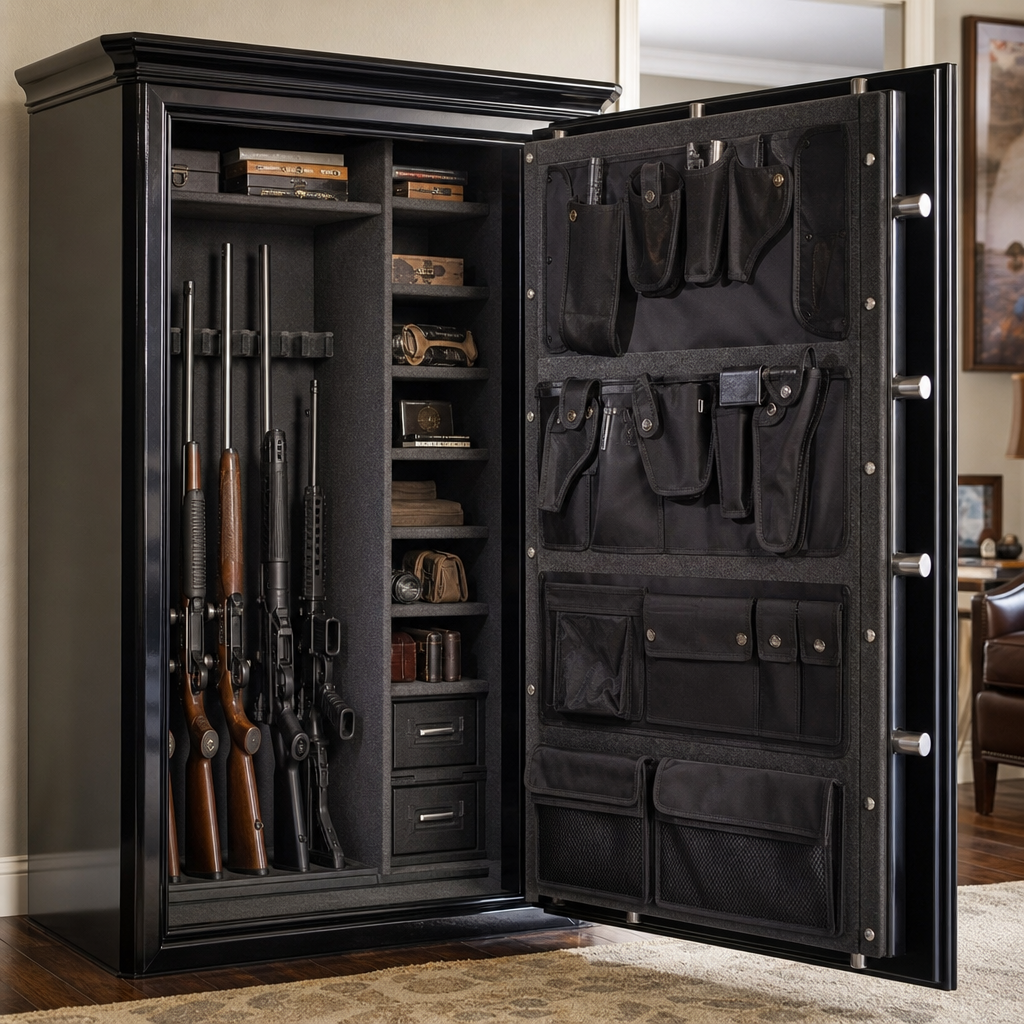
Hidden-compartment gun safes occupy a specific corner of the security market: they combine firearm storage, rapid access, and concealment, giving owners a way to keep weapons protected without advertising where they are. In practical terms, a hidden compartment is a space disguised inside furniture, walls, mirrors, shelving, beds, benches, or cabinetry, while a gun safe is a locked container built to resist unauthorized access, theft, and in many cases fire. Put together, the concept appeals to homeowners who want more than a standard black steel box in the closet. They want a safe that disappears into daily life, yet still performs like serious security equipment.
This category matters because modern gun storage has to solve several problems at once. A safe must keep firearms away from children, guests, and burglars. It must also support legal and insurance expectations, especially in states or municipalities with safe-storage rules. At the same time, many owners want quick access for home defense and do not want a visible safe telegraphing that firearms are inside. Over years of evaluating safes, hidden furniture vaults, and modular concealment systems, I have found that buyers usually balance five factors first: concealment quality, lock reliability, steel construction, installation method, and realistic capacity. A product that looks discreet but uses thin sheet metal or weak hardware is not a true security solution.
As the hub for gun safe comparisons and brand spotlights, this guide focuses on the top gun safe brands that feature hidden compartments and explains where each brand fits. Some specialize in tactical concealment furniture. Others build biometric bedside vaults, in-wall units, or modular systems that can be integrated into custom interiors. The goal is not to crown one universal winner. The right brand depends on whether you need a hidden handgun safe in a bedroom, a long-gun compartment behind a mirror, a bench at the foot of a bed, or a disguised wall unit in an office. Understanding the strengths, limitations, and ideal use cases of leading brands makes every follow-up comparison easier.
Before comparing brands, it helps to define the standards that separate quality products from decorative novelties. A credible hidden compartment safe should use solid locking hardware, tamper-resistant hinges or concealed hinge geometry, reinforced mounting points, and a concealment design that does not invite casual discovery. Biometric locks should have a backup keypad or key override. Electronic locks should have low-battery warning behavior and clear serviceability. Wood furniture should not be judged on finish alone; the steel insert, compartment frame, and anchor strategy matter more. For buyers planning a broader research path within gun safes and safety, hidden-compartment models are best understood as one branch of a larger category that includes fire-rated safes, modular long-gun cabinets, under-bed vaults, and quick-access pistol boxes.
What Makes a Hidden-Compartment Gun Safe Worth Buying
The best hidden-compartment gun safes do two jobs at once: they conceal and they secure. Many products on the market only do the first. They may look like ordinary furniture, but the hidden area is little more than a wooden cubby with a magnetic latch. That may hide a handgun from casual view, but it will not stop a determined thief, and it may not satisfy the level of access control most gun owners actually need. A worthwhile model includes a real steel vault or reinforced compartment, a dependable lock, and installation that prevents the entire unit from being removed quickly.
Construction is the first filter. Look for welded steel bodies, pry-resistant doors, thicker steel in critical areas, and robust slide or hinge mechanisms if the compartment opens vertically or laterally. The second filter is lock type. Mechanical simplex locks remain highly respected for speed and long-term reliability, while biometric systems can be excellent if the sensor is fast, stores multiple fingerprints, and includes keypad or physical backup access. The third filter is concealment realism. A hidden mirror safe should behave like a normal mirror in daily use. A shelf or nightstand vault should not have obvious seams, weak magnets, or suspicious weight distribution.
Placement also matters. A concealed handgun safe near a bed serves a different purpose than a hidden long-gun compartment in a den. For bedside access, speed and one-handed operation take priority. For a wall unit storing rifles, depth, mounting strength, and visual disguise matter more. In family homes, the standard should be strict: hidden does not mean childproof. The lock must be a true barrier, not a delay tactic. I routinely advise buyers to imagine the most curious teenager in the house and the most opportunistic burglar in the neighborhood. If the product would fail against either, move on.
Top Brands for Hidden-Compartment Gun Safes
Tactical Walls is one of the most recognized names in this niche, and for good reason. The brand built its reputation on concealment furniture and wall-mounted shelves that hide firearms in plain sight. Products such as hidden shelves, mirrors, and full-length furniture pieces are designed to blend into residential interiors rather than mimic overt tactical gear. Tactical Walls stands out for strong concealment design and broad style coverage, especially for handgun and carbine storage. The tradeoff is that buyers must distinguish between concealment furniture and burglary-resistant safes. Some products prioritize discreet access more than heavy safe construction, so this brand is strongest when the use case is rapid access plus concealment in a controlled home environment.
Liberty Safe, known primarily for full-size gun safes, also deserves attention because its accessory ecosystem, handgun vault options, and concealment-oriented integrations make it relevant for this subtopic. Liberty’s core strength is established security engineering, dealer support, and a long-standing reputation in the gun safe market. While it is not exclusively a hidden-compartment brand, buyers often pair Liberty quick-access units or compact vaults with custom furniture or closet concealment strategies. This makes Liberty a useful benchmark brand in comparison articles: if a hidden-compartment product cannot match the reliability and lock performance of mainstream safe makers, its concealment advantage may not be enough.
Vaultek is a leading brand for modern quick-access handgun safes, especially for buyers who want biometric access, app-connected monitoring, and compact form factors that can be hidden in drawers, nightstands, wardrobes, or purpose-built furniture. In real homes, I often see Vaultek products used as the secure insert inside a larger hidden setup. Models with Bluetooth management, rechargeable power systems, and responsive biometric scanners are particularly attractive to tech-comfortable owners. The limitation is obvious: Vaultek shines in small-form handgun storage, not hidden long-gun compartments. Still, for apartment dwellers or anyone building a discreet bedroom defense setup, it is one of the strongest brands in the category.
Hornady Security brings another respected option, especially through its RAPiD line. RFID-enabled access is the defining feature here. For users who want a safe hidden under a bed, behind furniture, or inside cabinetry, RFID can be faster and less visually obvious than entering a keypad code at night. Hornady has practical credibility because it focuses on real defensive use: fast retrieval, durable latches, and flexible access methods. The best fit is the owner who wants proven rapid-entry hardware in a concealed location rather than decorative concealment furniture. In comparisons, Hornady typically performs well on access speed and day-to-day usability.
SnapSafe and related modular-security brands are relevant because they support hidden installations in spaces where traditional safes are hard to place. In-wall units, under-bed vaults, and compact safes that can be anchored inside cabinetry are often more secure than furniture-first products with light locking systems. SnapSafe’s value is flexibility: buyers can create a hidden-compartment solution using a legitimate lockbox or in-wall vault as the secure core, then build concealment around it. This brand is especially useful for homeowners remodeling closets, offices, or mudrooms and wanting storage that remains low profile.
How Leading Brands Compare by Use Case
Brand selection becomes easier when you compare hidden-compartment gun safes by use case instead of marketing language. A parent wanting a discreet bedside handgun option should not shop the same way as a collector trying to conceal two AR-platform rifles in a home office. Below is a practical comparison framework that I use when helping buyers narrow the field.
| Brand | Best Hidden Use Case | Primary Strength | Main Limitation |
|---|---|---|---|
| Tactical Walls | Shelves, mirrors, concealment furniture | Excellent visual disguise and fast access | Security level varies by model |
| Liberty Safe | Hybrid concealed setups with compact vaults | Strong safe-market reputation and lock reliability | Less specialized in furniture concealment |
| Vaultek | Drawer, closet, and nightstand handgun storage | Advanced biometric and smart features | Not built for rifle-length hidden storage |
| Hornady Security | Under-bed or cabinet rapid-access storage | Fast RFID entry and practical design | Concealment usually depends on installation |
| SnapSafe | In-wall and custom hidden installations | Flexible integration into remodels or built-ins | Appearance depends on the surrounding build |
For renters, compact hidden-compartment options are usually smarter than major built-ins. Vaultek and Hornady products can be secured inside furniture and removed later with less damage to the property. For homeowners planning a remodel, in-wall or millwork-based concealment often produces the cleanest result. Tactical Walls becomes compelling when aesthetics drive the decision and the location is low risk, such as a private office or master bedroom. Liberty enters the conversation when the hidden unit is part of a layered storage plan that also includes a primary full-size safe for bulk firearms, documents, and ammunition.
Another useful distinction is between “hidden from sight” and “hardened against attack.” A shelf safe might be almost invisible, but if the locking pocket is shallow and lightly built, it is still a secondary security device. A compact steel vault hidden behind cabinetry may be less elegant, but materially more secure. The best buyers recognize that concealment buys time and reduces discovery risk; it does not replace steel, anchoring, and quality locks. That principle should guide every brand comparison on this topic.
Features That Separate Premium Brands From Gimmicks
Premium hidden-compartment brands consistently get the details right. The first detail is access reliability. Fingerprint readers should open consistently across dry skin, partial placement, and repeated use. RFID systems should read from practical angles and distances, not only in ideal demonstrations. Mechanical buttons should have clear tactile response. If a lock is frustrating in daily use, owners stop trusting it, and that defeats the purpose of staged defensive storage.
The second detail is installation integrity. Quality brands provide proper mounting hardware, clear stud-spacing guidance, and realistic weight ratings. A hidden wall safe that misses framing standards or relies on decorative screws is a liability. The third detail is interior protection. Foam cradles, barrel supports, corrosion-resistant finishes, and organized magazine storage turn a hidden compartment into a functional storage system rather than an improvised cavity. I strongly prefer brands that engineer interiors around actual firearm dimensions instead of generic empty boxes.
Finally, premium brands acknowledge limitations honestly. Fire protection in slim hidden compartments is usually limited compared with traditional full-size safes. Moisture control may require desiccants or dehumidifiers depending on location. Concealment furniture can be vulnerable if placed in rooms frequently accessed by contractors, housekeepers, or guests. Good brands do not pretend otherwise. They explain where their products work best and where a conventional safe is still the better answer.
Buying Advice for This Subtopic Hub
If you are using this page as a hub for gun safe comparisons and brand spotlights, start by matching the brand to the problem you need solved. For a single defensive handgun in a bedroom, look first at Vaultek and Hornady Security. For discreet décor-driven concealment, evaluate Tactical Walls. For in-wall or custom cabinetry projects, include SnapSafe-style modular options. For households that need both daily-access concealment and serious bulk storage, compare these brands alongside Liberty Safe and other full-size safe manufacturers instead of treating them as substitutes.
Also decide whether your priority is access speed, disguise quality, theft resistance, or installation flexibility, because no brand leads every category at once. Read lock specifications, confirm steel construction, and verify whether the product can be anchored to framing or heavy furniture. Measure your firearm with any light, optic, or extended magazine installed. Many returns happen because owners shop by marketing photos rather than internal dimensions. That simple check eliminates most disappointment.
Top gun safe brands that feature hidden compartments can solve a real storage problem when chosen carefully. The strongest options come from brands that respect both concealment and security, not one at the expense of the other. Use this hub as your starting point for deeper comparisons by format, lock type, room placement, and firearm size. When you shortlist products, focus on build quality, realistic access needs, and how the safe will function in your actual home. Then move forward with a model that keeps firearms protected, discreet, and ready only for the people authorized to reach them.
Frequently Asked Questions
What should I look for in a gun safe brand that offers hidden compartments?
Start with the basics: the best hidden-compartment gun safe brands do not rely on concealment alone. A well-made product should combine stealth with real security features, including solid steel construction, dependable locking hardware, reinforced access points, and a design that limits tampering. In other words, a hidden shelf, mirror, bench, or nightstand is only valuable if the secure compartment inside it is also built to resist unauthorized access. Strong brands usually publish details about materials, lock types, dimensions, and mounting requirements rather than asking buyers to trust appearance alone.
It is also important to evaluate how the hidden compartment fits your intended use. Some brands specialize in rapid-access safes designed for a single handgun near a bed or desk, while others focus on larger hidden storage integrated into furniture or wall installations for multiple firearms and accessories. Look for practical features such as biometric, RFID, keypad, or mechanical lock options; silent or low-noise opening; interior padding; and enough room for magazines, documents, or valuables. If quick access is a priority, the compartment should open consistently under stress and without unnecessary steps.
Brand reputation matters as much as the product itself. Established manufacturers and respected concealment-furniture companies tend to stand out because they offer better quality control, clearer installation guidance, stronger warranties, and more responsive customer support. Reviews from verified buyers can help you identify recurring strengths or weaknesses, especially around lock reliability, finish quality, fit and alignment, and long-term durability. The strongest brands strike a balance between concealment, speed, build quality, and everyday usability, which is exactly what buyers should want from a hidden-compartment gun safe.
Are hidden-compartment gun safes actually secure, or are they mainly for concealment?
They can be secure, but the answer depends heavily on the brand and the type of product. Hidden-compartment safes are designed around layered protection: first, the compartment is disguised so it is less likely to be noticed; second, the firearm is stored behind a lock or secure access mechanism. That said, concealment should never be mistaken for the same level of protection offered by a full-size heavy-duty burglary or fire safe. The strongest hidden-compartment brands understand this and build products that provide meaningful physical security in addition to discreet placement.
In real-world use, hidden safes are often most effective against casual discovery, smash-and-grab theft, and unauthorized household access, especially when installed correctly. A hidden wall safe behind a mirror, a locked shelf with a secret release, or a disguised compartment inside bedroom furniture can reduce the chance that a visitor, child, or opportunistic burglar will immediately find the firearm. However, if a determined intruder has time to search thoroughly or remove unsecured furniture, weaker concealment products may fail. That is why anchoring, mounting, lock quality, and construction are so important.
The best way to think about these safes is as a specialized security solution. They are ideal for owners who want discreet storage and rapid access in strategic areas of the home, but they are not automatically interchangeable with large traditional safes for long-term collection storage. Top brands typically position hidden-compartment models as part of a broader security plan: conceal the gun, secure it with a reliable lock, install it properly, and use the right product for the right risk level. When all of that comes together, hidden-compartment gun safes can be both practical and genuinely protective.
Which types of hidden-compartment gun safes are most popular from top brands?
The most popular options usually fall into a few clear categories. One of the biggest is concealment furniture, including nightstands, coffee tables, end tables, headboards, benches, and shelving units with integrated secure compartments. These products are popular because they blend naturally into living spaces and can provide quick access to a defensive firearm without making the storage location obvious. Many top brands focus heavily on this category because it appeals to homeowners who want function, discretion, and a furniture-grade appearance.
Another major category is wall-mounted or in-wall hidden safes, often concealed behind mirrors, framed art, cabinets, or movable panels. These are especially attractive for buyers who want a more permanent installation with a lower visual profile. When properly installed between studs or within custom built-ins, they can be very difficult to spot and may preserve floor space better than traditional safes. Some premium brands also offer under-bed drawer safes, hidden compartments inside closets, and modular storage systems that let buyers tailor concealment to a specific room or routine.
Finally, there are rapid-access concealment products built for a very specific purpose, such as handgun storage inside a bedside unit, desk compartment, vehicle-adjacent locker, or entryway cabinet. These emphasize speed and convenience, often using RFID, biometric, or electronic keypad entry. The most respected brands tend to distinguish themselves by offering a range of hidden-compartment styles rather than a one-size-fits-all design. That variety matters because the best hidden gun safe is usually the one that fits the owner’s daily habits, home layout, and firearm type while remaining discreet and reliable.
How do top gun safe brands balance fast access with child safety and responsible storage?
This is one of the most important issues in the hidden-compartment gun safe market. Responsible brands know that speed means very little if the product can be discovered or opened by children, guests, or other unauthorized users. The strongest designs try to solve both problems at once: they keep the firearm out of plain sight while also requiring a deliberate unlocking method. Depending on the model, that might include a biometric reader, RFID key, keypad, mechanical lock, or a hidden release sequence that is not obvious to anyone unfamiliar with the unit.
Good brands also pay attention to how the safe behaves in real life, not just in marketing photos. For example, the compartment should stay closed and locked during normal household use, should not reveal itself through loose panels or visible seams, and should allow the owner to access the firearm quickly without fumbling. Interior organization matters too. Foam inserts, handgun racks, magazine slots, and proper orientation can reduce delays and make the firearm easier to retrieve safely. Some brands also offer tamper alerts, backup keys, or low-battery warnings for added peace of mind.
That said, no hidden safe replaces the need for responsible handling, secure placement, and household training. Parents and guardians should choose a location that minimizes discovery, avoid demonstrating access methods unnecessarily, and routinely test the lock to ensure it functions as expected. Top brands support this kind of ownership by offering dependable hardware and thoughtful design, but the user still plays a central role. The real goal is not just a hidden compartment or a fast-opening door; it is controlled, secure access that works for the owner while helping prevent accidents and unauthorized handling.
Is a hidden-compartment gun safe worth buying instead of a traditional gun safe?
For many buyers, it is not an either-or decision. A hidden-compartment gun safe is often worth buying when the goal is discreet, fast-access storage for one or two defensive firearms in a bedroom, living room, office, or other frequently used part of the home. In that role, it can offer advantages a traditional large safe cannot. It is less visually obvious, easier to integrate into everyday furniture or architecture, and often more convenient during an emergency. That combination is exactly why top brands in this niche have built a loyal customer base.
However, hidden-compartment safes usually serve a different purpose than a full-size traditional gun safe. If you need to store multiple long guns, high-value collections, large quantities of ammunition, or important documents with substantial burglary and fire protection, a heavier conventional safe is often the better primary solution. Traditional safes typically provide greater steel thickness, more robust boltwork, certified fire ratings in many cases, and larger storage capacity. Hidden-compartment models are strongest when used as targeted, room-specific storage rather than as a complete replacement for all firearm security needs.
The smartest approach for many owners is a layered setup: a traditional safe for primary storage and a hidden-compartment safe for rapid access in a strategic location. Top brands in the hidden-safe category are appealing precisely because they fill that second role well. They give owners a way to keep a firearm protected, concealed, and accessible without advertising its location. If that matches your priorities, and if you choose a reputable brand with proven construction and dependable access features, a hidden-compartment gun safe can be a very worthwhile investment.