
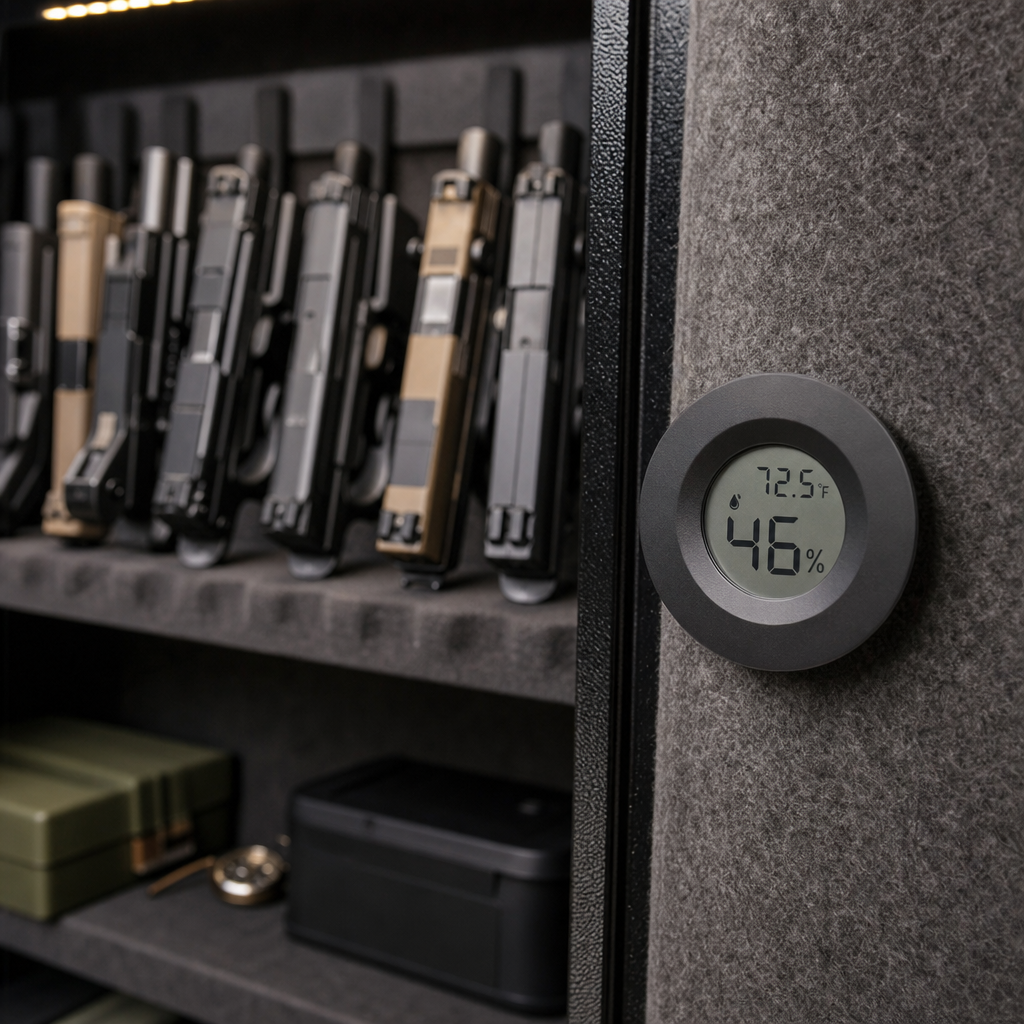
Adding a humidity monitor to protect your firearms is one of the most practical gun safe modifications you can make, because moisture damage starts quietly and becomes expensive fast. In the gun safes and safety category, humidity control matters as much as lock quality, fire rating, and anchoring. A humidity monitor is the device that tells you whether the air inside your safe, cabinet, or vault room is dry enough to prevent rust, wood swelling, mold, optic fogging, and ammunition degradation. In plain terms, it answers the question every gun owner should ask: what is actually happening inside the safe when the door is closed?
I recommend this upgrade early, even before adding lighting, rifle racks, magnetic organizers, or door panel storage, because measurement comes before correction. Many owners install a goldenrod-style heater rod or silica packs and assume the problem is solved. Sometimes it is, but I have opened safes with active dehumidifiers and still found surface oxidation on blued barrels, moisture under foam, and condensation near exterior walls. Without a humidity monitor, you are guessing. With one, you can confirm whether your setup holds a stable relative humidity level through seasonal changes, power outages, and daily door openings.
For most firearm storage, the target range is typically 45 to 50 percent relative humidity, with many owners staying safely between 40 and 55 percent. Relative humidity measures how much water vapor the air contains compared with the maximum it could hold at that temperature. If humidity stays too high, steel rusts faster, leather slings absorb moisture, and walnut stocks can expand or warp. If it drops too low for extended periods, some wood furniture can dry excessively. The right number is not abstract; it is the difference between a clean bore and orange speckling under the handguard.
This article serves as the hub for custom and DIY gun safe modifications, using humidity monitoring as the starting point because it connects to nearly every other upgrade. Once you know your safe’s moisture pattern, you can plan dehumidifiers, vent placement, seal improvements, lighting, power routing, interior lining changes, and maintenance intervals with real data. The goal is not to overbuild a science project. It is to create a safer, cleaner, easier-to-maintain firearm storage system that protects metal, wood, optics, documents, and ammunition over the long term.
Why Humidity Monitoring Should Be Your First DIY Gun Safe Upgrade
Humidity monitoring should come first because every storage environment behaves differently. A safe in a climate-controlled bedroom usually runs very differently from one in a basement, garage, workshop, or exterior wall closet. Even two safes in the same house can show different readings depending on sun exposure, slab moisture, nearby HVAC vents, and how often the door is opened. I have seen a garage safe sit at 62 percent relative humidity in summer while a bedroom safe in the same home held 47 percent with identical dehumidifier rods. The difference was location, not brand.
This is why a humidity monitor belongs at the center of custom and DIY gun safe modifications. Before drilling for cable routing, adding battery-powered lighting, swapping shelves, or lining compartments with foam, you need a baseline reading. Foam, fabric, cardboard ammunition boxes, and gun socks can all affect moisture retention inside the enclosure. So can door organizers, especially densely packed ones that reduce air circulation. A monitor lets you evaluate whether a modification helps, hurts, or does nothing. That turns the process from trial and error into controlled improvement.
A good monitor also supports maintenance discipline. If you know the safe stayed at 48 percent all month, you can focus routine checks on lubrication, dust control, and battery replacement. If you see repeated spikes above 60 percent, you know to inspect seals, desiccant saturation, heater function, and room conditions. That direct feedback is what makes this simple upgrade so valuable. It prevents avoidable corrosion, protects expensive optics, and gives you confidence that the storage environment is doing its job when you are not looking at it.
Choosing the Right Humidity Monitor for a Gun Safe
The best humidity monitor for a gun safe is accurate, easy to read, and stable over time. Look for a digital hygrometer with stated accuracy around plus or minus 2 to 3 percent relative humidity, a temperature display, and min-max tracking. Models from ThermoPro, SensorPush, Govee, and AcuRite are commonly used, though features vary. Bluetooth connectivity is useful if your safe is hard to access daily, but it is not mandatory. A simple display inside the door can work very well if you check it regularly. What matters most is reliable measurement, not gimmicks.
Avoid very cheap analog gauges unless they are from a reputable manufacturer and can be calibrated. Many decorative dial hygrometers drift significantly, especially in the ranges that matter for firearm storage. If you want stronger confidence, use a monitor that supports calibration adjustment or verify it with a salt test. In that method, a sealed container with salt slurry should stabilize near 75 percent relative humidity after several hours, giving you a reference point. It is not a laboratory procedure, but it is good enough to spot a monitor that is badly off.
| Feature | Why It Matters | Best Choice for Most Safes |
|---|---|---|
| Accuracy rating | Determines whether your corrective actions are based on trustworthy data | ±2% to ±3% RH |
| Temperature display | Helps interpret humidity swings and condensation risk | Included on the same screen |
| Min/max history | Shows hidden spikes after door openings or weather changes | Built-in memory |
| Connectivity | Lets you review readings without opening the safe | Bluetooth if convenient |
| Power source | Affects maintenance intervals and placement options | Coin cell or AA with long runtime |
| Mounting method | Determines whether installation is clean and reversible | Magnet, stand, or removable adhesive |
If your safe stores collectible firearms, suppressors, premium glass, or paper records, buy two monitors instead of one. Put one high and one low. Warm air and moisture distribution are not always uniform, particularly in crowded safes with shelves, pistol hangers, and door organizers. Dual placement reveals whether you have stratification or dead zones. That information becomes useful later if you add a heater rod, desiccant canister, or low-speed circulation fan.
How to Install a Humidity Monitor Without Damaging the Safe
Installation is usually simple, and it should be reversible. Do not drill the safe body unless you have confirmed the manufacturer’s guidance and understand the location of fire lining, relockers, hard plate, wiring channels, and warranty limits. Most owners can avoid drilling completely. A magnetic-backed monitor can attach to interior steel panels. A freestanding unit can sit on a shelf. Removable adhesive strips work if the interior surface is clean and the monitor is light. My preference is to mount the primary sensor at mid-height away from the heater rod and not directly against the door seal.
Placement matters more than people expect. If the monitor sits directly above a dehumidifier rod, the reading can skew lower than the rest of the safe. If it is pressed into a corner behind soft cases, the reading may lag behind actual door-open spikes. Keep it in open air where circulation is representative of the firearms you are protecting. For larger safes, a second sensor near the bottom rear is useful because cool, less-circulated areas often reveal problems first. Basements especially tend to create these pockets.
After installing the monitor, leave the safe closed for at least twenty-four hours before making decisions. Record the reading, then compare it over several days and through normal use. If you open the safe often, note how long it takes to return to baseline. That recovery time tells you whether your current dehumidification setup is adequate. A safe that jumps from 47 to 58 percent after opening and returns within an hour is behaving differently from one that stays elevated overnight.
Pairing the Monitor With Dehumidifiers and Other Safe Modifications
A humidity monitor becomes most valuable when you pair it with corrective tools. The two common approaches are electric dehumidifier rods and rechargeable or disposable desiccants. Heater rods slightly warm the air inside the safe, lowering relative humidity and encouraging gentle circulation. They are simple and effective for many full-size safes if power is available. Desiccants actively absorb moisture and work well in smaller safes, cabinets, or locations where electrical routing is difficult. The monitor tells you which method is keeping the environment in range and when service is needed.
In custom and DIY gun safe modifications, this measurement-and-response cycle should guide every upgrade. If adding LED lighting raises internal temperature slightly, your humidity reading may change. If you install a door panel organizer that packs the door with holsters, magazines, and documents, airflow may decrease. If you line shelves with closed-cell material, the effect may differ from open-cell foam, which can retain moisture. The right response is not to avoid modifications. It is to monitor after each change so your safe remains protective, not just organized.
Ventilation is another area where data matters. Some cabinets benefit from passive venting in drier homes, but venting in a damp garage can make the problem worse. Likewise, weatherstripping improvements may help stabilize conditions, yet a tighter seal also means moisture introduced during door openings can linger longer without active drying. A monitor shows the net result. That is why experienced owners treat humidity data like a dashboard, not a one-time installation detail. It informs every future decision inside the safe.
Common Mistakes That Lead to Rust, Mold, and False Readings
The most common mistake is assuming a single reading tells the whole story. Humidity changes with season, weather, indoor heating cycles, and how often the safe is opened. Check trends, not isolated numbers. Another mistake is placing firearms into the safe after exposure to rain, sweat, cold vehicle air, or outdoor humidity without wiping them down and letting temperatures stabilize. Condensation can form when a cold firearm enters a warmer room, even if the room itself feels comfortable. The monitor may show normal humidity while moisture still sits on the metal.
Another frequent problem is storing guns in foam-lined cases inside the safe for long periods. Many soft and hard cases trap moisture against steel and bluing, especially in humid climates. I have seen otherwise clean safes hide rust under the contact points of scoped rifles left in padded sleeves. Leather slings and holsters can create the same issue if left touching metal for months. Humidity monitoring helps, but it does not replace sensible storage practices: light protective oil, breathable spacing, and periodic inspection remain essential.
False readings also come from neglected batteries, uncalibrated sensors, and poor placement near heat sources. If a monitor suddenly reports an implausible drop, verify the power source before changing your whole setup. If readings disagree between sensors, test them together in the same sealed container. Finally, do not chase perfection. A safe that stays consistently around 45 to 50 percent is doing its job. Constantly opening the door, moving sensors, and swapping products can introduce more moisture than a stable, slightly imperfect system.
Building a Long-Term Firearm Protection Routine Around the Monitor
The best gun safe setup is not the one with the most accessories. It is the one that stays consistent. Once your monitor is installed, create a routine. Check the reading weekly at first, then monthly once you know the pattern. Recharge desiccants on schedule or when the monitor shows drift. Test heater rods and inspect power cords during seasonal transitions. Wipe down firearms after range trips, especially carry guns exposed to body salt. Record baseline readings in winter and summer so you can spot changes before rust appears.
This routine can also anchor the rest of your DIY modifications. When you add motion-activated lighting, document whether temperature changes are negligible. When you upgrade shelving for better rifle spacing, compare humidity recovery time after door openings. When you improve cable management for power and chargers, make sure cords do not block airflow along the back wall. Over time, your monitor becomes a practical management tool for the entire storage system, not just a weather gadget. That is why it belongs at the hub of custom and DIY gun safe modifications.
Adding a humidity monitor to protect your firearms is a small project with outsized value. It gives you hard evidence, not assumptions, about the condition inside your safe. That evidence helps you choose the right dehumidifier, place accessories intelligently, avoid moisture-trapping materials, and catch problems before they become corrosion or stock damage. For any owner building a safer storage setup, the first step is simple: install a quality monitor, log the readings, and let the data guide your next modification. Your firearms, optics, and documents will last longer because you measured first.
Frequently Asked Questions
Why should I add a humidity monitor to my gun safe if it already seems dry?
A gun safe can feel dry when you open it and still have enough trapped moisture to damage firearms over time. That is exactly why a humidity monitor is such a valuable upgrade. Rust, corrosion, wood stock swelling, mold, optic haze, and even ammunition deterioration usually begin slowly and quietly, not with obvious standing moisture. Inside a sealed or semi-sealed safe, humidity can rise from normal seasonal changes, damp basements, garage temperature swings, recently handled firearms, foam cases, gun socks, and even moisture carried in by the air each time the door opens. Without a monitor, you are guessing. With a monitor, you know whether conditions are actually in the safe range for long-term storage.
For most firearm storage setups, the goal is to maintain relative humidity low enough to reduce corrosion risk without making conditions excessively dry for wood and leather accessories. A monitor gives you a real number instead of relying on feel, and that makes every other moisture-control decision more effective. If the reading starts climbing, you can respond before rust spots form on blued steel, before optics begin fogging internally, or before stocks and grips react to excess moisture. In practical terms, adding a humidity monitor is one of the simplest and least expensive gun safe modifications because it turns humidity control from a guess into a system you can manage.
What humidity level is best for protecting firearms inside a safe?
In general, many firearm owners aim for a relative humidity range of about 40% to 50% inside a gun safe. That range is commonly considered a good balance for protecting metal components from corrosion while also avoiding overly dry conditions that may affect wood stocks, grips, slings, documents, and some accessories. If humidity consistently climbs much above that level, the risk of rust, mildew, and moisture-related damage increases. If it drops too low for extended periods, certain organic materials can dry out, shrink, or become brittle. The ideal target can vary slightly depending on the types of firearms you store, your climate, and whether the safe is located in a basement, garage, interior room, or dedicated vault space.
The key is stability as much as the exact number. Frequent swings in humidity can be just as problematic as high readings because temperature and moisture shifts create condensation risk, especially on metal surfaces. A quality humidity monitor helps you track not only the current reading but also patterns over time. If your safe regularly spikes after rainy weather, after opening the door, or during seasonal transitions, that tells you your setup may need a dehumidifier rod, silica gel, better room climate control, or a change in safe placement. Rather than chasing a perfect number, focus on maintaining a consistent, controlled range that keeps your firearms, optics, ammunition, and accessories protected year-round.
Where should I place a humidity monitor inside a gun safe for the most accurate reading?
Placement matters because humidity can vary within the safe, especially if you use shelves, door organizers, dehumidifier rods, rechargeable desiccants, or tightly packed storage layouts. For the most useful reading, place the humidity monitor around the middle of the safe at a spot where air circulates naturally and where it is easy to check without moving everything around. Avoid placing it directly against a heating rod, directly beside a desiccant pack, or pressed into a corner where airflow is limited, because those locations can give you a reading that reflects a microclimate rather than the overall condition inside the safe. You also want to keep it away from areas where metal or walls might be cooler and create misleading localized moisture readings.
If you have a large safe or vault room, it can be smart to use more than one monitor. One can be positioned higher and another lower, since warm and cool air layers can affect humidity patterns. In many safes, the lower section is where moisture problems show up first, especially if the safe sits on concrete or in a basement. If you store optics, documents, suppressors, or collectible firearms on upper shelves, monitoring both zones can provide a more complete picture. The best placement is the one that gives a representative reading, is visible enough to encourage regular checks, and helps you notice changes before they become expensive problems.
Do I need a humidity monitor by itself, or should I also use a dehumidifier or desiccant?
A humidity monitor is the tool that tells you what is happening, but it does not remove moisture on its own. Think of it as the control panel for your firearm protection strategy. In many cases, the best setup includes both a monitor and an active or passive moisture-control solution such as a golden rod-style heating element, reusable silica gel canisters, rechargeable desiccant units, or room-level climate control. The monitor lets you see whether those products are actually doing their job. Without that feedback, you may assume your safe is protected when the humidity is still too high, or you may replace desiccants too late after they are already saturated.
The right combination depends on the environment. In a climate-controlled room, a monitor plus a small desiccant pack may be enough. In a basement, garage, or humid region, you may need a dehumidifier rod inside the safe along with silica gel and occasional monitoring of the surrounding room. The monitor is what helps you make that decision intelligently. It also helps you spot when conditions change. If readings begin to rise despite using desiccant, it may be time to recharge or replace it. If humidity remains high even with multiple products in place, the room itself may be the real issue. In that way, a monitor does more than report numbers; it helps you build an effective, evidence-based moisture control system for long-term firearm storage.
How often should I check the humidity monitor, and what should I do if the reading is too high?
As a practical habit, check the humidity monitor every time you access the safe and do a more intentional review at least weekly, especially during humid seasons or major weather changes. If your monitor stores minimum and maximum readings, review those trends instead of just glancing at the current number. A safe can appear fine at the moment you open it but still be cycling into unsafe humidity levels overnight or during temperature swings. New safes, relocated safes, and safes stored in basements or garages deserve closer attention until you understand how they behave in your environment. Once you establish a stable pattern, you may not need to watch it obsessively, but regular checks are still important because moisture issues develop over time.
If the reading is too high, start with the simplest corrective steps. Confirm the monitor is accurate, then inspect whether your desiccant is saturated, whether your dehumidifier rod is functioning, and whether the safe has recently been opened often or stocked with items that introduced moisture. Wipe down recently handled firearms with a protective oil or rust preventive, because fingerprints and residual moisture accelerate corrosion. Next, consider the safe’s location. If it sits against an exterior wall, on concrete, or in a damp room, the surrounding environment may be driving the problem. Raising the safe slightly, improving room ventilation, running a room dehumidifier, or moving the safe to a better climate-controlled area can make a major difference. The important thing is to respond early. Once rust, mold, stock movement, or optic damage begins, the cost of repair is usually far greater than the cost of proper humidity monitoring and control.