
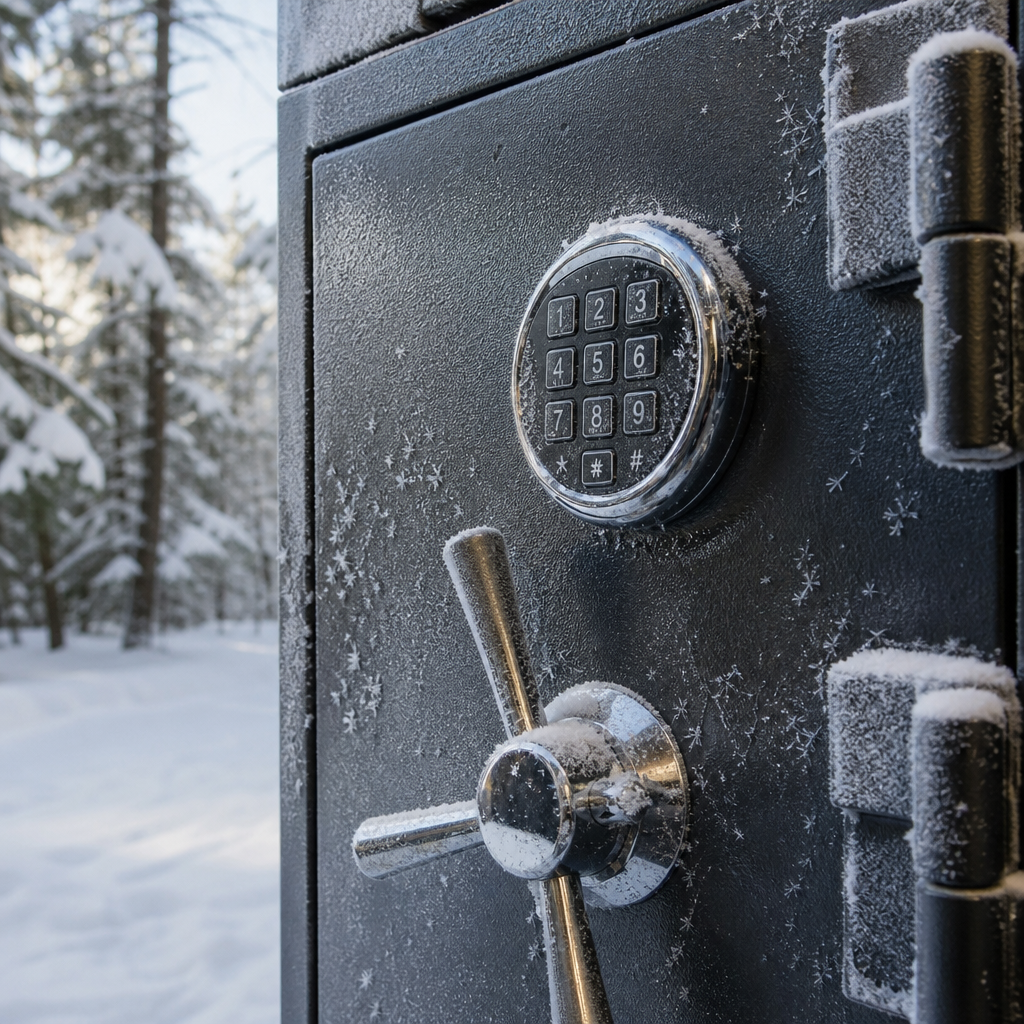
Cold weather exposes weak assumptions about firearms storage, and one of the most common questions I hear from safe owners is simple: do gun safe locks freeze in cold weather? The short answer is that a gun safe lock can become difficult to operate in very low temperatures, but the lock itself usually is not “freezing” in the way people imagine. In most cases, trouble comes from condensation, thickened lubricants, shrinking batteries, stiff keypad membranes, or metal contraction that reduces tolerance inside moving parts.
That distinction matters because many gun safe myths start with a real symptom and end with the wrong conclusion. If a keypad does not respond after a subzero night in an unheated garage, owners often blame the entire safe design, when the actual cause may be a weak alkaline battery whose output dropped sharply in the cold. If a dial turns roughly in winter, the issue may be old grease that has increased in viscosity rather than ice packed inside the mechanism. Understanding what cold weather truly does to a safe lock helps you prevent failures before they happen.
In the gun safes and safety category, lock performance is not a small detail. A safe is only secure when you can access it reliably and unauthorized users cannot. That balance becomes harder in basements, detached shops, cabins, hunting camps, RV storage, and garages, where temperatures swing, humidity changes quickly, and owners may leave a safe untouched for weeks. I have seen lockouts happen after snowmelt, after power outages, and after a warm front caused condensation on a steel door that had been sitting below freezing for days.
This article serves as a hub for gun safe myths and misconceptions, with cold-weather lock behavior as the anchor topic. It explains what happens to electronic, mechanical, and biometric locks in the cold; which claims are true, exaggerated, or false; and what practical steps keep a safe working year-round. If you want a clear answer, use this rule: cold weather can affect a gun safe lock, but proper placement, maintenance, battery selection, and moisture control prevent most winter problems.
What Cold Weather Actually Does to Gun Safe Locks
A gun safe lock does not usually fail because the entire unit turns into a block of ice. It fails because cold changes how materials, power sources, and moisture behave. Steel contracts slightly as temperature drops. Plastics and rubber keypads become less flexible. Lubricants thicken. Batteries deliver less current. Air inside and around the safe holds less moisture when cold, but condensation forms when warm humid air touches cold steel. That thin film of water is the real freezing risk if temperatures drop again before the moisture evaporates.
In practical terms, the environment around the safe matters as much as the lock type. A climate-controlled interior room rarely creates winter lock issues. An attached garage may be fine in mild regions but problematic in northern states where overnight temperatures stay below freezing. A detached outbuilding is the harshest scenario because it combines temperature extremes, wind-driven humidity shifts, and long periods without inspection. I advise owners to think of a safe lock as a precision access device, not a tractor hitch; rugged construction helps, but neglect still shows up under environmental stress.
Manufacturers of UL-listed safe locks generally design for broad operating ranges, yet field conditions matter. A lock rated to function at low temperatures may still disappoint if the keypad is exposed to condensation, the battery is years old, or the boltwork is under pressure from a misleveled floor. That is why two owners with the same model can have opposite experiences in January. The lock design may be sound, but one installation supports it and the other undermines it.
Electronic Locks: The Most Misunderstood Winter Failure Point
Electronic gun safe locks are often blamed first, and sometimes fairly. Their biggest cold-weather vulnerability is power delivery. Standard alkaline 9-volt batteries and AA cells lose effective performance as temperatures fall, especially under sudden load. The keypad may light up weakly, beep inconsistently, or reject a valid code because the lock motor or solenoid does not receive enough current to complete the opening sequence. Owners then assume the lock has frozen, even though the real failure was voltage sag.
In my experience, battery condition is the fastest thing to check and the most commonly ignored. A battery that works at 70 degrees Fahrenheit may become unreliable near freezing, particularly if it was already half depleted. Lithium batteries, where the lock manufacturer permits them, generally outperform alkaline cells in cold conditions because they maintain voltage better and resist leakage. Always confirm compatibility in the lock documentation, since some electronic locks are calibrated around specific battery chemistry and size tolerances.
Another issue is keypad membrane stiffness. Rubberized buttons can harden in low temperatures, reducing tactile feedback and making partial presses more likely. On some older budget locks, the display response also slows. This does not mean all electronic locks are unsuitable for winter use. Commercial-grade designs from established lock makers perform very well when installed correctly and supplied with fresh batteries. The myth is that electronic locks are inherently unreliable in the cold. The reality is that poorly maintained electronic locks are unreliable anywhere, and cold simply reveals the weakness faster.
| Lock type | Main cold-weather issue | Typical symptom | Best prevention |
|---|---|---|---|
| Electronic keypad | Battery voltage drop, condensation, stiff keypad | Dim display, weak beep, no unlock cycle | Fresh approved batteries, dry location, regular testing |
| Mechanical dial | Thickened lubricant, debris, tight tolerances | Rough turning, dialing errors, delayed opening | Professional service, clean environment, correct installation |
| Biometric | Sensor performance, power loss, moisture on scanner | Fingerprint rejection, slow wake-up | Backup entry method, clean sensor, battery replacement |
Mechanical Dial Locks: Reliable, but Not Immune to Winter Problems
Mechanical dial locks are widely viewed as the cold-proof answer, and that reputation is partly deserved. They do not depend on batteries, screens, or circuit boards, so one major failure pathway disappears. High-quality Group 2 and Group 2M style locks have earned trust over decades because they tolerate long service intervals and broad temperature ranges. Still, saying mechanical locks never have cold-weather issues is inaccurate.
What affects them most is lubricant condition and internal wear. If a dial lock has been over-lubricated, serviced with the wrong product, or exposed to dust and humidity for years, cold weather can make a marginal situation obvious. Grease thickens. Tiny contaminants drag inside the wheel pack or fence interface. The dial may feel heavy, or the owner may overshoot numbers because the action is no longer smooth. Older safe doors can also shift slightly if the safe sits unevenly, putting side pressure on the boltwork and making an already stiff lock feel worse.
I have opened safes in winter that owners swore had frozen solid, only to find a combination dialing technique problem made worse by a cold, rough dial. Mechanical locks remain excellent for unheated spaces because they remove battery concerns, but they still need correct mounting, periodic inspection, and a clean, dry environment. The myth is that a dial lock is maintenance-free forever. The truth is that it is lower-maintenance, not no-maintenance.
Biometric Locks and the Myth of Instant Access in Every Condition
Biometric safe locks are marketed around speed, but winter conditions expose their limits quickly. Fingerprint readers depend on a clean sensor, consistent finger placement, sufficient power, and skin conditions that produce a readable pattern. In cold weather, dry skin, gloves, numb fingers, and condensation on the scanner all reduce accuracy. If the safe is in a garage or cabin, a user may approach it with cold hands after being outside, exactly when the reader is least forgiving.
That does not make biometric locks useless. Better models store multiple fingerprint angles, wake quickly, and include backup keypad or override methods. For bedside handgun safes in climate-controlled rooms, biometrics can work very well. For a long-gun safe in an outbuilding, they should never be your only access plan. The misconception is that fingerprint access is the most advanced option and therefore the most dependable. In reality, winter reliability depends on redundancy more than novelty. A biometric reader with a tested backup code is superior to a biometric-only setup you have not evaluated in realistic conditions.
Common Gun Safe Myths and Misconceptions Owners Should Retire
Several gun safe myths feed confusion about cold weather. First, “a heavier safe never has lock problems.” Weight improves theft resistance and sometimes fire performance, but it does nothing to stabilize batteries or eliminate condensation. Second, “fire lining prevents moisture.” Fireboard and insulation do not function as dehumidification systems. A safe can be fire-rated and still collect moisture in changing temperatures. Third, “a garage is fine if the safe is sealed.” Gun safes are not hermetically sealed labs; every opening exchanges air, and steel doors track ambient temperature.
Another common myth is “a frozen lock needs force.” Forcing a keypad, handle, or dial is how minor resistance becomes a broken component or a locked boltwork system requiring a technician. If a lock suddenly behaves differently, stop and diagnose. Check the battery, let the safe warm gradually, inspect for visible condensation, and review the exact opening procedure. Repeatedly yanking a handle before the lock retracts is especially damaging on some consumer safes.
The last myth is “winter lockouts prove the brand is junk.” Sometimes the product is poor, and some low-cost imported locks do fail early. But many winter complaints trace back to installation and upkeep, not just manufacturing quality. A reputable safe placed on a damp concrete slab in an unheated building, with a three-year-old battery and no desiccant, is being set up to struggle.
How to Prevent Cold-Weather Lock Problems Before They Start
Prevention is far easier than emergency opening. Start with location. If possible, place the safe inside conditioned space where temperature and humidity stay moderate. If the safe must live in a garage or outbuilding, keep it off bare concrete with a riser or anchored platform. Concrete transmits cold and can contribute to moisture issues around the base. Next, control humidity inside the safe with a dehumidifier rod or rechargeable desiccant, and monitor conditions with a small hygrometer. Relative humidity between about 45 and 55 percent is a practical target for most firearm storage.
For electronic locks, replace batteries on a schedule rather than waiting for failure. I recommend annual replacement before winter for safes in unconditioned spaces. Use only the battery type approved by the lock manufacturer, test the lock after installation, and keep the code written and secured according to your household security policy. For mechanical locks, if the dial becomes rough, do not spray household lubricant into the keypad opening or dial spindle area. That shortcut attracts debris and can worsen the problem. Have the lock serviced by a qualified safe technician familiar with brands such as Sargent and Greenleaf, SecuRam, La Gard, and AMSEC systems.
Finally, practice access in realistic conditions. Open the safe on a cold morning, not just in comfortable afternoon temperatures. Verify that every authorized user can operate the lock correctly. If you rely on a biometric reader, enroll multiple fingers from both hands and confirm the backup method works. Reliability is proven by testing, not assumed from packaging.
When a Lock Seems Frozen: Safe Troubleshooting Steps
If your gun safe lock appears frozen, take a methodical approach. For electronic locks, install a fresh approved battery first, even if the old one seems alive. Then wait several minutes and try the code carefully. Listen for a full unlocking sound, not just a beep. If the keypad is damp, dry the exterior and allow the area to warm gradually; do not apply direct high heat with a torch, heat gun, or hair dryer pressed against the keypad. Rapid heating can damage plastics and drive condensation deeper.
For mechanical dials, ensure there is no pressure on the handle while dialing, then enter the combination exactly as the manufacturer specifies. Small dialing errors become more likely when the dial is stiff. If the safe was recently moved or bolted down on an uneven surface, door alignment may be contributing. In either case, avoid forcing the handle. If basic steps fail, call a qualified safe technician before damage escalates. Professional opening is cheaper than replacing a lock and repairing bent boltwork after a DIY force attempt.
Cold weather does not automatically freeze gun safe locks, but it can expose every weakness in power, lubrication, moisture control, and installation. Electronic locks usually struggle because batteries lose performance or condensation affects components. Mechanical locks remain highly dependable, yet they are not immune to thickened lubricant, wear, or door pressure. Biometric locks add convenience, but winter proves why a tested backup method matters. The central lesson across gun safe myths and misconceptions is that most “frozen lock” stories are really maintenance and environment stories.
For owners building a safer storage plan, the practical path is clear. Choose the lock type that matches your environment, install the safe in the most stable location available, manage humidity, replace batteries before winter, and service rough mechanical locks instead of ignoring them. Just as important, test your safe under real conditions rather than assuming it will perform when you need it most. A reliable gun safe is not defined by marketing claims; it is defined by consistent access, secure lockup, and predictable operation in every season.
Use this article as your starting point for the broader gun safe myths and misconceptions hub, then review your own setup today. Check the battery, inspect for moisture, confirm the opening procedure, and make one improvement before the next cold snap arrives.
Frequently Asked Questions
Do gun safe locks actually freeze in cold weather?
Usually not in the way most people picture it. In most cases, the lock is not turning into a solid block of ice internally. What cold weather really does is expose weak points in the safe system. Electronic locks may respond slowly because batteries lose output in low temperatures. Mechanical parts can feel stiff because lubricants thicken. Keypads can become less responsive when rubber membranes harden. If the safe has been moved between warm and cold environments, condensation can also form and create temporary operating issues. Metal parts may contract slightly as temperatures drop, which can reduce clearances and make a lock or boltwork feel less forgiving. So while a gun safe lock can become difficult to operate in winter conditions, the problem is often cold-related performance loss rather than literal freezing.
Why does my gun safe lock become hard to open when temperatures drop?
There are several common reasons, and they often happen together. The first is battery performance. If your safe uses an electronic lock, cold weather can reduce the battery’s ability to deliver enough power, even if the battery is not technically dead. The second is lubricant behavior. Oils and greases that work fine at room temperature can become thicker in the cold, making internal lock components move more slowly or with more resistance. The third issue is condensation. If the safe is stored in a garage, shed, basement, or other space with temperature swings, moisture can form on or inside lock components and interfere with reliable operation. A fourth factor is material contraction. Metal shrinks slightly in low temperatures, and while that change is small, it can affect already-tight tolerances in the lock or door mechanism. Finally, exterior parts such as keypads, handles, and relock components can become stiff or less responsive. When a safe is already marginally adjusted or poorly maintained, cold weather tends to make those hidden issues show up more clearly.
Are electronic gun safe locks more vulnerable to cold weather than mechanical dial locks?
In general, yes, electronic locks tend to be more sensitive to cold weather because they rely on batteries, circuit boards, and keypad materials that can all be affected by low temperatures. A battery that seems perfectly fine indoors may struggle to provide enough voltage in a cold garage or unheated outbuilding. Keypads can also become sluggish, especially if the membrane or buttons stiffen. That does not mean electronic locks are unreliable by default, but they do have more temperature-sensitive components than a traditional mechanical dial lock. Mechanical locks avoid battery-related problems, but they are not immune to cold. They can still suffer from thickened lubricants, condensation, internal stiffness, or reduced operating tolerance when temperatures drop. The practical difference is that electronic locks often fail in a more obvious way, such as no beep, delayed response, or failure to unlock, while mechanical locks may simply feel rougher, tighter, or less smooth. If cold-weather reliability is a major concern, many owners prefer high-quality mechanical locks or electronic locks specifically rated for broader environmental conditions.
How can I prevent gun safe lock problems in winter?
The best prevention strategy is to control both temperature and moisture as much as possible. If possible, keep the safe in a climate-controlled part of the home rather than a garage, shed, or other space that experiences sharp swings in temperature. Replace batteries on a schedule instead of waiting for low-battery warnings, and use fresh, high-quality batteries recommended by the lock manufacturer. Avoid over-lubricating the lock or boltwork, especially with generic oils that can thicken or attract dust. If lubrication is needed, use only products approved for your lock or safe mechanism. Moisture control is also critical. A dehumidifier rod, desiccant packs, or other safe-safe humidity control products can help reduce condensation risk inside the safe. Check the door seal area, keypad, handle, and lock for signs of corrosion, stiffness, or inconsistent operation before winter becomes severe. If the safe is in a cold location, test it periodically so you know how it behaves before an emergency access situation. Preventive maintenance from a qualified safe technician can also identify boltwork alignment issues or worn components that cold weather may aggravate.
What should I do if my gun safe lock will not open during very cold weather?
Start with the simplest and safest steps. If the safe has an electronic lock, replace the battery with a fresh one from a reliable brand, even if the current battery seems recent. Weak battery output is one of the most common causes of cold-weather failure. Enter the code carefully and deliberately, since stiff keypads may not register rushed presses. If the safe is located in a very cold space, gently warming the surrounding room can help stabilize the lock and reduce stiffness, but avoid using direct heat guns, open flames, or aggressive heating methods that can damage the lock, finish, or fire insulation. If condensation is suspected, allow the safe to acclimate gradually rather than forcing the mechanism. For mechanical locks, turn the dial slowly and precisely, since cold-stiffened components may be less forgiving of dialing errors. Do not force the handle or try to muscle the door open, because that can make the problem worse or damage the boltwork. If repeated attempts fail, contact the safe manufacturer or a qualified safe technician. A professional can diagnose whether the issue is battery-related, alignment-related, moisture-related, or a true lock malfunction, and that is far better than risking damage through trial and error.