
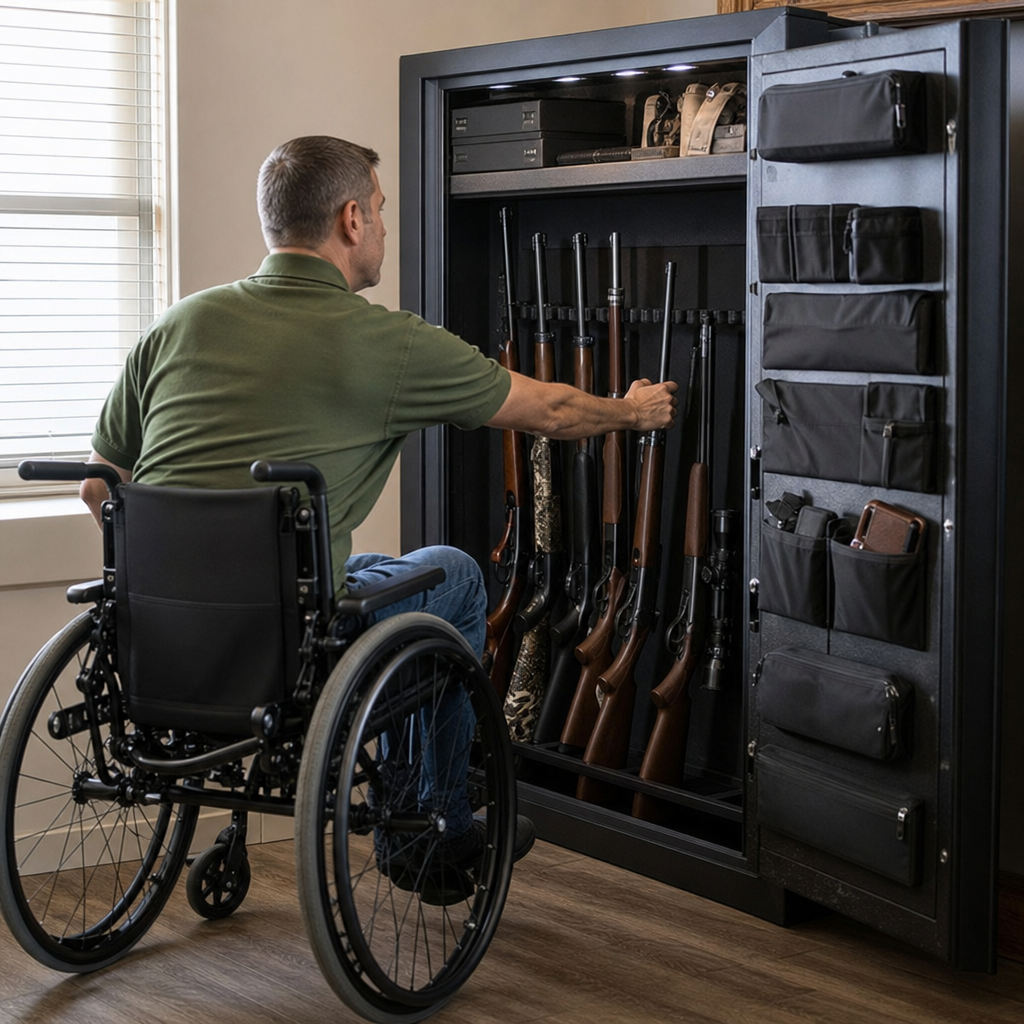
Choosing gun safe solutions for people with limited mobility or disabilities requires more than comparing steel thickness and lock ratings. It means matching firearm storage to real physical needs, home layout, daily routines, and emergency access requirements. In my work evaluating safes for households with aging owners, wheelchair users, veterans with hand injuries, and people managing chronic pain, the best results never came from a one-size-fits-all model. They came from understanding the buyer persona first. A buyer persona is a practical profile that groups users by goals, limitations, risks, and buying priorities. In the gun safe category, personas matter because the safest option on paper can become the wrong option if the handle is too stiff, the keypad is too high, or the interior requires lifting and twisting that the owner cannot do reliably.
This topic matters for three reasons. First, secure storage is a legal and safety obligation, especially in homes with children, caregivers, visitors, or shared living arrangements. Second, accessibility affects whether the owner can store and retrieve a firearm consistently, which is essential for both accident prevention and lawful self-defense. Third, disability is not a single condition. Limited mobility may involve arthritis, spinal cord injury, amputation, neuropathy, visual impairment, reduced grip strength, balance limitations, or temporary recovery after surgery. Each condition changes what “easy access” actually means. A useful gun safe hub page must therefore connect buyer personas to lock types, door styles, mounting heights, interior organization, and installation choices, while recognizing tradeoffs between speed, capacity, fire protection, and physical effort.
For this subtopic, “gun safe buyer personas” means the common user profiles that shape how a person should shop. Some buyers need bedside quick-access storage that opens with one hand. Others need a full-size long-gun safe with seated reach ranges and low-resistance shelving. Some rely on caregivers and need controlled delegated access without sharing a master code. Others need a discreet safe in an apartment where space for wheelchair turning radius is limited. By organizing the market around these personas, buyers can move from broad product marketing to specific selection criteria that improve safety, usability, and long-term satisfaction. The central question is simple: which safe can this person use correctly every single time under normal conditions and under stress?
Why mobility-focused buyer personas should drive gun safe selection
A mobility-focused persona turns abstract product claims into concrete buying requirements. Manufacturers often advertise “quick access,” “heavy-duty construction,” or “biometric convenience,” but those phrases mean little until you ask how a real user interacts with the safe. For a person with severe arthritis, a recessed keypad with small rubber buttons can be harder to use than a mechanical push-button lock with raised tactile inputs. For a wheelchair user, a floor-standing safe with a low bottom shelf may create difficult forward bending and side reach. For someone with tremors, a fingerprint scanner may fail more often unless the sensor area is large and enrollment quality is excellent. Persona-based shopping prevents expensive mistakes because it identifies friction points before purchase.
In practice, I start with five variables: hand function, reach range, transfer ability, sensory limitations, and urgency of access. Hand function includes grip strength, finger dexterity, and pain during twisting or pinching. Reach range includes seated height, overhead access, and the ability to bend safely. Transfer ability matters when the safe is placed beside a bed, in a closet, or inside furniture. Sensory limitations can include low vision, hearing loss, or reduced tactile feedback. Urgency of access distinguishes between a defensive handgun safe needed in seconds and a compliance-oriented storage unit for long-term rifles or collectibles. Once these variables are clear, the shortlist becomes far more accurate.
Another reason personas matter is that disability-friendly design often overlaps with better design for everyone. Lever-assisted doors, illuminated keypads, interior lighting, pull-down rifle racks, modular shelves, and lower mounting positions help users with disabilities, but they also improve speed and reduce user error for spouses, older adults, and family members. This is especially relevant in multigenerational households where one safe may serve users with very different abilities. A hub article on gun safe buyer personas should therefore connect specialized needs with mainstream product features rather than treating accessible storage as a niche afterthought.
Core buyer personas in this sub-pillar and what each one needs
The first major persona is the wheelchair user or seated-access buyer. This person needs clear floor space in front of the safe, comfortable handle height, door swing that does not block approach, and interior layouts usable from a seated position. Out-swing doors on large safes can create side clearance issues, while deep interiors may make rear items hard to reach. The second persona is the reduced hand strength buyer, often dealing with arthritis, neuropathy, tendon injury, or age-related dexterity loss. This buyer benefits from locks requiring minimal finger force, easy-to-read controls, and shelves or holsters that avoid awkward manipulation.
The third persona is the chronic pain or fatigue buyer. This person may have good function some days and poor function on others. Lightweight doors, organized interiors, and minimal lift requirements are critical because repetitive strain discourages proper storage habits. The fourth persona is the visually impaired buyer, who needs tactile controls, audible feedback, predictable interior arrangement, and strong lighting contrast. The fifth persona is the caregiver-supported owner, who may require controlled shared access, audit trails, and clear procedures for emergencies. The sixth persona is the apartment or small-space buyer with mobility limitations, where compact dimensions, discreet installation, and accessible path of travel matter as much as burglary resistance.
| Buyer persona | Main challenge | Best safe features | Common mistake |
|---|---|---|---|
| Wheelchair or seated user | Reach height and approach clearance | Mid-height controls, wide door opening, pull-out storage | Buying a tall safe with inaccessible lower and upper zones |
| Reduced hand strength | Small buttons, stiff handles, fine motor demands | Large tactile keypad, assisted opening, easy-turn handle | Relying only on a tiny biometric reader |
| Chronic pain or fatigue | Repeated bending, lifting, and twisting | Modular shelves, door organizers, lighted interior | Overloading a heavy door or deep shelf |
| Visually impaired owner | Reading controls and locating contents | High-contrast interface, tactile indexing, voice or beep cues | Choosing a glossy keypad with poor differentiation |
| Caregiver-supported household | Shared access and accountability | Multiple user codes, audit trail, backup method | Sharing one permanent master code |
| Small-space mobility-limited buyer | Narrow rooms and transfer obstacles | Compact footprint, wall mounting, side clearance planning | Ignoring door swing and wheelchair turning radius |
These personas are not rigid categories. Many buyers fit more than one. A veteran with a hand injury may also use a wheelchair. An older adult may have both low vision and chronic pain. That is why the persona framework works best as a planning tool: identify the dominant limitations first, then rank features by necessity. The linked articles within this hub should explore each persona in depth, but the central buying principle remains consistent. Fit the safe to the user’s body, environment, and routine, not just to the firearm collection.
Accessibility features that matter most in real-world use
Lock interface is usually the first make-or-break feature. Electronic keypads can work well if the buttons are large, backlit, responsive, and mounted where the user can see or feel them easily. Mechanical push-button locks such as Simplex-style systems remain valuable because they avoid batteries and can be operated by touch, but some require finger pressure that may be difficult for users with severe arthritis. Biometric locks can be excellent for one-handed access, yet they should never be assumed ideal. Fingerprint performance varies with skin condition, enrollment quality, and sensor size. Dry skin, scars, and tremors can reduce reliability. The most dependable approach for many disabled users is a primary method that suits their physical ability plus a secondary backup they can still use under stress.
Door operation deserves equal attention. Large full-size safes may have heavy doors even with external hinges and good balance. Pay attention to handle throw, starting resistance, and how far the user must move the door to gain access. Soft-close or gas-strut-assisted designs can reduce effort on some pistol safes. On long-gun safes, interior door organizers can improve reach by moving frequently used items forward, but they should not add so much weight that the door becomes harder to control. For wheelchair users, door swing direction and clearance can be as important as weight. I have seen well-built safes become awkward simply because the door blocked the user’s preferred angle of approach.
Interior layout is often overlooked. Adjustable shelving, pull-out trays, handgun holsters, labeled bins, and rifle supports at reachable heights transform usability. Firearm storage should minimize the need to lift one item to reach another. This is especially important for people with shoulder limitations or reduced balance. Interior lighting matters, too. Battery-powered LEDs activated by motion or door opening are inexpensive but make a major difference for low-vision users and anyone accessing the safe in darkness. If the owner stores medication, documents, or hearing protection in the same unit, clear zones prevent confusion.
Placement, installation, and home layout considerations
The right safe in the wrong place is still the wrong solution. Start with path-of-travel analysis. Can the user reach the safe without navigating tight corners, thick carpet, thresholds, or cluttered furniture? Is there enough room for a walker or wheelchair to approach, turn, and back away safely? For bedside handgun safes, test access from the actual sleep position, not an idealized standing position. For closet installations, measure clear opening width and check whether clothing, shelves, or sliding doors interfere with access. These details shape daily usability more than brochure specifications do.
Mounting height should match the user’s normal reach, and that requires realistic measurement. A wall-mounted safe that appears compact may be unusable if the keypad sits above seated shoulder height. Under-bed safes can reduce vertical reach demands, but they may require pulling weight and leaning, which can be hard for users with back pain. In many homes, a mid-height installation on reinforced cabinetry or a dedicated platform works best because it brings the lock, shelf, and handle into a neutral zone. ADA reach ranges are helpful reference points for planning, even though residential gun safes are not certified accessibility fixtures. As a design guide, they encourage better placement.
Anchoring and structural support also deserve careful review. Full-size safes should be bolted according to manufacturer guidance, usually to concrete or reinforced flooring, to resist tip-over and theft. For buyers with limited mobility, stability is not only a security issue but also a safety issue. A shifting safe, dragging drawer, or poorly mounted wall unit increases injury risk. If delivery crews place the safe, confirm that final positioning still supports accessible use. I have seen installers tuck safes into corners for concealment, unintentionally making the keypad unreachable from a seated angle. Accessibility must be part of the installation brief, not an afterthought after the safe is already anchored.
Balancing security, speed, and independence
Every buyer in this category is balancing at least three priorities: protection against unauthorized access, practical speed for lawful use, and independence in operating the safe without assistance. Those goals do not always align perfectly. A heavy composite fire safe with long-gun capacity may offer stronger burglary resistance and better fire ratings, but it can be slower and more physically demanding to use. A lightweight bedside handgun safe may be faster, yet it depends heavily on secure mounting and disciplined code management. The best choice depends on the owner’s actual risk profile.
For defensive use, consistency beats theoretical speed. A lock that opens in one second during a product demo is not superior if the user cannot operate it accurately during pain flare-ups or in darkness. For long-term storage, organization and ease of handling may matter more than opening speed because the main goal is safe, repeatable compliance. Buyers should also think about backup access. Battery-powered locks need predictable maintenance intervals. Key backups should be stored securely and accessibly, not in a place the owner cannot reach during an emergency. If a caregiver or spouse may need access, use separate user credentials when available rather than sharing one code indefinitely.
Independence is the benefit that ties these decisions together. The right gun safe allows a disabled owner to store firearms responsibly without relying on someone else to open, move, or reorganize the unit. That independence supports privacy, dignity, and consistent safety habits. It also reduces the temptation to leave a firearm unsecured because the safe feels inconvenient. In practical terms, that is the standard every product should meet.
How this hub guides the rest of the Gun Safe Buyer Personas cluster
This hub article is the starting point for a broader set of pages under Gun Safes & Safety. From here, readers should move into detailed guides for bedside safes for arthritis sufferers, long-gun safes for wheelchair users, biometric versus keypad choices for reduced dexterity, apartment-friendly accessible safes, caregiver access planning, and installation checklists for low-vision households. Each supporting article should answer a narrower question, but all of them connect back to the same framework introduced here: identify the persona, map the physical reality, and choose features that reduce friction without compromising secure storage.
The main takeaway is clear. Gun safe buyer personas are not marketing labels; they are decision tools that translate disability, mobility limits, and home constraints into better purchases. When buyers evaluate lock usability, door effort, reachable storage, mounting height, and path of travel together, they avoid the most common failure point in this category: buying a secure safe that is not truly usable. If you are comparing options now, start by writing down your specific mobility challenges, your fastest and safest access position, and who else may need authorized entry. Then use those facts to build a shortlist. That simple step leads to safer storage, better independence, and a gun safe solution you can use with confidence every day.
Frequently Asked Questions
What features matter most when choosing a gun safe for someone with limited mobility or a disability?
The most important features are the ones that reduce physical strain while still allowing secure, reliable access. For many people, that starts with lock usability. A lock that looks advanced on paper may be frustrating in real life if it requires strong grip strength, fine finger movement, or awkward wrist positioning. Larger keypad buttons, illuminated controls, easy-to-read displays, and biometric systems with consistent performance can all be helpful, but the best choice depends on the user’s actual abilities rather than marketing claims.
Door design is just as important. Heavy doors, stiff hinges, and awkward opening angles can make a safe difficult or even unsafe to operate for wheelchair users, people with chronic pain, or those with shoulder, back, or hand limitations. Interior layout also matters. A safe that forces the owner to bend, reach overhead, or move other items out of the way before accessing a firearm can create real problems in both daily use and emergencies. Adjustable shelving, pull-out gun racks, and placement of frequently needed items within easy reach make a major difference.
Beyond the safe itself, installation height and location are often overlooked. A well-chosen safe in the wrong spot can be nearly unusable. For someone with limited mobility, a smaller quick-access safe installed at a reachable height may be more practical than a large traditional cabinet placed in a garage corner or basement. The best gun safe solution is the one that fits the user’s body, home, and routine without forcing painful movement or complicated access steps.
Are biometric gun safes a good option for people with arthritis, hand injuries, or reduced dexterity?
Biometric safes can be a very good option, but they are not automatically the best choice for every user. Their biggest advantage is that they reduce or eliminate the need to turn a dial, manage a small key, or enter a code under stress. For someone with arthritis, nerve damage, tremors, or limited hand strength, that can make access much easier. A fingerprint reader can be especially useful when speed matters and when manipulating traditional locks would be painful or unreliable.
That said, biometric performance varies widely. Fingerprint readers can struggle if the user has worn fingerprints, scar tissue, dry skin, moisture on the hands, or inconsistent finger placement. This is why quality and testing matter. A safe should be evaluated not just for advertised biometric speed, but for how well it reads the actual user’s fingers in normal conditions. It is also wise to enroll multiple fingers from both hands if possible, especially if pain or injury affects one hand more than the other.
Even with a strong biometric system, a backup entry method is essential. Batteries can fail, sensors can misread, and emergencies are not the time to discover an access problem. A reliable secondary keypad or key override adds resilience. In practical terms, biometric safes are often excellent for people with reduced dexterity, but only when they have been tested by the actual owner, installed in a usable location, and supported by a dependable backup method.
Where should a gun safe be installed for someone who uses a wheelchair or has difficulty walking?
The best installation location is one that balances security, accessibility, and realistic daily use. For wheelchair users or people who have difficulty walking, the safe should be placed on the main living level whenever possible, not in a basement, elevated closet shelf, or cramped garage corner. If reaching the safe requires navigating stairs, tight turns, heavy doors, or cluttered pathways, access may be delayed or impossible when it matters most.
Height and approach space are critical. The owner should be able to move directly in front of the safe, open it comfortably, and access its contents without twisting, overreaching, or straining. That often means avoiding floor-level placement for frequently used storage and instead positioning the safe so the lock, handle, and contents fall within a comfortable reach range. Wall-mounted or bedside quick-access safes can work well if installed at an appropriate height and angle. Full-size safes should be evaluated for door swing clearance, transfer space, and whether the user can maintain balance or proper chair position while operating them.
It is also important to think through the complete access sequence. Can the user get to the safe at night without obstacles? Is there enough lighting, or should motion-activated lighting be added? Does the safe door block the pathway once open? In homes where emergency access is a concern, many people benefit from one primary safe for long-term storage and one secondary quick-access safe positioned where the owner can reach it easily and safely. A secure installation is important, but a secure safe that the owner cannot practically use is not a complete solution.
How can someone balance fast emergency access with safe firearm storage if they have physical limitations?
Balancing speed and security starts with being honest about what “fast access” really means for that individual. For someone with limited mobility, the issue is not only how quickly the lock opens, but how quickly they can get to the safe, position themselves, open the door, retrieve the firearm, and do so without pain, fumbling, or loss of control. A realistic setup often includes simplifying each of those steps rather than relying on a single high-tech feature.
In many households, the best answer is a layered storage strategy. A larger safe can provide secure storage for multiple firearms, documents, and valuables, while a smaller quick-access safe can be dedicated to the defensive firearm most likely to be needed urgently. This allows the user to maintain strong overall security without making every access scenario dependent on a heavy full-size safe. The quick-access unit should be mounted where it is easily reachable from the user’s normal sleeping or resting location and should use a lock system the owner can operate consistently under stress.
Practice is also a major part of safe emergency access. The user should rehearse opening the safe and retrieving the firearm from realistic positions, such as seated in a wheelchair, getting out of bed, or dealing with pain flare-ups. If any part of the process is difficult during practice, it will be harder during an emergency. The right solution is the one that remains secure against unauthorized access while still being truly usable for the owner in the conditions they actually live with every day.
Should people with disabilities consider custom or modified gun safe setups instead of standard off-the-shelf models?
Yes, in many cases a custom or modified setup is the most practical and effective option. Standard gun safes are generally designed around average assumptions: standing users, full upper-body strength, easy hand function, and simple access paths. Those assumptions do not fit everyone. People with disabilities often benefit from changes that are relatively minor but make a major difference in real usability, such as repositioned shelving, pull-down storage, low-resistance door hardware, improved lighting, alternative mounting height, or dedicated quick-access placement near key living areas.
Customizing the surrounding environment can matter as much as modifying the safe itself. That may include widening the approach area, improving floor clearance for wheelchairs or walkers, reducing thresholds, adding task lighting, or relocating the safe to a room that supports easier access. In some cases, choosing two different safes for two different purposes works better than trying to force one standard model to do everything. For example, a primary fire-rated safe for long-term storage and a separate accessible handgun safe for immediate use can be a far better fit than one oversized unit that is difficult to open and navigate.
The goal is not simply to own a safe, but to create a storage system the person can use independently, consistently, and safely. That often requires moving beyond catalog comparisons and thinking in terms of human factors: reach range, grip strength, body position, fatigue, pain levels, and home layout. For many buyers with limited mobility or disabilities, the smartest purchase is not the most expensive safe on the showroom floor, but the one that can be adapted to their needs without compromising security.