
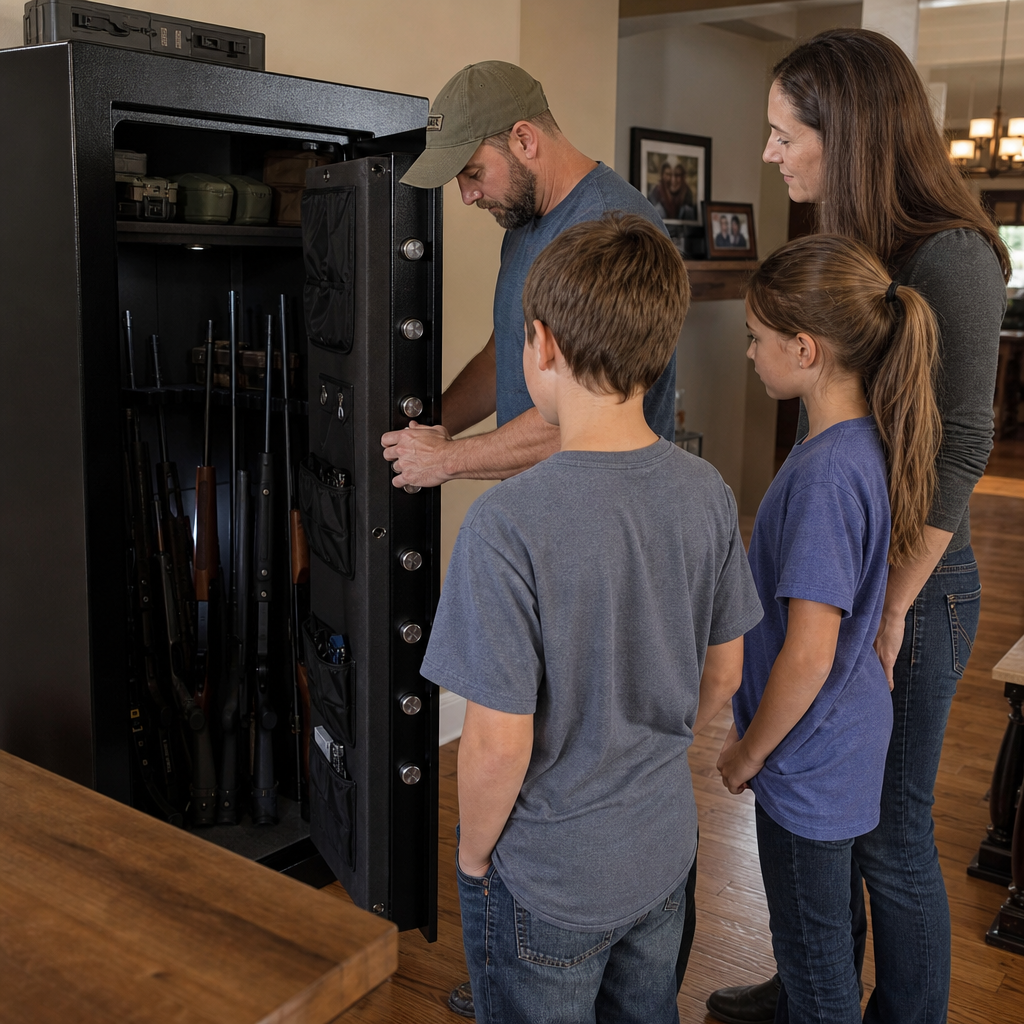
Gun safe solutions for people with large families and shared access needs must solve two problems at once: prevent unauthorized use and let the right person reach the right firearm quickly under stress. In practice, that means a family gun safe is not just a steel box. It is a layered security system built around access control, storage capacity, household routines, child safety, and local law. I have helped households evaluate safes after moves, remarriages, new children, and aging-parent transitions, and the same lesson repeats every time: the best gun safe for one owner often fails when several adults, teenagers, caregivers, or frequent visitors share the home. Shared access changes everything from lock choice to shelf layout.
For this article, “large family” means a household with multiple adults, several children, or both, often spread across different ages and responsibilities. “Shared access” means more than one authorized person may need entry, whether that is spouses, adult children, ranch managers, security-minded relatives, or a trusted caregiver. The challenge is balancing speed, accountability, and separation. A parent may want bedside access to a defensive handgun, while keeping hunting rifles available to another adult and locking ammunition away from curious teenagers. A collector may need burglary protection and humidity control, while still ensuring only two family members can open the main compartment.
This matters because household risk is cumulative. More people means more chances for accidental discovery, code sharing, lockout, poor storage habits, and confusion during emergencies. The U.S. Centers for Disease Control and Prevention and the American Academy of Pediatrics both emphasize secure firearm storage as a core injury-prevention measure, especially where children and adolescents live or visit. At the same time, a safe that is too slow, too complex, or too rigid creates workarounds, and workarounds are where safety plans usually fail. The right approach is not simply buying a larger safe. It is choosing a gun safe system that matches specific buyer personas inside the family and then defining who can access what, when, and how.
The family gun safe hub: understand buyer personas before you compare models
Most gun safe buying mistakes happen because shoppers compare steel thickness, fire ratings, and lock types before identifying the people who will actually use the safe. In family settings, buyer personas are practical profiles based on behavior, responsibilities, and risk tolerance. One home may include five personas at once: the primary owner, the defensive-access spouse, the hunting-and-sport user, the parent focused on childproofing, and the aging grandparent who may need simplified access. If you do not map these personas first, you can end up with one expensive safe that technically fits the collection but functionally serves no one well.
The primary owner persona usually cares about burglary resistance, long-gun capacity, organization, and long-term durability. This buyer compares plate steel, body thickness, relocker systems, hard plates, pry resistance, and independent lock certifications such as UL-rated electronic locks or Group II mechanical locks. In a shared household, however, the primary owner also needs auditability and delegated control. That often leads to modular setups: a main safe for long guns and valuables, plus one or two quick-access handgun safes in controlled locations. This arrangement is common because it preserves central security without forcing every authorized user into the same access method.
The defensive-access spouse or partner has different priorities. This persona needs intuitive operation in darkness, consistent opening under adrenaline, and a lock that does not depend on fine motor precision. Biometric readers can work well when they are quality units with good capacitive sensors and multiple enrolled fingerprints, but in my experience they should never be the only opening method. PIN keypad plus backup key, or biometric plus keypad, is more reliable for households where one user has dry skin, arthritis, or inconsistent hand placement. For this persona, speed matters, but so does repeatability after months of not opening the safe.
The parent-focused safety persona sees the safe first as a barrier against unauthorized access by children, guests, and friends of children. This buyer often asks the smartest questions: Can the code be guessed? Can a child watch an adult enter it? Is the safe anchored into concrete or wall studs? What happens during a power outage? How are spare keys stored? These questions matter more than glossy marketing claims. A family gun safe should always be anchored according to manufacturer guidance, because even a heavy safe can be tipped, attacked on its side, or removed with dollies if it is not secured.
How family size changes safe selection: capacity, zones, and access levels
Large families need more than advertised gun count. Manufacturers routinely overstate capacity by counting slim, unscoped rifles packed tightly together. In real homes, optics, slings, lights, suppressor-ready configurations, and document storage reduce usable space quickly. For family buyers, a practical rule is to buy for at least 30 to 50 percent more capacity than the current collection. If a household owns ten long guns today and expects seasonal purchases, inherited firearms, or youth rifles as children age into supervised use, a “24-gun” model is often the true starting point, not the finish line.
Zones are equally important. Shared access households benefit from compartmentalization: separate shelves for legal documents and valuables, handgun racks for rapid identification, interior lockboxes for medications or restricted items, and ammo segregation where appropriate. Some safes include factory-installed interior lockers; others support aftermarket lockable compartments. This creates access tiers inside one enclosure. For example, both spouses might access the main door, but only one has the key or code to an internal ammo locker or NFA paperwork box. That is a practical compromise for families balancing readiness with accountability.
Placement should follow family traffic patterns. A main safe in a climate-controlled master closet, office, or reinforced utility room generally outperforms a garage installation for humidity stability and discreet access. Garages expose safes to temperature swings, visible delivery paths, and easier tool access for burglars. Still, some large homes need garage placement for size or slab anchoring. In that case, dehumidification, concealment, and camera coverage become more important. I have seen excellent garage installations built into cabinetry with dedicated power for a GoldenRod-style dehumidifier and monitored contact sensors on both the room and the safe door.
Access levels should be explicit, written, and rehearsed. Families do best when they define categories such as full access, defensive-only access, no unsupervised access, and emergency-only access. Without those definitions, households drift into informal sharing, and informal sharing eventually means codes on phones, keys in nightstands, and children learning more than adults intended.
| Buyer persona | Primary need | Best safe setup | Key caution |
|---|---|---|---|
| Primary collector or owner | Burglary protection, capacity, organization | Large anchored main safe with interior compartments | Do not rely on listed gun capacity numbers |
| Defensive-access spouse | Fast, repeatable opening | Quick-access handgun safe plus access to main safe if needed | Avoid single-mode biometric dependence |
| Parents of young children | Child resistance and routine control | Main safe anchored out of sight; separate ammo control | Never store override keys in the same room |
| Home with teens | Permission boundaries and accountability | Tiered compartments and documented access rules | Shared codes usually spread quickly |
| Multigenerational household | Simplified use for older adults | Low-effort keypad or mechanical option with training | Test access with limited dexterity |
Choosing locks for shared access: biometric, keypad, mechanical, and hybrid options
Lock choice is where family gun safe buyer personas become concrete. Electronic keypad locks are the most common recommendation for shared access because they are fast, familiar, and easy to reprogram after a move, divorce, contractor visit, or suspected code leak. Good units from established lock makers have better long-term reliability than bargain imports and typically provide lockout delays after repeated incorrect entries. For many families, a quality keypad lock on the main safe and a separate quick-access pistol vault near the bed is the most balanced arrangement.
Mechanical dial locks still have a place. They are slower, but they avoid battery dependence and often appeal to owners who want simplicity over electronics. The drawback is shared use under stress. If two or three adults seldom practice dialing, opening times vary dramatically, especially in darkness. For that reason, I rarely recommend a dial-only strategy for a family that expects more than one person to retrieve a defensive firearm quickly. Mechanical locks are excellent on secondary safes, heirloom storage, or households where immediate access is not the main priority.
Biometric safes attract family buyers because they seem to solve the code-sharing problem. Sometimes they do. High-quality fingerprint readers can grant access while keeping children from learning a PIN by observation. But fingerprint systems are not magic. Enrollment quality, finger placement, moisture, dirt, cuts, and sensor maintenance all affect performance. The right way to use biometric access is as a convenience layer backed by a keypad or key override, with multiple fingers enrolled for each authorized adult. Test the safe under realistic conditions: after yard work, after hand lotion, with the non-dominant hand, and in low light.
Hybrid options are best for complex households. A main safe with an electronic lock, an internal locking compartment, and one or two biometric handgun safes gives flexibility without concentrating every need into one door. If a teen reaches supervised training age, the family can expand access gradually by changing a compartment code rather than rethinking the whole system. This is safer and more manageable than giving universal access too early.
Real-world household scenarios and the best safe strategy for each
Consider a family with two parents, four children under twelve, and a mix of home-defense handguns and hunting rifles. Their strongest option is usually a large anchored safe in the master suite or office, plus a compact quick-access handgun safe mounted discreetly near the bed. The main safe handles all long guns, spare handguns, documents, and ammunition. The bedside unit supports immediate defensive access for one or both adults without exposing the children to daily main-safe openings. In these homes, routine matters: open the main safe when children are absent or asleep, and close it before any firearm leaves your direct control.
Now take a multigenerational home with parents, teenagers, and an elderly grandparent. Here, physical usability may outweigh raw speed. If the grandparent has reduced hand strength or memory concerns, giving broad access can create more risk than resilience. A better strategy is limited authorized access for two adults, with the grandparent covered by a separate emergency plan such as room hardening, phone placement, and clear defensive roles. Families sometimes feel guilty excluding a relative from access, but safe ownership is about matching capability to responsibility, not making access symbolic.
A rural household with ranch work, predators, and frequent early-morning departures may need a different setup. In those cases, one adult may require rapid access to a truck gun or varmint rifle while another manages defensive pistols indoors. The answer is often not one giant safe in the mudroom. It is a main safe for the collection, a purpose-specific long-gun cabinet or quick-access long-gun safe for daily ranch use, and documented return procedures so firearms never linger unsecured after a late shift. Households that depend on firearms as tools benefit from check-in routines just as much as those focused primarily on self-defense.
Blended families present another common scenario. After remarriage, access assumptions are often unclear, and existing codes may be known by former partners, adult children, or in-laws. Any change in household composition should trigger a full access reset: reprogram codes, replace batteries, inventory contents, confirm key control, and review who is authorized. This is basic security hygiene, yet it is frequently skipped because the safe itself feels permanent. The hardware may be permanent; the trust model is not.
Installation, maintenance, and legal considerations families cannot ignore
Even the best gun safe fails if it is installed poorly. Weight distribution, floor strength, door swing clearance, moisture control, and anchoring all affect long-term performance. On upper floors, confirm load capacity before placing a heavy safe, especially above older framing. On slabs, use appropriate anchors and follow the hole pattern specified by the manufacturer. Concealed placement matters too. Delivery paths, visible windows, and social media photos have exposed more safe locations than many owners realize. Keep the installation discreet and remove packaging quickly.
Maintenance is not glamorous, but family reliability depends on it. Replace keypad batteries on a calendar rather than waiting for low-power warnings. Check anchor bolts annually. Inspect door seals, shelving fasteners, and dehumidifiers. If you use desiccants, recharge or replace them. Run access drills with every authorized adult several times a year. I advise families to test opening the safe in darkness, from sleep, and after mild physical exertion. Those conditions reveal bad PIN habits and poor interior organization faster than any spec sheet.
Legal requirements vary by state and locality, but secure storage laws are increasingly important, particularly where minors may gain access. Some jurisdictions impose criminal penalties if a child accesses an unsecured firearm; others set standards for locked storage during transport or in homes with prohibited persons. Insurance also matters. Standard homeowners policies may cap firearm coverage unless you schedule items separately. If a family collection includes optics, heirlooms, or high-value pistols, document serial numbers, take photos, and review policy language. Fire ratings deserve skepticism as well: compare independent testing details, not just the number printed on the door.
Large families should also think beyond the safe itself. Layered security includes monitored alarms, exterior lighting, reinforced doors, and habits that reduce unwanted attention. A safe is your last physical barrier, not your only one.
How to choose the right gun safe solution and build a plan that lasts
The best gun safe solution for people with large families and shared access needs is usually a system, not a single product. Start by listing every user and assigning a realistic persona: primary owner, defensive-access adult, sport shooter, teen in supervised training, elder with limited dexterity, or no-access household member. Then define the firearms and valuables each person truly needs to reach. From there, choose capacity with growth in mind, select a lock strategy that matches household abilities, and install the safe where climate, discretion, and anchoring are strongest.
For most households, the winning formula is straightforward: one properly anchored main safe for the collection, one or more quick-access handgun safes for immediate defensive use, and written access rules that are revisited whenever the household changes. Buy more space than you think you need. Prefer proven locks from established manufacturers. Avoid putting all trust in a single biometric reader. Practice access, maintain the hardware, and treat codes and keys like bank credentials. If you are building out your broader Gun Safes & Safety plan, use this hub as the starting point for evaluating every family persona in your home, then move into detailed guides on lock types, installation, childproofing, fire protection, and long-gun versus handgun storage. A well-chosen safe protects firearms, supports responsible access, and gives a busy household something just as valuable: clarity.
Frequently Asked Questions
What should a family gun safe include when multiple adults need access but children live in the home?
A family gun safe in a shared-access household should be treated as a complete security system, not just a heavy container with a lock. The first priority is controlled access: only specifically authorized adults should be able to open the safe, and that access method should remain reliable under stress. In many homes, that means comparing biometric readers, mechanical locks, keypad locks, or hybrid systems rather than assuming one lock type fits every situation. Biometric access can be fast, but it should be tested by every authorized user under realistic conditions. Mechanical or keypad backup is equally important in case of battery failure, fingerprint read errors, or hand injuries.
The second priority is internal organization. In a large family, confusion is a security risk. A safe should have clearly designated storage areas for defensive firearms, hunting rifles, ammunition, important documents, and accessories. If adults share access but not every firearm should be equally available to every person, interior compartments, lockable interior boxes, or separate quick-access units can help create different permission levels within the same overall system. That is often a better solution than keeping everything loose in one large cabinet.
Child safety is non-negotiable. A safe for a home with children should be anchored properly, placed where it cannot be tipped or quietly tampered with, and paired with consistent household rules. Kids should never be able to observe or learn the access code, and adults should avoid casual unlocking habits that undermine the entire system. Many incidents happen not because the safe failed, but because a door was left open during routine use or because an access method became too familiar and predictable.
Finally, the safe must fit the household’s real routines. If one adult leaves early, another comes home late, and caregiving responsibilities shift from day to day, the storage plan should reflect that reality. The right setup lets the correct person access the correct firearm quickly while still keeping unauthorized users out. In practice, that usually means layered storage: a primary full-size safe for long-term and bulk storage, plus one or more quick-access defensive storage solutions located where they can be reached by authorized adults but never by children or visitors.
How do large families decide between one large gun safe and multiple smaller safes?
For most large families, this is not an either-or decision. The strongest solution is often a layered approach that combines one larger central safe with smaller purpose-built access points. A single large safe offers better storage efficiency, simpler inventory management, and often stronger fire protection and burglary resistance per dollar. It works well for long guns, seasonal firearms, ammunition reserves, optics, records, and items that do not need immediate access every day.
However, one large safe can become impractical when multiple adults have different schedules, different training levels, or different reasons for needing access. If every authorized person must use the same unit for every purpose, bottlenecks develop. One person may need fast access to a defensive handgun, while another only needs occasional access to sporting firearms. In those cases, smaller secondary safes or lockboxes can reduce delay and limit unnecessary exposure of the entire collection.
Multiple safes also make it easier to separate firearms by role, user, or risk level. For example, a primary safe may hold the majority of firearms and ammunition, while a bedside quick-access safe holds one designated defensive handgun for a trained adult. Another interior-locking compartment or secondary safe may be used for specialty items, inherited firearms, or guns that should not be part of routine access. This structure is especially useful in blended families, multigenerational homes, and households where adult children, caregivers, or aging parents are part of the daily living arrangement.
The main caution with multiple safes is consistency. Every additional unit creates another lock, another battery, another code, and another point of possible human error. If a family cannot maintain disciplined access control across multiple devices, a simpler setup may be safer. The best choice depends on traffic patterns in the home, number of authorized users, firearm types, and whether fast defensive access is truly needed in more than one location. In most real-world evaluations, families benefit from centralizing the bulk of storage while decentralizing only carefully selected defensive access.
What is the safest way to manage shared access codes, biometric entry, and backup keys in a busy household?
Shared access management should be deliberate, limited, and documented, even in a family setting. The biggest mistake households make is treating safe access casually because everyone trusts one another. Trust matters, but security depends on process. Access should be restricted only to adults who are both legally permitted and consistently trained to handle firearms safely. Not every adult relative, house sitter, or frequent guest should be included simply because they are familiar with the home.
When using keypad codes, families should avoid obvious numbers, repeated patterns, birthdays, anniversaries, or codes that children might guess from daily life. If multiple adults need access, the code should be known only to those adults, changed immediately after any household transition, and reviewed periodically. Moves, divorces, remarriages, adult children moving in or out, caregiver changes, and domestic conflict are all reasons to update access credentials. In shared households, access control should be treated as a living system, not a one-time setup.
Biometric access can be useful, but it should never be accepted without testing. Every authorized user should enroll multiple fingers, confirm successful reads at different times of day, and practice use under non-ideal conditions such as dry skin, damp hands, awkward body position, and low light. A fingerprint reader that works for one person and fails for another is not a true shared-access solution. Families should also verify how many users the device can reliably store and whether adding new users is secure and easy to audit.
Backup keys require even more discipline. They should not be kept in a dresser, desk, kitchen drawer, or any predictable place inside the home. A hidden key in the same bedroom as the safe often defeats the point of the safe entirely. Backup keys should be secured in a separate, controlled location with limited adult access. Some households use a second locked document safe, a secure off-site storage arrangement, or another carefully controlled method. What matters is that the backup remains available for genuine emergencies without becoming the easiest path for unauthorized access.
Most importantly, families should rehearse the system. Under stress, even a good safe can become hard to operate if no one has practiced. Authorized adults should know exactly which safe they can access, what method they will use, and what backup option exists if the primary method fails. Good access control is not just about the lock itself; it is about making sure the right person can operate it correctly every time without creating opportunities for the wrong person to do the same.
How can families balance quick defensive access with secure long-term storage?
Balancing speed and security is the core challenge in a shared-access home. The safest answer is usually to stop expecting one safe to do everything. Long-term storage and emergency defensive access involve different risks, so they often require different tools. A large, well-anchored safe is ideal for comprehensive security, inventory control, and keeping the majority of firearms inaccessible to children, visitors, and unauthorized adults. But a full-size safe may not always provide the fastest response when seconds matter.
That is why many well-designed family setups use a tiered system. The primary safe stores most firearms unloaded or in the configuration the household has chosen for long-term control, along with ammunition in an organized layout that reflects both safety and legal considerations. Separately, a quick-access handgun safe or similar rapid-entry unit can be placed in a strategically appropriate location for a specifically trained and authorized adult. This allows immediate access where justified while avoiding the much greater risk of keeping an entire collection broadly available.
The key is restraint. Quick access should be limited to the firearm or firearms that are actually intended for urgent defensive use, not expanded until the whole home effectively becomes unlocked storage. Each quick-access unit should still be secured from children, hidden from casual discovery, and checked regularly for function, battery health, and reliable opening. In larger households, it is especially important to define who is expected to respond in an emergency and who is not. Vague assumptions create dangerous overlap and confusion.
Routine matters just as much as hardware. Families should have clear rules for when firearms are returned to secure storage, who verifies that they are secured, and what happens when household patterns change. A firearm temporarily removed for cleaning, training, or lawful carry can become the weak point in an otherwise excellent storage plan if it is left unsecured during interruptions. In homes with children, teens, frequent visitors, or caregiving activity, these lapses are often more dangerous than a safe-selection mistake.
Done properly, balancing access and security means minimizing decision-making during stress. The right adult knows where the defensive firearm is, how to reach it, and how it is secured. Everything else stays protected in more robust storage. That separation reduces unauthorized access risk while preserving the speed that some families reasonably consider necessary.
What legal and practical issues should families review after major household changes like remarriage, new children, a move, or an aging parent moving in?
Any major household transition should trigger a full review of firearm storage, access permissions, and legal responsibilities. Families often underestimate how much a move, remarriage,