
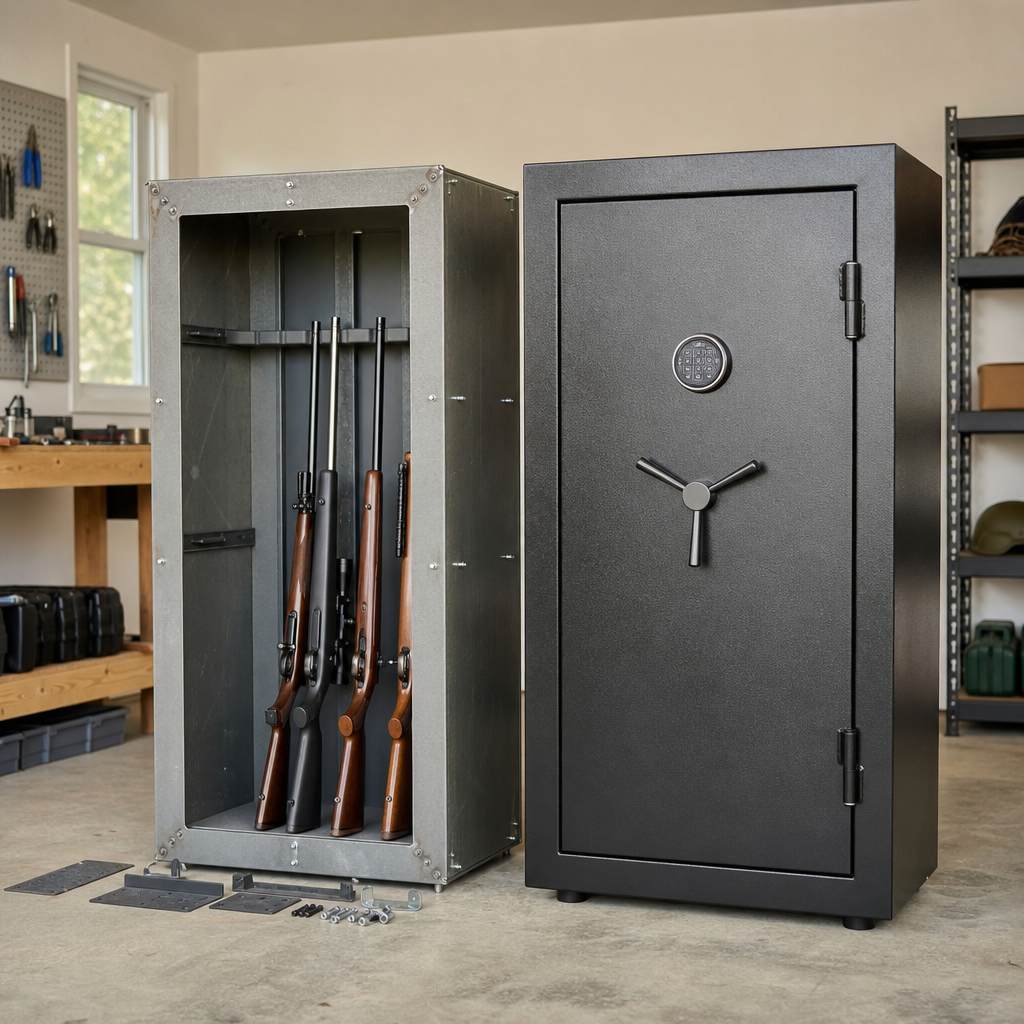
Choosing between DIY gun safe kits and pre-made safes is not just a pricing question; it affects burglary resistance, fire protection, installation difficulty, long-term reliability, and how well your storage setup fits your home and firearms collection. In the gun safes and safety category, this comparison matters because buyers often see flat-packed modular kits advertised as flexible, affordable alternatives to welded safes, while traditional ready-made safes are marketed as stronger, simpler, and more secure. Both claims contain some truth, but the better option depends on your layout, access needs, budget, and risk profile.
A DIY gun safe kit is typically a modular safe shipped in panels or partially assembled sections that the owner bolts together on site. A pre-made safe arrives fully welded or factory assembled, requiring only delivery, placement, anchoring, and setup. The distinction sounds simple, yet it changes everything from where the safe can be installed to how it performs under attack. I have worked with homeowners who chose modular kits because a basement stairwell or second-floor closet could not accommodate a 700-pound welded safe, and I have also seen buyers regret choosing a kit when they underestimated assembly time or expected premium fire performance at entry-level prices.
This hub article covers gun safe comparisons and brand spotlights from the perspective of real-world use rather than marketing slogans. We will compare security construction, fire ratings, relocation practicality, brand positioning, and buyer fit across popular names such as Zanotti, SnapSafe, SecureIt, Liberty, Browning, Fort Knox, Vaultek, and Stack-On. The goal is straightforward: help you understand where DIY gun safe kits are genuinely better than pre-made safes, where they are not, and which brands deserve attention for specific priorities like modular installation, premium steel thickness, rapid access, or value-oriented storage.
For most buyers, the key questions are direct. Are modular gun safes secure enough for burglary protection? Do pre-made safes offer better fire resistance? Which brands have strong reputations for fit and finish? Is a kit safe suitable for apartments, closets, and tight staircases? By answering those questions clearly and comparing major categories side by side, this guide serves as the central reference point for gun safe comparisons and brand spotlights within the broader gun safes and safety topic.
What DIY gun safe kits do better than pre-made safes
DIY gun safe kits excel when access constraints make a traditional safe impractical. Their biggest advantage is transportability. A modular safe can pass through narrow hallways, upstairs landings, attics, closets, and basement turns that block welded safes. That matters more often than many first-time buyers expect. Standard large pre-made gun safes can weigh 500 to 1,200 pounds before packaging, while modular panels can be carried separately and assembled in place with basic tools. If your ideal location is a room with delicate flooring, limited door width, or difficult stairs, a modular design can be the only realistic way to install substantial firearm storage.
Zanotti is the best-known example in this category. Its safes use heavy interlocking steel panels and mechanical assembly that create a sturdier result than lightweight cabinet-style products. SnapSafe also dominates the modular conversation, especially among buyers who want a recognizable brand with mainstream availability. SecureIt, while not always positioned as a traditional safe competitor, offers modular firearm storage systems that prioritize organization, adaptability, and lighter-weight deployment. In practice, these products solve a common homeowner problem: getting secure storage into a space where a welded safe cannot go without structural risk, expensive movers, or partial home disassembly.
DIY kits also simplify relocation. People who move every few years, rent larger homes, or expect to reconfigure a gun room benefit from safes that can be disassembled. With a pre-made safe, moving often means hiring specialized safe movers, paying stair fees, and accepting the risk of scratched floors, damaged drywall, or unsafe lifting. A modular safe breaks down into manageable sections and usually avoids those costs. That practical benefit is one of the strongest reasons some experienced gun owners choose a kit even when they can afford a premium welded model.
Another overlooked advantage is controlled installation. When a modular safe is assembled inside the final room, it may be easier to conceal in a closet, utility space, or corner where a large one-piece safe would never fit. That can improve security by reducing visibility. A hidden safe is not burglar-proof, but obscurity plus anchoring can materially reduce risk in smash-and-grab situations.
Where pre-made safes still lead
Pre-made safes usually lead in raw rigidity, finish consistency, fire package integration, and simpler ownership. A welded body has fewer seams and typically better resistance to racking forces during prying attacks. In higher-end models, thicker steel bodies, reinforced door frames, multi-layer fire board, expanding door seals, relockers, hard plates, and robust boltwork are integrated at the factory under controlled conditions. That does not make every pre-made safe superior, because many big-box safes rely on thin steel and attractive interiors more than serious burglary resistance, but at comparable quality levels, a factory-built safe generally has the edge in structural cohesion.
Brands like Fort Knox, Liberty, Browning, American Security, and Hollon illustrate this advantage at different price points. Fort Knox has long been associated with heavier construction options, customization, and substantial locking systems. Liberty is widely recognized for broad dealer distribution, feature-rich residential gun safes, and a spectrum from entry models to more serious lines. Browning emphasizes interior layouts and capacity management, while AMSEC has a strong reputation because it builds products across residential security containers, burglary-rated safes, and commercial units. When buyers want one-time delivery, minimal assembly, refined interiors, and broad accessory support, pre-made options remain the default recommendation.
Fire resistance is another category where pre-made safes often perform better, especially in the midrange and premium segments. Many welded safes use layered gypsum-based fireboard, heat-expanding seals, enclosed door edges, and tested construction methods designed to slow internal temperature rise. Fire ratings in the consumer market are not perfectly standardized, so buyers should read the details carefully, but in my experience the more serious fire packages still show up more often in traditional welded safes than in modular kits. If your primary concern is house fire exposure rather than space constraints, a pre-made safe usually deserves first consideration.
Brand comparisons that matter most to buyers
Brand comparisons are most useful when tied to actual buyer needs instead of broad claims about being the strongest or most advanced. The table below summarizes where major gun safe brands and product types tend to fit in the market.
| Brand or Type | Best For | Main Strength | Main Tradeoff |
|---|---|---|---|
| Zanotti modular safes | Tight access installations | Heavy modular construction with strong reputation | Assembly required and fewer mainstream retail channels |
| SnapSafe modular safes | DIY-friendly modular buyers | Easier delivery and relocation | Usually less premium than top welded safes |
| SecureIt systems | Organization and flexible storage | Adaptable layouts and lighter deployment | Not equivalent to heavy traditional safes for burglary resistance |
| Liberty safes | Mainstream residential buyers | Wide model range, dealer support, strong features | Performance varies significantly by line |
| Browning safes | Interior layout efficiency | Good shelving and firearm organization | Need careful model-by-model steel comparison |
| Fort Knox safes | Premium security buyers | Heavier build options and customization | Higher cost and heavier delivery demands |
| Vaultek | Handgun and quick-access use | Modern access tech and compact form factors | Not a substitute for full-size long-gun safes |
| Stack-On cabinets and safes | Budget-conscious storage | Lower entry price and broad availability | Many models are cabinets, not high-security safes |
The most important lesson from these brand spotlights is that category matters as much as logo. A premium modular safe may outperform an entry-level welded safe, and a true safe will outperform a thin locking cabinet even if both are sold in the same store aisle. Buyers should compare body steel thickness, door construction, lock type, boltwork, anchoring options, internal layout, and warranty support before drawing conclusions from marketing language alone.
Security, steel thickness, and lock systems explained plainly
If you want the clearest answer to whether DIY gun safe kits are better than pre-made safes for security, look first at construction details, not advertising. Steel thickness is a critical indicator. Thicker steel resists prying, bending, and cutting longer than thin sheet metal. Many mass-market residential gun safes use 14-gauge to 12-gauge bodies, while stronger units move into 10-gauge, 7-gauge, or heavier construction. Door design matters too. Composite doors with plate steel, reinforcement, hard plate protection for the lock, and relockers provide significantly more resistance than decorative panel doors built mostly for appearance.
Lock systems deserve equal attention. Mechanical dial locks remain highly trusted for longevity and simplicity, though they are slower to open. Electronic keypad locks provide faster access and are now common on both modular and pre-made safes. Good electronic locks from established manufacturers can be reliable, but quality varies widely. Quick-access biometric systems, common on Vaultek handgun safes, are valuable for bedside or vehicle-adjacent use, yet they fill a different role than full-size rifle safes. For long-gun storage, the lock is only one piece of the system; weak steel or poor anchoring can negate a decent lock.
Anchoring is non-negotiable. Even a strong safe becomes vulnerable if thieves can tip it or remove it. I routinely advise buyers to treat anchor installation as part of the purchase, not an optional accessory step. A modular safe bolted securely to concrete can outperform a loosely placed welded safe in a real burglary scenario because criminals often exploit movement and leverage before they ever attack the lock directly.
Fire ratings, placement, and realistic expectations
Fire protection in gun safes is more nuanced than many listings suggest. Consumer fire ratings are often based on manufacturer testing protocols rather than a single universal standard. That does not make them meaningless, but it means you should compare methodology, temperature thresholds, and duration claims carefully. In practical terms, thicker insulation layers, better door seals, and tighter overall construction usually improve performance. Pre-made safes, especially from brands with established dealer networks and mature product lines, more often provide substantial fire packages than DIY kits.
Placement can matter as much as the label. A safe installed against an exterior wall in a garage may experience different fire conditions than one placed in a climate-controlled interior room on a concrete slab. Humidity also matters for firearm preservation. Dehumidifier rods, desiccant systems, and air circulation are important whether you buy Zanotti, Liberty, Browning, or Fort Knox. A buyer who spends heavily on a fire-rated safe but ignores moisture control can still damage wood stocks, optics, and metal finishes over time.
For many households, the best strategy is layered protection: choose a safe with credible fire resistance, place it in the most structurally favorable and discreet location available, anchor it properly, and manage interior humidity continuously.
Which option is better for different buyers
DIY gun safe kits are better than pre-made safes for buyers with difficult installation paths, frequent moves, upper-floor storage plans, or strong preferences for closet concealment. They also make sense for people willing to trade some convenience for access flexibility. If that describes you, start with Zanotti or SnapSafe and compare panel construction, total weight, locking design, and assembly method carefully.
Pre-made safes are better for buyers prioritizing heavier one-piece construction, stronger fire packages, faster setup after delivery, and a wider range of premium features. If you have straightforward ground-floor access and can anchor to concrete or substantial framing, brands like Liberty, Browning, Fort Knox, Hollon, and AMSEC deserve close comparison. For dedicated handgun access, Vaultek fills a separate but important niche. For basic compliance-oriented storage on a tight budget, Stack-On may be enough, provided you understand the difference between a cabinet and a true safe.
The best buying decision comes from matching the product to the threat model. If your biggest obstacle is getting a safe into the right room, modular wins. If your biggest concern is maximizing structural security and fire protection in a permanent location, pre-made usually wins. Compare specifications carefully, visit a dealer when possible, and choose the design that protects your firearms where you actually live.
Frequently Asked Questions
Are DIY gun safe kits actually as secure as pre-made gun safes?
Sometimes, but not automatically. The biggest difference usually comes down to construction method, steel thickness, door design, locking system, and how the safe behaves under attack once it is assembled and anchored. A well-designed modular or flat-packed gun safe kit can provide respectable security for many households, especially when it uses heavy panels, reinforced seams, quality hardware, and a strong lock. However, many buyers assume that once a kit is assembled, it performs exactly like a welded safe of similar size and price, and that is not always true.
Pre-made safes often have an advantage in overall rigidity because the body is welded at the factory rather than bolted together in sections. Fewer seams can mean fewer potential pry points, and factory assembly can create more consistent fit and finish around the door and frame. By contrast, DIY gun safe kits depend heavily on precise assembly. If panels are not aligned properly, bolts are not torqued correctly, or the unit is not anchored securely, real-world burglary resistance can drop. In other words, a kit safe may be only as strong as both its engineering and its installation.
That said, some modular brands are specifically built to compete on security and are much better than entry-level welded safes sold mainly on size and cosmetics. When comparing brands, look beyond advertising phrases like “vault-style” or “heavy-duty.” Focus on measurable details: steel gauge, composite door construction, number and depth of locking bolts, relocker features, hard plate protection for the lock, internal hinge protection, and whether the safe has been tested against common forced-entry methods. If burglary resistance is your top priority, a premium pre-made safe or a high-end modular unit with documented security features will usually outperform a bargain option in either category.
Do pre-made safes offer better fire protection than DIY gun safe kits?
In many cases, yes, but it depends on how the fire rating is established and how the safe is built. Fire protection is one of the most confusing parts of the gun safe market because not all ratings are created equal. Some safes are tested by independent labs under standardized conditions, while others use internal or manufacturer-generated estimates. Pre-made safes have traditionally dominated this area because they are easier to seal consistently at the factory and often include layered fireboard, heat-expanding door seals, and body construction designed to slow heat transfer.
DIY gun safe kits can offer fire protection, but the challenge is that panel joints and assembly points must perform well under heat. Every seam matters during a fire. If a modular safe relies on multiple interconnected panels, the quality of the seals, insulation placement, and panel fit become especially important. A good modular brand can engineer around these issues, but lower-cost kits may prioritize portability and assembly convenience over robust fire insulation. That can make them a weaker choice if you are storing valuable firearms, optics, documents, or heirlooms in an area with elevated fire risk.
When comparing brands, avoid relying only on the number of “fire minutes” printed in marketing materials. Ask whether the rating is independently verified, at what temperature it was tested, and whether the entire safe or just a representative design was evaluated. Also consider where the safe will sit in your home. A garage, workshop, or unfinished basement may expose it to more extreme conditions than a climate-controlled interior room. If fire protection is a major concern, pre-made safes from established brands with clearer test standards often inspire more confidence, although a premium modular safe can still be a strong contender if its fire system is documented and well reviewed.
Is a DIY gun safe kit worth it for easier installation and moving?
For many buyers, this is the strongest argument in favor of a DIY kit. Modular and flat-packed gun safes are designed to solve one of the biggest practical problems in safe ownership: getting a heavy, bulky unit into the house and into the exact room where it needs to go. If you have tight staircases, narrow doorways, upper-floor placement needs, or concerns about damaging floors during delivery, a DIY kit can be significantly easier to manage than a large welded safe. Individual panels can often be carried separately, reducing the need for specialized movers or equipment.
That convenience can also make a modular safe more appealing for renters, military families, or homeowners who expect to move in the future. A pre-made safe is typically simpler on day one because it arrives assembled, but it can be much harder and more expensive to relocate later. By comparison, a kit safe can often be disassembled and reinstalled in a new home with less hassle. That flexibility is a real advantage if your collection may expand or your living situation may change.
Still, “easier to move” should not be confused with “easy overall.” Assembly takes time, planning, and attention to detail. Some kits require multiple people, careful handling of heavy panels, and precise installation of doors, locks, and interior components. Anchoring is also essential. A lighter or more easily transported safe that is not bolted down can become a liability during a burglary. So the value of a DIY kit depends on your priorities: if access, placement, and future mobility are major concerns, a quality modular brand can be a smart choice; if you want a more turnkey ownership experience, a pre-made safe may feel more straightforward.
How do long-term durability and reliability compare between modular kits and traditional safes?
Long-term durability depends less on the category alone and more on engineering quality, materials, lock type, corrosion resistance, and how the safe is used over time. Pre-made safes often benefit from one-piece welded bodies and factory-controlled assembly, which can reduce opportunities for loosened connections or panel movement years down the road. For buyers who want something installed once and left alone for decades, that can be reassuring. Traditional safes also have a long track record across a wide range of brands, making it easier to judge reputation based on owner experiences.
DIY kits can still be highly durable, especially from brands that use robust fasteners, reinforced corners, precision-machined panel connections, and quality finishes that resist wear and rust. But with modular construction, reliability depends partly on proper assembly and maintenance. Over time, owners may need to check anchor points, inspect door alignment, and ensure hardware remains tight. That does not mean kit safes are inherently fragile; it means there are simply more variables in the system. If assembly is rushed or the safe is installed on an uneven surface, issues like door binding or misalignment may appear sooner.
The lock matters too. Whether you choose a modular or pre-made safe, a dependable lock from a reputable manufacturer is one of the most important long-term reliability factors. Electronic locks add convenience, but buyers should evaluate battery access, keypad durability, and service support. Mechanical dial locks may require more patience, but many owners value their simplicity and longevity. Brand support is equally important. A company that offers replacement parts, responsive customer service, and clear warranty terms can make a major difference if problems arise years after purchase. In many brand comparisons, this after-sale support is where higher-quality manufacturers separate themselves from budget competitors.
Which is the better choice overall for most buyers: a DIY gun safe kit or a pre-made safe?
For most buyers, the better choice depends on which problem they are trying to solve. If your main goal is maximum simplicity, strong out-of-the-box construction, and potentially better consistency in security and fire protection, a pre-made safe is often the safer default choice. It is usually easier to compare, easier to buy, and easier to trust if you stick with a reputable brand that clearly states its steel specs, locking features, and fire rating standards. Buyers who have enough space for delivery and do not anticipate moving the safe again often find that a traditional model fits their needs well.
A DIY gun safe kit becomes more attractive when your home layout makes delivery difficult, when you want the ability to assemble the safe in a basement or upstairs room, or when modular flexibility matters more than having a welded body. It can also be a strong option for people who want a more tailored installation or plan to relocate in the future. In those cases, a well-reviewed modular brand may deliver a better real-world ownership experience than a pre-made safe that is technically stronger on paper but difficult to place where you actually need it.
The smartest way to compare brands is to ignore the simple “kit versus pre-made” framing and instead evaluate the total package. Consider burglary resistance, verified fire performance, lock quality, interior capacity, ease of installation, anchoring options, warranty coverage, and customer support. Also think about your firearms collection today and where it may be in five or ten years. A safe that fits your house but not your long-term storage needs is not really the best value. In short, neither category wins automatically. A premium modular safe can outperform an entry-level welded unit, while a high-quality pre-made safe can be the best all-around investment for buyers who want strength, convenience, and proven performance in one package.