
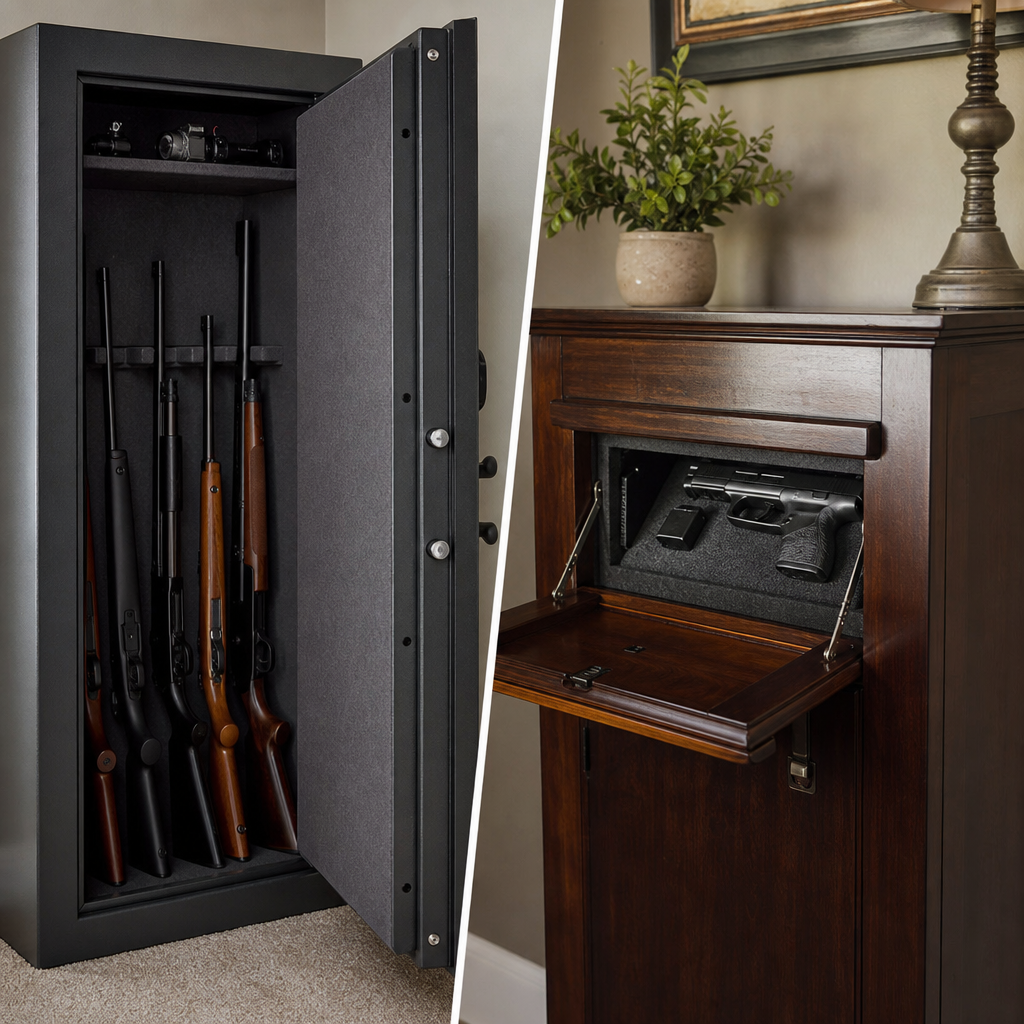
Hidden gun safes can be more secure than traditional models in some situations, but they are not automatically safer, stronger, or more appropriate for every firearm owner. In practice, security depends on threat model, construction, installation quality, lock reliability, fire protection, and how well the safe matches the owner’s daily habits. I have evaluated residential security products, reviewed burglary reports, and helped homeowners compare concealment furniture, wall safes, closet vaults, and full-size gun safes, and the same pattern appears repeatedly: buyers overestimate secrecy and underestimate forced-entry resistance. That gap fuels many of the most persistent gun safe myths and misconceptions.
A hidden gun safe is any storage unit designed to blend into furniture, walls, floors, cabinetry, or decor so it escapes casual notice. A traditional gun safe usually refers to a freestanding or built-in steel safe clearly intended for firearm storage, often with greater internal capacity, thicker bodies, more substantial boltwork, and higher fire ratings. Concealment and resistance are different properties. A hidden safe aims to avoid detection. A traditional safe aims to delay or defeat attack after detection. The distinction matters because most residential burglaries are quick, opportunistic events, but not all intruders behave the same way.
This topic matters for three reasons. First, safe selection affects unauthorized access, especially by children, guests, or service workers. Second, it affects theft risk and insurance outcomes after a burglary. Third, it affects whether firearms remain accessible when needed yet secured when not in use. Many shoppers ask a simple question: are hidden gun safes more secure than traditional models? The accurate answer is conditional. Hidden gun safes can outperform traditional models against casual discovery, but they usually lose on pry resistance, storage flexibility, long-gun capacity, and certified fire protection. Understanding the tradeoffs helps buyers avoid expensive mistakes and choose storage that aligns with actual risk rather than marketing promises.
This hub page addresses the central myths that distort buying decisions. Common misconceptions include believing heavier always means better, believing any biometric lock is childproof, assuming fire ratings are standardized across brands, thinking a hidden safe is invisible forever, or assuming a safe without proper anchoring is still secure because it looks substantial. Each of those claims contains a kernel of truth but fails under real-world scrutiny. The sections below explain where hidden gun safes excel, where traditional models remain superior, and how to evaluate both using practical security criteria.
What “More Secure” Really Means for a Gun Safe
When comparing hidden gun safes and traditional models, define security before comparing products. In the field, I break security into five measurable elements: concealment, access control, burglary resistance, fire protection, and retention after installation. Concealment asks whether an intruder notices the safe. Access control asks who can open it and how reliably. Burglary resistance asks how long the unit resists prying, cutting, drilling, or lock attack. Fire protection asks whether interior temperatures stay below critical thresholds long enough to protect contents. Retention asks whether the safe can be carried away because it was not anchored correctly.
A concealed compartment behind a mirror may score high on concealment and speed of access but low on burglary resistance if it uses thin sheet metal, light hinges, and short screws into drywall only. A traditional 700-pound gun safe may score high on pry resistance and moderate on fire protection but low on concealment because it is obvious, especially in a garage. Neither is universally better. Security is contextual. The best safe is the one that addresses the most likely threats in a specific home, not the one with the most aggressive marketing language.
Buyers should also separate residential security containers from true safes. In the United States, many consumer gun safes are classified under UL 1037 as Residential Security Containers rather than high-burglary-rated safes. That does not make them useless; it simply means they are tested to a different standard. Likewise, many hidden gun safes have no independent burglary certification at all. If a product page substitutes phrases such as military style, tactical steel, or law-enforcement inspired for actual gauge, bolt count, lock listing, and fire test details, treat that as a warning sign.
Where Hidden Gun Safes Have a Real Security Advantage
Hidden gun safes have one undeniable strength: they can prevent discovery during a short, rushed burglary. FBI burglary pattern summaries and insurance industry loss studies have long shown that many residential break-ins are fast. Intruders often search primary bedrooms, closets, dressers, home offices, and obvious cabinet locations first because cash, jewelry, documents, and firearms are frequently stored there. A hidden safe installed behind a functional bookshelf, inside custom millwork, beneath stair storage, or within a well-executed false HVAC return can survive simply because the intruder never knows it exists.
That benefit is strongest against opportunistic thieves, casual visitors, and unauthorized users who are not systematically searching the structure. For example, a homeowner with one defensive handgun may choose a hidden bedside safe integrated into furniture to keep the firearm away from children while preserving rapid access. In another case, a collector may store a small number of high-value pistols in a concealed in-wall compartment within a locked office, adding layers of delay and reducing the chance that a smash-and-grab burglar finds the cache. In both examples, concealment is not the only security measure, but it meaningfully improves the odds that the firearms remain untouched.
Hidden safes can also reduce social exposure. Traditional safes telegraph gun ownership to movers, contractors, house sitters, and anyone who enters the room. That visibility can create future targeting risk. A hidden unit lowers that signaling effect. For owners concerned about privacy, domestic discretion, or neighborhood perception, concealment offers a practical defensive layer that a large visible safe cannot provide.
Why Traditional Gun Safes Usually Win on Physical Protection
Once a safe is discovered, traditional gun safes usually offer more real protection than hidden models. That is because quality traditional safes tend to use heavier steel bodies, reinforced door edges, longer locking bolts, hard plates to resist drill attacks, and better frame geometry against prying. Hidden safes, by design, must fit into walls, furniture cavities, floor spaces, or compact compartments. Those dimensional limits often force compromises in steel thickness, lock placement, door swing, and anchor strategy.
Most wall safes fit between standard 16-inch on-center studs, which constrains width and depth. That size is convenient for concealment but poor for storing rifles and optics securely. Furniture safes often rely on cabinetry materials around the steel box, creating a visual disguise but not meaningful structural resistance. If an intruder discovers the compartment and has a pry bar, many concealment products fail quickly compared with a well-anchored traditional safe weighing several hundred pounds.
Fire protection is another major difference. Many traditional gun safes include specified fire ratings based on internal temperature thresholds over set durations, though shoppers should verify the testing method because claims vary widely by brand. Hidden safes often provide little or no serious fire insulation because insulation adds bulk, weight, and heat-sensitive installation complications. If the owner is protecting documents, optics, ammunition records, suppressor paperwork, or heirloom firearms, that limitation matters.
| Factor | Hidden Gun Safe | Traditional Gun Safe |
|---|---|---|
| Concealment | Usually strong if installation is well disguised | Usually low because the unit is obvious |
| Pry resistance | Often moderate to weak | Usually stronger on quality models |
| Capacity | Best for handguns and small valuables | Better for rifles, gear, and documents |
| Fire protection | Often limited or absent | Common on midrange and premium models |
| Anchoring options | Can be constrained by walls or furniture | Usually easier to anchor to slab or framing |
| Access speed | Can be excellent for staged defensive use | Varies by lock and interior layout |
The Biggest Gun Safe Myths and Misconceptions Buyers Still Believe
The first myth is that hidden means impossible to find. It does not. Experienced burglars look for irregular trim, shallow bookcases, fresh paint lines, unusual vents, and furniture that appears too heavy or fixed. Poor concealment often attracts attention. The second myth is that a biometric lock is always the safest choice. In reality, fingerprint locks vary dramatically in sensor quality, false rejection rates, power management, and resistance to spoofing. The best biometric safes include backup entry methods, tamper lockouts, and proven track records, while cheap imports can fail under stress, low batteries, or dirty fingers.
The third myth is that steel thickness alone tells the whole story. Steel gauge matters, but door design, relockers, hinge protection, hard plates, weld quality, and anchor layout matter too. A fourth myth is that heavier safes cannot be stolen. Unanchored safes are regularly tipped, dragged, or loaded onto dollies. Weight helps, but anchoring is decisive. A fifth myth is that any fire rating is comparable across brands. It is not. Some manufacturers use independent testing; others rely on internal protocols with different pass criteria. Always ask what temperature standard, duration, and test method produced the rating.
Another misconception is that concealment furniture qualifies as secure gun storage on its own. In many households it does not, particularly where children are present. A magnetic latch hidden behind a picture frame may keep out a curious guest, but it is not equivalent to robust child-resistant locking hardware. Finally, buyers often think one safe must do everything. In practice, layered storage works better. A rapid-access bedside unit, a concealed document safe, and a larger anchored long-gun safe can each serve different needs more effectively than one compromised all-purpose product.
How to Choose the Right Safe for Your Home, Firearms, and Risk Level
Start with the firearm mix. If you own scoped rifles, shotguns, and ammunition, a traditional gun safe or secure cabinet with meaningful burglary resistance is usually the foundation. If you need one handgun accessible at night while still secured from children, a hidden or low-profile quick-access safe may be appropriate as a secondary unit. Next, assess location. A closet on a concrete slab offers stronger anchoring than an upstairs bedroom with limited structural support. Humidity, flood exposure, and room traffic also matter.
Then evaluate the likely threat. For most households, the biggest risks are unauthorized access by minors, theft during a short burglary, and poor lock reliability under daily use. Match features to those realities. Look for UL-listed locks when available, pre-drilled anchor holes, continuous or protected hinges, steel body specifications stated clearly, and interior layouts that fit your actual firearms without forcing optics against the door. For corrosion control, plan for desiccants, dehumidifier rods, or controlled room conditions, because rust prevention is part of responsible storage.
Budget honestly. Spending on a premium hidden safe but skipping professional installation can erase the benefit. The same is true of buying a large traditional safe and never anchoring it. If you are building a full gun safe and safety plan, link this hub mentally to adjacent topics: safe placement, child access prevention, biometric lock reliability, fire ratings, and installation best practices. The smart next step is to audit your risks, compare construction details rather than slogans, and choose the combination of hidden and traditional storage that gives your firearms the protection they actually need.
Hidden gun safes are not inherently more secure than traditional models, but they can be more effective against discovery, which is a legitimate and often overlooked part of home firearm security. Traditional gun safes, especially well-built and properly anchored models, usually provide superior resistance once found. That is the core answer, and it resolves many gun safe myths and misconceptions that confuse buyers. Concealment is not the same as strength. Fire ratings are not all equal. Biometric locks are not all reliable. Heavy safes are not secure if they can be removed. Real security comes from matching the storage method to the risk.
For most owners, the best solution is layered. Use a traditional safe for primary storage, long guns, and fire protection. Use a quality hidden or low-profile quick-access unit where discreet access solves a real problem without compromising child safety or theft resistance. Evaluate every product by construction, lock quality, certification, anchoring, and installation environment. Ignore vague marketing claims and demand specifics. The more precisely you define the threat, the easier the buying decision becomes.
If you are comparing options within the broader Gun Safes and Safety category, use this page as your hub for separating fact from fiction. Review your current setup, identify the myths shaping your assumptions, and upgrade the weak point first. Better storage decisions start with accurate information, and accurate information keeps firearms more secure.
Frequently Asked Questions
Are hidden gun safes actually more secure than traditional gun safes?
Hidden gun safes can be more secure in specific situations, but they are not automatically better than traditional models. Their biggest advantage is concealment. A burglar who does not find the safe cannot attack it, which makes hidden placement a real security benefit. In many residential break-ins, thieves work fast, target obvious locations, and focus on valuables they can spot quickly. A well-concealed wall safe, closet vault, or furniture-style hidden compartment may avoid attention entirely, and that can be more valuable than raw steel thickness in a short-duration burglary.
That said, concealment is not the same as physical resistance. Many hidden safes, especially furniture-based or shallow wall units, do not match the burglary protection of a heavy traditional gun safe built with stronger steel, reinforced doors, hard plates, quality boltwork, and better anchoring. If a hidden safe is discovered, it may be easier to pry open, cut into, or remove entirely depending on how it was constructed and installed. Traditional safes are often more obvious, but better models are designed specifically to resist forced entry for longer periods.
The real answer depends on your threat model. If your primary concern is a smash-and-grab intruder spending only a few minutes inside the home, concealment can be a major advantage. If your concern includes targeted theft, determined attackers, multiple firearms, or long-term storage of high-value collections, a stronger traditional safe may be the better fit. In many homes, the most secure solution is not choosing one category over the other, but matching the safe type to the firearms, the room, the risk level, and how quickly the owner needs access.
What factors matter most when comparing a hidden gun safe to a traditional model?
The most important factors are construction quality, installation, lock reliability, fire protection, and whether the safe realistically fits your daily routine. Construction matters because two products that look similar can perform very differently under attack. Steel thickness, door design, hinge protection, pry resistance, internal reinforcement, and the way the unit is assembled all affect whether a thief can defeat it quickly. A hidden safe that blends in beautifully but uses thin metal and weak mounting hardware may provide more appearance than real security.
Installation is just as important. A safe is only as strong as the way it is anchored and integrated into the structure. A hidden wall safe installed between studs without reinforcement may be convenient, but its size and depth are limited by the wall cavity. A closet vault tied into framing and flooring can be much more substantial. Traditional safes also vary widely here. A good safe that is not bolted down can be tipped, pried, or removed. Proper anchoring to concrete or structural framing is one of the most overlooked security upgrades.
Lock quality deserves close attention because fast access means little if the lock fails or creates inconsistent performance under stress. Mechanical locks, electronic keypads, RFID systems, and biometric scanners all have tradeoffs. Some hidden safes emphasize convenience and concealment but use lower-grade lock systems. Traditional safes often offer more lock options, including higher-end commercial-grade components. Fire protection is another key consideration. Many hidden safes offer little or no meaningful fire resistance, while some traditional gun safes include insulation and tested fire ratings, although those ratings should always be examined carefully rather than accepted at face value.
Finally, the best safe is one you will actually use correctly every day. If a homeowner leaves a traditional safe open because it is inconvenient, that safe is not functionally secure. If a hidden safe is so small or awkwardly placed that it encourages poor storage habits, that is also a problem. Good security works with real human behavior. The right choice is the one that balances resistance, access, concealment, child safety, and consistency in actual use.
Are hidden gun safes good for quick access and home defense firearms?
They can be, but only if the design supports fast, reliable access under stress. Many owners consider hidden safes for defensive handguns because they want security without placing a visible safe in a bedroom, office, or living area. In that role, a concealed quick-access safe can make sense. It can keep a firearm out of sight, reduce the chance of casual discovery by guests or children, and still provide relatively fast retrieval when mounted in a practical location.
However, quick access depends on more than concealment. The opening mechanism must be intuitive, consistent, and dependable in low light and under adrenaline. A hidden compartment that requires multiple motions, awkward positioning, or a finicky release system may be slower than expected when seconds matter. This is especially important with disguised furniture safes and decorative concealment products. Some are designed more for novelty and appearance than for serious defensive use. A product that looks clever online may prove frustrating in a real emergency.
Traditional bedside or handgun safes often perform better in this category because they are purpose-built for access speed and simple operation. Many open with a direct keypad code, mechanical push-button sequence, or tested biometric system and present the firearm consistently. That does not mean hidden options are unsuitable; it means they need to be evaluated more rigorously. If the firearm is intended for home defense, owners should practice access regularly, verify the lock works reliably, and make sure the safe can be opened from the intended position, including in darkness and with one hand if necessary.
For many people, the best hidden safe for home defense is not the most secretive design, but the one that combines discreet placement with straightforward access and solid retention. It should prevent unauthorized handling, support safe storage habits, and still allow a competent adult to retrieve the firearm quickly without guesswork.
Do hidden gun safes provide enough protection against theft, fire, and children?
Sometimes, but not always. Against theft, hidden safes can perform well when concealment keeps them from being discovered in the first place. That advantage is real and often underestimated. Many burglars do not have the time or patience to conduct a room-by-room forensic search. Still, once found, a hidden safe may offer less resistance than a traditional gun safe, especially if it is shallow, lightly built, or mounted in furniture rather than anchored to structural materials. Parents and homeowners should separate the idea of “hard to notice” from “hard to attack.” They are not the same thing.
For child safety, a quality hidden safe can be very effective if it uses a dependable lock and is installed in a location that children cannot casually access or observe. Concealment adds a layer of protection because children are less likely to know the firearm is there. But concealment should never be treated as the primary safety measure. Kids are curious, observant, and often more aware of household patterns than adults realize. The locking mechanism must be the real security barrier, and the owner should still follow all responsible storage practices.
Fire protection is where many hidden safes are weaker. Wall safes and concealment furniture products frequently prioritize compact dimensions and hidden appearance over insulation and heat resistance. Traditional gun safes are more likely to offer dedicated fire protection, though the quality and testing behind those claims vary significantly by manufacturer. If document storage, ammunition considerations, optics, heirloom firearms, or long-duration protection are important, fire performance should be evaluated carefully rather than assumed.
In practical terms, hidden safes can be enough for theft deterrence and child access prevention when chosen well and used properly, but they are not universally strong in every category. Homeowners who need broad protection across theft, fire, and unauthorized access should evaluate whether a hidden unit alone is sufficient or whether a larger traditional safe, or even a layered approach, is the smarter long-term solution.
Who should choose a hidden gun safe, and who is usually better off with a traditional gun safe?
Hidden gun safes are often a good fit for homeowners who have a small number of firearms, need discreet storage in lived-in spaces, and want to reduce visibility to visitors, contractors, or opportunistic burglars. They can work especially well for a defensive handgun, a backup firearm, or selective storage in a bedroom, office, hallway, or closet where a full-size safe would be impractical or visually intrusive. They also appeal to owners who value low-profile security and want something integrated into the home rather than immediately recognizable as a gun safe.
Traditional gun safes are usually the better choice for larger firearm collections, long guns, high-value optics, ammunition storage planning, and owners who place a premium on stronger physical security and fire protection. They make more sense when the goal is to protect multiple rifles and handguns in one centralized location, or when the owner faces a higher theft risk and wants thicker steel, stronger doors, and more robust anchoring options. Traditional safes also tend to provide better organization, more interior space, and greater flexibility as a collection grows.
There is also a category of owners who benefit from both. For example, a homeowner may keep the majority of firearms in a properly anchored traditional safe while using a small hidden quick-access safe for one defensive handgun. That layered setup often aligns better with real-world needs than trying to force one product type to do everything. It separates long-term storage from immediate access and allows each safe to serve a specific role.
Ultimately, the right choice comes down to priorities rather than labels. A hidden safe is not