
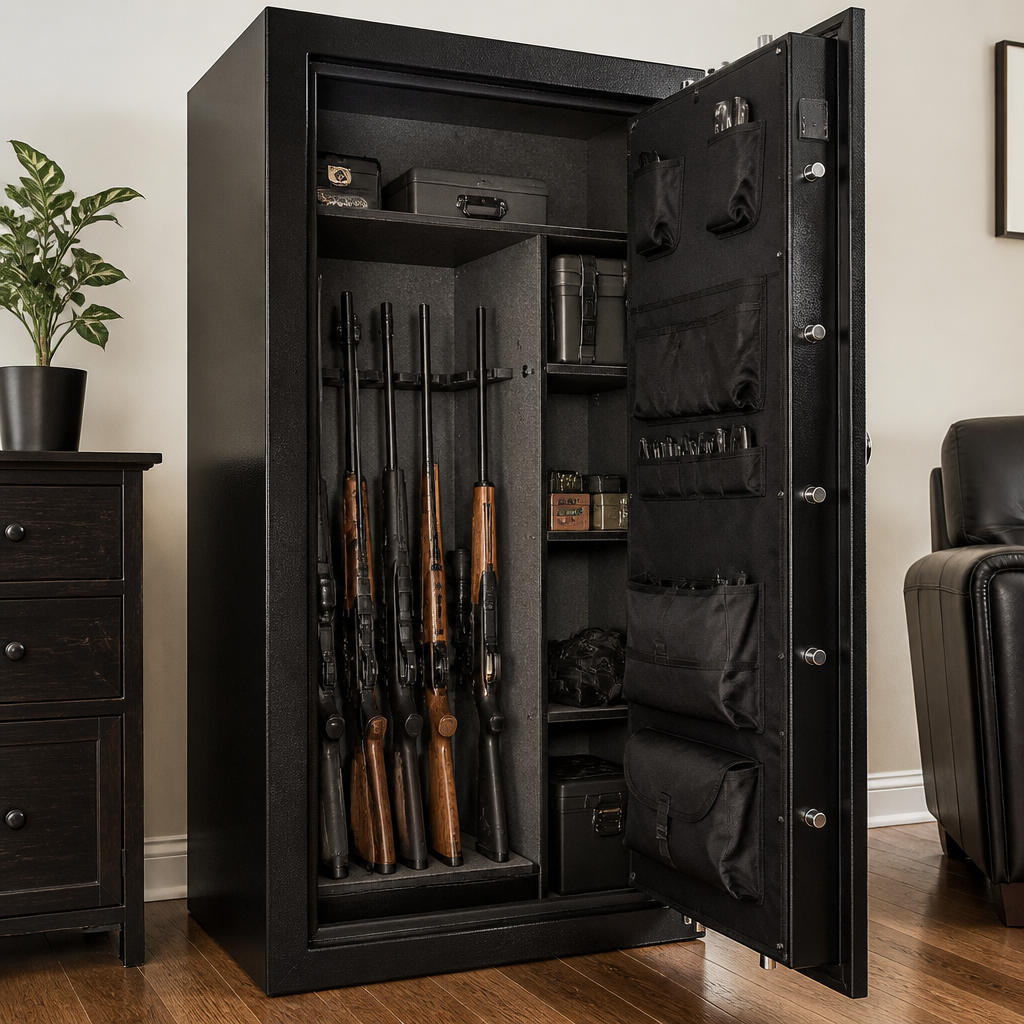
The Barska Large Biometric Rifle Safe is a full-size gun safe designed for owners who need quick biometric access, organized long-gun storage, and stronger access control than basic keyed cabinets. In the “Gun Safes & Safety” category, this model also works as a practical entry point into product reviews because it sits at the intersection of capacity, convenience, and everyday usability. When I evaluate rifle safes, I look beyond brochure claims and focus on the details that affect ownership after installation: lock speed, false rejection rates, interior layout, anchoring options, backup entry methods, and how well the safe fits the user’s firearm collection now and five years from now.
“Large biometric rifle safe” refers to a tall steel safe that stores multiple long guns and unlocks with a fingerprint scanner rather than relying only on a dial or electronic keypad. “Biometric” in this context usually means a capacitive fingerprint reader connected to an electronic locking mechanism. The benefit is straightforward: authorized users can open the safe quickly without memorizing a code or reaching for a key, which matters during a home-defense emergency, when fine motor skills degrade under stress, and in daily use when owners access firearms for range trips, cleaning, or secure storage after hunting.
This topic matters because a gun safe is not just a purchase; it is part of a risk-management system. Safe storage helps reduce unauthorized access by children, guests, burglars, and prohibited persons. It also protects optics, documents, ammunition, and valuables from casual theft. At the same time, no safe is perfect. Buyers need to understand the difference between a residential security container, a true burglary-rated safe, and a thin steel gun cabinet. They also need to know that convenience features, including biometrics, are only valuable if the safe is properly anchored, maintained, and matched to realistic threat levels.
As a sub-pillar hub for product reviews, this article uses the Barska Large Biometric Rifle Safe as a central example while laying out the criteria that should guide comparisons across the category. The goal is not to treat one unit as universally right for every buyer. Instead, it is to show what serious shoppers should examine before choosing any biometric rifle safe: construction, capacity, access system reliability, tamper resistance, interior flexibility, and support from the manufacturer. If you are building out your broader safe research, this page should help you evaluate related reviews on quick-access safes, fire-rated safes, modular gun cabinets, and heavy-duty long-gun safes with more confidence.
What the Barska Large Biometric Rifle Safe Is Built to Do
Barska’s large biometric rifle safes are intended for home gun owners who want more storage than a bedside pistol vault but do not necessarily need the mass, fire rating, or price of a premium commercial-grade safe. Most versions in this family are tall vertical safes made from steel with a biometric locking module on the front, interior rifle racks, and mounting points for floor or wall anchoring. The basic mission is secure storage with fast authorized access. In practical terms, that means the safe should hold several long guns, deter smash-and-grab theft, and let the owner retrieve firearms in seconds.
That design target makes sense for many suburban households. A hunter may need to store bolt-action rifles with scopes, a shotgun, and a few handguns. A sport shooter may need one consolidated safe for AR-pattern rifles, cleaning kits, hearing protection, and magazines. A homeowner who prioritizes child access prevention may value fingerprint entry because it removes the temptation to hide keys in obvious places or share keypad codes too widely. In those settings, the Barska format is attractive because it combines familiar upright storage with a lower learning curve than a mechanical dial safe.
The limitation is equally important: a large biometric rifle safe like this is generally aimed at residential use, not high-end jewelry-store style burglary resistance. The steel gauge, total weight, and lock protection are usually stronger than entry-level cabinets but lighter than heavy plate-steel safes with certified burglary ratings. That does not make the safe ineffective. It means buyers should assess threats honestly. Against unauthorized family access and opportunistic burglars who expect a quick theft, it can be a very sensible solution. Against a prepared attacker with time, pry tools, and privacy, anchoring, room placement, and supplemental security become critical.
Key Features to Evaluate Before You Buy
The most important feature in any biometric rifle safe is lock performance. A fingerprint scanner must read consistently across different fingers, angles, and skin conditions. Good systems allow multiple enrolled prints, which lets the owner register both thumbs and index fingers, plus prints for a spouse or another authorized adult. In my experience, enrolling several fingers from the same person is not optional; it materially improves real-world access. Dry skin, minor cuts, and hurried placement can all reduce first-read success if only one fingerprint is stored.
Capacity claims require careful interpretation. If a manufacturer advertises storage for a certain number of rifles, that count often assumes slim long guns without large optics, bipods, side saddles, or oversized charging handles. Scoped hunting rifles and AR-platform rifles usually consume more space than the nominal number suggests. A safe advertised for ten rifles may comfortably hold six to eight configured firearms. This is why interior depth, rack spacing, and shelf placement matter more than the headline capacity figure. Always buy for your future collection, not just today’s inventory.
Steel thickness, door construction, and locking bolts also deserve close scrutiny. Heavier steel resists prying and deformation better. Continuous deadbolts or multiple live locking bolts help spread force across the door edge. Concealed hinges can reduce attack points, though external hinges are not automatically weak if the door has internal locking tabs. Look for pre-drilled anchor holes, a tamper alert if available, and backup access options. Most electronic safes include a backup key or external battery support; those features are essential because electronics can fail, batteries die, and lockouts happen at the worst possible moment.
| Feature | What to Look For | Why It Matters in Daily Use |
|---|---|---|
| Fingerprint scanner | Stores multiple users and multiple fingers per user | Improves first-attempt access and reduces lockout frustration |
| Interior capacity | Real space for scoped rifles, shotguns, and accessories | Prevents overcrowding and protects optics from contact damage |
| Steel and bolts | Solid door, pry resistance, secure bolt engagement | Raises the effort and time required for forced entry |
| Anchoring points | Factory-drilled holes for floor or wall mounting | Stops thieves from simply removing the entire safe |
| Backup entry | Override key or emergency power option | Maintains access when batteries fail or electronics malfunction |
How the Barska Safe Performs in Real Home Use
In actual home use, the Barska Large Biometric Rifle Safe tends to deliver its strongest value in access speed and straightforward setup. Fingerprint enrollment is typically simple enough for nontechnical users, and once prints are registered correctly, day-to-day opening is faster than most keypad-only alternatives. That matters more than many buyers expect. A safe that is annoying to open often leads to bad habits, such as leaving firearms unsecured temporarily after a range trip. A quick biometric workflow lowers that friction and makes consistent secure storage more likely.
The upright format is also practical for mixed collections. Owners can separate long guns in the rack while using upper shelves or floor space for handguns in soft cases, ammunition, important papers, and cleaning supplies. For a first serious gun safe, this flexibility is useful because collections rarely stay static. One owner may start with two hunting rifles and later add a home-defense shotgun and an AR-pattern carbine. Another may use the safe as a combined firearm-and-valuables cabinet. The Barska design supports those transitional storage needs better than single-purpose quick-access boxes.
There are tradeoffs. Biometrics remain electronic systems, and electronic systems demand maintenance. Batteries should be changed on a schedule, not after failure. Fingerprint readers should be kept clean. Users should test enrolled prints periodically and maintain backup access methods. Interior dimensions can also be less forgiving than product photos suggest, especially with scoped rifles or accessories attached. Finally, while the safe may feel substantial compared with a thin cabinet, its real security level depends heavily on installation. A freestanding safe that is not anchored is far easier to defeat by removal than most buyers realize.
Security Strengths, Limitations, and Best Installation Practices
The Barska Large Biometric Rifle Safe offers meaningful security improvements over unsecured closets, soft cases, and basic sheet-metal lockers. Its lock system restricts access to enrolled users, its enclosed steel body adds delay against opportunistic attack, and its vertical form factor allows owners to centralize firearm storage in one controlled location. For homes with children, roommates, or regular visitors, that access control alone is a major step forward. It creates a documented, repeatable storage routine, which is the foundation of responsible ownership.
However, the safe should be understood as one layer in a broader home security plan. Placement matters. A safe installed in a visible garage corner is easier for thieves to inspect, attack, or remove than one positioned in a closet, utility room, or reinforced interior space. Anchoring is nonnegotiable. Use the factory holes and secure the unit to concrete with wedge anchors or to appropriate structural framing with hardware rated for the load. If the floor is wood, verify joist support and use backing plates where appropriate. Added concealment, such as a closet install or cabinetry face, further improves resistance by reducing discovery time.
Environmental conditions matter too. Basements and garages can introduce humidity swings that affect both firearms and electronics. A dehumidifier rod, desiccant packs, and periodic inspection help prevent rust and protect optics, documents, and the biometric module. If your priority includes fire protection, verify whether the specific Barska model has an actual fire rating and what testing standard supports that claim. Many buyers incorrectly assume all gun safes are meaningfully fire resistant. Some are not. If wildfire risk, attached-garage exposure, or document storage is central to your needs, fire performance may be the deciding factor that pushes you toward another category.
Who Should Buy It and How It Compares Within Product Reviews
This safe is a strong fit for buyers who want a midrange long-gun storage solution with faster access than a mechanical dial safe and more structure than a low-cost cabinet. That includes first-time safe buyers, households securing a modest but growing rifle collection, and owners who value simple biometric access for one or two authorized adults. It is especially useful when the priority is balancing access and security rather than maximizing weight, fire insulation, or elite burglary resistance. In product reviews, that places it in the practical mainstream of residential rifle safes.
It is less ideal for buyers with very large collections, unusually wide optic setups, or a need for premium fire protection. Those users often outgrow mid-capacity biometric safes quickly and may be better served by larger safes from brands that emphasize heavier steel, more adaptable interiors, or independently validated fire ratings. Similarly, if your threat model includes a determined burglar with time and tools, stepping up to a heavier safe with stronger door architecture may be justified. Cost rises sharply with those upgrades, but so does resistance to attack and long-term storage flexibility.
As the hub page for “Product Reviews” under “Gun Safes & Safety,” the larger lesson is clear: every safe review should be read through the lens of use case. Compare advertised capacity to your actual firearms. Compare lock convenience to your maintenance discipline. Compare the safe’s construction to your home’s threat environment. Then consider adjacent review categories: bedside biometric pistol safes for immediate-access defense, fire-rated safes for document protection, modular cabinets for tight stair access, and heavy-duty safes for larger collections. If you are narrowing your options now, use this framework to shortlist the right type first, then the right model.
The Barska Large Biometric Rifle Safe earns attention because it solves a common problem well: secure several long guns in one place while keeping access simple enough for everyday responsible use. Its strongest advantages are biometric convenience, familiar vertical organization, and suitability for many normal households. Its limitations are equally manageable when understood in advance: real capacity is lower with accessorized firearms, electronics require upkeep, and security depends heavily on proper anchoring and placement.
For shoppers exploring gun safe product reviews, that balance is exactly what makes this model useful as a reference point. It shows how modern access features can improve compliance with safe-storage habits without eliminating the need for sound installation and realistic expectations. A good safe is not the one with the longest feature list; it is the one that matches your collection, home, and risk profile. Start by measuring your firearms, defining your must-have features, and comparing this Barska category against heavier, fire-rated, and modular alternatives before you buy.
Frequently Asked Questions
What makes the Barska Large Biometric Rifle Safe different from a basic gun cabinet or keyed storage unit?
The biggest difference is the level of access control and day-to-day usability. A basic keyed cabinet is usually designed as a simple barrier that keeps firearms out of casual reach, but it often falls short in speed, convenience, and overall owner experience. The Barska Large Biometric Rifle Safe is built for users who want a more advanced way to secure long guns while still being able to access them quickly when needed. Its biometric entry system is a major upgrade over traditional lock-and-key setups because it reduces dependence on physical keys, which can be lost, copied, or stored insecurely nearby.
Beyond the lock itself, this safe is also more practical for organized firearm storage. Full-size rifle safes like this one are meant to hold multiple long guns in a structured layout, helping prevent crowding and making it easier to retrieve a specific firearm without disturbing everything else inside. That matters in real ownership, because a safe that looks spacious in marketing materials can still feel cramped if the interior is poorly arranged. In this category, the Barska model stands out as an appealing middle ground: more secure and more convenient than a cabinet, but generally more approachable for many buyers than a much heavier, more expensive premium safe.
For many owners, that balance is exactly the point. It offers a stronger sense of controlled access, practical storage capacity, and everyday ease of use, which is why it often comes up in discussions about entry-level rifle safe reviews. It is not just about storing guns behind a locked door; it is about having a safer, more manageable system that fits real routines.
How reliable is the biometric locking system for quick access, and what should owners expect in everyday use?
Biometric access is one of the main reasons people consider this safe, and in practical terms, its value comes down to two things: speed and consistency. When properly set up, a biometric lock can be much faster than fumbling with a key or dialing a combination, especially in low light or high-stress moments. For owners who want a rifle safe that feels modern and convenient, that quick fingerprint-based entry is a major advantage.
That said, realistic expectations matter. No biometric system should be judged only by the idea of instant access right out of the box. Performance depends heavily on proper fingerprint enrollment, clean sensor contact, and consistent hand placement. Owners typically get the best results when they register the same finger more than once from slightly different angles and ensure the sensor remains clean. Dry skin, moisture, dirt, or rushed placement can affect scanner performance on many biometric safes, not just this one. In other words, the technology is useful, but it still benefits from practice and routine maintenance.
A well-designed biometric rifle safe should also be evaluated as part of a broader access system, not as a one-feature miracle. Owners should confirm what backup entry options are included, understand battery requirements, and test the lock periodically rather than assuming it will always perform perfectly without attention. In everyday use, the Barska Large Biometric Rifle Safe is most appealing to buyers who want faster access than a traditional lock provides, but who are also willing to treat the biometric system like any other critical mechanism: something to set up carefully, test regularly, and use responsibly.
Is the Barska Large Biometric Rifle Safe spacious enough for multiple rifles and organized gear storage?
For many buyers, capacity is just as important as the lock, and this is where a large biometric rifle safe can make a real difference. The Barska Large Biometric Rifle Safe is designed for owners who need room for multiple long guns rather than just one or two firearms tucked into a corner. That makes it a practical option for households with several rifles or shotguns, especially if the goal is to consolidate storage into a single secure location.
Still, real-world capacity should always be viewed a little more critically than advertised capacity numbers. Manufacturer counts often assume slim profiles, minimal accessories, and ideal spacing. In actual use, rifles with optics, slings, bipods, wider stocks, or other attachments can reduce how many firearms fit comfortably. The more useful question is not just “How many guns can it technically hold?” but “How manageable is the interior once real gear is inside?” That is where interior organization matters. A safe that allows rifles to stand securely and gives enough room to avoid constant shifting and contact between firearms is much more valuable than one that simply posts a higher number on paper.
This model is especially attractive for owners who want a combination of vertical long-gun storage and enough flexibility for related equipment. Even if the primary purpose is rifle storage, many users also want room for accessories, documents, ammunition in appropriate quantities and conditions, or maintenance items depending on their overall storage plan. A spacious design supports better organization, and better organization usually leads to safer and more consistent use. Instead of stacking firearms awkwardly or overloading a small cabinet, owners can maintain a cleaner setup that is easier to access, inspect, and manage over time.
Who is the Barska Large Biometric Rifle Safe best suited for?
This safe is best suited for firearm owners who want a meaningful step up from basic storage without immediately moving into the highest-end heavy safe market. It fits particularly well for people who value quick access, need space for multiple long guns, and want a more modern locking method than a simple key system. In that sense, it appeals to practical buyers: people who care less about flashy claims and more about how a safe works in everyday life.
It can be an especially strong choice for first-time rifle safe buyers who have outgrown lightweight cabinets and are starting to think more seriously about access control, storage efficiency, and routine firearm security. It also makes sense for existing gun owners who already know their frustrations with cramped interiors, awkward retrieval, or inconvenient locking methods and want something more user-friendly. Because it sits at the intersection of capacity and convenience, it often serves as a useful benchmark product in the “Gun Safes & Safety” category.
At the same time, buyers should match the safe to their actual priorities. If someone is focused primarily on ultra-heavy construction, specialized fire protection ratings, or premium commercial-grade anti-theft features, they may want to compare this model against more robust high-end safes. But for many households, the Barska Large Biometric Rifle Safe occupies a very practical middle space: secure enough to represent a real improvement over entry-level storage, large enough to be genuinely useful, and convenient enough that owners are more likely to use it consistently.
What should you evaluate before buying the Barska Large Biometric Rifle Safe for your home?
Before buying, start with the fundamentals of fit, placement, and purpose. A full-size rifle safe may look straightforward online, but dimensions matter in ways buyers sometimes overlook. Measure the intended location carefully, including door swing, wall clearance, flooring strength, and the path needed to move the safe into place. Stairs, narrow hallways, and tight corners can quickly turn a simple delivery into a challenge. It is also smart to think about where the safe makes the most sense for both security and accessibility rather than choosing a spot based only on empty floor space.
Next, evaluate the lock system from a practical ownership perspective. Biometric entry is appealing, but it should be part of a complete plan. Review how fingerprints are programmed, what backup access methods are available, how batteries are managed, and how easy the system is to test over time. A safe is only as convenient as it is dependable, so buyers should think ahead about who needs authorized access, how often the safe will be opened, and whether the interface feels intuitive enough for regular use.
It is also worth taking a close look at interior layout and realistic storage needs. Consider not only how many rifles you own today, but how they are configured and what else may need secure storage. Optics, accessories, paperwork, and spacing all affect how usable the safe feels after the first week of ownership. Finally, think in terms of long-term habits. The best safe is not just one that checks boxes on a product page; it is one that fits your routine well enough that you use it properly every time. That is where the Barska Large Biometric Rifle Safe earns attention in reviews: it is not just about advanced access technology, but about whether that technology supports safer, more organized, and more realistic firearm storage at home.