
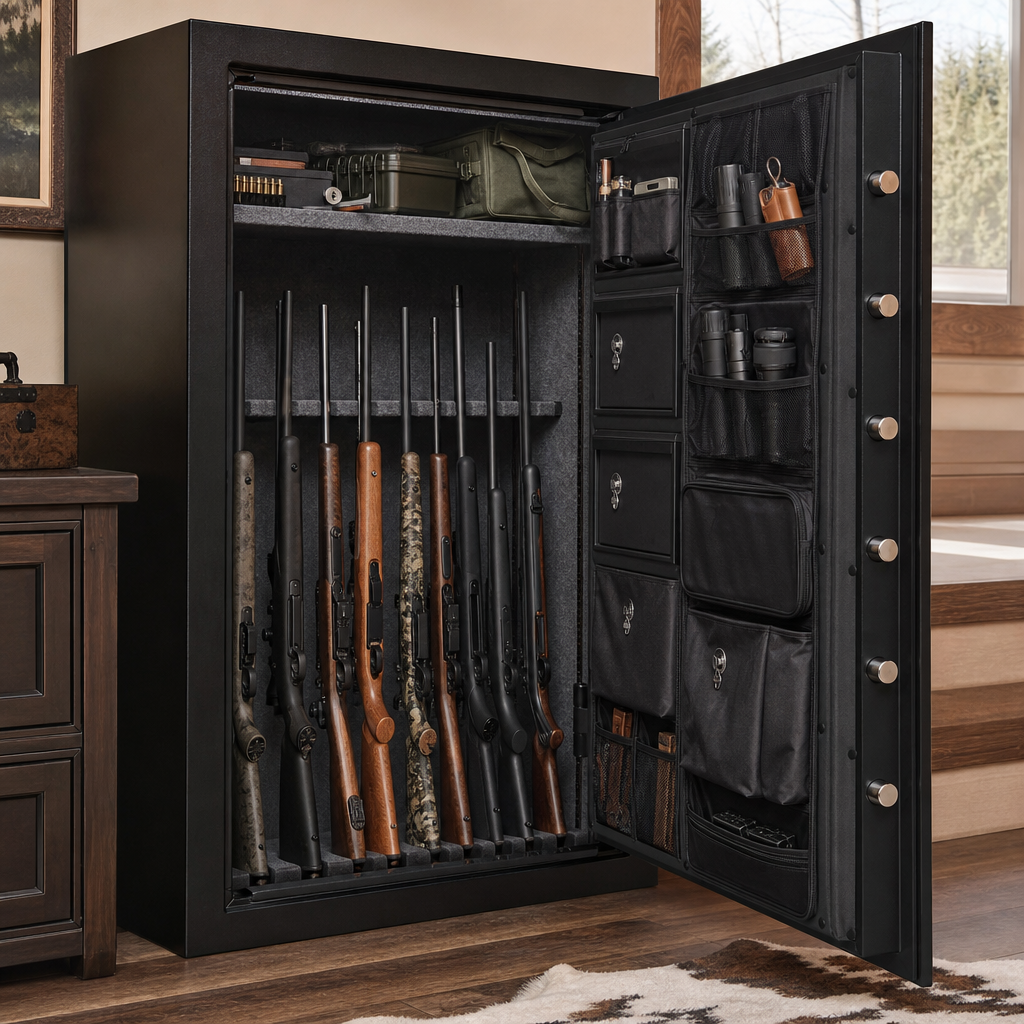
Choosing the best gun safes with integrated locking compartments for accessories starts with understanding what those compartments actually solve: they separate high-value or sensitive items such as handgun magazines, passports, suppressor tax stamps, optics, backup keys, and ammunition from the main firearm storage area while keeping everything inside one secured unit. In practical terms, a gun safe with integrated locking compartments is a full-size or compact safe that includes one or more independently lockable interior spaces, often called interior lock boxes, ammo lockers, or accessory vaults. These designs matter because firearm owners rarely store only long guns or pistols. They also store documents, serialized accessories, hearing protection, bolts, magazines, batteries, and maintenance gear, and not every item should be equally accessible to every household member.
After evaluating residential security containers, true burglary safes, and modular gun storage systems across different homes and use cases, I have found that integrated compartments are one of the most useful features a buyer can choose, especially for mixed-access households. A parent may want full access to the safe while restricting a teenager from ammunition. A collector may want to keep NFA paperwork, rare optics, and spare handgun slides in a smaller, separately keyed box. A home-defense owner may want a fast-access rifle area but still keep medications, cash, and legal documents behind a second lock. That flexibility is what turns a gun safe from a basic cabinet into a controlled storage system.
This buying guide explains how to evaluate these safes the right way. It covers lock types, steel thickness, fire ratings, compartment layouts, mounting, humidity control, and brand differences, while clarifying the tradeoffs between convenience, security, and usable space. It also serves as a hub for deeper buying-guide questions: what size safe to buy, how to compare fire protection claims, whether interior ammo lockers are worthwhile, and which features matter most for home defense, collection storage, and family safety. If you want one safe that organizes firearms and accessories without sacrificing control, this is the framework to use.
What integrated locking compartments do better than standard interiors
The main advantage of an integrated locking compartment is layered access control. In a standard gun safe, every shelf, rack, and door organizer becomes available once the main door opens. That is fine for a single owner, but less ideal when multiple authorized users need different permissions. An interior lock box creates a second security boundary. If a spouse needs access to documents but not suppressors, or if a range assistant can retrieve cleaning kits but not loaded magazines, the safe supports that arrangement without requiring a second exterior cabinet.
These compartments also improve organization and reduce damage. Optics, watches, hard drives, tax documents, and pistol magazines tend to get lost or scratched when stored loosely beside rifles. Interior lock boxes create defined space for small valuables. In many models from Liberty Safe, Browning, Sports Afield, Rhino Metals, and Winchester, the accessory compartment is mounted high on the back wall or side wall, preserving floor space for long guns while keeping delicate gear off the shelf edges where it can be crushed. Better organization sounds minor until you need immediate retrieval during a storm, evacuation, or legal transfer.
Another benefit is compliance-minded storage. While laws vary by jurisdiction, safe storage practices increasingly focus on preventing unauthorized access, especially by minors. Separating firearms from ammunition or bolts can materially reduce misuse risk. An integrated compartment makes that separation easier without forcing owners to maintain multiple safes in different rooms. It is not a substitute for knowing your local requirements, but it is a practical way to exceed the baseline standard in many households.
Core buying criteria: security, fire protection, and usable layout
Security starts with construction, not marketing language. Many products sold as gun safes are technically residential security containers tested to UL 1037 standards rather than high-security burglary safes. That distinction matters. For most homes, a quality RSC anchored correctly provides meaningful delay against smash-and-grab theft, but buyers should still compare body steel thickness, door plate construction, hard plate protecting the lock, relocker design, internal hinges versus external hinges, and bolt coverage. A 12-gauge body is common in midrange models, while 10-gauge or thicker steel offers substantially better pry resistance. Door edges, frame reinforcement, and anchor hole placement often matter as much as raw gauge numbers.
Fire protection claims require equal scrutiny. Brands may advertise 45, 60, 75, or 120 minutes at temperatures such as 1,200 or 1,400 degrees Fahrenheit, but the test protocol is not always independently verified. Ask whether the rating comes from an ETL or Intertek-style test, a manufacturer test, or a generalized insulation estimate. In real homes, survivability also depends on where the safe sits, whether the room has sprinkler coverage, and how long local fire response takes. For documents and electronic media placed in an interior accessory compartment, add document sleeves or dedicated media boxes because paper, USB drives, and hard drives fail at lower thresholds than steel and guns do.
Usable layout is where many buyers misjudge value. A safe advertised for 36 guns rarely stores 36 scoped rifles in the real world. Once you add AR-style rifles, bipods, wide fore-ends, tactical shotguns, and shelf kits, actual capacity can drop sharply. Integrated lock compartments consume some internal volume, so the right question is not the headline gun count but whether the safe stores your exact mix of rifles, pistols, magazines, ammo, optics, and paperwork without crowding. Measure shelf depth, compartment dimensions, and door swing width before buying.
Lock options and compartment access systems
The main door lock usually determines daily usability. Mechanical dial locks remain durable and need no batteries, but they are slower and less convenient in low light. Electronic keypad locks dominate the market because they are faster, easier for multiple users, and simpler to update after a household change. Higher-end safes may use redundant systems or biometric modules, though biometrics vary widely in consistency and should be treated as convenience features rather than sole security mechanisms. On safes I have installed for clients, quality keypad locks from Sargent and Greenleaf or SecuRam have generally delivered the best balance of speed and reliability.
The interior compartment may use a separate tubular key, flat key cam lock, digital lock, or, less commonly, a mechanical dial. Keyed interior boxes are common because they are inexpensive and preserve battery-free access. Their drawback is key management: if the key lives inside the main safe, the second lock adds little control. If the key lives elsewhere, retrieval slows access. Digital interior compartments solve that problem but add cost and maintenance. For most buyers, a separately keyed box works well for long-term valuables, while a digital inner locker is better for frequently accessed magazines, documents, or carry gear.
| Feature | Best for | Main advantage | Main drawback |
|---|---|---|---|
| Mechanical dial main lock | Long-term reliability | No batteries, proven design | Slower access |
| Electronic keypad main lock | Daily use, multiple users | Fast code entry | Battery dependence |
| Keyed interior compartment | Documents, backup valuables | Low cost, simple | Key control required |
| Digital interior compartment | Frequent accessory access | Separate fast entry | Higher cost, battery upkeep |
Whatever lock style you choose, change default codes immediately, replace batteries annually with name-brand cells, and verify override procedures before the safe is loaded. Buyers often research steel and fireboard extensively, then ignore lock serviceability, which is the feature they interact with most.
How to choose the right accessory compartment configuration
Not every integrated compartment is equally useful. Some are shallow boxes intended for one pistol and a passport. Others span nearly the full width of the safe and can hold bulk ammunition, cameras, title documents, and suppressor accessories. Start by listing what you need separated from the main cavity. Common categories include ammunition, loaded magazines, handgun storage, cash and jewelry, NFA paperwork, spare bolts, medication, and emergency electronics. Then divide those items by access frequency and risk. Fast-access items should sit near the front in a compartment that opens easily. Rarely accessed items can go in deeper upper lockers.
Placement matters. Upper rear compartments preserve rifle space but can obstruct tall optics or long barrels. Side-mounted lock boxes may interfere with door organizers if the door shelves are deep. Lower compartments are easier to reach but consume valuable floor area for long guns and hard cases. In several installs, the most efficient setup was a full-width upper locker combined with modular shelves below and a door panel for handguns and documents. That arrangement keeps rifles vertical, small valuables elevated, and frequently used accessories visible.
Pay attention to the compartment’s own construction. Thin sheet-metal lockers add organization but little true resistance once the main safe is breached. Better designs use heavier steel, shielded lock hardware, and full enclosure rather than an open-top cubby with a lockable flap. Also check whether the compartment is factory welded or removable. Removable units improve flexibility but can sacrifice rigidity.
Best safe types for different buyers
For home-defense owners, the best gun safe with integrated locking compartments is usually a medium-size safe with a fast electronic main lock, interior pistol storage on the door, and a small secondary locker for documents, spare magazines, and medication. The priority here is speed and controlled access, not maximum collection capacity. A 20- to 30-gun class safe anchored in a bedroom closet or nearby utility space often fits this role better than an oversized safe in a garage.
For hunters and sporting shooters, layout flexibility matters more. Shotguns, scoped bolt rifles, ammo boxes, choke tubes, rangefinders, and cleaning kits require shelves that can be reconfigured seasonally. Browning’s Axis shelving approach and similar modular interiors from other brands work well because they let you shift between rifle-heavy and gear-heavy storage. An integrated upper locker is ideal for tags, licenses, optics, and travel documents that should stay dry and separate.
For collectors, steel thickness, interior finish quality, and document protection matter most. Collectors often store provenance papers, appraisals, rare magazines, and premium optics alongside firearms with delicate wood or custom coatings. They benefit from larger safes with dehumidification, carpeted or leatherette interiors, and more substantial internal compartments. In this category, upgrading one size above your current collection is usually the right move because collections grow faster than expected.
For families with children or multigenerational access, layered permissions are the defining feature. Separate interior lockers can isolate ammo, handgun keys, or specific defensive tools from other contents. That is where integrated compartments provide their highest value.
Installation, placement, and long-term ownership costs
A well-built safe loses much of its theft resistance if it is not anchored. Most residential thefts are fast. If criminals can tip or remove a safe, they can attack it later with better tools. Bolt the safe to a concrete slab when possible, or use manufacturer-approved reinforcement over wood framing. Corner placement reduces pry space, and ground-floor interior locations are generally better than garages for climate stability and concealment. Basements can work well if humidity is controlled and flood risk is addressed.
Climate control is especially important when accessories share the safe. Ammunition, optics, batteries, leather slings, paper records, and electronics all respond differently to moisture and heat. Use a desiccant pack for short-term absorption and an electric dehumidifier rod for ongoing control. Hygrometers are inexpensive and should not be optional. In damp regions, I have seen rust appear first on magazine springs, optic mount screws, and exposed tool steel, not on the rifle barrel buyers inspect most often.
Ownership costs also include delivery, stair carry, anchoring, electrical access for lights or dehumidifiers, battery replacement, and possible lock service. A bargain safe can become expensive if the interior layout fails and you need add-on cabinets for ammo or documents. Buy for the full storage system, not just the sticker price.
How this buying guide hub helps you compare related safe topics
As a sub-pillar hub within gun safes and safety, this guide should help you navigate the wider buying process. If you are deciding between a gun cabinet and a safe, focus first on steel thickness, lock protection, and anchoring. If you are comparing fireproof gun safes, examine testing method, seal design, and document protection for items inside accessory lockers. If your question is safe size, inventory your current firearms, then add at least 25 to 40 percent extra capacity for optics, suppressor-ready hosts, and future purchases. If your concern is child access prevention, prioritize layered compartments and code management over cosmetic interior upgrades.
The best gun safes with integrated locking compartments for accessories are the ones that match your access pattern, not the ones with the longest feature list. Buy heavier steel when theft delay is your top concern. Buy better layout when you own mixed firearm types. Buy stronger internal separation when multiple people need different levels of access. Start with a written inventory, compare construction honestly, and choose a safe that will still make sense five years from now. Then anchor it, control humidity, and review your storage plan today.
Frequently Asked Questions
What is a gun safe with an integrated locking compartment, and why is it useful?
A gun safe with an integrated locking compartment is a firearm safe that includes a separate, independently secured interior space designed for smaller or more sensitive items. Instead of placing everything on the same shelf or in the main body of the safe, the owner can keep specific accessories and important documents behind an additional lock inside the larger unit. This setup is especially useful for storing handgun magazines, optics, backup keys, passports, suppressor paperwork, tax stamps, ammunition, and other valuables that benefit from extra organization and restricted access.
The biggest advantage is layered security. The main safe protects firearms from theft, unauthorized access, and environmental exposure, while the internal locking compartment adds another barrier for items that may need tighter control. For example, someone may want quick access to long guns in the main section but still prefer to keep documents, cash, or regulated accessories locked separately. It also reduces clutter and helps prevent small items from getting misplaced among rifles, shelves, and gear. For many buyers, the integrated compartment turns a standard gun safe into a more efficient all-in-one security solution.
What items should be stored in the integrated locking compartment instead of the main safe area?
The integrated locking compartment is best used for smaller, high-value, sensitive, or legally important items that should not simply be left loose on a shelf. Common examples include handgun magazines, optics, suppressor tax stamps, NFA paperwork copies, passports, emergency cash, jewelry, backup door keys, and important personal records. Many owners also use it for spare batteries for optics and lights, disassembled bolt components, and small defensive tools that they want to keep controlled but easy to locate.
Ammunition can also be stored there in limited quantities if the safe is designed for that use and local regulations or manufacturer guidance do not discourage it. However, it is usually smarter to think of the interior locking compartment as a place for compact items that are easy to lose, expensive to replace, or particularly important to separate from general firearm storage. The key idea is organization with purpose. If an item has legal significance, financial value, or a need for restricted access even among household members who may otherwise access the main safe, the integrated compartment is often the right place for it.
Are integrated locking compartments actually more secure, or are they mostly for organization?
They serve both purposes, but the security benefit is real when the safe is well designed. An integrated locking compartment creates a second level of access control inside the main safe. That matters because not every user of the main safe necessarily needs access to everything stored inside it. In a household, one person may be authorized to access firearms while another may need access only to certain documents or not to certain regulated accessories at all. An interior compartment helps separate those categories without requiring the purchase of a second standalone safe.
That said, the effectiveness of the added security depends on construction quality. A thin metal interior box with a weak cam lock is better than no separation, but it is not the same as a heavily reinforced compartment with a solid door and reliable locking mechanism. Buyers should look at steel thickness, lock type, hinge protection, how the compartment is mounted inside the safe, and whether it can be tampered with by removing surrounding shelves or hardware. So yes, integrated compartments improve security, but they are most valuable when combined with strong safe construction, proper anchoring, and realistic expectations about what level of protection they provide.
What features should I look for when choosing the best gun safe with integrated locking compartments for accessories?
Start with the fundamentals of the main safe: solid steel construction, a reputable locking mechanism, pry-resistant door design, fire protection appropriate to your needs, and pre-drilled anchor holes for secure installation. Once those basics are covered, evaluate the integrated locking compartment itself. Pay close attention to its size, placement, and accessibility. A compartment that is too small may not hold documents in protective sleeves, boxed optics, or multiple magazines, while one placed awkwardly may interfere with long-gun storage or shelf use.
You should also look for practical interior design details such as adjustable shelving, door organizers, labeled storage areas, and enough clearance to prevent optics or accessories from getting bumped when firearms are removed. The lock on the internal compartment matters as well. Some safes use basic tubular or cam locks, while better models may use sturdier keyed locks or reinforced latching systems. If your goal is true separation of valuables, choose a model where the compartment is visibly robust and not just a light add-on box. Finally, consider humidity control options, interior lighting, and overall layout. The best gun safe is not just the one with the most features; it is the one that lets you securely store firearms and accessories in a way that is organized, accessible, and realistic for your daily use.
Is it better to buy one gun safe with integrated locking compartments, or a separate safe for accessories and documents?
For many buyers, a gun safe with integrated locking compartments is the most efficient choice because it consolidates security into one footprint. It simplifies installation, often costs less than buying two separate quality safes, and keeps related items together in one protected location. This can be ideal for homeowners who want a streamlined setup for firearms, magazines, optics, paperwork, and emergency valuables without dedicating more floor space to additional storage units. It also makes routine access easier, since everything is in one place but still separated internally.
However, a separate safe may be the better choice in certain situations. If you have a large number of accessories, extensive documentation, high-value collectibles, or family members who need access to some items but not others, independent safes offer stronger separation and more flexibility. A dedicated document safe or accessory safe can also provide specialized fire or water protection that a gun safe may not match. In short, integrated locking compartments are an excellent solution for many owners, especially those who want convenience and layered storage in one unit. But if your storage needs are complex or your risk profile is higher, pairing a gun safe with a separate dedicated safe can be the more secure long-term strategy.