
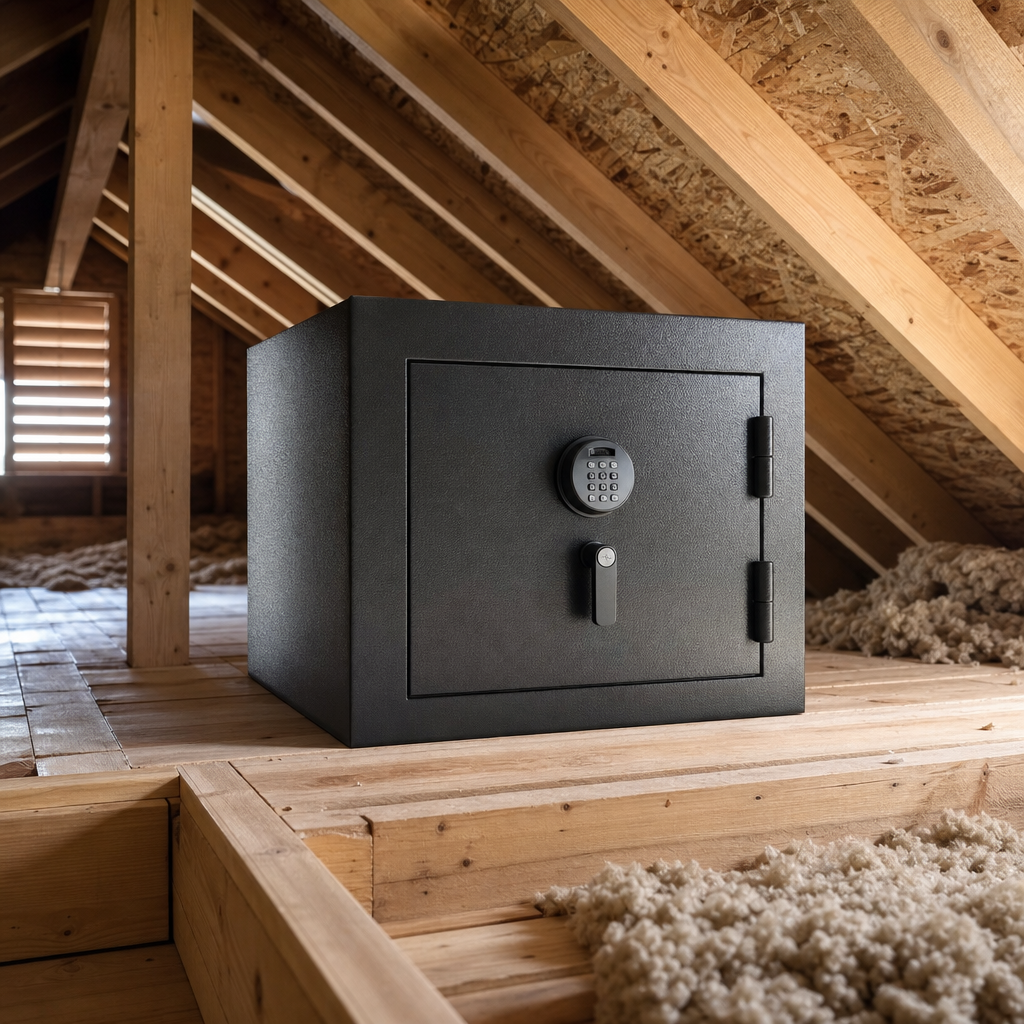
Selecting a gun safe that can be installed in an attic or crawl space requires more than comparing lock types and steel thickness. These locations create unusual structural, environmental, and access challenges that can ruin firearms, compromise security, or even damage the house if the safe is chosen poorly. In my experience evaluating residential safe placements, attic and crawl space installations fail for predictable reasons: homeowners underestimate floor load, ignore humidity, and buy dimensions that look workable on paper but cannot clear joists, access hatches, stairs, or framing obstructions during delivery.
A gun safe is a secure storage container designed to restrict unauthorized access to firearms and related valuables. For this guide, “attic installation” means placing a safe in a conditioned or unconditioned upper storage area beneath the roof structure, while “crawl space installation” means placing it in a low-clearance area below the main floor, typically over soil, concrete, or piers. “Buying guides” in this category should help readers choose the right product, not just the most heavily marketed one, and that means balancing burglary resistance, fire protection, corrosion control, logistics, anchoring, and code-aware placement.
This topic matters because safe placement can determine whether the safe performs as intended. A premium safe installed in a damp crawl space without vapor control may protect against theft while slowly corroding firearms and ammunition. A heavy model placed over undersized attic joists can create structural stress, sagging, drywall cracking, or failure during a move. Poor location decisions also affect emergency access, concealment, insurance documentation, and long-term maintenance. The right approach is to treat attic and crawl space installations as specialized applications that require a narrower product shortlist than a standard garage or closet install.
This hub article covers the core buying decisions that should guide every related purchase: safe size, weight, fire rating, door swing, locking system, humidity control, structure, delivery path, anchoring method, and maintenance plan. It is written to answer the practical questions buyers usually ask first. Can a gun safe go in an attic or crawl space? Yes, sometimes. Should any safe go there? No. The best choice is usually a compact to midsize safe or modular safe built for constrained access, paired with moisture management and a verified load-bearing location. If you start with those principles, every later comparison becomes easier and more accurate.
Start with the Site: Structure, Access, and Environmental Risk
The first step is not shopping by brand. It is evaluating whether the location can support a safe at all. In attics, the main concern is live and dead load on ceiling joists or attic floor framing. Many attics are designed for limited storage, not concentrated point loads from a 400- to 1,000-pound safe. A safe footprint may place hundreds of pounds on a small area, and weight increases further once firearms, ammunition, magazines, optics, and documents are added. As a rule, verify framing capacity with a qualified contractor or structural engineer before purchase, especially in older homes, truss-framed roofs, or houses with long joist spans.
Crawl spaces raise a different set of questions. The issue is not usually roof framing but moisture, flooding, clearance, and stable support. A safe sitting on uneven soil, deteriorated wood blocking, or thin slab sections can twist over time, making doors misalign and seals wear unevenly. If the crawl space is vented, humidity may swing dramatically by season. If it is unvented but poorly sealed, trapped moisture can be even worse. Buyers should inspect for standing water, condensation on ducts, mold, efflorescence on foundation walls, pest activity, and available headroom for opening the safe door fully.
Access path is the other site factor that disqualifies many safes. Measure every turn from exterior entry to final location: doorway widths, stair landings, attic hatches, pull-down stairs, crawl space openings, joist spacing, and the clearance needed to tilt, pallet-jack, or hand-truck the unit. Manufacturers list exterior dimensions, but buyers also need to account for handles, keypad projections, hinges, and packaging. I have seen otherwise suitable safes rejected on delivery because the published width excluded the handle or because the installer needed several extra inches to rotate the unit upright.
Environmental risk determines the feature set you need. Attics often face extreme heat, with summer temperatures far above living-space conditions, while crawl spaces often face persistent dampness and cooler surfaces that encourage condensation. Those realities affect lock electronics, adhesives used in interior liners, door seal longevity, and the corrosion rate of blued steel firearms. Before comparing models, determine whether your installation space is conditioned, insulated, vapor-managed, and accessible for regular inspection. That information will drive better decisions than any advertisement promising “ultimate protection.”
Choose the Right Safe Type for Tight and Difficult Installations
Not every gun safe format works in an attic or crawl space. Traditional full-size safes are often too heavy and too awkward to move into restricted spaces, even if the final location could technically support them. For these installations, the most practical categories are compact long-gun safes, small to midsize composite safes, and modular gun safes that ship in panels and are assembled on site. Modular systems are especially useful when the route includes narrow attic stairs, low crawl space access doors, or sharp turns that make one-piece bodies impossible to maneuver.
Compact safes reduce structural stress and simplify anchoring, but they limit collection growth. That tradeoff matters because published firearm capacities are optimistic. A “12-gun safe” may hold far fewer scoped rifles, modern sporting rifles, or shotguns with side saddles. When I help buyers estimate capacity, I usually recommend using 50 to 70 percent of the claimed number for real-world storage comfort. That leaves room for optics, socks, dehumidifiers, shelves, pistols, and easy retrieval. In a difficult location, overbuying size is often impossible, so interior layout efficiency becomes more important than raw stated capacity.
Burglary protection should be assessed honestly. If the attic or crawl space is concealed and hard to reach, location itself may add delay for a thief, but it should not be treated as security. Look for welded steel construction, robust boltwork, hard plates protecting the lock, and anchor holes that allow secure mounting to a suitable base. The steel gauge should be meaningful, not just reinforced in the door while the body remains thin. Heavier safes generally resist prying better, but in these locations, structural limits may push buyers toward smaller units with better steel quality rather than larger, lighter cabinets.
Fire protection is where many buyers overspend or misunderstand ratings. Fire ratings are not perfectly standardized across all manufacturers, and some published numbers come from proprietary testing rather than independent certification. For attic placement, high ambient heat can already stress contents, so a safe with credible fire-resistant construction may still be worthwhile, but insulation adds weight. In crawl spaces, flood and humidity concerns often outweigh fire concerns. The right balance depends on your actual threat profile: burglary, house fire, water intrusion, or corrosion. Good buying decisions come from ranking those risks rather than assuming every premium feature is equally valuable.
| Buying Factor | Attic Priority | Crawl Space Priority | Why It Matters |
|---|---|---|---|
| Weight and footprint | Very high | High | Protects framing in attics and prevents sinking or instability below floors. |
| Modular construction | High | High | Simplifies delivery through hatches, stairs, and small access openings. |
| Humidity control compatibility | Medium | Very high | Essential for corrosion prevention in damp or poorly sealed spaces. |
| Fire rating | High | Medium | Useful in roof-area installs, but often secondary to moisture below grade. |
| Anchor options | High | High | Prevents tipping and theft, but must match structure and substrate. |
Match Materials, Locking Systems, and Interior Features to the Environment
Material choice matters more in hostile spaces. Exterior steel should have a durable powder-coat or similar finish that resists scratches and surface oxidation. Interior fabrics and drywall-based fire liners can absorb moisture if the environment is uncontrolled, so buyers should inspect how the safe handles condensation risk. Door seals, especially expanding fire gaskets, should be checked for heat tolerance and long-term serviceability. In a crawl space, any component that can trap moisture against steel becomes a maintenance concern unless you actively manage humidity with desiccants, rods, or conditioned air.
Lock choice deserves practical thinking. Electronic locks are fast and convenient, but attics can reach temperatures that shorten battery life or stress lower-quality electronics. Crawl spaces may expose keypads to damp air, dust, and insects. Mechanical dial locks are slower but generally tolerate harsh conditions well and avoid battery dependence. High-quality electronic locks from established manufacturers can still work reliably if the space is controlled, yet buyers in remote, inconvenient locations often appreciate the predictability of a dial lock. If quick defensive access is the main priority, however, an attic or crawl space may be the wrong storage location altogether.
Interior configuration should support your actual inventory. Adjustable shelving, barrel rests sized for scoped rifles, door organizers, and dedicated document areas improve usable capacity. In cramped installations, full door swing may be limited, so plan around the angle needed to remove long guns without scraping optics or stocks. Soft interiors protect finishes, but they are not a substitute for climate control. For rust prevention, use silicone-treated gun socks where appropriate, store firearms cleaned and lightly protected, and keep ammunition in sealed containers if the environment is variable.
Accessories should be selected before installation, not after. If the safe needs power for a dehumidifier rod, lighting, or networked monitoring device, confirm that a protected electrical path exists. Running an extension cord through an attic hatch or crawl opening is a poor long-term solution and may create safety issues. Wireless humidity sensors from brands like Govee or SensorPush can help monitor conditions without frequent access, and rechargeable desiccant units can work in very small safes. The point is simple: the safe is only one part of the storage system, and in these locations the support equipment often determines success.
Plan Installation, Anchoring, and Long-Term Maintenance Before You Buy
Installation planning should happen before you place an order. Confirm who will move the safe, what equipment they will use, whether they are insured, and whether the manufacturer’s warranty has any placement limitations. Professional safe movers may use stair climbers, lift gates, pallet jacks, gantries, or panel-by-panel assembly techniques for modular models. For attic installs, some homeowners assume they can slide a safe into position across joists; that is risky and can damage framing and ceilings below. For crawl spaces, installers may need ground vapor barriers, poured pads, or steel plates to create a stable base.
Anchoring is essential, but the method must fit the structure. In an attic, anchoring directly to framing can help resist tipping or removal, but it should never compromise joists or trusses by careless drilling. A reinforced platform designed by a carpenter or engineer may be necessary. In crawl spaces, concrete anchors work well if there is an adequate slab or properly poured pad. Where only wood framing is available, through-bolting to a reinforced base can be effective. The goal is not simply to make the safe “hard to move,” but to prevent pry leverage, tip-over hazards, and gradual shifting.
Maintenance requirements are higher in remote spaces. Inspect the safe several times per year for rust spots, seal wear, lock performance, condensation, insect intrusion, and substrate movement. Verify humidity with a hygrometer and aim for controlled interior conditions, commonly around 40 to 50 percent relative humidity for firearm storage. Recondition desiccants, replace keypad batteries proactively, and lubricate moving parts according to the lock and hinge manufacturer’s instructions. In crawl spaces, check after heavy rain events. In attics, check after extreme heat waves and after roofing work, because new leaks often appear around penetrations.
As a buying guide hub under the broader gun safes and safety topic, this page should help readers narrow the field and identify which deeper comparisons they need next. Some buyers will need detailed guides on modular gun safes, dehumidifier options, attic floor reinforcement, crawl space vapor control, mechanical versus electronic locks, or safe mover selection. Use this article as the decision framework. Start with whether the space is appropriate, then choose a safe type sized for the route and load, then match lock, materials, and accessories to the environment, and finally confirm anchoring and maintenance. That sequence prevents expensive mistakes.
The best gun safe for an attic or crawl space is rarely the biggest model or the one with the loudest marketing. It is the safe that your structure can support, your access path can handle, your environment can preserve, and your installation plan can secure. Buyers who begin with realistic site conditions almost always make better choices than buyers who shop by capacity claims alone. Weight distribution, moisture control, credible construction, and service access matter more here than showroom appearance or oversized stated gun counts.
Three conclusions should guide your purchase. First, verify the location before comparing products. A safe is only as good as the framing, slab, pad, or platform beneath it. Second, prioritize environmental protection as seriously as burglary resistance. Rust, mold, and seal failure are common in these spaces and are preventable with the right setup. Third, treat delivery, anchoring, and maintenance as buying criteria, not afterthoughts. If you cannot move it in safely, bolt it down correctly, and inspect it regularly, it is not the right safe for that location.
If you are building out your buying shortlist, begin by measuring the route, documenting temperature and humidity conditions, and confirming structural support with a qualified professional. Then compare compact, midsize, and modular gun safes that match those limits. That simple process will save money, reduce risk, and lead to a safer installation that actually protects your firearms for the long term.
Frequently Asked Questions
Can a gun safe safely be installed in an attic or crawl space?
Yes, but only if the location and the safe are evaluated as a system rather than as separate decisions. An attic or crawl space can work for gun storage, but these areas are far less forgiving than a garage, closet, or slab-level room. The first issue is structural capacity. Many homeowners assume that if they can walk in an attic or crawl space, it can support a loaded safe. That is not a safe assumption. A gun safe concentrates a great deal of weight into a very small footprint, and once firearms, ammunition, shelving, and accessories are added, the installed weight may be hundreds of pounds more than the advertised empty weight.
The second issue is environmental exposure. Attics often experience extreme heat swings, while crawl spaces can trap moisture, condensation, and persistent damp air. Both conditions are hard on firearms, optics, wood stocks, paperwork, and electronic lock components. The third issue is access. If installers cannot safely move the safe through tight framing, pull-down stairs, hatches, or low-clearance entries, the installation becomes risky for both the house and the people doing the work. In other words, the safe itself may be perfectly good, but the location may still be wrong.
The best approach is to verify load capacity, confirm clear access dimensions, assess temperature and humidity behavior in that exact space, and choose a safe size and style that fits the environment instead of forcing a standard full-size model into a marginal location. In many cases, a smaller, higher-quality safe with excellent corrosion control and secure anchoring is a better choice than a larger safe that overstresses the structure or sits in uncontrolled humidity.
How do I know whether my attic or crawl space floor can support the weight of a gun safe?
This is one of the most important questions to answer before you shop, because structural overload is one of the most common reasons these installations fail. Start by looking beyond the listed safe weight. You need to calculate the realistic loaded weight, which includes the safe, firearms, ammunition, magazines, optics, documents, interior accessories, and sometimes dehumidifying equipment. Ammunition alone can add a surprising amount of weight. Once you know the likely total, consider how that weight is distributed. A safe does not spread weight evenly across a whole room; it concentrates it on a small base, which can create much higher stress than ordinary storage.
In an attic, the framing may have been designed primarily for ceiling loads, insulation, and limited maintenance access, not for heavy concentrated storage. In a crawl space, the issue may be less about the floor deck and more about the soil condition, piers, slab thickness, or whether the safe is being placed over an adequately supported platform. Joist size, span, spacing, decking thickness, and proximity to bearing walls all matter. A safe placed near a load-bearing wall or above reinforced structural support is usually a better choice than one placed mid-span on lighter framing.
If there is any uncertainty, consult a structural engineer or qualified contractor before installation. That is not overkill; it is the correct step when placing heavy concentrated loads in nonstandard parts of a house. In some cases, reinforcement is straightforward, such as adding blocking, shortening joist span, building a properly supported platform, or distributing the load with a steel or engineered base. What you do not want is guesswork. If the floor deflects, cracks finishes below, or gradually settles, the safe installation was never truly secure to begin with.
What features matter most when choosing a gun safe for high-humidity or high-temperature spaces?
For attic and crawl space use, corrosion resistance and environmental control matter just as much as burglary protection. In a climate-controlled interior room, many safes perform adequately with only basic moisture management. In an attic or crawl space, conditions are harsher and more variable, so you should prioritize a safe with a well-built body, tight door fit, durable finish, and an interior setup that allows airflow around stored firearms rather than packing them tightly together.
If the location is humid, look for a plan that includes active or passive dehumidification inside the safe. That may mean a desiccant system, an electric dehumidifier rod if power is available, or both. In a crawl space, vapor management in the room itself is often just as important as what happens inside the safe. If the crawl space is not sealed, encapsulated, or at least reasonably dry, the safe will be constantly fighting the environment. In an attic, high heat can stress adhesives, optics, lubricants, batteries, and some electronic lock systems. That does not mean you must avoid electronic locks entirely, but it does mean you should choose a reputable lock with a strong service history and be realistic about battery maintenance and heat exposure.
Interior materials also matter. Soft liners, shelves, and fabric interiors can absorb moisture if the environment is poor. Fire ratings should be viewed carefully as well. Fire protection is valuable, but some fireboard-based constructions can hold residual moisture for a period after manufacturing or in damp conditions. A good safe for these spaces is one paired with a full environmental strategy: controlled humidity, monitored temperature, regular inspection, and enough clearance around the safe to prevent trapped condensation against walls or framing. The right safe is not just heavy steel; it is a safe that can remain stable in the specific conditions of the space where it will live.
Is a smaller safe better than a large safe for attic or crawl space installation?
Very often, yes. In these locations, smaller can be smarter, safer, and more secure. A large safe may seem attractive because it offers future capacity, but attic and crawl space installations are limited by structural load, entry dimensions, turning radius, headroom, and the practical realities of moving a bulky steel box through a confined part of the home. Many failed installations begin with a buyer choosing a safe based only on interior storage goals and not on the physical demands of the route to the final location.
A smaller safe has several advantages. It is easier to transport without damaging framing, drywall, stairs, access panels, or the safe itself. It imposes less concentrated load on the structure. It is also easier to place precisely where support is strongest and easier to anchor correctly. In difficult environments, reducing weight and size can make it possible to spend more on better steel construction, a stronger lock, improved fit and finish, and better environmental accessories rather than spending the same budget on sheer volume.
That said, smaller should not mean undersized. You still want enough room to avoid cramming firearms tightly together, because overcrowding reduces airflow, complicates access, and increases the chance of stock or finish damage. A good rule is to buy for realistic use, not marketing capacity numbers, which are often optimistic. If your available attic or crawl space location is marginal, it is usually better to select a compact safe designed for the actual site conditions than to force an oversized model into a place that cannot support it well or protect its contents properly.
What installation mistakes should I avoid when putting a gun safe in an attic or crawl space?
The biggest mistake is treating the job like a normal room installation. Attics and crawl spaces introduce special risks, and shortcuts show up quickly. One major error is failing to confirm the route from the delivery point to the final location. Measurements need to include not just the safe’s exterior dimensions, but also pallet size, door swing clearance, handle projection, stair angle, hatch width, low rafters, crawl access openings, and any turns that require rotation. Another common mistake is placing the safe where it fits rather than where the structure is strongest. Convenience should never override support.
Environmental neglect is another frequent problem. Homeowners often assume the safe alone will protect the contents from moisture, but safes are not climate-control systems. If a crawl space has standing moisture, poor drainage, exposed earth, or no vapor barrier, that needs to be corrected before installation. If an attic reaches extreme temperatures, plan for inspection intervals, lock maintenance, and realistic expectations about what items should or should not be stored there long term. Firearms, optics, important paper records, and ammunition all respond differently to environmental stress.
Improper anchoring is also a serious issue. A safe in a remote space still needs to be secured according to manufacturer guidance and appropriate substrate conditions. In some attic or crawl installations, homeowners rely on weak decking or unsuitable fasteners that do little to resist tipping or removal. Finally, many people skip ongoing monitoring. Once installed, the safe should not be forgotten. Check humidity levels, inspect for condensation or rust, verify that the door seal and lock are functioning properly, and watch for structural movement under the safe. A successful attic or crawl space installation is not just about getting the safe into place; it is about making sure the location can support, protect, and secure it for years.