
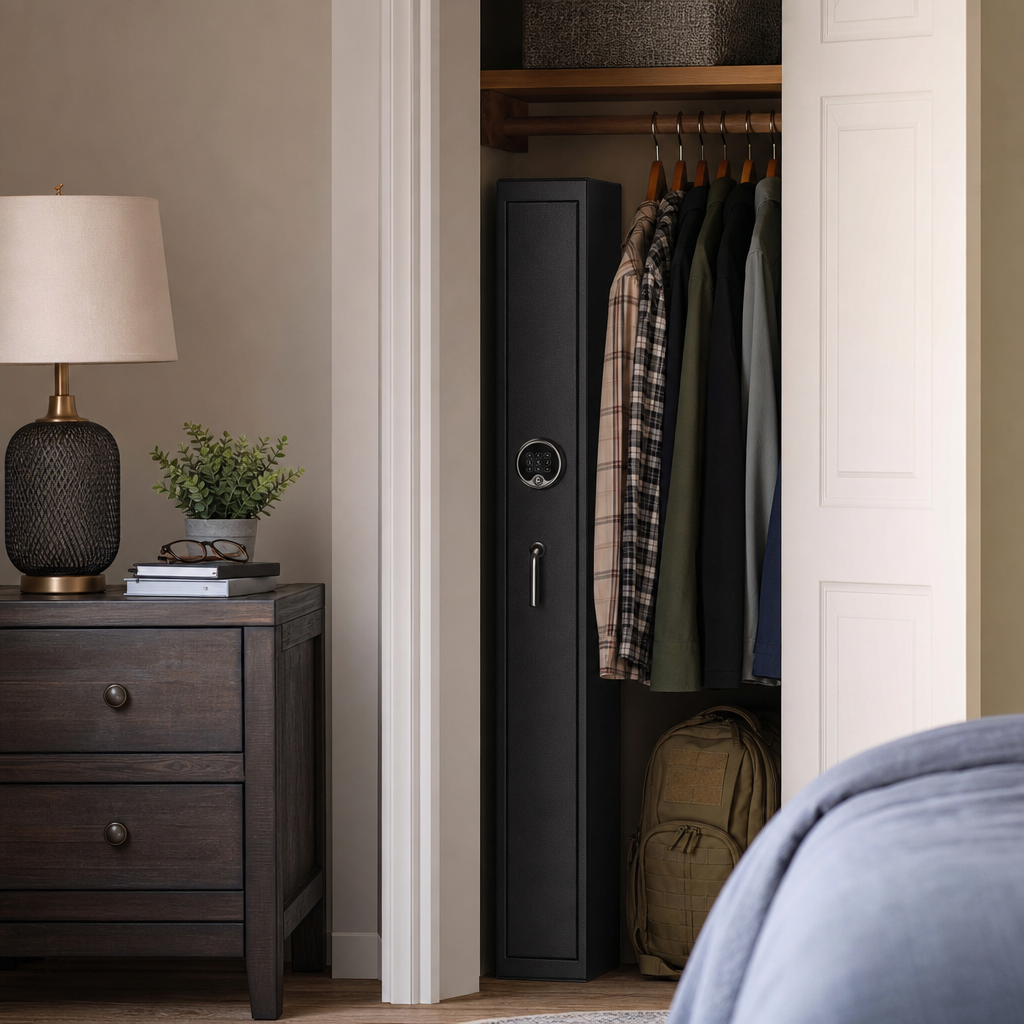
Choosing a gun safe designed for ultra-compact storage starts with understanding a simple truth: small spaces create different security, access, and installation problems than full-size rooms. In apartments, condos, closets, under-bed cavities, and vehicle-adjacent mudrooms, every inch matters. A compact safe is not just a smaller version of a traditional gun cabinet. It is a purpose-built storage solution engineered around limited floor space, shallow depth, discreet placement, and fast access while still meeting core safety requirements. For owners building out a practical gun safes and safety plan, this buying guide serves as the hub for evaluating dimensions, lock types, construction quality, fire resistance, mounting methods, and realistic storage capacity.
When I help buyers compare compact options, the first mistake I see is shopping by listed gun count alone. Manufacturers regularly advertise a “4-gun” or “8-gun” safe based on tightly packed long guns without optics, slings, lights, or padded sleeves. In real use, capacity drops quickly. A safe marketed for four rifles may hold two modern sporting rifles comfortably. Ultra-compact storage means balancing footprint against usable interior volume. Key terms matter here. Footprint refers to the floor area the safe occupies. External depth determines whether it fits in a closet, beside a bed, or inside built-in cabinetry. Internal clearance affects whether scoped rifles, braced pistols, or handguns in cases actually fit. Burglary resistance describes how well the body, door, lock, and boltwork withstand forced entry. Fire rating, usually expressed in minutes at a tested temperature, indicates how long the safe may protect contents during a fire event, though testing methods vary by brand.
This topic matters because a poorly chosen safe can fail in three ways at once: it wastes scarce space, slows authorized access, and provides less protection than expected. Compact safes are often purchased by urban homeowners, renters, first-time firearm owners, and people adding secondary storage near sleeping areas or home offices. Those buyers need direct answers to practical questions: How small is too small? Is biometric access reliable? Does a lightweight safe need to be bolted down? Can a shallow cabinet safely store rifles with optics? The right buying decision protects children and visitors, reduces theft risk, supports responsible ownership, and preserves fast access where lawful. The wrong one becomes a heavy inconvenience with weak steel, inflated capacity claims, and placement limitations discovered after delivery.
Start with threat model, legal requirements, and space measurements
The best compact gun safe is the one that fits your actual risks and your actual room, not the one with the most aggressive marketing. Start by defining your threat model. Are you mainly preventing unauthorized access by children and guests, delaying a smash-and-grab burglary, or adding quick-access storage for one defensive handgun? Those are different use cases. For child access prevention, a certified lockbox or compact handgun safe may be sufficient if it is properly mounted. For burglary delay, heavier steel, reinforced doors, internal hinges, anti-pry tabs, and anchor points matter much more. For long-gun storage in a small apartment, vertical clearance and depth become critical constraints.
Next, check your state and local storage laws and any landlord restrictions. Some jurisdictions require firearms to be stored locked when not under direct control, particularly where minors are present. If you travel across state lines or stage a firearm in a vehicle, separate transport and storage rules may apply. This is also where insurance enters the conversation. Homeowners policies often place sub-limits on firearms and may require documentation for theft claims. In my experience, buyers who plan for secure storage, serial number records, and anchored installation from day one recover faster after a loss and avoid expensive replacement mistakes.
Then measure the installation area precisely. Record width, height, depth, door swing clearance, baseboard interference, nearby outlets, and whether the safe must pass through narrow stairwells or hallway turns. For under-bed safes, measure both the vertical clearance and the unobstructed slide path. For closet installations, include trim and hinge projections, not just drywall-to-drywall dimensions. Leave room for dehumidifiers, power cords, and hand access to the lock. Compact storage fails when buyers assume a safe will fit because the listed exterior dimensions looked close enough on a product page.
Choose the right ultra-compact safe format for the firearms you own
Compact gun safes generally fall into four formats: handgun lockboxes, drawer or bedside safes, under-bed safes, and slim vertical cabinets for long guns. Handgun lockboxes are ideal for one to two pistols and documents. They work well in nightstands, closets, and vehicles, but many are designed more for access control than serious burglary resistance. Drawer and bedside safes offer a low profile with better mounting options and often support biometric, keypad, or RFID entry. Under-bed safes maximize wasted space and can store multiple handguns, valuables, and sometimes a takedown rifle. Slim vertical cabinets are the usual answer for long-gun owners in apartments because they use height instead of width, though they demand honest capacity expectations.
If you own rifles with mounted optics, suppressor-ready barrels, bipods, or weapon lights, skip generic “gun count” claims and compare internal dimensions against your longest and widest configured firearm. A shallow cabinet that technically fits a rifle may force awkward angles that strain optics or snag slings. Many buyers do better with fewer slots and adjustable interiors than with a packed foam rack. Modular interiors from brands such as Vaultek, Hornady, and SecureIt often use bins, shelves, and cradles that adapt to accessories better than fixed barrel rests. SecureIt’s lightweight cabinet approach is especially popular in compact spaces because it prioritizes organization and quick access over the bulk of traditional fire-lined safes.
For owners mixing handguns and one or two long guns, consider whether a dual-purpose compact safe actually saves space. Sometimes two specialized units work better: a bolted quick-access handgun safe near the bed and a slim anchored cabinet in a closet. That setup often improves both accessibility and storage efficiency. It also supports future internal linking across your buying guides, such as quick-access bedside safes, under-bed safe comparisons, and compact rifle cabinet reviews, because the categories solve distinct problems.
Evaluate steel thickness, door design, lock quality, and mounting options
Construction quality matters more than cosmetic finish. On compact safes, the first specifications to review are steel thickness, door overlap, locking bolt engagement, hinge design, and anchor provisions. Steel may be listed in gauge or decimal inches. Lower gauge numbers mean thicker steel. A body made from 18-gauge steel may deter casual tampering, but 14-gauge, 12-gauge, or thicker construction offers meaningfully better resistance to pry attacks and tool abuse. The door is the most attacked component, so recessed doors, anti-pry lips, reinforced frames, and robust boltwork provide more real protection than plush interiors or decorative handles.
Lock choice affects both security and daily usability. Mechanical simplex-style pushbutton locks are valued for durability and no-battery operation. Electronic keypads offer fast access and broad availability, but quality varies widely. Biometric safes have improved, especially on premium units using capacitive fingerprint sensors, yet they still require enrollment discipline, clean sensors, and backup access methods. In testing and field use, I advise buyers never to rely on biometrics alone. Choose a model with a reliable keypad or physical override, and practice opening it in low light and under stress. The lock should be UL-listed where applicable, and the safe should include lockout protection, tamper alerts, or audit trails if those features match your use case.
| Feature | Why It Matters in Ultra-Compact Storage | What to Look For |
|---|---|---|
| Steel thickness | Thin bodies are easier to pry or deform, especially on light safes | Prefer 14-gauge or thicker for higher-risk locations |
| Lock type | Determines speed, reliability, and failure modes | Keypad or mechanical lock with backup access; biometric only if proven |
| Anchor points | Small safes are vulnerable to being carried away whole | Multiple pre-drilled holes and quality mounting hardware |
| Internal layout | Compact interiors lose usable space quickly | Adjustable shelves, bins, pistol racks, and optic clearance |
| Fire protection | Added insulation can reduce interior space and increase weight | Verified test details, door seals, and realistic expectations |
Mounting is non-negotiable for most compact models. A small safe with a great lock can still be stolen intact if it is not anchored to floor joists, wall studs, concrete, or substantial furniture designed for load-bearing attachment. Use the manufacturer’s hardware only if it matches your substrate; otherwise upgrade to appropriate concrete anchors or lag bolts. In rentals, where drilling may be limited, you may need a heavier cabinet combined with approved anchoring into closet framing or a professionally installed security platform. The point is simple: portability is convenient during delivery, but it is a security weakness after installation.
Understand fire ratings, interior environment, and realistic value protection
Fire protection in ultra-compact gun safes requires careful interpretation. Many compact units either omit fire ratings entirely or advertise broad claims without disclosing the test protocol. There is no single universal standard across the category. Some brands use independent labs such as Intertek or ETL, while others rely on internal testing. Look for specific data: temperature, duration, and whether the rating applies to paper survival, not firearm finish, optics electronics, or ammunition performance. Added insulation improves fire resistance, but it increases weight and often reduces usable interior dimensions, which is a major tradeoff in small-space storage.
Humidity control is just as important as fire protection, especially in closets, garages, and exterior-wall rooms where condensation can form. Compact safes concentrate moisture quickly. Use desiccant packs, rechargeable silica units, or a low-watt dehumidifier rod if the safe supports power entry. Check that door seals and cable pass-throughs do not compromise fit. I have seen pristine pistols develop surface rust in under a season because owners focused on theft resistance and ignored microclimate control. Firearms with blued finishes, leather slings, and paper records are especially vulnerable.
Also match the safe to the value you are protecting. A small residential security container, even a well-made one, is primarily a delay device against residential theft, not an impenetrable vault. If you are storing high-value collections, NFA items, heirloom firearms, or expensive thermal optics, step up to stronger burglary ratings, dedicated alarm coverage, serial number inventories, and possibly a layered setup with cameras and monitored entry sensors. Compact storage can still be part of that plan, but expectations must stay realistic. The safe buys time and denies easy access; it does not replace broader physical security.
Compare access speed, placement strategy, and long-term usability before buying
Access speed is a buying guide issue, not just a feature preference. A safe can be extremely secure and still fail your daily needs if it opens awkwardly in the chosen location. Test whether the door clears bed frames, closet bifolds, or shelving. Consider whether you can grip the handle or keypad from your normal approach path. In bedside use, practice opening from a standing and kneeling position. In closet use, verify that hanging clothes do not obstruct the door swing. Fast access depends as much on installation geometry as on lock technology.
Placement strategy should also account for concealment, structure, and routine. A compact safe hidden in a master closet may be more secure from casual discovery, while a visible bedside safe may be faster in emergencies. Under-bed safes work best when the bed frame has enough lift and the floor is level enough for smooth sliding. Vertical cabinets should be placed where they can be anchored into studs and where humidity is controlled. Avoid garage corners unless the model is built for harsher environments, because temperature swings and moisture shorten the life of electronics and finishes.
Finally, buy for the next three to five years, not just today. Most owners add optics, spare magazines, documents, suppressor accessories, or another handgun. If the safe will be full on arrival, it is already undersized. Review warranty terms, battery access, replacement key policies, and customer support reputation. Brands with strong accessory ecosystems and responsive parts support usually create less friction over time. A well-chosen ultra-compact gun safe should integrate into your routine, protect what matters, and leave enough flexibility for your collection and your living space to evolve.
The smartest way to choose a gun safe designed for ultra-compact storage is to treat the purchase as a fit problem first and a feature problem second. Measure the space carefully, define the risk you need to address, and match the safe format to the firearms and accessories you actually own. Then focus on the specifications that determine real-world performance: steel thickness, reinforced door design, dependable lock operation, anchor points, realistic capacity, and credible fire and humidity protection. Compact storage works best when every dimension and every feature is chosen intentionally.
For most buyers, the winning option is not the smallest safe on the market. It is the smallest model that still allows secure mounting, comfortable access, and honest storage for configured firearms with optics, lights, and documents. If you need fast handgun access, a dedicated bedside or drawer safe often beats a cramped all-in-one box. If you need long-gun storage in limited square footage, a slim cabinet with adjustable organization usually outperforms a shallow “gun count” promise. And if theft risk is a priority, construction quality matters more than decorative finishes or inflated marketing language.
Use this buying guide as your hub for the broader Buying Guides section within Gun Safes & Safety. From here, the next step is simple: measure your intended location, list your firearms in their real configured dimensions, and compare compact safe categories against those requirements before you buy. That process leads to a safer home, better access, and fewer compromises in a small space.
Frequently Asked Questions
What makes an ultra-compact gun safe different from a standard gun safe?
An ultra-compact gun safe is designed specifically for tight, space-restricted environments where a traditional safe would be impractical or impossible to install. Instead of simply shrinking the exterior dimensions of a full-size safe, manufacturers typically rethink the entire layout, access method, and mounting strategy. That means you will often see features such as shallow-depth bodies for closets, low-profile designs for under-bed placement, vertical configurations for corners, and discreet form factors that fit inside furniture, cabinets, or mudroom storage zones.
The biggest difference is that compact storage must balance security with footprint efficiency. In a small apartment, condo, or narrow hallway closet, a safe that protrudes too far can interfere with door swing, walking clearance, or furniture placement. Ultra-compact models are built to minimize that disruption while still securing firearms against unauthorized access. They also tend to prioritize rapid access because many of these safes are used for defensive firearms rather than long-gun collections.
Another key distinction is installation flexibility. Standard safes often assume a dedicated room or open floor area. Compact safes are usually intended to be bolted into smaller, more constrained locations such as a closet floor, wall cavity, bed platform, cabinet base, or vehicle-adjacent utility area. Because of that, you should evaluate not just the outside dimensions, but also the door clearance, internal usable space, mounting hole placement, and the amount of room needed to retrieve the firearm safely and efficiently.
How do I measure my space correctly before buying a compact gun safe?
Start by measuring more than the footprint alone. Many buyers make the mistake of measuring only width and depth, then discover the safe door cannot open fully or the handgun cannot be drawn cleanly from the interior. You should measure width, height, depth, surrounding wall clearance, baseboard interference, shelf height, and any obstructions such as door trim, closet rods, vents, or nearby furniture. If the safe will live under a bed, measure the actual clearance at the lowest point, not the advertised bed frame height.
You also need to account for operational space. A compact safe may physically fit in a 20-inch-wide opening, but if the door swings outward and blocks access, or if you need to crouch awkwardly to retrieve the firearm, the placement may not be practical. For biometric or keypad models, make sure you can reach the controls comfortably and see the keypad in low light. For drawer-style or slide-out safes, check extension clearance so the unit can open fully without hitting walls, bed rails, or cabinetry.
Finally, measure for installation and long-term use, not just initial placement. Leave room for anchoring tools, power cords if the safe uses an electronic lock, and any moisture-control accessories. It is also wise to compare the manufacturer’s external dimensions to the interior dimensions. In compact safes, wall thickness, door structure, and lock housing can reduce usable storage more than expected. If you plan to store a firearm with accessories such as a mounted light, optic, or extended magazine, measure the actual setup exactly as it will be stored, not the base firearm dimensions listed by the manufacturer.
Which security features matter most when choosing a gun safe for a small apartment, closet, or under-bed space?
In compact environments, the most important security feature is usually effective anchoring. A small safe can be highly secure in terms of lock design but still vulnerable if a thief can simply carry it away. Look for a model with pre-drilled mounting holes and strong anchoring options for wood subfloors, concrete, wall studs, or bed platforms, depending on where it will be installed. A properly anchored compact safe is dramatically more secure than a heavier unanchored unit placed loosely in a closet.
Lock quality is the next major consideration. Biometric locks can offer excellent speed, but they should be backed by a keypad or mechanical override in case of battery failure or inconsistent fingerprint reads. Keypad locks are common and convenient, but choose a model with a reliable reputation, tamper resistance, and clear low-battery warnings. Mechanical simplex-style push-button locks are popular for fast access because they do not depend on power and can be extremely dependable when well made. The best choice depends on whether your top priority is speed, simplicity, or redundancy.
You should also evaluate pry resistance and door construction. In small spaces, compact safes may be hidden, but concealment should never be treated as a substitute for security. Look for reinforced doors, solid steel construction, concealed hinges where possible, anti-pry lips, and internal locking bolts. If the safe will be in a shared living environment or frequently accessible area, these features become even more important. The ideal ultra-compact safe combines discreet placement, strong anchoring, dependable lock access, and enough structural resistance to deter quick forced entry attempts.
What size and layout should I choose if I want compact storage without sacrificing quick access?
The right size depends on what you actually need to store and how quickly you need to reach it. If your primary goal is home-defense readiness, a dedicated handgun safe or slim quick-access safe may be a better choice than a slightly larger general-purpose model. Compact storage works best when the interior is purpose-built around the firearm type, not when you try to force multiple roles into a tiny enclosure. For example, a handgun with a red dot and weapon light needs a different interior profile than a basic pistol, and a folding carbine requires a completely different layout than a bedside handgun safe.
Interior organization matters just as much as overall volume. In ultra-compact safes, dead space becomes a real problem. Foam inserts, adjustable brackets, magazine slots, and separated compartments can make a small safe much more efficient. Some models use upright presentation to position the firearm naturally for retrieval, while others use horizontal trays or slide-out drawers to fit under beds or benches. The best layout is one that lets you open the safe, establish a proper grip, and remove the firearm cleanly without snagging accessories or shifting stored items around.
It is also smart to leave some growth room. If a safe is packed to absolute capacity on day one, access can become slower and less safe over time. Choose a model that fits your space tightly but not so tightly that you lose usability. In practical terms, that usually means buying for your real-world setup with a modest buffer for accessories, spare magazines, documents, or a second compact firearm if allowed and appropriate for your needs. The best ultra-compact safe is not necessarily the smallest one you can cram into a space; it is the one that makes efficient use of the space while preserving secure, repeatable access.
Where is the best place to install an ultra-compact gun safe, and what should I avoid?
The best installation location is one that balances access, concealment, structural support, and environmental protection. In many homes, that means a bedroom closet floor, a secured nightstand compartment, under a bed with proper anchoring, or a low-traffic mudroom area near an entry point if that suits your defensive plan. The right location should allow you to reach the safe quickly during an emergency while keeping it out of plain sight from guests, service workers, or casual observation. Discreet placement can reduce attention, but it should not make the safe difficult to use under stress.
You should avoid locations that introduce moisture, heat, instability, or repeated visibility. For example, garages, uninsulated sheds, and damp basements can create rust concerns if climate control is poor. A closet shelf may save floor space, but if the shelf is weak or the safe is too heavy, it can become unsafe and difficult to anchor properly. Under-bed locations can work very well, but avoid areas where bed skirts, storage bins, or frame supports interfere with access. In a mudroom or transitional area near a vehicle, be especially cautious about temperature swings, humidity, and the possibility of outsiders spotting the safe during open-door activity.
It is equally important to think through daily patterns. If the safe is in a place that requires moving boxes, bending around furniture, or unlocking multiple barriers before reaching it, fast access may suffer. On the other hand, a highly visible location may undermine the benefits of compact, discreet storage. The ideal installation site is one where the safe can be securely anchored, opened fully, accessed consistently, and protected from unnecessary exposure to theft risk or environmental damage. Before finalizing placement, test the full motion of opening, reaching, gripping, and removing the firearm so you know the setup works in real conditions, not just on paper.