
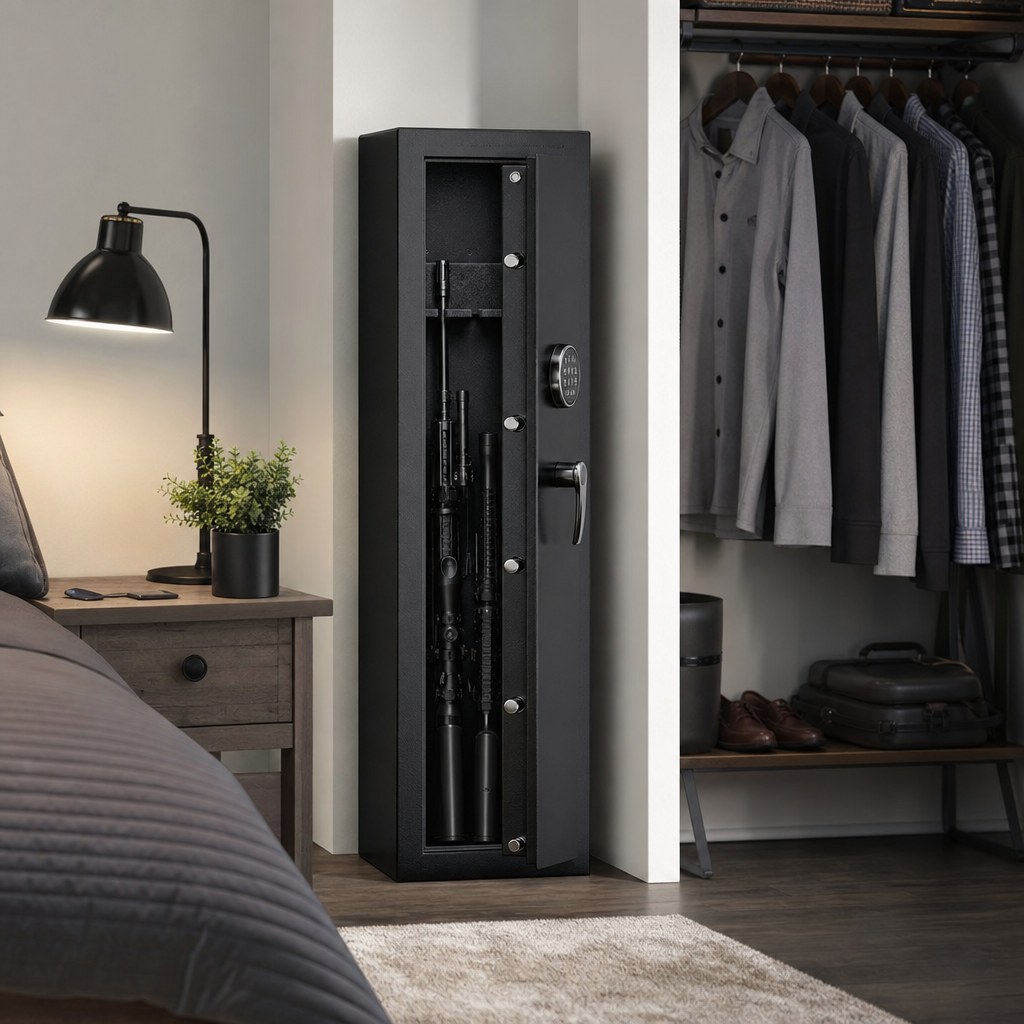
Choosing the best gun safe for small spaces starts with a simple reality: most owners are not outfitting a large basement vault, but trying to secure firearms in apartments, closets, bedrooms, offices, or tight corners without sacrificing access, theft resistance, or fire protection. In practical terms, a small-space gun safe is any storage solution designed to fit where square footage is limited while still meeting the core goals of safe firearm ownership. Those goals are straightforward: prevent unauthorized access, slow down theft, organize firearms and valuables, and, where possible, provide some protection from fire and water. The challenge is that compact safes force tradeoffs. As safe bodies shrink, interior capacity drops, door swing becomes more restrictive, long-gun storage can turn awkward, and manufacturers often cut steel thickness or locking features to hit a lower price point.
That is why brand comparisons matter. Two safes with nearly identical exterior dimensions can differ sharply in wall construction, locking mechanism quality, hinge design, fire rating credibility, and real usable capacity. I have seen buyers rely on marketing labels like “24-gun” or “compact tactical safe,” only to discover that optics, shelves, door organizers, and carpeted barrel rests reduce realistic storage by half. In small homes, that mistake is expensive because every inch matters. A safe that is three inches deeper than expected can block a closet door; a model with a protruding electronic keypad may prevent flush placement against a wall; a lightweight cabinet may fit perfectly but become a liability if it is not bolted down.
The best gun safe for small spaces therefore is not a single model for everyone. It depends on firearm count, whether you need quick access or long-term storage, your tolerance for weight, your flooring, and whether the safe must disappear into furniture or stand openly in a closet. This hub article covers the core of gun safe comparisons and brand spotlights so you can evaluate the market intelligently. It explains what compact-safe buyers should prioritize, compares major brands commonly considered in the category, and identifies which types of safes work best for apartments, bedroom closets, under-bed storage, and mixed firearm-and-document use. If you are building a short list, this is the page that frames the decision clearly.
What Makes a Gun Safe Good for Small Spaces
A gun safe for a small space is not merely a smaller version of a full-size safe. The best compact models are engineered around footprint efficiency, anchorability, and realistic access. In my experience, five criteria separate good options from disappointing ones. First is exterior footprint versus interior usability. A narrow safe with a deep body may technically fit a closet, but if the shelf layout wastes vertical space or the door organizer crowds rifle stocks, capacity suffers. Second is weight relative to security. Compact safes are easier to move, which helps installation on upper floors, but lower mass also makes them easier for thieves to tip or carry if they are not anchored.
Third is steel thickness. Many entry-level cabinets use thin steel that keeps costs down but offers limited pry resistance. For true security, buyers should look beyond generic claims and check body steel gauge, door thickness, and whether the door uses multiple locking bolts. Fourth is lock quality and failure management. Electronic locks are convenient in cramped settings because they open quickly without a long key sweep, but the better brands use proven lock makers such as Securam, SecuRam ProLogic, UL-listed electronic locks, or mechanical dials from trusted manufacturers. Fifth is layout flexibility. Adjustable shelving, pistol racks, and door panels matter more in small safes because every cubic inch must work hard.
Fire protection needs nuance. A fire label that states “30 minutes at 1200 degrees” can be useful, but the testing method matters, and not every manufacturer uses the same standard. Compact safes also have less thermal mass than heavier full-size safes, so a modest fire rating should be viewed as a buffer, not a guarantee. For many apartment dwellers, anti-theft performance and discreet placement matter more than chasing inflated fire numbers. In other words, the best compact safe is the one that fits your room, your firearm collection, and your security priorities without relying on unrealistic marketing capacity.
How Major Brands Compare in the Compact Safe Category
Brand reputation matters because build consistency, warranty support, lock sourcing, and dealer networks vary widely. In the compact and mid-size market, several names appear repeatedly: Hornady, Vaultek, SecureIt, Stack-On, Winchester, Liberty, Sports Afield, Mesa Safe, and Browning. Each brand tends to excel in a different slice of the market rather than across every use case.
| Brand | Best Small-Space Use | Primary Strength | Main Limitation |
|---|---|---|---|
| Vaultek | Nightstands, closets, quick-access storage | Fast electronic access and compact design | Limited long-gun capacity |
| Hornady | Rapid-access rifle storage | RFID and vertical entry options | Less emphasis on heavy fire protection |
| SecureIt | Closets and modular organization | Efficient interior flexibility | Lighter construction than traditional safes |
| Stack-On | Budget apartments and starter setups | Low cost and light weight | Cabinet-level security |
| Liberty | Compact premium traditional safes | Stronger construction and support | Higher price and weight |
| Browning | Small traditional long-gun safes | Thoughtful interior storage systems | Bulkier depth on some models |
| Mesa Safe | Mixed gun and document storage | Commercial-grade build quality | Less specialized firearm layout |
Vaultek has earned strong recognition in quick-access handgun safes and compact biometric units. For small-space owners, the appeal is obvious: slim bodies, app-enabled monitoring on some models, rechargeable power systems, and fast access from a nightstand or closet shelf. Vaultek is ideal when the priority is defensive-access storage for one to four handguns, but it is not a substitute for a substantial long-gun safe.
Hornady is especially relevant because its RAPiD line tackles the small-space rifle problem directly. Vertical RFID-enabled safes can fit in closets or beside furniture, giving owners quicker long-gun access than a traditional deep safe. SecureIt takes a different approach, emphasizing military-inspired organization panels and configurable storage that often uses space more efficiently than old-style barrel racks. Buyers who want to store fewer rifles with optics, lights, and slings often find SecureIt layouts more realistic.
Stack-On remains common because price matters. In apartments or first-home settings, buyers often begin with a security cabinet rather than a heavy safe. That choice can be rational if expectations are correct: a cabinet primarily restricts unauthorized access and provides basic organization, but it does not offer the pry resistance of thicker steel safes. Liberty and Browning sit higher in the market, with more traditional safe construction, better fit and finish, and stronger after-sale support. If your space can handle the weight and depth, these brands often deliver the best blend of compact footprint and meaningful security.
Best Types of Gun Safes for Apartments, Closets, and Bedrooms
Small spaces generally call for one of four formats: handgun safes, under-bed safes, vertical compact rifle safes, or shallow traditional safes. Handgun safes are the easiest recommendation. They fit drawers, shelves, and bedside positions, and quality models from Vaultek, Fort Knox, Hornady, and V-Line can secure defensive pistols without dominating the room. Mechanical simplex locks from V-Line and Fort Knox remain excellent for owners who want battery-free reliability. Electronic and biometric options are faster for many users, but they require disciplined battery management and periodic function testing.
Under-bed safes are often the most efficient answer in small homes because they use otherwise dead space. Models from SnapSafe, Hornady, and Monster Vault can store handguns, documents, and even broken-down long guns while remaining visually discreet. The downside is ergonomics: access requires bending or kneeling, and very low bed frames can limit fit. For families with children, under-bed placement should still be anchored and treated as primary secure storage, not casual concealment.
Vertical compact rifle safes are particularly useful in bedroom closets. The Hornady RAPiD Safe AR Gunlocker and similar products from SecureIt or Stack-On occupy relatively little floor area while storing one to several long guns upright. This format works well for owners who prioritize one defensive rifle or shotgun over large collection capacity. Shallow traditional safes, including smaller Liberty, Winchester, and Browning models, make sense when the owner needs a balance of long-gun storage, pistol organization, and some fire protection. Measure not only width and depth but also door swing clearance, closet trim interference, and access path through stairwells or apartment hallways.
Key Buying Factors That Matter More Than Marketing
The most important buying factor is honest capacity planning. Take your current firearm count, include optics, extended magazines, slings, suppressor-ready height if relevant, and then cut every advertised long-gun number roughly in half for real-world use. That estimate is often more accurate than the box label. Next, verify anchoring options. A lightweight safe that is well anchored into concrete or substantial wood framing is far more useful than a heavier unit simply standing loose on carpet.
Pay close attention to dimensions that brochures bury in fine print. Exterior depth often excludes the handle and keypad, but those projections matter in closets. Interior height may not accommodate rifles with tall optics unless shelves are removed. Door organizers can increase storage efficiency for handguns and documents, yet they may also intrude into rifle space. Lock placement and hinge style affect usability in corners. An external hinge may allow a wider door opening, which can improve access in narrow spaces, while an internal hinge may keep the profile cleaner.
Fire ratings should be read critically. Look for specifics: duration, temperature, seal type, and whether the brand describes independent testing. The California Department of Justice roster, UL-listed locks, and ETL verification can provide useful signals, but no single certification covers every aspect of safe performance. Finally, consider serviceability. Electronic locks eventually fail, gas struts wear, and interiors need reconfiguration. Buying from a brand with accessible support and replacement parts is not glamorous, but it matters over years of ownership.
Which Brands Fit Different Buyer Profiles Best
If you need the best gun safe for a studio apartment or bedroom and primarily store handguns, Vaultek and Fort Knox are strong choices. Vaultek favors technology, compact packaging, and quick access; Fort Knox emphasizes heavier steel and simplex lock reliability. If you need a single rifle ready in a closet, Hornady is one of the most practical brands because its vertical RFID products solve a real access problem elegantly. If organization flexibility is your top concern, SecureIt consistently uses interior space better than many traditional small safes.
If budget is tight and the immediate need is to secure firearms from children or casual access, Stack-On cabinets and similar products from Yukon or Sentinel can be acceptable entry points, provided they are anchored and understood as lower-security options. If you want a true compact traditional safe with better all-around protection, Liberty and Browning are safer long-term bets. Their small and mid-size lines usually cost more, but the increase often buys thicker construction, better fitment, stronger boltwork, and a support network that is easier to deal with if a lock fails or a move is required.
Mesa Safe deserves mention for owners who prioritize document and valuables protection alongside one or two firearms. Its products often feel closer to commercial safes than gun-branded storage, which can be useful in offices or mixed-use rooms. Winchester and Sports Afield remain competitive in big-box channels, especially for buyers seeking promotional pricing, but the exact model specifications vary enough that shoppers should compare steel, lock brand, and fire claims line by line rather than buy on name alone.
Conclusion: The Best Small-Space Gun Safe Is the One That Fits Real Life
The best gun safe for small spaces is rarely the one with the biggest capacity claim or the lowest sale price. It is the safe that fits your actual room, stores your firearms with realistic clearance, anchors securely, and gives you the right balance of access, theft resistance, and fire protection. For quick-access handgun storage, brands like Vaultek and Fort Knox stand out. For compact rifle access, Hornady and SecureIt are often smarter than traditional deep safes. For buyers who want a more conventional compact safe with stronger overall construction, Liberty and Browning usually justify their higher cost.
The central lesson in gun safe comparisons and brand spotlights is that format matters as much as brand. A well-chosen under-bed safe can outperform a poorly fitting closet safe. A thoughtfully organized vertical locker can be more useful than a nominally larger “18-gun” box. Once you measure your space, define your firearm mix, and decide whether access speed or heavier construction matters most, the right shortlist becomes much clearer.
Use this hub as your starting point for the broader Gun Safes & Safety category, then compare individual models with a tape measure, a realistic capacity estimate, and a hard look at steel, locks, and anchoring. If you buy for your space instead of the marketing label, you will end up with a safer, more practical setup that works every day.
Frequently Asked Questions
What features matter most when choosing the best gun safe for a small apartment, closet, or bedroom?
When space is limited, the best gun safe is not automatically the smallest one. The right choice balances size, security, access speed, interior layout, and how well the safe fits into your actual living space. Start with dimensions, but go beyond the exterior footprint. Measure the width, depth, and height of the area where the safe will sit, and also account for door swing, handle clearance, ventilation, baseboards, carpet thickness, and whether you need room to open the door fully in a closet or tight corner. Many buyers focus on where the safe will fit closed, but the real test is whether it is still practical to use once installed.
Security should be the next priority. In a small-space setup, a safe is often more visible and more accessible to a thief than one stored in a basement or dedicated gun room. That makes pry resistance, steel thickness, solid locking bolts, concealed or reinforced hinges, and the ability to anchor the safe to the floor or wall especially important. A compact safe that can be carried away is a weak solution unless it is bolted down securely. Fast-access locks also matter, particularly for owners storing a defensive handgun in a bedroom or office. Reliable biometric, electronic keypad, or mechanical push-button systems can all work well, but they should be evaluated for consistency, battery backup options, and ease of use in low light or under stress.
Interior design is another major factor in small-space safes. Adjustable shelves, door organizers, pistol racks, magazine storage, and convertible interiors can make a major difference because every inch counts. Some compact long-gun safes claim to hold several rifles, but that number is often based on bare guns with no optics, lights, slings, or larger stocks. In real use, usable capacity can be much lower. Fire protection is also worth reviewing carefully. Not every small safe offers meaningful fire resistance, and manufacturers may advertise fire ratings that are difficult to compare. In a small home or apartment, even limited fire protection can be valuable, but it should be weighed alongside theft resistance, because a fire-rated box with weak anti-pry construction may not be the best overall fit. In short, the best small-space gun safe is the one that fits your available space, secures your firearms against unauthorized access, supports your access needs, and makes efficient use of every inch inside.
Are biometric gun safes a good option for small spaces, or is a keypad or mechanical lock better?
Biometric gun safes can be an excellent option for small spaces, especially when quick access is important and the safe will be placed in a bedroom, office, or discreet closet setup. Their biggest advantage is speed. A well-designed biometric reader can open the safe in seconds without requiring you to remember a code or manipulate a dial in the dark. For handgun safes used for home defense, that convenience is a real benefit. In small homes where the safe may need to fit under a bed, inside a nightstand, or on a closet shelf, a fast one-handed opening system can make the safe much easier to live with on a daily basis.
That said, biometric performance varies significantly by brand and model. Some fingerprint readers are consistently accurate, while others can be finicky with dry skin, partial finger placement, dirt, or rushed use. That is why the best biometric safes usually include backup access methods such as a keypad override or physical key. If a biometric model does not provide dependable backup entry, it is worth treating with caution. Electronic keypad safes are often a strong middle ground. They are generally simple to use, widely available, and can be very dependable when made by a reputable manufacturer. Many also allow silent entry, backlit keys, and multiple user codes, which can be useful in a household setting.
Mechanical locks, including simplex-style push-button systems, are often praised for long-term reliability because they do not depend on batteries, electronics, or fingerprint recognition. They can be particularly appealing for owners who want fast access with fewer failure points. However, they are less common on some compact safes and may limit your design options depending on the size and style you need. The best choice comes down to your priorities. If immediate access is the top concern, a high-quality biometric safe from a trusted brand can be a strong fit. If you want a balance of convenience and predictability, a keypad safe may be ideal. If you prefer durability and simplicity above all else, a mechanical lock is often the best route. In a small-space environment, where placement and daily usability matter just as much as security, the smartest move is to choose the locking system you can operate quickly, confidently, and consistently every time.
Which gun safe brands are usually best for small spaces, and how do they compare?
Several brands routinely come up in small-space gun safe comparisons, but they do not all serve the same type of buyer. Vaultek is often a top choice for compact handgun safes and modern small-format storage because the brand emphasizes quick access, sleek design, app-connected features on some models, and space-efficient layouts. These safes tend to appeal to apartment dwellers, professionals, and anyone looking for a bedside or office-friendly option. Hornady is also widely respected in the rapid-access category, particularly for products designed to mount in tight spots such as vehicles, closets, or furniture-adjacent spaces. Their focus is often on practical, defensive-use access rather than maximizing long-gun capacity.
For buyers needing a compact long-gun safe or a more traditional upright cabinet footprint, brands like Stack-On, Barska, and SecureIt are often compared. Stack-On models are common because they are accessible in price and available in sizes that fit closets, spare rooms, or corners. Their appeal is usually affordability and basic security, though buyers should pay close attention to steel thickness, lock quality, and whether the model is intended more as a security cabinet than a heavy-duty safe. Barska offers a variety of biometric and keypad options in slim formats, which can be appealing when footprint matters, but comparison shoppers should closely review build quality and long-term lock reliability. SecureIt stands out for its organizational flexibility and efficient interior layouts, especially for modern rifles and gear. Its modular approach can be very attractive in small spaces because it helps owners use vertical storage more effectively.
At the higher end, brands such as Fort Knox, Liberty, and SnapSafe may enter the discussion depending on the size constraints and security expectations. These brands are often associated with stronger construction or broader safe lineups, though not every model is optimized for very tight living spaces. SnapSafe, in particular, can appeal to buyers who need modular or assembled-in-place solutions for closets, apartments, or upper-floor rooms where moving a heavy welded safe is difficult. Overall, the best brand depends on what you are storing and where the safe will go. If you need a discreet bedside handgun safe, one brand may lead the field. If you need a slim long-gun safe for a closet, another may offer better value or better internal organization. Brand comparisons matter, but the model-level details matter more. A well-designed compact model from a mid-tier brand can be a better fit for a small space than an oversized premium safe that technically offers more protection but cannot be placed or used effectively.
Is it better to buy a compact long-gun safe, a handgun safe, or a modular system for a small space?
The best type depends on what firearms you own, how you use them, and how much flexibility you need as your collection changes. A compact long-gun safe makes sense if you need to secure rifles or shotguns and want them in a single upright unit that fits in a closet, office corner, or bedroom alcove. These safes use vertical space efficiently, which is often the best strategy in small homes. The challenge is that many “small” long-gun safes are still relatively tall and may have limited real-world capacity once optics, slings, and accessories are added. They also require enough clearance to open the door and remove firearms safely, so placement needs to be planned carefully.
A dedicated handgun safe is often the most practical solution for people who primarily need secure access to one or two pistols. These safes fit more easily under beds, inside nightstands, on closet shelves, or in office furniture. They are usually the strongest choice when fast access is a priority and when available square footage is extremely limited. However, they are not a complete solution for households that also own long guns unless you are using separate storage systems. If you have both handguns and long guns, a small handgun safe for quick-access defensive use plus a compact closet safe for long guns can often be a smarter arrangement than trying to force everything into one undersized unit.
Modular systems are especially useful when traditional safes are too heavy, too bulky, or too difficult to move into the available location. They can be assembled inside a room or closet and may offer better use of awkward spaces than a one-piece welded safe. Some also excel at interior customization, which is a major advantage in tight quarters. The tradeoff is that modular designs vary in overall security, fire resistance, and price. In many cases, the decision comes down to whether your priority is defensive access, long-gun storage, or space efficiency across multiple firearm types. For a small apartment, condo, or bedroom setup, there is no universal answer. The best option