
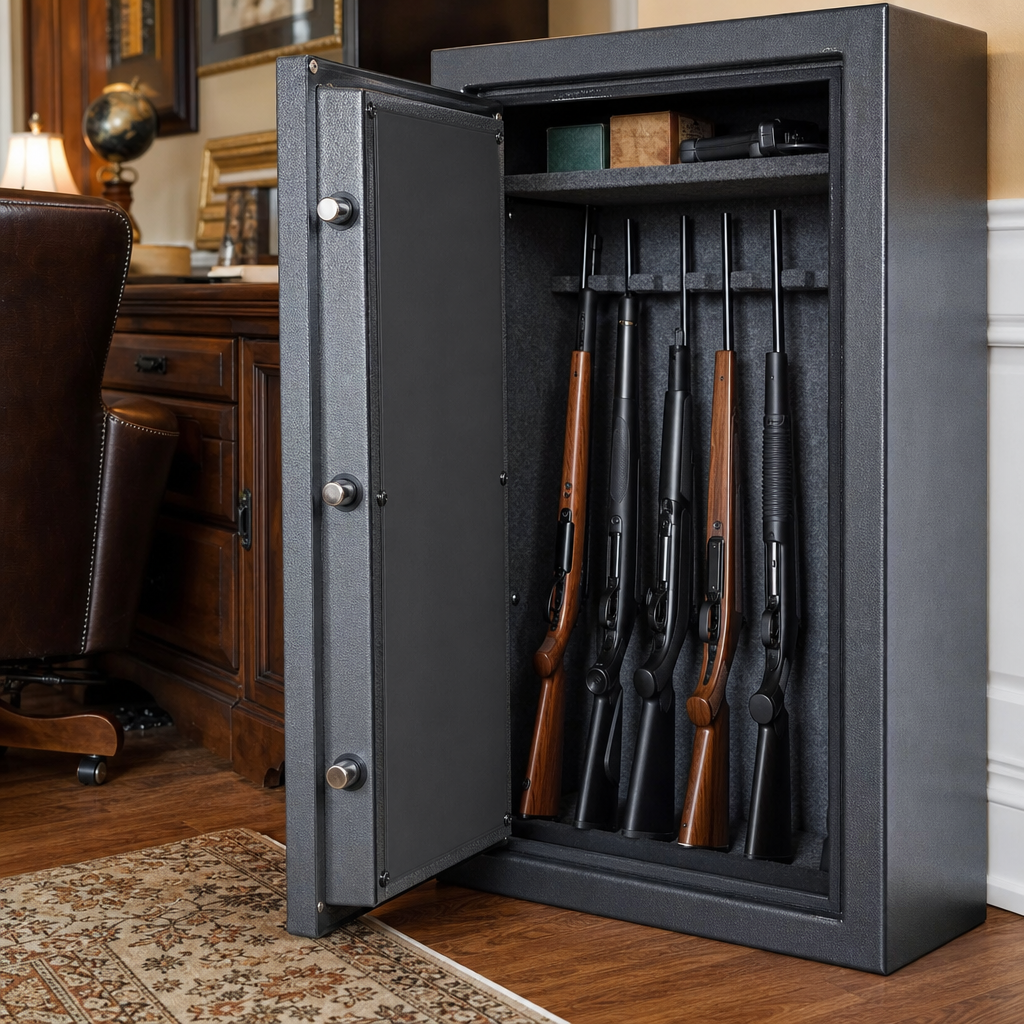
How insurance companies view fireproof gun safe ownership starts with risk, because insurers price policies by estimating how likely a loss is, how severe it could become, and how well a homeowner reduces preventable damage. In the firearms space, a fireproof gun safe is more than a metal box. It is a burglary deterrent, a heat barrier, a document vault, and a signal that the owner takes storage seriously. That combination matters when carriers review underwriting details, decide whether to extend scheduled personal property coverage, or evaluate a future claim involving stolen or damaged firearms.
Fireproof and disaster-resistant storage refers to safes or vaults designed to protect contents against high temperatures, smoke, water intrusion, impact, and sometimes structural collapse. In practice, protection levels vary widely. A safe with a 30-minute fire label at 1200 degrees Fahrenheit is not equivalent to a gun safe tested for 90 minutes at 1680 degrees with expanding door seals and insulated walls. Some products emphasize burglary resistance and offer only modest heat protection. Others are built for combined hazards, including wildfire exposure, fire hose runoff, and flood-prone basements. Insurance companies notice those distinctions because the engineering behind the safe affects expected loss outcomes.
Homeowners often assume any safe automatically lowers premiums. That is not how most carriers work. In my experience reviewing policy language and speaking with agents about firearm collections, the more common result is not a blanket discount but a better underwriting profile, easier approval for higher limits, and fewer disputes when documenting responsible ownership. A fireproof gun safe can support applications for inland marine endorsements, scheduled firearms coverage, and higher sublimits for accessories, optics, or ammunition. It can also strengthen the narrative that the insured took reasonable precautions, which becomes valuable after a claim.
This matters because standard homeowners insurance frequently limits theft coverage for firearms, often around $2,500, though forms and states vary. Fire damage to guns may be covered under dwelling or personal property provisions, but collections, antique firearms, suppressors, and custom builds can quickly exceed default limits. Add the cost of serialized accessories, tax stamps, records, and related documents, and the financial exposure grows fast. A quality fireproof gun safe helps preserve both the items and the paperwork needed to prove ownership. For insurers, that means better risk control. For owners, it means a stronger position before and after disaster.
Why insurers ask about gun safes in the first place
Insurance companies ask about safes because storage habits affect frequency and severity of claims. A firearm left unsecured is easier to steal, more likely to be damaged in a chaotic evacuation, and more likely to create liability concerns if accessed by a child or unauthorized person. A fireproof gun safe directly addresses several of those issues. It slows theft, concentrates valuables in one hardened location, and reduces heat exposure long enough for many residential fires to be controlled. Underwriters do not see a safe as a guarantee, but they do see it as measurable mitigation.
Carriers also use safe ownership as a proxy for broader household risk management. Owners who anchor a safe, maintain an inventory, keep purchase receipts, and choose a tested model often have smoke alarms, monitored security systems, and updated policy schedules as well. That pattern matters. Underwriters build decisions from multiple small indicators, and responsible storage contributes to the overall picture. If a policyholder wants broader firearms coverage, the carrier may ask where guns are stored, whether the safe is bolted down, and whether records are backed up offsite or in a secondary fire-resistant container.
Another reason insurers care is claims administration. After a fire or burglary, the hardest disputes usually involve proof: what existed, what was worth what, and whether the damage happened as reported. A well-organized safe often contains receipts, appraisals, serial number logs, photographs, and tax documents. That documentation can shorten the adjustment process significantly. I have seen claims move faster when the owner could produce a pre-loss inventory and clear photos of the interior arrangement. From the insurer’s perspective, a fireproof gun safe is partly a protection device and partly a documentation hub.
What features make a fireproof gun safe insurance-relevant
Not every advertised fireproof gun safe carries equal weight. The details that matter most are independent testing, fire duration, temperature rating, seal design, lock quality, steel thickness, anchoring method, and placement in the home. Independent testing is especially important because manufacturer claims vary in rigor. A labeled fire rating should identify both the test temperature and the duration. Door seals that expand under heat help block smoke and steam. Composite insulation, continuous welds, and multi-directional locking bolts usually perform better than thin cabinets with decorative branding.
Water resistance also matters more than many owners realize. Most residential fire losses involve water from sprinklers, hoses, or roof failure. A safe that survives heat but allows standing water to enter may still leave firearms rusted, optics fogged, and paper records ruined. For that reason, insurers and adjusters tend to view disaster-resistant storage more favorably when the owner pairs fire protection with dehumidification, desiccants, elevated installation, and waterproof document sleeves. In wildfire and hurricane regions, this layered approach is especially persuasive because the hazard rarely arrives in only one form.
| Feature | Why insurers care | Practical example |
|---|---|---|
| Verified fire rating | Reduces uncertainty about heat survivability | 90 minutes at 1680°F protects firearms and records better than vague “fireproof” marketing |
| Anchored installation | Lowers theft and tip-over risk | Bolting a 700-pound safe to concrete makes smash-and-grab removal far harder |
| Water-resistant seals | Addresses hose runoff and flooding after fire | Documents stay legible after suppression water enters the room |
| Inventory stored inside | Improves claim verification | Serial numbers and receipts survive even if the rest of the room burns |
| Humidity control | Prevents corrosion-related losses | GoldenRod and desiccants limit rust on blued steel in humid basements |
Placement influences performance too. A safe in a garage can be convenient, but garages may see faster heat buildup, vehicle fuel loads, and direct wildfire exposure. An upper-floor installation can become inaccessible after structural damage. In many homes, a ground-floor interior wall on a concrete slab provides the best balance of burglary resistance, weight support, and fire survivability. If the safe is installed in a basement, owners need to think seriously about flood risk, sump failures, and the possibility that water will pool around the door. Insurers appreciate owners who understand these tradeoffs instead of relying on the word fireproof alone.
How safe ownership affects underwriting and premiums
For most policyholders, owning a fireproof gun safe does not trigger a simple line-item discount the way a central alarm or impact-resistant roof might. Instead, it affects underwriting judgment. If you are requesting increased firearms limits, scheduling individual guns, or insuring a collection with rare or custom items, the existence of a quality safe can make the carrier more comfortable extending coverage. Some specialty insurers explicitly ask for the make, model, weight, lock type, and fire rating. Others may require a safe above a certain burglary classification once collection values exceed a threshold.
When I have seen premium changes tied to gun safe ownership, they usually occur indirectly. A homeowner qualifies for a broader policy, avoids a surcharge attached to unsecured collections, or gains access to a specialty market with more favorable rates because the risk is better controlled. In other cases, the premium stays the same, but the insured receives higher limits or fewer restrictive conditions. That outcome is still valuable. Insurance value is not only about lower price; it is also about the quality and reliability of coverage when a serious event happens.
Carriers differ widely. A mass-market homeowners insurer may barely note a safe unless the insured asks for additional firearms coverage. A high-net-worth carrier or collectibles insurer may care deeply and request photos, appraisals, and installation details. State regulation, policy form, local theft rates, wildfire exposure, and prior claims all shape the final decision. The practical takeaway is straightforward: do not assume your safe earns a discount, and do not assume it is irrelevant. Ask the agent exactly how the carrier treats secured firearms, what sublimits apply, and whether documented safe ownership supports stronger terms.
Fire, theft, and liability: the three risks carriers balance
Insurance companies usually evaluate firearm storage across three connected risks: direct property damage, theft, and liability. Fireproof gun safe ownership speaks most obviously to direct damage, but theft is often the larger day-to-day concern. According to FBI property crime reporting trends over time, residential burglary remains a meaningful source of firearm theft, and stolen guns can create long downstream consequences for owners and communities. A well-built safe with relockers, drill-resistant hard plates, and anchored installation sharply reduces opportunistic theft. That risk reduction may matter as much as the fire rating.
Liability is the third leg of the analysis. If an unauthorized person accesses a firearm because it was stored negligently, the resulting legal exposure can exceed the value of the gun itself. Safe storage laws in some states strengthen this concern, but even where statutes are less specific, insurers know juries respond poorly to careless storage. A fireproof safe with controlled access, audit-capable smart locks in some cases, and separate ammunition management demonstrates a higher standard of care. It will not eliminate liability, but it helps show the owner acted responsibly.
These risks overlap during disasters. Imagine a house fire followed by a temporary vacancy while repairs proceed. If firearms survive but are left in a compromised structure, theft risk rises. If records are destroyed, proving ownership becomes harder. If a damaged firearm later malfunctions because corrosion went unnoticed, safety issues compound. Carriers therefore prefer storage systems that support continuity: heat resistance, water resistance, inventory preservation, and secure relocation plans. Owners who think beyond the initial event usually recover faster and encounter fewer insurance complications.
Documentation, valuation, and claims after a loss
One of the strongest insurance arguments for a fireproof gun safe is claims readiness. A safe should contain more than firearms. It should hold serial number inventories, dated photos, purchase receipts, appraisals for collector pieces, National Firearms Act paperwork where applicable, and a current copy of the policy declarations page. Digital backups should live in encrypted cloud storage or an offsite location. If a disaster destroys the home, those records become the difference between a smooth claim and an exhausting reconstruction exercise based on memory.
Valuation is another area where owners often make mistakes. Standard homeowners policies commonly settle personal property losses on an actual cash value basis unless replacement cost coverage has been added, and even then collectibles or unique firearms may need special handling. A rare Winchester, a hand-fitted competition pistol, or a precision rifle with premium glass cannot be documented adequately with a rough estimate. Insurers respond best to specifics: manufacturer, model, serial number, modifications, accessories, purchase date, and current appraised value. Keeping that information protected inside the safe strengthens any future claim.
After a fire, do not assume a firearm is safe to use because it looks intact. Heat can affect temper, optics, adhesives, polymers, and ammunition stability. Insurers may request expert inspection before paying for restoration or replacement. Reputable gunsmith evaluations, manufacturer assessments, and adjuster-approved reports carry weight. I recommend photographing the safe exterior, lock area, interior, and every affected item before moving anything, unless emergency responders instruct otherwise. Those images preserve context and help prove whether the safe performed as intended under real conditions.
Choosing storage that insurers respect
If this page is your hub for fireproof and disaster-resistant storage, the clearest buying rule is to match the safe to the real hazard profile of your location, not to advertising slogans. In wildfire country, prioritize longer fire duration, better door seals, and placement away from attached garage fuel loads. In humid coastal or flood-prone areas, elevate the safe and add corrosion control, waterproof sleeves, and offsite backups. In high-theft neighborhoods, lean harder into steel thickness, lock protection, anchoring, and alarm integration. The best insurance outcome comes from aligning features with risks.
Brands and models change, but the evaluation method stays consistent. Ask for tested fire ratings, not generic claims. Verify whether the safe uses gypsum board, proprietary composite fill, or ceramic wool insulation, because materials influence both performance and interior humidity behavior. Check lock options carefully; electronic locks are convenient, while mechanical dials can offer long-term reliability, and some premium units combine both. Review warranty terms and post-fire replacement policies. Several major manufacturers offer after-fire replacement programs, which insurers may view favorably because they reduce restoration uncertainty.
Finally, treat the safe as one layer in a broader protection plan. Add monitored smoke detection, maintain updated appraisals, review firearms sublimits annually, and confirm with your agent whether your collection belongs on a scheduled endorsement. A fireproof gun safe helps insurers see a lower, better-managed risk, but its biggest benefit is practical: it protects firearms, documents, and financial value when theft, fire, or severe weather hit. Audit your current storage, compare it to your policy limits, and upgrade where the gaps are obvious.
Frequently Asked Questions
Do insurance companies give discounts for owning a fireproof gun safe?
Sometimes, but not always in the simple, automatic way many homeowners expect. Insurance companies generally do not treat a fireproof gun safe like a universal coupon that instantly lowers every policy premium. Instead, they look at it as one risk-management factor among many. Underwriters evaluate the overall chance of loss, the potential size of a claim, and the steps a policyholder has taken to reduce avoidable damage. A fireproof gun safe can help on all three fronts by lowering the likelihood of firearm theft, limiting fire-related damage to firearms and related valuables, and showing that the owner uses responsible storage practices.
Whether that translates into a discount depends on the carrier, the policy type, the insured value of the firearms, and how the guns are classified under the policy. Some insurers may offer better terms through scheduled personal property coverage, reduced underwriting concern, or easier approval for higher-value collections when secure storage is documented. Others may not advertise a specific “safe discount” at all, but may still view the safe favorably when pricing or renewing coverage. In practical terms, safe ownership often helps more with insurability, coverage flexibility, and claims defensibility than with a dramatic premium reduction. If a homeowner wants to know the actual impact, the best approach is to ask the insurer exactly how secure firearm storage affects underwriting, endorsements, collectibles coverage, and liability considerations.
Why do insurers care whether a gun safe is fireproof and not just theft-resistant?
Insurers care because their exposure is not limited to burglary. A standard homeowners claim can involve fire, smoke, water used to extinguish a fire, structural collapse, or secondary property damage that affects firearms, optics, documents, ammunition records, appraisals, and serial number documentation. A fireproof gun safe addresses multiple categories of loss at once. It may help protect the firearms themselves from heat for a rated period, but it can also preserve purchase receipts, inventory lists, tax documents, trust paperwork, and other records that become extremely important during a claim.
From the insurer’s perspective, that matters because better protection can reduce claim severity and simplify claims handling. If a safe preserves proof of ownership and valuation documents, the policyholder is in a stronger position to substantiate the loss, and the insurer can process the claim with fewer disputes about what was owned and what it was worth. Fire resistance also signals a more comprehensive approach to risk. A homeowner who chooses a rated fireproof safe, installs it properly, and uses it consistently is often seen as someone actively reducing preventable damage rather than merely checking a box. That responsible-storage profile can influence underwriting decisions, especially when firearms collections are valuable, specialized, or specifically scheduled on the policy.
Can a fireproof gun safe help a homeowner qualify for better firearms coverage?
Yes, in many cases it can help, particularly when the homeowner is trying to insure firearms beyond the basic limits included in a standard homeowners policy. Many policies place sublimits on theft coverage for firearms, meaning the default protection may be far lower than the actual value of a collection. To close that gap, policyholders often need a scheduled personal property endorsement, a valuables rider, or even a separate policy. When an insurer evaluates that request, storage conditions become highly relevant. A fireproof gun safe can support the argument that the collection is being stored responsibly and that the risk of theft or catastrophic damage is being actively managed.
That does not mean the safe alone guarantees broader coverage. Insurers may still ask for appraisals, purchase records, photographs, serial numbers, alarm system details, and in some cases the safe’s brand, fire rating, locking mechanism, anchoring method, and location within the home. But secure storage can absolutely strengthen a homeowner’s underwriting profile. For higher-value firearm owners, it may be the difference between receiving favorable terms, facing stricter conditions, or being asked to seek coverage from a specialty insurer. In that sense, a fireproof gun safe is often part of the documentation package that supports better coverage, higher insured values, and smoother policy approval for collections that exceed standard policy assumptions.
What features of a fireproof gun safe matter most to an insurance company?
Insurance companies are usually less impressed by marketing language and more interested in practical, verifiable risk-reduction features. The first major factor is whether the safe has a credible fire rating from a recognized testing standard or clearly documented manufacturer specifications. Underwriters want to know how long the safe can withstand a certain temperature range and whether that protection is realistic for residential fire scenarios. The second major factor is burglary resistance, including steel construction, locking mechanism quality, pry resistance, door design, and overall build strength. A safe that is only nominally “fireproof” but easy to remove or breach may not carry much underwriting value.
Other details matter too. Anchoring the safe to the floor or structure is important because a heavy safe that can still be carried away may offer less real-world theft protection than homeowners assume. Placement inside the home can also influence risk; a concealed, climate-stable location away from easy entry points may be viewed more favorably than a highly visible garage installation. Insurers may also care about whether the safe is used consistently, whether access is limited, and whether it stores related documents and records in addition to firearms. In short, the features that matter most are the ones that reduce the chance of theft, reduce the severity of fire loss, and improve post-loss documentation. The more a safe functions as a serious protective system rather than just a storage container, the more useful it tends to be from an insurance standpoint.
Should homeowners tell their insurance company that they own a fireproof gun safe?
In most situations, yes. Informing the insurer can be beneficial because a risk-control measure only helps underwriting if the company knows it exists. If the homeowner owns firearms of meaningful value, is seeking higher limits, or wants to schedule individual guns or an entire collection, disclosure is especially important. A fireproof gun safe can provide context that the firearms are not loosely stored, that theft deterrence is in place, and that records may be protected in the event of a fire. That can improve the quality of the underwriting conversation and help the homeowner avoid assumptions about what is or is not covered.
The key is to communicate clearly and accurately. Homeowners should not simply say they have a “safe” and leave it at that. It is better to be prepared with the safe’s make, model, fire rating, lock type, installation details, and whether it is anchored. If the firearms are valuable, maintaining an updated inventory with serial numbers, photos, receipts, and appraisals is just as important as the safe itself. This kind of documentation can make claims much easier if a loss occurs. Just as importantly, disclosing the safe gives the homeowner an opportunity to ask direct questions: Are firearms subject to a theft sublimit? Is accidental damage covered? Would a rider or scheduled endorsement be better? Are accessories, optics, and suppressors covered the same way? By bringing up the fireproof gun safe proactively, homeowners can often uncover gaps in coverage and put stronger protection in place before a loss happens.