
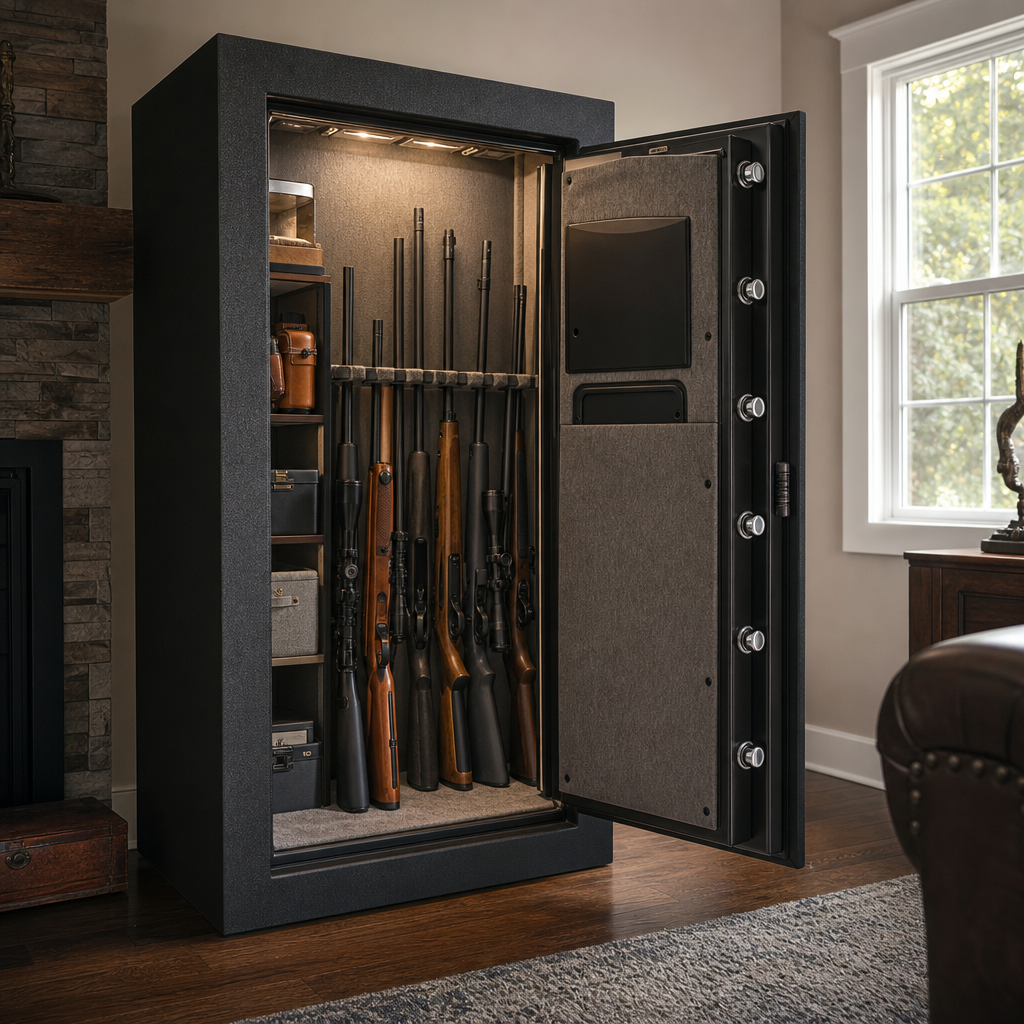
Fireproof gun safes have changed from simple steel boxes with insulation into engineered storage systems built to resist heat, smoke, water, impact, and forced entry during real emergencies. In the gun safes and safety market, “fireproof” usually means fire-resistant for a tested duration at a stated temperature, while disaster-resistant storage includes protection against floodwater, structural collapse, corrosion, and tampering after a fire. That distinction matters because many buyers assume any heavy safe will shield firearms and documents indefinitely, yet performance depends on test standards, seal design, insulation chemistry, locking systems, and installation method. I have evaluated safes after house fires, and the pattern is clear: the units that perform best combine layers of technology rather than relying on thick steel alone. Modern designs now use advanced fireboard composites, expanding door seals, digital monitoring, reinforced boltwork, and anchor strategies that help a safe stay intact when a room reaches extreme temperatures or a floor gives way. For gun owners, collectors, and households storing passports, cash, optics, and legal paperwork alongside firearms, these advances reduce the risk of irreversible loss. Understanding how new technologies are improving fireproof gun safe designs helps buyers compare ratings correctly, avoid misleading labels, and choose storage that protects both safety and long-term asset value.
Smarter fire insulation is raising real-world fire resistance
The biggest improvement in fireproof gun safe design is not cosmetic; it is the insulation package hidden inside the walls, door, and ceiling of the safe. Earlier consumer safes often relied on basic gypsum board because it contains chemically bound water that releases as steam when heated, slowing internal temperature rise. Many current models still use gypsum, but higher-performing safes now layer it with ceramic fiber, proprietary fireboard composites, or poured insulation systems that fill voids more evenly. The engineering goal is straightforward: delay the moment when the interior exceeds temperatures that damage wood stocks, polymer frames, optics adhesives, ammunition packaging, documents, or electronic media.
Manufacturers usually target interior temperatures below about 350 degrees Fahrenheit for paper protection during a standardized fire exposure. That number is important because ordinary paper begins to char around 405 degrees Fahrenheit, but damage starts well before open ignition. Firearms introduce a more complex requirement. Bluing, lubricants, optics, and synthetic components can degrade at lower thresholds than the steel receiver itself. In practice, this means a “60-minute” rating is only useful if it comes from a credible test protocol and if the safe has enough insulation mass to handle sustained heat rather than a brief spike.
Newer composite wall assemblies improve performance by reducing heat transfer at seams and corners, where older safes often failed first. Some premium models also create thermal breaks between exterior steel and interior liners so heat does not conduct inward as quickly. That matters in garage installations, where fires can burn hot because of fuel loads such as gasoline, paint, tires, and power equipment. I have seen insulated body panels remain serviceable while an under-engineered door edge leaked heat and smoke; modern designs are better because engineers now treat the door opening as the most critical thermal weak point, not just the shell.
Heat-activated seals now block smoke, steam, and embers more effectively
An insulated safe body can still fail if superheated smoke and embers enter through the door gap. That is why expanding intumescent seals are one of the most important fireproof gun safe upgrades. These seals swell when exposed to high heat, closing small gaps around the door frame and reducing the pathways for smoke, flame, and pressure-driven hot gases. Older entry-level safes often used minimal gasket material or focused only on a basic dust seal. Newer designs frequently pair intumescent seals with compression seals, creating two layers of defense: one for daily environmental resistance and one that activates during a fire.
This technology matters because smoke damage is not a minor issue. Fire residue is acidic and corrosive, especially when modern building materials, plastics, and electronics burn. Even if the safe interior never reaches destructive temperatures, smoke infiltration can etch metal finishes, damage optics coatings, and contaminate documents or ammunition boxes. Better door-frame machining also helps. Tighter tolerances allow the expanding seal to work more uniformly, which reduces localized leakage points at corners and hinge sides.
Some manufacturers combine fire seals with water-resistant door channels that slow intrusion from firefighting runoff or minor flooding. That is not the same as a full waterproof certification, but it addresses a common post-fire threat. In a residential fire, the safe may survive the heat and then sit in several inches of water for hours. A well-designed seal system buys time before moisture reaches the contents. Buyers comparing models should look for specifics about seal placement, number of layers, and whether the safe is rated for both fire and water exposure rather than relying on general language on a product label.
Testing standards and verified ratings are becoming more meaningful
One of the most positive trends in fireproof gun safe design is the market shift toward clearer testing language. A safe is only as credible as the standard behind its rating. In the United States, buyers often encounter references to independent laboratories such as UL, along with manufacturer-run furnace tests. These are not equivalent. UL 72 is a recognized fire endurance standard for record protection equipment, and while not every gun safe is tested to that exact standard, products that cite independent verification generally deserve more confidence than those using vague claims like “factory tested at 1400 degrees.”
The key variables are furnace temperature, test duration, internal temperature threshold, cool-down period, and whether the safe remains closed and functional after exposure. Cool-down matters because a safe can continue heating internally even after the external fire is extinguished. Structural integrity matters too. If the body warps, the door springs, or the lock fails after heating, the practical value of the fire rating drops sharply. Serious buyers should also distinguish between document ratings and data ratings. Hard drives, USB devices, and memory cards are more heat sensitive than paper, and most gun safes are not designed to protect digital media unless they include a dedicated inner chest.
Better brands now publish more transparent details about their protocols, including external temperatures of 1200 to 1680 degrees Fahrenheit and durations from 30 to 120 minutes. That transparency is an improvement because it lets consumers compare models on meaningful terms. It also reduces the confusion between “fireproof” marketing language and actual fire-resistant performance under documented conditions.
Locks, sensors, and power systems are improving reliability during disasters
Lock technology has advanced beyond convenience features and now directly supports disaster resistance. Traditional mechanical dial locks remain respected because they are simple, durable, and independent of batteries. They are still an excellent choice for long-term reliability. However, new electronic locks have improved significantly, especially on quality safes using EMP-resistant designs, external battery override ports, redundant key systems where legally appropriate, and encrypted keypad modules. The best electronic systems lock faster, allow multiple user codes, and can integrate audit trails or tamper alerts without sacrificing security.
Internal environmental sensors are another meaningful development. Some modern safes include humidity monitoring, temperature readouts, or connections to home security systems. For collectors storing blued firearms, antique wood stocks, or suppressor accessories, humidity control is not optional. A fireproof safe with poor moisture management can still damage guns through rust or stock warping. Dehumidifier rods, rechargeable desiccants, and app-linked sensors help owners catch conditions before corrosion starts.
I increasingly recommend buyers think about post-disaster access as much as fire survival. After a wildfire evacuation or a house fire, owners may need to document contents quickly for insurance or law enforcement. Locks with illuminated keypads, backup power access, and reliable relockers make that process easier. At the same time, electronic convenience should never replace proven boltwork, hard plates, and drill-resistant lock protection. The strongest modern designs integrate digital features around a fundamentally robust mechanical security platform, not instead of it.
Water, impact, and structural protection now complement fire resistance
Fireproof and disaster-resistant storage has expanded because manufacturers finally recognize that most losses are not caused by heat alone. Fire hoses, sprinklers, burst pipes, hurricanes, tornadoes, and collapsing framing can all destroy contents after or alongside a fire. New technologies are addressing these threats through welded body construction, continuous door channels, raised thresholds, corrosion-resistant coatings, and improved anchor systems. A safe that tips over during a structural failure or floats in floodwater may lose its seal integrity or become easier to attack, so base stability has become a design priority.
Some safes now include verified water resistance measured in hours at a certain depth, often using gasketed door systems and tighter manufacturing tolerances. While that is useful, buyers should read the fine print. Water resistance often assumes the safe remains upright and properly bolted. It may not apply in full submersion after a foundation shift. Impact resistance is also improving through stronger weld geometry, thicker door plates, and reinforced hinge-side designs that reduce deformation when debris falls onto the safe.
The following comparison highlights how current disaster-resistant features work together in practice.
| Feature | What it does | Why it matters in a real event |
|---|---|---|
| Intumescent door seal | Expands under heat to block gaps | Reduces smoke, ember, and heat intrusion during a house fire |
| Composite fire insulation | Slows internal temperature rise | Protects firearms, documents, and optics longer than basic single-layer board |
| Water-resistant gasket system | Limits moisture entry around the door | Helps during sprinkler discharge, hose runoff, or shallow flooding |
| Anchor-ready reinforced base | Secures safe to slab or framing | Reduces tipping, theft, and movement during impact or collapse |
| EMP-resistant electronic lock with override power | Maintains access when internal battery fails | Improves reliability after evacuation, outage, or long storage intervals |
These improvements do not make any safe invulnerable, but together they dramatically increase the odds that contents remain protected and recoverable after a disaster.
Materials, layout, and installation choices are making safes safer to own
Better materials science has also improved daily usability, which indirectly supports safety. Adjustable interior modules, barrel racks that reduce pressure points, and fabric-lined shelves help owners store long guns, handguns, passports, and ammunition more efficiently. That matters because overcrowding causes damage and slows emergency access. New interiors often use modular systems that let owners configure space for scoped rifles, document bins, and power cords for dehumidifiers or lighting. A well-organized safe is less likely to be left open, overpacked, or used improperly.
On the exterior, powder-coated finishes and improved steel preparation increase corrosion resistance in humid basements and coastal climates. Stainless components are still uncommon in full safe construction because of cost and security tradeoffs, but zinc-coated hardware and improved primers reduce rust at hinges, bolts, and anchor points. Some manufacturers now use robotic welding and CNC cutting for more consistent fitment. That consistency matters because uneven gaps undermine both fire seals and burglary resistance.
Installation technology has improved as well. The best fireproof gun safe can underperform if placed on a combustible wood floor without support, installed in a flood-prone corner, or left unanchored in a garage. Today, more dealers use moisture barriers, engineered shims, heavy-duty concrete anchors, and site-specific placement guidance. In my experience, a modestly priced safe that is correctly anchored on a slab, kept off direct water paths, and paired with humidity control often outperforms a more expensive model that is poorly installed. Buyers should treat delivery and anchoring as part of the protection system, not an afterthought.
How to evaluate a fireproof gun safe before you buy
Start with your risk profile. A suburban home with a monitored alarm and low flood risk needs a different safe than a rural property exposed to wildfire, long emergency response times, and detached-garage storage. Next, verify the fire rating source, duration, and temperature. Look for independent testing where possible, and ask whether the rating includes cool-down. Examine door seal design, steel thickness, boltwork coverage, lock type, and anchor options. If you plan to store documents or digital media with firearms, use interior protective boxes rated for those materials rather than assuming the main safe covers every item equally.
Pay attention to warranty language and replacement terms after fire or flood. Reputable brands often provide clearer disaster replacement policies and stronger dealer support. Also consider serviceability. Can the lock be replaced without destroying the door? Are replacement parts available? Is the brand supported by trained locksmiths in your area? These practical questions matter more than glossy marketing photos.
Finally, use this page as a hub for deeper research across the fireproof and disaster-resistant storage category. From fire ratings and waterproofing to placement, maintenance, and insurance documentation, every subtopic connects back to one principle: the best gun safe is the one engineered, installed, and maintained for the specific disasters you are most likely to face.
New technologies are improving fireproof gun safe designs by solving the exact problems that caused older safes to fail: weak insulation, leaky door gaps, vague testing claims, moisture intrusion, poor anchoring, and unreliable access after an emergency. Today’s best models combine composite fire barriers, expanding seals, validated ratings, stronger lock systems, environmental monitoring, and better water and impact protection. That layered approach matters because real disasters do not happen one variable at a time. A house fire can include smoke, hose water, collapse, theft risk, and days of damp conditions afterward. A modern disaster-resistant safe is built for that chain of events, not just a furnace test.
For gun owners, the benefit is broader than protecting metal from heat. You are preserving legal documents, family records, optics, ammunition organization, and the long-term condition of valuable firearms. You are also improving household safety by keeping guns secured in a storage system that remains dependable under stress. The smartest buying decision is to match verified fire performance with the right installation, humidity control, and access method for your environment.
If you are comparing options in the gun safes and safety category, continue with the related fireproof and disaster-resistant storage guides linked from this hub, then shortlist models with documented ratings and professional installation support before you buy.
Frequently Asked Questions
1. How are new technologies making modern fireproof gun safes more effective than older designs?
Modern fireproof gun safes are no longer just steel boxes lined with basic insulation. New technologies have transformed them into multi-layered protective systems engineered to perform during actual disasters, not just under ideal showroom conditions. Today’s designs often combine reinforced steel bodies, composite door construction, advanced fireboard or proprietary insulation blends, expanding heat seals, upgraded locking systems, and improved internal organization that helps reduce heat transfer to firearms and valuables. Many newer models are also built with tighter manufacturing tolerances, stronger hinge and bolt configurations, and better door sealing to help block smoke, heat, and moisture intrusion.
Another major improvement is the way manufacturers now design safes around multiple threats at once. In the past, a safe might have been marketed mainly for theft deterrence or basic fire resistance. Newer models are engineered to resist heat, water used in firefighting, impact from falling debris, and attempted forced entry after a structure fire weakens surrounding materials. Some safes now include corrosion-resistant interior materials, dehumidification support, digital monitoring features, and anchoring systems that improve stability during catastrophic events. In practical terms, new technology is improving both survivability and usability, giving owners protection that is more realistic, measurable, and tailored to real emergency conditions.
2. What does “fireproof” really mean for a gun safe, and how do modern testing standards affect what buyers should look for?
In the gun safe industry, “fireproof” is usually a marketing shortcut rather than a literal guarantee. A more accurate term is “fire-resistant,” meaning the safe has been designed to keep internal temperatures below a damaging threshold for a specific amount of time at a stated external temperature. For example, a safe may be rated for 30, 60, 90, or 120 minutes at a certain heat level. That matters because no safe is universally immune to all fire conditions. Real fires vary widely in duration, intensity, ventilation, structural collapse, and post-fire exposure to steam, smoke, and water. A safe that performs well in one test scenario may face very different challenges in a full-scale residential fire.
Modern testing and engineering have made it easier for consumers to compare products, but buyers still need to read claims carefully. The most useful fire ratings identify the temperature, duration, and ideally whether testing was conducted by an independent laboratory rather than only in-house by the manufacturer. New technologies have improved thermal barriers and door seals, but buyers should also ask what the safe is intended to protect. Firearms, paper documents, optics, electronics, and ammunition all respond differently to heat and humidity. The best approach is to look beyond the word “fireproof” and focus on tested fire resistance, seal design, body construction, door integrity, water resistance, and how the safe performs as part of a broader disaster-resistant storage strategy.
3. What new materials and insulation technologies are being used in fire-resistant gun safes?
One of the biggest advances in gun safe design is the move toward more sophisticated thermal barrier materials. Older fire safes often relied heavily on layers of gypsum-based fireboard, which still remains common because it releases moisture when heated and helps slow temperature rise. However, many newer safes improve on that approach with multiple insulation layers, denser composite barriers, proprietary fill materials, and strategically placed heat-resistant linings around vulnerable areas such as doors, seams, and lock housings. Some premium designs use poured or layered composite construction rather than depending only on sheet steel plus standard fireboard. This can create a more robust shell that slows heat penetration and improves structural rigidity at the same time.
Heat-activated door seals are another important innovation. These seals expand during a fire to help close off gaps around the door, reducing the amount of hot gases, smoke, and embers that can enter the safe. That is especially important because smoke and superheated gases can damage firearm finishes, optics, wood stocks, documents, and internal electronics even before direct flame exposure becomes the main issue. In addition, manufacturers are paying more attention to corrosion control after a fire event. Since steam, residual moisture, and firefighting water can create long-term damage inside a safe, some modern interiors use better coatings, moisture-management accessories, and dehumidifier compatibility. Together, these material and insulation advances help turn the safe from a simple heat barrier into a more complete protective enclosure.
4. Are new fireproof gun safes also better at protecting against water, smoke, impact, and forced entry?
Yes, and that is one of the most important shifts in the market. A serious house fire rarely involves only heat. Firefighting efforts can flood floors with water, ceilings can collapse, walls can fail, and smoke can infiltrate nearly every opening. After the fire is out, a damaged home may be left exposed to weather, theft, and prolonged humidity. New gun safe designs increasingly reflect those realities by combining fire resistance with disaster-resistant features. Better door seals can help limit smoke and water intrusion. More rigid bodies and reinforced doors may better withstand falling debris or structural shifts. Protective finishes and interior treatments can reduce corrosion risk when moisture exposure follows a fire. Some safes also offer elevated thresholds, tighter seam construction, and improved boltwork that continue to protect contents even after the safe has been battered by a chaotic environment.
Forced entry resistance is also receiving more engineering attention because safes can become especially vulnerable after a fire. A criminal may target a damaged property, assuming the safe is weakened or easier to remove. Newer safes may include thicker steel, reinforced hard plates, relockers, stronger locking bolts, anti-pry door designs, internal hinge support, and anchor provisions that make removal more difficult. The best modern safe is not just trying to survive flames for a period of time; it is designed to preserve security before, during, and after the event. For buyers, this means it is smart to evaluate a safe as an all-hazard storage system rather than judging it on a single fire-rating number alone.
5. What should buyers prioritize when choosing a modern fire-resistant gun safe for real-world protection?
Buyers should start by matching the safe to the risks they are most likely to face. Fire rating is important, but it should be evaluated alongside burglary resistance, seal quality, steel thickness, locking system reliability, interior capacity, anchoring options, and moisture control. A well-designed modern gun safe should offer a clearly stated fire-resistance duration and temperature, preferably backed by credible testing. It should also have features that address what happens after flames reach the room: expanding seals, a durable finish, a secure lock protected from heat and attack, and a construction method that does not rely on thin materials or cosmetic weight. If the safe will store more than firearms, such as passports, cash, hard drives, or legal documents, buyers should also consider whether interior temperatures during a rated fire could still damage sensitive items.
Placement and installation matter just as much as technology. Even the best safe performs better when anchored properly, located in a part of the home with lower fire exposure risk, and protected from direct flood pathways where possible. Buyers should also think about long-term maintenance. Modern safes often support dehumidifiers, lighting systems, and modular interiors, which can improve day-to-day protection and organization. Finally, it is wise to view manufacturer claims with a critical eye. The strongest choice is usually a safe that balances tested fire resistance, real anti-theft engineering, post-fire durability, and practical storage needs rather than one that simply advertises itself as “fireproof.” In today’s market, the most advanced gun safes are those designed for the full life cycle of an emergency, from initial heat exposure to the difficult hours and days that follow.