
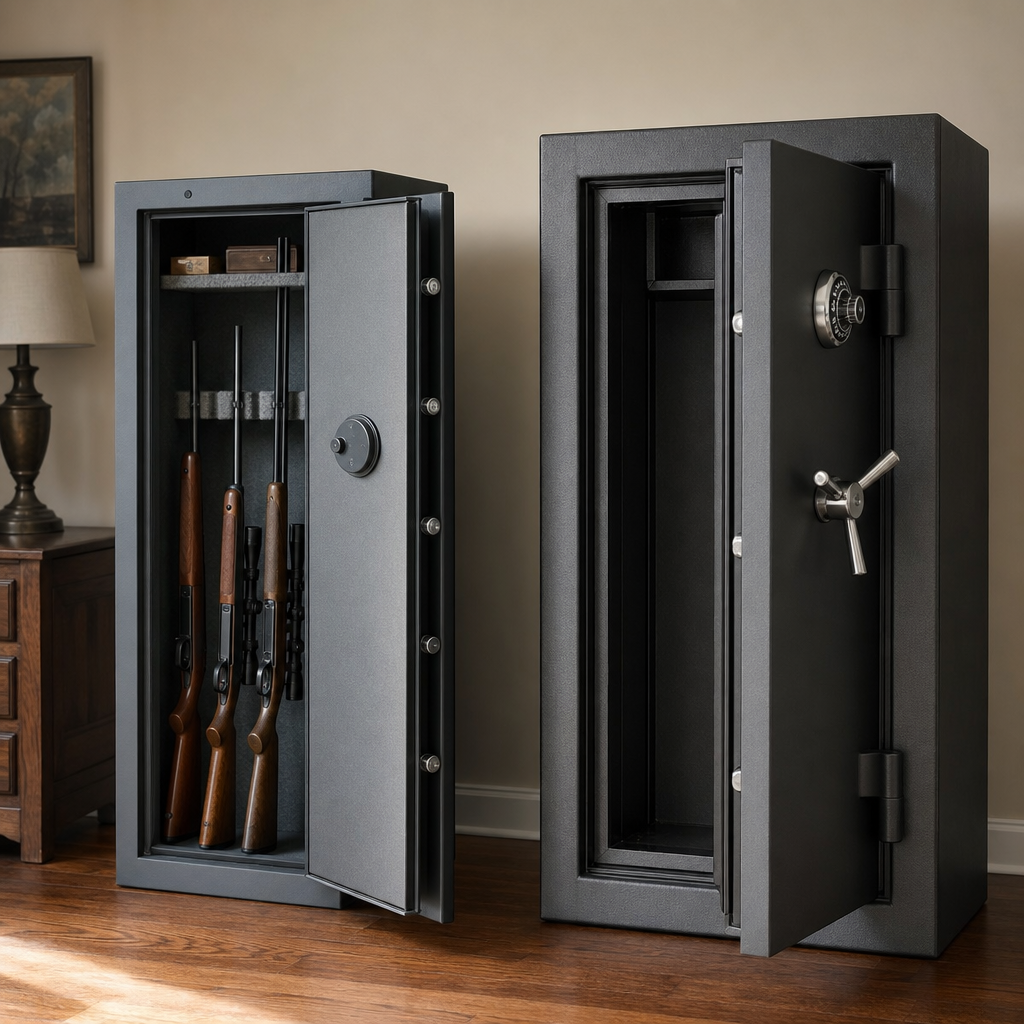
Choosing between fireproof gun cabinets and traditional safes is one of the most important decisions in firearm storage because the right container must balance fire resistance, theft deterrence, access speed, capacity, cost, and day-to-day usability. In the gun safes and safety category, fireproof and disaster-resistant storage refers to products designed to protect firearms, ammunition, documents, optics, and accessories from heat, smoke, water, humidity, and physical attack. Although the terms are often used loosely, a gun cabinet is usually lighter-gauge steel with simpler locking hardware, while a traditional safe typically uses thicker steel, more robust bolts, layered insulation, and tested fire seals. I have worked with homeowners comparing these options after moves, remodels, and insurance reviews, and the same pattern repeats: buyers often focus on advertised fire ratings first, then realize installation location, anchoring, and real burglary risk matter just as much. This topic matters because house fires can exceed 1,100 degrees Fahrenheit, suppression efforts introduce water damage, and stolen firearms create legal, financial, and safety consequences that last far beyond the event itself.
As a hub for fireproof and disaster-resistant storage, this article explains what each option does well, where each falls short, and how to match a cabinet or safe to your actual risk profile. It also clarifies common questions: Are fireproof gun cabinets truly fireproof? Do traditional safes always protect better? How should you evaluate ratings, steel thickness, lock types, and placement? By the end, you should be able to compare products intelligently and identify when a lower-cost cabinet is enough, when a heavier safe is the smarter investment, and what supporting measures improve performance during fire, flood, and forced entry.
What Fireproof Gun Cabinets and Traditional Safes Actually Are
A fireproof gun cabinet is best understood as a cabinet-style firearm storage unit that adds some level of thermal protection beyond a standard metal locker. Many models use formed sheet steel, key, electronic, or biometric locks, and an internal layer of fireboard or composite insulation. Some include intumescent door seals that expand during heat exposure to slow smoke and flame intrusion. In practice, these products target buyers who want organized firearm storage with moderate fire resistance at a lower price and weight than a full safe.
A traditional gun safe is a heavier enclosure built around stronger anti-pry construction and more substantial fire protection. Better models use thicker steel bodies, reinforced door edges, multiple live locking bolts, hard plates protecting the lock, relockers, and layered gypsum or proprietary composite insulation. Door seals are usually more sophisticated, and interiors often support long guns, handguns, shelving, dehumidifiers, and document storage. A traditional safe is not invincible, but it is designed to delay both heat transfer and physical attack significantly longer than most cabinets.
The confusion starts with marketing language. “Fireproof” almost never means a product can survive any fire indefinitely. It usually means the manufacturer claims the interior stays below a target temperature for a set period, such as 30, 45, 60, or 90 minutes under specific test conditions. Traditional safes more often publish a time-and-temperature rating, while cabinets may cite insulation without equivalent third-party testing. That distinction matters because not all ratings are created under the same protocol, and some are manufacturer tested rather than independently verified.
The Main Advantages of Fireproof Gun Cabinets
The strongest argument for a fireproof gun cabinet is value. For many households, it delivers a meaningful upgrade over an unsecured closet or non-rated cabinet without requiring the budget, floor reinforcement, or moving logistics associated with a 700-pound safe. I have seen cabinet buyers move from zero dedicated protection to organized, lockable, insulated storage in a single afternoon, and that is a practical win. If the alternative is no secure storage, a quality cabinet is materially better.
Fireproof gun cabinets are also easier to place. Because they commonly weigh far less than traditional safes, they can fit in second-floor closets, utility rooms, or corners where a very heavy safe may be impractical or require structural consultation. Installation is faster, delivery costs are lower, and anchoring into concrete or wall framing is simpler. For renters, apartment dwellers, or owners who relocate often, that lower weight can be decisive.
Another advantage is capacity per dollar. Cabinets often offer generous long-gun counts and flexible shelving at a price where a comparably sized safe would cost substantially more. That makes them attractive for owners with hunting rifles, shotguns, and modest accessory collections who want separation from unauthorized users and basic disaster protection. Many current cabinet lines also include electronic locks, door organizers, barrel rests, and carpeted interiors that improve daily convenience.
Finally, cabinets can support layered security strategies. In homes with alarm systems, monitored smoke detectors, sprinkler coverage, cameras, and rapid fire response, the needed delay time may be lower than in a remote rural property. In those cases, a fireproof cabinet paired with anchoring, humidity control, and smart placement can meet the real requirement at a lower total cost.
The Main Drawbacks of Fireproof Gun Cabinets
The biggest drawback is reduced burglary resistance. Most fireproof cabinets use lighter steel and simpler door construction than traditional safes, making them more vulnerable to pry attacks, cutting tools, and brute-force removal if not anchored properly. Even when the lock itself is adequate, the surrounding metal may not be. In after-loss reviews, I have repeatedly found that unanchored lighter units were tipped, peeled, or carried off entirely before the fire rating ever mattered.
Fire protection claims can also be inconsistent. Some cabinet manufacturers provide only limited information about test methodology, ambient temperatures, or the interior temperature threshold used. Firearms, optics, polymer components, ammunition packaging, and paper records do not all fail at the same temperature. For example, paper begins charring around 350 degrees Fahrenheit, while many plastics and adhesives degrade at lower levels. A vague “fire resistant” label is not enough when you need to protect both guns and important documents.
Cabinets also tend to have thinner gaskets, less robust hinge-side protection, and fewer anti-tamper features. Water resistance is often minimal. During a structure fire, damage may come less from flame impingement than from hose water, steam, and corrosive smoke residue. A cabinet that slows heat briefly but allows heavy moisture intrusion can still leave bluing rusted, stocks swollen, and optics compromised. Buyers should view cabinets as partial protection, not comprehensive disaster shields.
| Feature | Fireproof Gun Cabinet | Traditional Safe |
|---|---|---|
| Typical steel thickness | Lighter-gauge body construction | Heavier steel, reinforced doors |
| Fire protection | Basic to moderate, often shorter ratings | Moderate to high, usually better sealed |
| Theft resistance | Limited unless well anchored | Stronger pry and attack resistance |
| Weight and placement | Easier to move, fits more locations | Harder to move, may need planning |
| Cost | Lower entry price | Higher upfront investment |
| Best fit | Budget-conscious owners with layered security | Owners prioritizing maximum protection |
Why Traditional Safes Remain the Benchmark
Traditional safes remain the benchmark because they address the full risk stack more effectively. In real terms, that means they are better at resisting smash-and-grab theft, surviving longer fire exposure, limiting smoke entry, and preserving contents after suppression efforts. A heavier safe anchored into concrete creates a serious time problem for burglars, and time is the key variable in residential security. Most thieves are not expert safe technicians. They exploit convenience, weak placement, poor anchoring, and thin metal. Traditional safes reduce those opportunities.
Fire performance is also more credible in better safe lines because manufacturers are more likely to publish specific ratings and construction details. You may see 60 minutes at 1,200 degrees Fahrenheit or 90 minutes at 1,400 degrees, along with expanded door seals and multi-layer insulation. While published ratings still deserve scrutiny, the design intent is clearer. More mass and more insulation generally slow heat transfer, and more substantial door interfaces reduce smoke penetration.
Another reason traditional safes lead this category is interior protection. Better units support power ports for dehumidifiers, sealed pass-throughs, adjustable shelving, handgun racks, and dedicated document sections. That matters because disaster-resistant storage is not just about keeping steel guns from warping. It is about protecting optics coatings, suppressor paperwork, tax stamps, passports, hard drives, and family records that owners often place inside the same enclosure. A safe built for all of those contents is simply more versatile.
Where Traditional Safes Fall Short
The drawbacks are real. Cost is the most obvious. A genuine traditional safe with useful fire performance and solid anti-theft construction can cost several times more than a fireproof cabinet, and delivery charges may be significant. If stairs, tight turns, or upper floors are involved, professional installation becomes almost mandatory. That raises the barrier to purchase, especially for first-time gun owners who are already buying firearms, training, and accessories.
Weight creates both strength and inconvenience. A 600- to 1,200-pound safe may require floor load consideration, especially in older homes. Placement options narrow quickly. Basements are common, but basements also bring flood exposure and humidity management challenges. Garages offer concrete slabs but can present wider temperature swings and visibility risks. Closets improve concealment but may not fit the footprint or allow full door swing. In short, a better safe still performs poorly if it is installed in a bad location.
Traditional safes also create a false sense of absolute protection when buyers misunderstand ratings. No residential gun safe should be treated like a bank vault. Extended burn times, structural collapse, or severe flood conditions can overwhelm even premium models. Some “gun safes” sold through mass retail channels look substantial but rely on thin outer shells and optimistic marketing. The lesson is not that safes fail; it is that specification sheets must be read critically.
How to Evaluate Fire and Disaster Resistance Correctly
Start with the fire rating, but do not stop there. Ask who performed the test, what exterior temperature was used, how long the test lasted, and what interior temperature threshold was maintained. Independent testing from recognized labs carries more weight than internal claims. Look for details on intumescent seals, insulation type, body thickness, and whether the rating accounts for heat rise over time after the external fire source is removed. Some containers pass a short burn yet continue heating internally afterward.
Next, consider the full disaster profile of your home. In wildfire regions, longer heat exposure and ember intrusion matter. In hurricane zones, water resistance, elevation, and anchoring are critical. In humid climates, corrosion control is a daily issue, not an emergency issue. In theft-prone urban settings, pry resistance and concealment may outweigh an extra 15 minutes of fire rating. The best storage choice is local and situational, not universal.
Placement changes outcomes more than many buyers realize. A safe on a ground-floor concrete slab near a sprinklered area, away from fuel loads, generally fares better than one in a garage corner beside gasoline cans or in an upper room under a heavy roof collapse zone. Add desiccants or an electric dehumidifier rod, keep documents in rated internal pouches, and anchor the unit correctly. Those supporting steps often determine whether contents are merely dirty after an incident or completely lost.
Which Option Fits Different Gun Owners Best
A fireproof gun cabinet often fits newer gun owners, renters, hunters with a modest collection, or households that already have strong perimeter security and want better organization without a major structural installation. It is also practical for secondary storage in a low-traffic room, such as separating overflow long guns from the primary defensive firearms kept in a more secure safe. If the cabinet is bolted down, hidden from casual view, and chosen from a manufacturer that publishes credible fire data, it can be a sensible middle-ground solution.
A traditional safe is usually the better primary choice for collectors, owners with high-value optics and NFA items, families storing legal documents alongside firearms, and anyone in a location where emergency response times are long. It is also the better fit when the consequence of theft is especially severe, such as homes with multiple handguns, expensive precision rifles, or estate firearms with irreplaceable value. The more concentrated the value, the more traditional safe economics make sense.
The most effective approach is often staged protection. Use one robust safe for core firearms and sensitive paperwork, and use a cabinet for less valuable long guns or gear that still needs controlled access. That hub-and-spoke model keeps the most critical items behind the strongest barrier while expanding storage capacity affordably.
Fireproof gun cabinets and traditional safes solve the same problem from different directions. Cabinets emphasize affordability, lighter weight, and acceptable protection for owners who need a practical upgrade from basic locked storage. Traditional safes emphasize stronger burglary resistance, longer fire performance, better seals, and more credible all-around disaster protection. Neither category is automatically right or wrong. The right choice depends on your budget, collection value, local fire and theft risks, installation constraints, and how much performance you need from the container itself versus your broader home security setup.
If you remember only a few points, make them these. First, published fire claims need scrutiny; specific, test-based ratings beat vague marketing language. Second, burglary resistance and anchoring matter just as much as heat resistance because many losses happen through removal or pry attack, not direct burn-through. Third, placement, humidity control, and water exposure planning can dramatically improve results regardless of whether you choose a cabinet or a safe. Finally, buying for future growth is usually cheaper than replacing undersized storage in two years.
Use this page as your starting point for fireproof and disaster-resistant storage decisions within the broader gun safes and safety landscape. Compare ratings carefully, inspect steel thickness and door design, and choose a product that matches your real risks rather than the label on the box. If you are evaluating options now, measure your space, list what must be protected, and narrow your choice to the strongest unit your location and budget can realistically support.
Frequently Asked Questions
What is the main difference between a fireproof gun cabinet and a traditional gun safe?
The biggest difference is how each product is built and what it is primarily designed to do. A fireproof gun cabinet is usually a lighter-gauge steel storage unit that adds some level of fire or heat resistance through insulation, layered wall construction, door seals, or specialized liners. Its focus is often on organized firearm storage, faster access, lower weight, and lower cost. A traditional gun safe, by contrast, is typically heavier, uses thicker steel, has more substantial locking bolts and door construction, and is generally built with theft deterrence as a top priority. Many traditional safes also include fire ratings, but the overall design tends to emphasize forced-entry resistance more strongly than a basic cabinet does.
In practical terms, that means a fire-rated cabinet may be a good fit for owners who want better protection than a standard sheet-metal locker without stepping up to the size, price, or installation demands of a full safe. A traditional safe is usually the better choice when burglary resistance is a major concern, especially in a home where firearms, ammunition, optics, documents, and valuables are all being stored together. The challenge for buyers is that product labels can be misleading. Terms like “fireproof,” “fire resistant,” and even “safe” are often used broadly in marketing, so the better comparison is not the product name alone, but its actual steel thickness, lock type, boltwork, fire rating, seal system, anchoring options, and independent testing information.
Are fireproof gun cabinets actually reliable in a house fire?
They can be reliable within limits, but the key is understanding that no residential storage container is literally “fireproof” under all conditions. Most products in this category are better described as fire resistant for a specified time and temperature range. A cabinet may protect firearms, paper documents, optics, or some accessories during a shorter or less severe fire event, especially if it includes expanding door seals, insulation layers, and a tested fire rating. However, performance depends heavily on how long the fire lasts, how hot it gets, where the unit is placed, and whether the structure collapses or firefighters saturate the area with water.
This is why shoppers should look closely at the details behind the label. A rating such as 30, 45, 60, or 90 minutes at a stated temperature gives more useful information than marketing language alone. Even then, not all ratings are equal. Some are based on manufacturer testing rather than an independent certification standard, and internal temperatures matter just as much as exterior heat exposure. Firearms can survive heat better than paper in some cases, but stocks, scopes, lubricants, electronics, and important records may not. If your priority is real disaster resistance, a heavier traditional safe with better insulation, better seals, and a stronger overall body may offer more consistent protection. Still, a properly built fire-resistant cabinet is absolutely better than an unsecured closet or a non-rated metal locker, especially when paired with smart placement away from likely ignition points and anchored securely to reduce movement or collapse risk.
Which option offers better theft protection: a fireproof gun cabinet or a traditional safe?
In most cases, a traditional safe offers noticeably better theft protection. The reason is structural. Safes are typically built with thicker steel bodies, reinforced doors, more robust hinges, better locking mechanisms, and live or dead locking bolts designed to resist prying, drilling, and forced entry. Their weight also works in their favor, especially when anchored to concrete. A burglar trying to breach a true safe faces more time, more noise, and more effort, which is exactly what good theft deterrence is meant to create.
Fireproof gun cabinets can still play an important security role, particularly for preventing unauthorized access by children, guests, or opportunistic thieves. But many cabinets are not engineered to withstand sustained attacks with pry bars, grinders, or other tools the way better safes are. That does not make them a poor product; it simply means they serve a different point on the spectrum of protection. If the storage location is in a low-crime area, the guns are not high-dollar collectibles, and the main goal is responsible access control with some fire resistance, a quality cabinet may be enough. If you are storing expensive firearms, suppressors, important documents, cash, jewelry, or hard-to-replace optics, a traditional safe is usually the stronger investment. The best approach is to evaluate your actual threat profile: who might access the contents, how long the container could be attacked, whether it can be hidden or anchored, and how quickly law enforcement or alarms would respond in a break-in.
How do cost, size, and usability compare between fireproof gun cabinets and traditional safes?
Fireproof gun cabinets generally win on affordability, easier delivery, and simpler day-to-day placement. They are usually lighter, which makes them easier to move into closets, spare rooms, garages, or upstairs spaces where floor load and maneuverability matter. They also tend to offer good long-gun capacity for the money, making them attractive to newer gun owners or households that want to organize multiple rifles and shotguns without paying premium safe prices. In terms of usability, cabinets can also be easier to open and access quickly, especially when they are not built around extremely heavy doors and bolt systems.
Traditional safes, however, often provide a better long-term value if your collection is likely to grow or if your storage needs extend beyond firearms alone. They frequently include more flexible interior layouts, stronger shelving, door organizers, dehumidifier access points, and enough interior volume for documents, handguns, ammunition, magazines, and valuables. The tradeoff is that safes cost more, weigh much more, and may involve freight delivery, professional installation, and permanent placement decisions. Buyers also need to be realistic about advertised capacity. Whether you choose a cabinet or a safe, stated gun counts are often optimistic and based on slim, unscoped long guns packed tightly together. If you own rifles with optics, bipods, slings, wider fore-ends, or adjustable stocks, usable capacity can be substantially lower. For many owners, the right choice comes down to whether they prioritize budget and convenience or stronger all-around protection and future flexibility.
What should I look for before buying either a fireproof gun cabinet or a traditional safe?
Start with the fundamentals: construction quality, fire rating, lock type, and anchoring capability. Look for clear information on steel thickness or gauge, not just vague claims about “solid steel” construction. Review how the door is built, how many locking bolts it has, whether the hinges are internal or protected, and whether the unit can be securely bolted to concrete or another solid surface. For fire resistance, pay attention to the stated duration and temperature, whether there are heat-expanding door seals, and whether the testing was independently verified. If humidity or water exposure is a concern, look for features that support dehumidifiers, moisture control products, elevated interiors, or better perimeter sealing.
You should also match the storage unit to your actual usage habits. If quick access matters for defensive firearms, make sure the locking system and door design support safe but practical retrieval. If you are storing heirloom guns, expensive optics, paper records, or electronic accessories, interior environment control becomes more important. Think about where the unit will live in the home, whether it can be concealed, what kind of floor support is available, and how much room you need for future purchases. Finally, do not treat “cabinet” and “safe” as categories that automatically determine quality. Some premium cabinets outperform bargain safes in certain areas, while some entry-level safes offer only modest burglary protection despite looking impressive. The smartest buyers compare real specifications, realistic fire and theft risks, and total ownership costs before making a decision.