
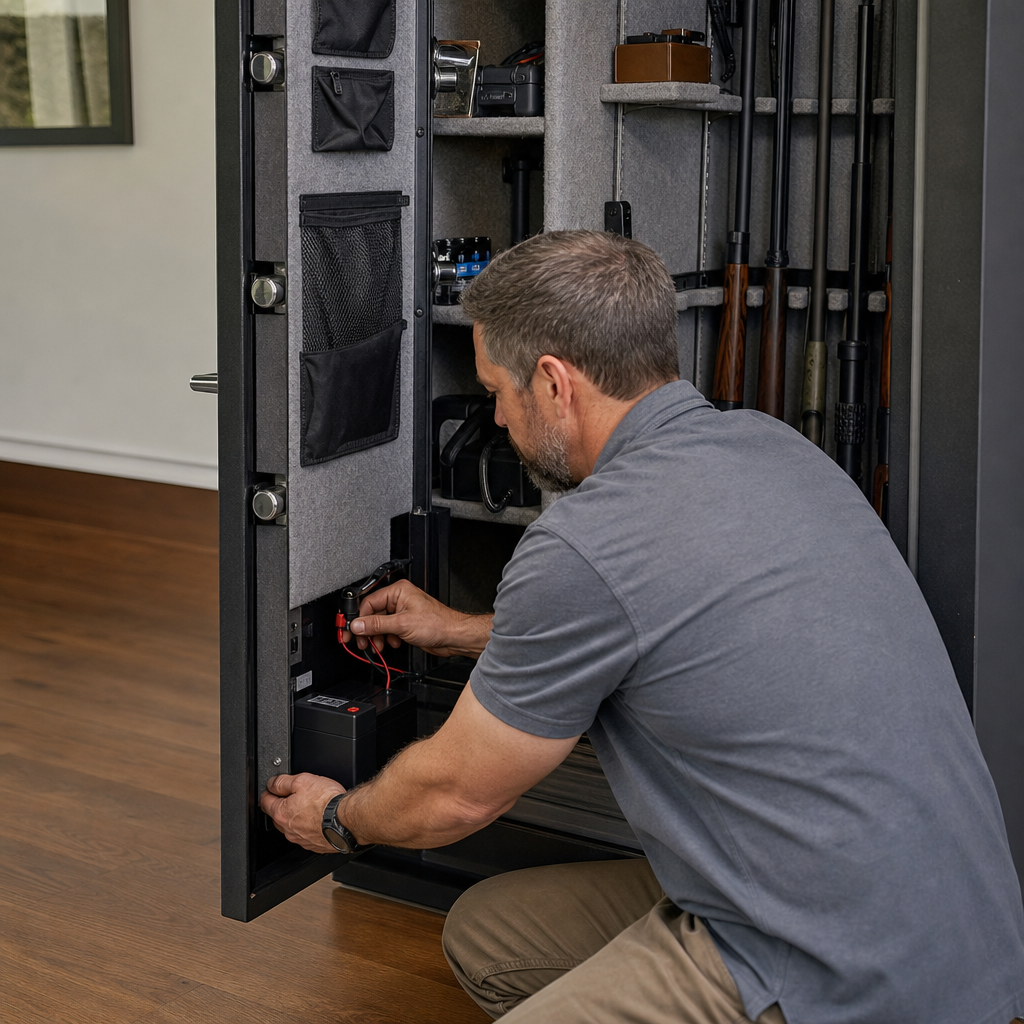
Installing an emergency battery backup for your gun safe is one of the smartest custom upgrades you can make because electronic locks fail at the worst possible moment: during a power loss, a dead keypad battery, or a rushed access attempt when seconds matter. In my work with residential security setups, I have seen owners assume their safe’s factory battery arrangement is enough, only to discover corrosion, poor contact tension, or a hidden power drain after years of neglect. An emergency battery backup adds a redundant power path so the locking system can still energize when the primary source fails. Within the broader world of custom and DIY gun safe modifications, this upgrade belongs near the top of the list because it directly affects access reliability, firearm security, and household safety.
A gun safe battery backup can mean several different things, so definitions matter. Some electronic safes use an internal 9-volt or AA battery pack behind the keypad. Others use an external jump contact that accepts a temporary battery placed against the keypad face. A more advanced backup system adds an external battery box, low-voltage wiring, protected connectors, and sometimes a small uninterruptible DC setup mounted inside or just outside the body. The goal is not to bypass security. The goal is to preserve normal lock function when the standard power source is dead. If you are planning custom and DIY gun safe modifications, understanding that difference prevents dangerous shortcuts, such as drilling access holes in the wrong place, overloading a lock circuit, or voiding the fire rating by disturbing insulation barriers.
This subject matters because modern gun safes increasingly rely on electronic locks for speed and convenience, yet every electronic component has a failure mode. A mechanical dial can still fail, but its vulnerabilities are different: wear, misalignment, or user error. Electronic locks add batteries, contact pads, membranes, traces, and logic boards. Standards from UL Type 1 electronic lock listings and manufacturer installation specifications exist for a reason. If you modify around those systems carelessly, you can reduce reliability rather than improve it. A well-planned emergency battery backup, however, fits into a larger hub of practical safe upgrades that includes interior lighting, dehumidification, anchoring, door organizers, sensor integration, and access control planning. Done correctly, it gives you a safer, more dependable safe without compromising burglary resistance.
How emergency battery backup systems for gun safes actually work
An emergency battery backup for a gun safe works by supplying the lock with the correct voltage and current through an approved secondary path when the main battery can no longer do the job. In simple keypad safes, the manufacturer may provide front-mounted contacts where a fresh 9-volt battery briefly powers the keypad, allowing code entry and bolt retraction. In premium retrofits, you may create a protected external battery harness that terminates in a concealed connector. When needed, you attach a battery pack, enter the code, and remove the pack. The lock remains unchanged in function; only the power source becomes redundant.
The technical constraints are straightforward but important. Most safe locks are designed for low-voltage DC and modest current draw, but they can be sensitive to voltage drop, reverse polarity, poor solder joints, or moisture. I always start by reading the exact lock model documentation from brands such as Sargent and Greenleaf, SecuRam, La Gard, or AMSEC-supported lock packages. Some support only manufacturer-approved emergency power methods. Others use internal battery trays that should simply be maintained, not modified. The right approach depends on the lock architecture, not on generic internet advice.
It also helps to distinguish between an emergency battery backup and a continuous external power conversion. Converting a battery-powered lock to permanent wall power is usually a bad DIY project because it introduces surge risk, transformer noise, and a single point of failure during outages. A true backup system remains dormant until needed, preserving the lock’s intended operating conditions. That is why the best installations emphasize sealed connections, short wire runs, strain relief, and no unnecessary electronic complexity.
Choosing the right backup approach for your safe and lock type
The correct backup method depends on your safe’s lock, construction, warranty status, and how comfortable you are working around security hardware. If your keypad already has emergency jump contacts, the best “installation” may be no installation at all. Instead, mount a labeled battery holder nearby, test it twice a year, and replace the spare on a schedule. If your safe has an internal battery compartment that requires the door to be open for replacement, your options narrow. In that case, many owners choose preventive maintenance rather than wiring changes: annual battery replacement with premium alkaline cells, contact cleaning, and keeping a mechanical override key secure if the model has one.
For custom and DIY gun safe modifications, the more advanced option is an external battery pack routed through an existing manufacturer pass-through, accessory port, or pre-approved opening. That can make sense on modular safes, converted cabinets, or specialty enclosures where preserving power access is a priority. However, I do not recommend drilling the safe body unless the manufacturer explicitly approves the location and method. Fire-lined gun safes often contain gypsum-based insulation, hard plate, relockers, and boltwork geometry that are easy to damage. A misplaced hole can create corrosion points, reduce fire performance, or interfere with relocking devices.
| Backup option | Best use case | Main advantage | Main limitation |
|---|---|---|---|
| Factory emergency jump contacts | Electronic keypads designed for external 9-volt access | No permanent modification | Only works on compatible locks |
| Scheduled battery replacement only | Safes with accessible internal batteries and low usage | Lowest risk to warranty and lock | Not true redundancy |
| External battery harness through approved port | Custom setups with manufacturer guidance | Reliable emergency access path | Requires careful routing and validation |
| Professional lock upgrade with backup feature | Older safes or frequent-access owners | Best long-term reliability | Higher cost |
If you are building a hub plan for custom and DIY gun safe modifications, this is where related projects connect naturally. Power routing overlaps with interior LED lighting, humidity control, door panel organizers, and sensor wiring. A clean design treats the safe as a complete system. You want cable management, protected penetrations, and maintenance access planned together instead of adding each upgrade separately and creating clutter.
Tools, materials, and installation practices that protect the safe
The safest DIY installations use as few parts as possible and avoid altering the lock body. Typical materials include the correct battery pack or holder, low-voltage stranded wire of appropriate gauge, insulated quick-disconnects or a locking DC connector, adhesive-backed cable mounts rated for temperature swings, rubber grommets, heat-shrink tubing, dielectric grease for exposed emergency contacts, and a multimeter. If a pass-through exists, use it. If the manufacturer permits a penetration, use the exact diameter specified and deburr the opening fully before adding a grommet.
My standard process is conservative. First, document the lock model, serial information, and battery specification. Next, verify the current draw during unlock using a meter, because weak or undersized packs can show correct voltage at rest and collapse under load. Then plan the wire route so it never crosses moving boltwork, relocker areas, or door seal surfaces. On fire-lined safes, any disturbed liner material should be contained and the opening sealed according to manufacturer guidance. I avoid hot glue, household extension wire, and generic USB power banks unless the lock maker explicitly supports them, which is uncommon. A safe lock is not a phone charger circuit.
Testing is where most DIY projects succeed or fail. After installation, simulate a dead primary battery and confirm the backup opens the safe repeatedly, not just once. Test with the door open first. Then test under slight bolt pressure, because misalignment can raise motor load on some electronic lock systems. Finally, label the external connection discreetly and store backup batteries in a cool, dry place outside the safe. A backup battery locked inside the safe is not a backup.
Common mistakes, security tradeoffs, and when to call a safe technician
The most common mistake is treating all electronic gun safe locks as interchangeable. They are not. A consumer safe from a big-box retailer may use a very different lock package and wiring layout than a higher-end safe from Fort Knox, Liberty, Browning, Rhino, or American Security. Another common error is chasing convenience at the expense of security by leaving an external cable exposed, labeling the connector too clearly, or mounting a battery pack where it can be tampered with. Emergency power should be available to the owner, not advertised to an intruder.
There are also practical tradeoffs. Any added penetration, connector, or wire introduces another point of failure. If your current lock already provides external jump power, adding more hardware may only complicate maintenance. Likewise, if your safe sees daily use, the better investment may be a professional lock replacement to a higher-grade model with clearer low-battery warnings and manufacturer-supported emergency access. I have recommended that route many times because it lowers long-term risk compared with an improvised retrofit.
Call a qualified safe technician when the safe is under warranty, when you cannot identify the lock model confidently, when drilling would be required, when boltwork clearance is uncertain, or when the safe includes relockers and hard plate near the proposed work area. Safe technicians use borescopes, manufacturer templates, and service knowledge that most DIY owners do not have. The labor cost is usually far less than repairing a lockout, damaged fire liner, or compromised door assembly. If this hub article guides your broader custom and DIY gun safe modifications plan, that is the core principle to keep: modify for reliability, not just novelty.
How this upgrade fits into a complete custom gun safe modification plan
An emergency battery backup is most valuable when it is part of a larger, intentional safe setup. In practice, I group gun safe modifications into access, preservation, organization, and monitoring. Access includes electronic lock upgrades, backup power, handle improvements, and lighting. Preservation covers dehumidifiers, desiccants, airflow management, and rust prevention. Organization includes rifle rods, door organizers, magazine bins, and shelf reconfiguration. Monitoring includes contact sensors, tilt sensors, room cameras, and humidity or temperature alerts. Thinking in those categories helps you prioritize modifications that solve real problems instead of buying accessories randomly.
For many owners, the next logical internal resources after this hub are articles on upgrading gun safe lighting, adding dehumidification, choosing between electronic and mechanical locks, and routing safe accessories without damaging the fire liner. Those topics connect directly because they share space, power management, and maintenance cycles. For example, annual battery replacement for the lock can coincide with checking LED adhesive integrity, replacing desiccant packs, inspecting anchor bolts, and verifying digital sensor batteries. A safe should have a maintenance calendar just like any other critical household security device.
The biggest benefit of installing an emergency battery backup for your gun safe is simple: dependable access without compromising secure storage. That matters during outages, after long periods of non-use, and in urgent situations where a dead keypad battery becomes more than an inconvenience. Choose the backup method that matches your lock, respect manufacturer guidance, and avoid invasive modifications unless a professional approves them. As you build out your custom and DIY gun safe modifications plan, treat backup power as a foundational upgrade and use it to guide smarter decisions about every other safe accessory. Review your lock model today, confirm how emergency power is supposed to work, and make reliability part of your safe setup before you need it.
Frequently Asked Questions
Why should I install an emergency battery backup for my gun safe if it already has an electronic lock with batteries?
An emergency battery backup adds a second layer of reliability to a system that many owners mistakenly assume is fail-safe. In real-world use, factory battery compartments and keypad power supplies can become unreliable over time due to corrosion, weak battery contacts, unnoticed parasitic drain, humidity exposure, and simple neglect. A lock may appear to work normally for months and then fail exactly when you need quick access most, such as during a power outage, a dead keypad event, or a high-stress situation where every second matters. That is why a backup power option is less about convenience and more about redundancy.
Another important point is that many electronic safe locks do not fail gradually in an obvious way. You may not get much warning before the keypad becomes inconsistent, dims unexpectedly, or stops responding altogether. In some cases, the problem is not the battery itself but poor contact tension, dirty terminals, or an external battery jump point that has never been tested. Installing an emergency backup system helps ensure you are not relying on a single overlooked component. For gun safe owners who prioritize dependable access, especially in a home defense or emergency preparedness context, backup power is one of the most practical upgrades you can make.
What types of emergency battery backup options are available for gun safes?
The right backup option depends on the lock design, the safe manufacturer, and how much modification you are comfortable making. Some gun safes use electronic locks with built-in emergency power terminals on the keypad face. In those cases, the simplest backup method is often an external battery pack, usually a 9-volt or similar compatible source, that temporarily energizes the lock so you can enter your code. This is common, affordable, and effective, but it still depends on the external contact points being accessible and in good condition.
Other owners choose a more customized solution, such as a remote battery compartment, a hardwired secondary battery source, or a discreetly mounted auxiliary power lead that can be accessed without opening the safe. These setups can be especially useful if the original battery placement is awkward, prone to corrosion, or hidden behind trim or door panels. A more advanced installation may involve routing a protected low-voltage lead to an accessible but concealed location, allowing emergency power to be applied without disassembling anything during a stressful moment. The best approach is one that preserves the safe’s security, does not interfere with the lock’s operation, and can be tested regularly without difficulty.
Can I install an emergency battery backup on my gun safe myself, or should I hire a professional?
Some emergency battery backup setups are simple enough for a careful do-it-yourself installation, especially if your safe lock manufacturer already supports an external battery assist or provides clear instructions for battery relocation. If the project involves replacing batteries, cleaning contacts, adding a plug-in emergency power option approved by the lock maker, or mounting an external battery holder in a non-invasive way, a skilled owner may be able to handle it successfully. The key is to work slowly, confirm voltage and polarity requirements, and avoid any changes that could damage the lock body, compromise fire insulation, or interfere with the safe door’s internal linkage.
That said, a professional is the better choice when the installation requires drilling, wire routing through the door or body, modifying lock components, or integrating a custom power solution into a high-value safe. Gun safes are not forgiving when mistakes are made. A poorly placed hole, pinched wire, reversed polarity connection, or unsecured battery housing can turn a smart upgrade into a lockout risk. A qualified safe technician or locksmith who understands residential security hardware can evaluate your specific lock model, recommend a compatible backup method, and install it in a way that maintains both function and security. If you rely on the safe for defensive firearms, legal documents, or valuables, professional installation is often well worth the cost.
How do I maintain an emergency battery backup system so it works when I actually need it?
Maintenance is what turns a backup system from a nice idea into a dependable feature. Start by using high-quality batteries recommended for your lock or backup module, and replace them on a schedule instead of waiting for failure. Many owners benefit from a fixed maintenance routine, such as checking the primary and backup power systems every six months. During that check, inspect terminals for corrosion, verify that contact points are clean and tight, test battery voltage if applicable, and confirm the lock responds normally using both its primary and emergency power method. A backup that has never been tested is not really a backup.
Environmental conditions matter as well. Gun safes are often placed in garages, basements, closets, or corners of rooms where humidity and dust can quietly degrade electrical components. Keep battery compartments dry, use desiccant or dehumidification inside the safe as appropriate, and inspect for rust, white residue, or weakened metal contacts. If your emergency system uses an external connector or hidden power lead, make sure it remains accessible, protected from accidental damage, and clearly documented for trusted household members. The goal is simple: when the keypad battery fails or the lock becomes unresponsive, you want a backup system that works immediately without guesswork, extra tools, or improvisation.
Will installing an emergency battery backup affect the security or warranty of my gun safe?
It can, depending on how the upgrade is done. A properly designed and correctly installed backup power system should improve reliability without reducing security, but poorly planned modifications can create problems. For example, drilling into the safe body or door without manufacturer guidance can weaken protective layers, interfere with relocking mechanisms, damage fire insulation, or create an unintended attack point. Likewise, sloppy wiring or visible external components can make the installation easier to tamper with or may snag during door movement. Security should never be traded for convenience, which is why compatibility and installation method matter so much.
Warranty concerns are also very real. Some safe manufacturers and electronic lock makers will void coverage if unauthorized modifications are made to the lock, keypad, door panel, or power system. Before installing any backup arrangement, review the safe’s documentation and, if possible, contact the manufacturer or lock supplier for approved methods. In many cases, there may already be a supported emergency power procedure or an acceptable accessory option. If you want the benefits of backup power without risking warranty issues, use manufacturer-approved components or have the work done by an authorized technician. That gives you the best chance of improving access reliability while preserving both the safe’s protective performance and any existing coverage.