
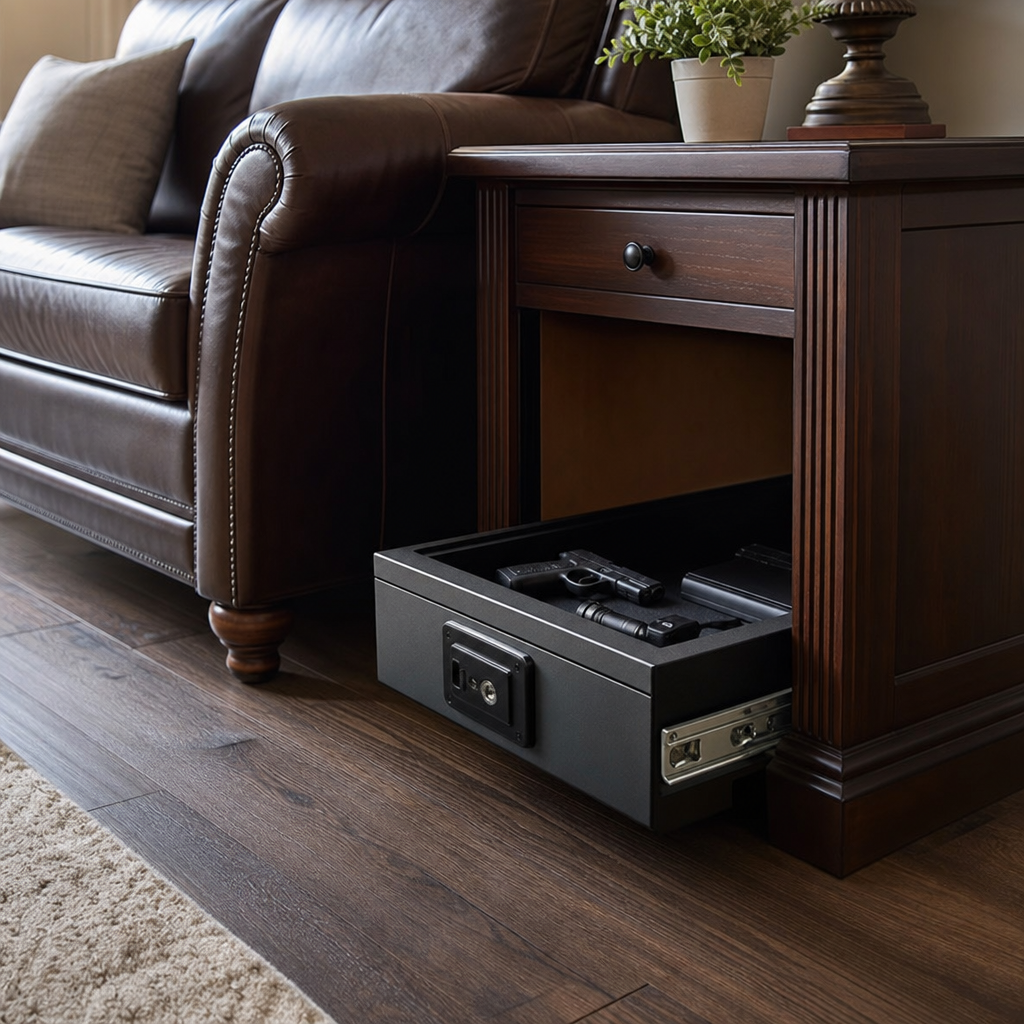
How to hide a gun safe under furniture for discreet storage starts with a simple principle: concealment should never compromise safe access, structural stability, or responsible firearm security. In practical terms, “under furniture” means placing a compact gun safe beneath a bed, sofa, bench, desk, console table, or similar piece so the safe remains out of casual sight while still being anchored, reachable, and compliant with basic safety best practices. “Discreet storage” does not mean careless storage. It means reducing visibility to visitors, children, and opportunistic thieves without creating delays in emergencies or violating local rules on firearm access. I have worked with homeowners who wanted hidden storage in apartments, family homes, workshops, and short-term rental properties, and the same pattern always appears: the best setup blends concealment, fast retrieval, and hard physical security. This article serves as a hub for custom and DIY gun safe modifications, covering planning, furniture selection, anchoring, access methods, moisture control, and common mistakes. If you are designing a hidden firearm storage system, the goal is not to make the safe invisible at any cost. The goal is to create a practical, durable installation that works every day, withstands routine wear, and keeps firearms secured from unauthorized hands.
Start with the right safe, dimensions, and threat model
The most important decision is not the furniture; it is the safe itself. Under-furniture installations work best with compact handgun safes, low-profile long-gun safes, and horizontal slide-out units designed for tight clearances. Before measuring any bed frame or sofa skirt, define your threat model. Are you mainly keeping firearms away from children, reducing visibility to guests, slowing smash-and-grab theft, or balancing all three? A thin lockbox may satisfy discreet storage for low-risk environments, but it will not provide the same pry resistance as a heavier steel safe with reinforced door edges, internal hinges, and a mechanical or electronic lock from a recognized brand such as Fort Knox, V-Line, Vaultek, Hornady, or SnapSafe.
Measure the safe in three states: closed footprint, door swing, and access position. Many buyers forget that a biometric bedside safe may fit under a couch yet become unusable once the lid opens into a rail, dust cover, or center support. In my installs, I leave at least one inch of side clearance, verify the lock can be reached without scraping knuckles, and test full access from a realistic body position, such as kneeling beside the bed in low light. Weight matters too. A 10-gauge steel unit offers better security than a stamped lockbox, but if the furniture cannot support repeated load and movement, the concealment plan fails. Review the safe’s bolt-down pattern, mounting hardware, battery access, override key procedure, and interior dimensions for holsters, spare magazines, and documents. A concealed safe should fit your firearm with any mounted light or optic you actually use.
Choose furniture that supports concealment without advertising a modification
The best furniture for hiding a gun safe looks ordinary, has enough clearance, and does not require obvious alteration. Beds are the most common choice because they already have visual shadow lines and usually sit in low-traffic spaces. Platform beds with recessed bases can hide a safe effectively, but slat support layouts may interfere with top-opening designs. Upholstered benches and storage ottomans offer extra flexibility, especially when paired with a floor-mounted safe concealed behind a false lower panel. Sofas can work well if the skirt or low frame blocks sightlines, though vacuuming, pet hair, and floor-level moisture become bigger concerns.
Desk knee spaces, console tables behind couches, nursery changing tables, and mudroom benches are also used, but each comes with tradeoffs. In homes with children, I avoid furniture that invites climbing or rough play over the access point. In small apartments, I prefer furniture that can be moved without revealing fresh cuts, exposed hardware, or anchor patches. The ideal piece has a stable frame made from hardwood, quality plywood, or steel—not brittle particleboard with weak cam fasteners. If you must modify inexpensive ready-to-assemble furniture, reinforce it first with concealed steel angle, hardwood cleats, or plywood backers. A hidden safe should disappear into the room, not create rattles, sagging panels, or mismatched trim that draw attention.
Best under-furniture concealment methods for custom and DIY builds
Most discreet storage projects fall into a few proven categories. Matching the method to the room and safe type prevents expensive rework later.
| Method | Best Furniture | Main Advantage | Main Limitation |
|---|---|---|---|
| Direct floor mount under overhang | Bed, sofa, bench | Strong anchoring and simple install | Visible if someone kneels and looks underneath |
| Slide-out tray or drawer concealment | Platform bed, desk, console | Fast access with clean appearance | Requires precision slides and clearance planning |
| False apron or kick-panel cover | Bench, cabinet, daybed | Excellent visual concealment | Can slow access if panel retention is poorly designed |
| Lift-up seat or hinged furniture shell | Ottoman, storage bench | Easy to integrate with existing storage furniture | Furniture movement may stress hinges and fasteners |
| Suspended mount to frame | Steel bed, heavy desk | Keeps safe off damp floors | Demands very strong frame and vibration control |
For most homeowners, the safest DIY path is a floor-mounted safe hidden by furniture overhang, a tailored skirt, or a removable furniture apron. It keeps the safe independent from furniture loads and allows proper anchoring into wood subfloor or concrete. More advanced builders can use full-extension locking slides rated for the load, often from Accuride or similar heavy-duty hardware lines, to create pull-out access beneath a platform bed or desk. When I build these systems, I use stops that prevent accidental overtravel, low-friction edge protection so the safe finish does not scrape, and a reveal gap tight enough to look intentional but loose enough for seasonal movement in wood furniture.
Anchoring, reinforcement, and why concealment alone is not security
A hidden gun safe that is not anchored can simply be carried away. That is why anchoring is non-negotiable in serious under-furniture storage. On concrete, wedge anchors or concrete screw anchors sized to the manufacturer’s mounting holes are standard. On wood subfloors, lag screws into joists or well-supported blocking are preferred over fasteners driven only into subfloor sheathing. If the exact joist layout does not align with the safe pattern, install a steel or hardwood mounting plate beneath the finish floor when feasible, or reinforce from below in a basement or crawlspace.
Furniture itself may also need reinforcement. For suspended or integrated installations, I add load spreaders, through-bolts with washers, and anti-rattle isolators. This matters because repeated access cycles loosen weak screws, enlarge particleboard holes, and create squeaks that attract attention. Concealment should also consider theft behavior. Many burglars search master bedrooms first, then offices, then closets. Hiding a safe under a bed may reduce casual detection, but it does not replace steel thickness, lock quality, and anchoring. A realistic design slows discovery, slows removal, and keeps access controlled. If your risk is high, discreet placement should be paired with layered home security such as solid-core doors, monitored alarms, motion lighting, and cameras covering entry routes rather than the safe itself.
Plan access carefully: speed, reliability, and family safety
The best hidden installation is the one you can open correctly under stress. Access planning should begin with a simple question: from what position will you retrieve the firearm most often? Bedside safes should open from a crouch or seated position without forcing a wrist angle that makes keypad entry awkward. Under-desk safes should not bang against chair legs or require twisting your shoulder into the underside of the frame. In my experience, biometric locks are convenient but should never be trusted without testing multiple fingers, dry skin, sweaty skin, and low-battery behavior. A quality keypad or Simplex-style mechanical pushbutton lock often delivers more consistent access over time.
Think about noise too. Metal-on-metal contact, rattling magazines, and drawer slides slamming open defeat the purpose of a discreet setup. Use foam inserts, neoprene bumpers, and soft-close hardware where appropriate. If children are in the home, your concealment plan should still assume they will eventually discover the area. That means the furniture must not make the safe easier to tamper with, pry, or observe while you open it. Practice retrieval unloaded, in daylight and darkness, and with your usual room layout. Rugs, slippers, charging cables, and pet beds often create small obstacles that matter during a fast access attempt. Hidden storage works only when concealment and retrieval are designed together.
Manage power, lighting, humidity, and finish wear in tight spaces
Under-furniture spaces are harsh on equipment. Dust collects, airflow is limited, and floors transmit moisture. If your safe uses an electronic lock, plan battery changes before the safe is boxed in by trim or a false panel. Some owners run a hidden low-voltage charging cable to a nearby outlet for accessories, but power should never interfere with the lock’s manual backup procedure. Small motion-activated LED strips can help identify the keypad and safe handle in darkness, but keep light spill minimal so the installation does not glow through furniture gaps.
Humidity control is especially important on ground floors, basements, and homes in humid climates. Firearms stored close to carpet or slab surfaces are more exposed to corrosion than owners expect. Use a desiccant pack or low-profile dehumidifier solution if the safe size permits, and inspect regularly. I also recommend rubber feet, polymer shims, or a sealed mounting plate to break direct contact with damp surfaces. Protect surrounding furniture finishes with edge banding, felt pads, and abrasion-resistant liners. Over time, a hidden safe announces itself through scraped paint, polished carpet tracks, compressed upholstery, or a recurring squeak. Good concealment is partly visual and partly acoustic, so maintenance matters as much as the original build.
Room-by-room applications and practical DIY modification ideas
In bedrooms, the classic approach is a low-profile safe under a bed frame with a matching valance or recessed base concealing sightlines. This is effective, but avoid relying on bedspreads alone; they shift too easily and make the hiding place obvious. In living rooms, a bench seat against a wall can conceal a floor-mounted safe behind a removable toe-kick panel held by rare-earth magnets. This method works well because the panel can be removed quickly while still looking like standard trim. In home offices, a console or desk can hide a safe on a pull-out platform, particularly useful when the safe stores a handgun, passport, and emergency cash together.
For DIY modifications, keep joinery straightforward and serviceable. A false apron can be built from hardwood or plywood faced with matching veneer, then attached with hidden magnets, cabinet clips, or a touch-latch mechanism. A slide-out base should use hardware rated beyond the actual weight of the loaded safe, not just the empty safe. If a safe weighs 80 pounds and the loaded content adds 20, choose slides comfortably above 100 pounds because dynamic loads during opening are higher. Avoid overcomplicated hidden-release gadgets. They may look clever on video, but in real homes they fail from dust, misalignment, or dead batteries. The best custom work is quiet, sturdy, and boring in the best sense: it functions the same way every time.
Common mistakes, legal considerations, and when to hire a pro
The most common mistakes are choosing a safe that opens the wrong way for the space, skipping anchoring, modifying weak furniture, and forgetting long-term usability. Another frequent error is concealing a safe so thoroughly that emergency access becomes clumsy. I have also seen owners place safes under recliners, nursery furniture, or pieces that are routinely moved for cleaning, which creates unnecessary risk and wear. Keep in mind that local laws may regulate firearm storage, child access prevention, transport between residences, and landlord restrictions on drilling floors or walls. If you live in a rental, get written approval before anchoring anything to the structure.
Hire a professional when the installation involves concrete drilling, hidden electrical routing, structural furniture fabrication, or a high-value firearm collection. A cabinetmaker can create a cleaner concealment panel than most DIYers, and a locksmith or safe technician can help evaluate lock reliability and mounting. The broader lesson for custom and DIY gun safe modifications is simple: every change should improve concealment without weakening security, access, or durability. If you treat the project as a system rather than a hiding trick, you will make better decisions. Start by measuring your space, selecting a properly sized safe, and sketching an access plan. Then build discreet storage that looks ordinary, works smoothly, and keeps firearms secured where they belong.
Frequently Asked Questions
What types of furniture work best for hiding a gun safe underneath?
The best furniture for discreet under-furniture gun safe storage is sturdy, heavy, and practical enough that its placement does not attract attention. Beds, sofas, storage benches, desks, console tables, and some media cabinets are common choices because they naturally create low, shadowed clearance areas that do not immediately draw the eye. The ideal furniture piece should have enough underside space to accommodate the safe without forcing it into an awkward position, and it must be stable enough that the added presence of a safe does not create tipping, wobbling, or uneven weight distribution. In most cases, a low-profile safe designed for compact storage works better than a taller unit that barely fits and becomes difficult to access.
It is also important to think beyond appearance. A piece of furniture may seem like a good visual cover, but if it has weak legs, thin engineered wood, or unstable framing, it may not be suitable. The goal is not just to keep the safe out of casual sight, but to maintain safe, repeatable access while preserving the structural integrity of the furniture and the surrounding floor. For example, a bed frame with solid rails and consistent under-bed clearance is often a better choice than a decorative side table with fragile legs. Likewise, a bench with a strong base may work well in an entryway or bedroom if it provides enough depth and concealment. Choose furniture that fits naturally in the room and does not make the safe placement obvious through bulges, blocked movement, or unusual room layout changes.
How do you hide a gun safe under furniture without making it hard to reach in an emergency?
The key is to balance concealment with direct, reliable access. A gun safe hidden under furniture should be positioned so it is not visible during ordinary use of the room, but it should still be reachable without moving heavy objects, kneeling into an unsafe posture, or fumbling around in low light. In practical terms, that means leaving enough clearance around the access side of the safe for the door or lid to open fully and for you to operate the locking mechanism smoothly. If the safe is under a bed, it should typically be oriented so you can slide into position and reach the keypad, biometric reader, or lock quickly. If it is under a sofa or bench, test whether seated, crouched, or side-angle access feels natural and consistent before committing to that location.
Fast access also depends on avoiding clutter. Shoes, storage bins, cords, dust ruffles, decorative skirts, and other under-furniture items can interfere with safe retrieval. Many owners focus so much on making the safe disappear visually that they accidentally create obstacles that slow them down when seconds matter. A better approach is to create a clean, defined access path that remains discreet but predictable. Consider lighting conditions, nighttime use, and whether the safe can be reached from the side of the bed or room where you would realistically approach it. If the safe includes biometric or electronic access, confirm that your chosen angle allows you to use it comfortably. Discreet storage is only effective when the safe remains secure and quickly usable under normal, low-stress, and urgent conditions alike.
Should a gun safe hidden under furniture still be anchored or secured in place?
Yes, in most cases it should. Concealment alone is not a substitute for physical security. A compact safe placed under furniture may be less noticeable to casual visitors, but if it is not anchored or otherwise secured, it can still be removed by a thief who discovers it. Anchoring helps prevent the safe from being carried away, shifted during use, or pulled into an unsafe position. Depending on the model, the floor type, and the room layout, this may involve bolting the safe to the floor, attaching it to a structural surface according to manufacturer guidance, or using a security cable system if the safe is specifically designed for that method. The correct solution depends on the safe’s design and the surface beneath the furniture.
Beyond theft resistance, anchoring also improves day-to-day safety. A secured safe stays in the same orientation, opens as intended, and does not slide when you interact with the lock. That matters when the safe is tucked beneath a bed, desk, or bench where your access angle may already be somewhat limited. It is essential to follow the manufacturer’s instructions and avoid improvising unsafe mounting methods that could damage the safe, flooring, or furniture. If the furniture itself is being used as visual concealment, do not assume the furniture provides meaningful security. The furniture hides the safe; the anchoring helps protect it. Those are two separate functions, and both should be addressed if discreet storage is the goal.
What safety mistakes should you avoid when storing a gun safe under a bed, sofa, or other furniture?
One of the biggest mistakes is prioritizing invisibility over usability. If a safe is shoved too far back, wedged into a tight opening, or blocked by furniture legs and nearby objects, it may become difficult to open properly or retrieve quickly. Another common issue is choosing furniture that cannot safely accommodate the space or weight requirements. Weak frames, uneven floors, low clearance, and furniture that shifts during normal use can all create access and stability problems. It is also a mistake to ignore the swing radius of the safe door, the reach needed to operate the lock, and the room required to remove or replace the firearm safely. If you have to twist awkwardly, drag the safe out every time, or force the door open at a bad angle, the setup needs improvement.
Other mistakes involve environment and household safety. Do not place the safe where moisture, dust buildup, HVAC vents, pet activity, or cleaning equipment regularly affect the area. Under-bed locations, in particular, can collect dust and debris, so maintenance matters. You should also avoid storing the safe in a way that makes it discoverable to children through obvious patterns, such as repeatedly reaching under the same piece of furniture in full view. In addition, do not treat “hidden” as equivalent to “childproof” or “theft-proof.” Responsible storage still means locking the safe, managing access credentials carefully, and ensuring the firearm is stored according to your broader household safety practices. A discreet setup should reduce visibility without lowering standards for control, maintenance, and secure handling.
How can you make an under-furniture gun safe look natural in the room without drawing attention to it?
The most effective approach is to make the furniture and room layout feel ordinary. A hidden gun safe should disappear into the normal function of the space rather than rely on elaborate concealment tricks that seem out of place. Start by choosing a room and furniture piece that naturally justify covered floor space. For example, a bed typically has unused underframe space, a sofa often casts a visual shadow beneath it, and a desk or console table may obscure lower storage areas from standard sightlines. If the safe fits comfortably under the furniture and nothing around it appears rearranged to “protect” that spot, the setup is usually more discreet. Consistency matters: if the furniture remains in a normal location and the room looks balanced, people are less likely to pay attention to what is beneath it.
It also helps to avoid overcompensating. Adding excessive draping, odd decorative covers, or furniture modifications can attract more attention than a simple, clean placement. The room should still function normally, and the furniture should be usable without revealing the safe. Make sure the safe does not protrude visibly from common standing or seated angles, and confirm that cords, rugs, or accessories are not creating visual cues that something is hidden there. At the same time, maintain enough open access that you can still reach the safe safely and efficiently. In short, natural concealment works best when the furniture looks like it belongs exactly where it is, the safe remains out of casual sight, and the storage method supports responsible firearm security rather than trying to rely on secrecy alone.