
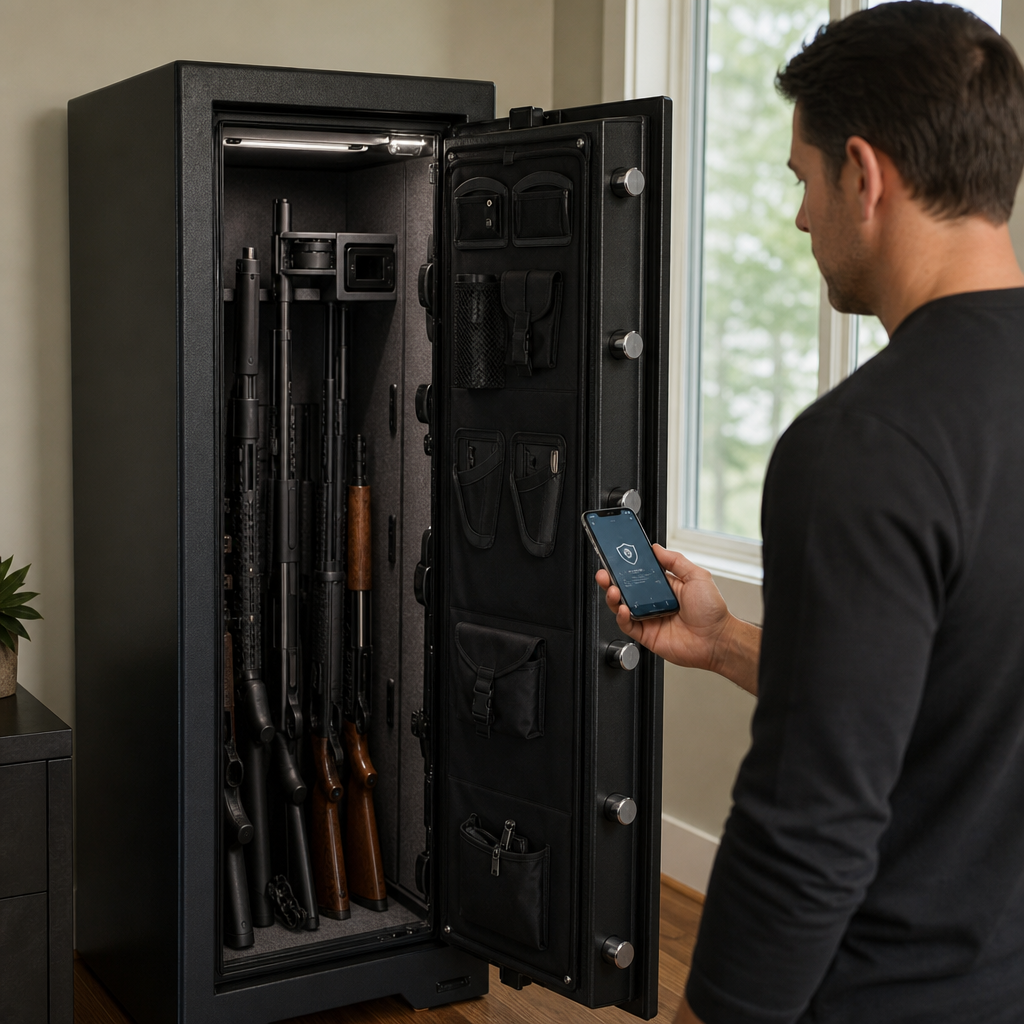
Selecting a gun safe that offers real-time security alerts requires more than comparing steel thickness and lock styles; it means evaluating how physical protection, connectivity, sensor quality, and day-to-day usability work together to reduce risk. In the gun safes and safety category, a buying guide is the practical bridge between product marketing and responsible storage decisions. Real-time alerts are notifications sent immediately when specific events occur, such as a failed code entry, vibration, motion, door opening, humidity rise, power loss, or tampering. For owners who travel, keep firearms in a primary residence with children, manage multiple properties, or simply want faster awareness of unauthorized access, these alerts materially improve response time.
I have evaluated safes in homes, retail settings, and small armory rooms, and the biggest mistake buyers make is assuming a smartphone notification alone equals meaningful security. It does not. A good alert system is only valuable when the safe has reliable sensors, resilient power, secure connectivity, useful event logs, and enough physical resistance to delay access. If a thin cabinet sends a perfect push notification while a pry attack opens the door in under two minutes, the technology has not solved the core problem. Likewise, an extremely strong safe with no remote awareness may leave you discovering a problem hours too late.
This buying guide explains how to choose a gun safe with real-time monitoring that actually performs under real conditions. It covers alert types, lock and sensor systems, connectivity choices, app quality, backup power, installation, and the standards that matter when comparing brands. It also serves as a hub for broader buying-guide questions within gun safes and safety: size planning, fire protection, child access prevention, humidity control, and long-term maintenance. The goal is straightforward: buy a safe that protects firearms from unauthorized users, supports responsible ownership, and gives you immediate, actionable information when something is wrong.
Start with the Security Outcome You Need
The first step is defining what problem the safe must solve. A bedside biometric safe for one handgun has different requirements than a 40-gun safe in a garage. In buying consultations, I ask four questions first: Who must be kept out, how quickly do you need access, where will the safe live, and what event should trigger an alert? Parents often prioritize door-open alerts and failed-entry notifications. Collectors may care more about tamper, tilt, and environmental alerts. Owners with vacation homes usually need power-loss and offline-status warnings because an alert system that quietly stops reporting is a major blind spot.
Think in layers. The physical layer includes body steel, door construction, bolt work, relockers, hinge protection, anchoring, and fire seals. The detection layer includes contact switches, accelerometers, vibration sensors, temperature and humidity sensors, and in some cases internal motion or light sensors. The communications layer includes Wi-Fi, cellular, Bluetooth, or hardwired Ethernet. The response layer includes push notifications, SMS, email, siren activation, camera triggers, and event history. A strong buying decision connects all four layers rather than overvaluing any single feature.
This is also where you decide whether you need a dedicated smart gun safe or a traditional safe upgraded with aftermarket sensors. Integrated smart safes are simpler to deploy and usually provide a cleaner app experience. Retrofitting can work well when you already own a quality safe from brands such as Liberty, Fort Knox, Browning, AMSEC, or Hollon, but aftermarket setups vary in reliability and may require separate hubs, automations, and battery management. If you want one warranty path and fewer compatibility issues, an integrated system is generally the safer purchase.
Which Real-Time Alerts Actually Matter
Not every alert type is equally useful. The most valuable alerts are door-open, failed access attempt, vibration or tamper, tilt or movement, power loss, low battery, and offline status. Door-open alerts confirm that someone successfully gained entry or that the safe was left unsecured. Failed-access alerts show repeated keypad or biometric attempts, which can indicate a curious child, an untrained household member, or an intruder testing codes. Vibration and tilt alerts are especially important for smaller safes that can be attacked with tools or physically removed if not anchored properly.
Environmental alerts matter too, but they serve a different purpose. Humidity above roughly 50 percent relative humidity over time can contribute to corrosion, especially in basements, garages, and coastal environments. Temperature alerts can warn of HVAC failures or conditions that may damage optics, documents, or ammunition packaging, although they are not substitutes for a certified fire rating. If your storage area is damp, the ideal setup pairs alerts with a dehumidifier rod, desiccant, and a sealed, anchored safe.
When comparing products, ask whether alerts are immediate, configurable, and event-specific. Some systems only notify on door opening, while others let you set thresholds for vibration sensitivity, quiet hours, or repeated failed attempts. The best apps attach a timestamp and device name to every event and retain logs for at least several weeks. If a manufacturer cannot clearly state what events are detected, how notifications are sent, and whether cloud service or subscription fees apply, treat that as a warning sign.
| Feature | Why it matters | Best use case |
|---|---|---|
| Door-open alert | Confirms entry or unsecured status | Families, daily-use safes |
| Failed-entry alert | Shows code or biometric misuse | Homes with children or guests |
| Vibration/tamper alert | Detects attacks before door opens | Garages, detached buildings |
| Tilt/movement alert | Warns if safe is being moved | Small and mid-size safes |
| Power-loss alert | Reveals outage or unplugging | Smart safes with AC adapters |
| Offline alert | Shows communication failure | Remote properties, travel |
| Humidity alert | Helps prevent rust and corrosion | Basements, coastal climates |
Evaluate the Safe First, the Smart Features Second
A smart feature set cannot compensate for weak construction. Start with steel thickness, door design, locking bolts, and how the safe is anchored. Many consumer gun safes are classified as Residential Security Containers under UL 1037 rather than true burglary safes, which means they provide a baseline level of attack resistance but are not equivalent to commercial TL-rated safes. That does not make them useless; it means you should match the product to the risk. For most households, a properly anchored RSC from a reputable manufacturer is the realistic standard. For high-value collections, NFA items, or locations with elevated burglary risk, step up in construction and consider monitored room security as well.
Pay attention to body steel gauge and door plate thickness, but read beyond marketing labels. “12-gauge body” is materially stronger than 14-gauge, while composite door structures can vary significantly between brands. Look for internal hard plates protecting the lock, relockers that engage under attack, continuous welds or well-executed stitch welds, and pry-resistant door gaps. A safe that weighs more because of thicker steel and better fire insulation is usually harder to move and attack, though weight alone is not proof of quality.
Anchoring is non-negotiable. I have seen compact handgun safes with excellent apps rendered pointless because they were not bolted down and disappeared entirely during a burglary. Whether the safe sits in a closet, bedroom, office, or garage, it should be anchored to concrete or substantial framing using manufacturer-approved hardware. If the model includes movement alerts, anchoring still matters because the notification may arrive after the thief is already leaving. The alert is your early warning, not your physical barrier.
Connectivity, Power, and App Reliability
The best real-time security alert system is the one that still works during a routine outage, a router reboot, or a dead battery. Wi-Fi is the most common connection method because it is easy to set up and inexpensive for manufacturers to support. Its weakness is dependence on local network stability. Cellular-enabled safes or aftermarket modules cost more, sometimes require a subscription, but offer better resilience when internet service fails. Bluetooth is useful for local setup or proximity features, yet it is not enough by itself if you need remote alerts while away from home.
Power design deserves close scrutiny. Some safes run primarily on replaceable batteries, others use AC power with battery backup, and a few support rechargeable internal packs. Ask how long the safe can continue sending alerts if household power fails and whether the communication module remains active on backup power. Low-battery alerts should arrive well before performance degrades. If the safe uses biometric access, battery health matters even more because fingerprint readers can become inconsistent as voltage drops.
App quality is where many products separate quickly. A polished app should support multi-user permissions, event history, firmware updates, notification customization, and clear device status reporting. It should tell you whether the safe is locked, online, and on external power, not merely whether the app last connected. Two-factor authentication is strongly preferred for account security. If a manufacturer has not updated its app in many months, has persistent complaints about dropped notifications, or provides vague privacy terms about stored event data, move on. The smart layer needs the same seriousness as the steel box itself.
Access Control, Redundancy, and Household Fit
Most buyers must balance fast authorized access with strong control over unauthorized users. Keypad locks remain a dependable choice because they are familiar, durable, and not dependent on biometric enrollment quality. Biometric locks offer speed, but sensor quality varies widely. The better systems use capacitive fingerprint readers, allow multiple enrolled prints per user, and authenticate consistently with dry, wet, or slightly dirty fingers. In testing, I always enroll the same finger several times from slightly different angles because that improves recognition in real use.
Redundancy is essential. A safe with real-time alerts should still provide alternate entry methods such as backup key override, external battery jump contacts, or secondary credential options, depending on the threat model and legal requirements in your area. Mechanical dial locks are slower but extremely reliable over decades, which is why many long-term owners still trust them for larger safes. Electronic locks from established manufacturers like SecuRam and Sargent and Greenleaf have strong track records when installed correctly, but they still require battery discipline and occasional maintenance.
Fit within the household matters as much as raw specifications. If two adults need access, confirm the system supports separate user codes and logs which credential was used. If teenagers are in the home, choose a safe with clear lockout settings after repeated failures and make sure backup keys are stored separately, never in the same room. For defensive firearms, quick access should not mean casual access. The best setup lets authorized users enter quickly while preserving a record of every attempt and every opening event.
Use This Hub to Compare Buying Guide Priorities
As the central buying guide within gun safes and safety, this page should help you frame every related decision before you narrow to a model. Start with capacity, but buy above your current firearm count. Optics, slings, magazines, documents, and shelf needs consume interior volume quickly, and manufacturers often overstate long-gun capacity. Next, check fire protection claims carefully. Independent fire testing is inconsistent across the industry, so compare duration, temperature, seal design, and construction details rather than trusting a headline number alone.
Then consider placement. Bedroom and closet installations favor quick access and discretion. Garage and basement installations need stronger humidity management and usually carry higher pry and temperature exposure. Detached buildings benefit from tilt alerts, offline alerts, and ideally a separate alarm or camera. If you are also researching childproof storage, dehumidification methods, or the pros and cons of biometric versus keypad access, treat those topics as connected buying guides rather than separate checkboxes. The right gun safe is a system decision, not a single-product purchase.
Before you buy, read the warranty, test the app reviews, and contact support with one technical question. Manufacturers that can clearly explain sensor behavior, data retention, battery backup duration, and replacement parts availability are usually easier to own long term. Choose the safe that gives you verified physical protection, dependable alerts, and a realistic fit for your space and habits. Then install it correctly, anchor it securely, configure every alert, and rehearse what you will do when one appears. That is how a smart gun safe delivers real security rather than just connected convenience.
Frequently Asked Questions
What features matter most when choosing a gun safe with real-time security alerts?
The most important features are the ones that connect physical security with fast, reliable notification. Start with the safe itself: solid steel construction, reinforced door edges, quality internal hinges or protected external hinges, pry resistance, secure bolt work, and a lock that has a proven reputation. Real-time alerts are valuable, but they should enhance a strong safe, not compensate for a weak one. If the safe can be easily defeated, app notifications alone will not meaningfully reduce risk.
Next, evaluate the alert system in detail. A good smart gun safe should be able to notify you immediately when specific events happen, such as a failed code attempt, unauthorized movement, vibration, tampering, door opening, low battery, loss of power, or loss of network connection. The more specific the alert categories are, the easier it is to tell the difference between a routine event and a genuine security concern. A safe that simply says “activity detected” is less useful than one that tells you exactly what happened and when.
Connectivity is another major factor. Some safes rely on Wi-Fi, others use Bluetooth, and some offer cellular backup or integration with a broader home security system. Wi-Fi can work well for homes with a strong, stable signal near the safe, while Bluetooth is more limited because it usually requires you to be nearby. Cellular backup can be especially valuable if your internet goes down or if an intruder disables home networking equipment. Also check whether the safe stores event logs locally and in the cloud, since a clear access history can help you review incidents later.
Sensor quality and system reliability are just as important as the notification feature itself. Look for safes with well-designed tamper detection, door position sensors, motion or vibration sensors where appropriate, and dependable firmware. If the sensors trigger too often, you may start ignoring alerts. If they are inconsistent, they may fail when you need them most. Battery backup, low-power warnings, and the ability to continue functioning during outages are also essential for real-world dependability.
Finally, think about everyday usability. A gun safe only improves safety if people use it consistently. Consider whether the app is easy to understand, whether alerts can be customized, whether multiple authorized users can be managed securely, and whether access is fast enough in an emergency without sacrificing security. The best choice is a safe that is strong, easy to operate correctly, and capable of sending meaningful alerts you can trust.
How reliable are real-time alerts on a smart gun safe, and what can affect their performance?
Real-time alerts can be highly useful, but their reliability depends on several moving parts. The first is the safe’s internal hardware and software. The sensors must accurately detect events, the lock electronics must record activity correctly, and the communication module must send data without delay. Well-built systems can notify you within seconds, but lower-quality products may experience lag, missed events, or vague notifications that are not very actionable.
Your home network environment also has a major impact. If the safe connects through Wi-Fi, signal strength near the safe matters. Gun safes are often installed in closets, garages, basements, or corners of a room, and these locations can weaken wireless performance. In addition, the metal body of the safe itself can sometimes affect signal behavior. Before buying, it is smart to think about router placement, mesh networking, or whether the safe supports external antennas, stronger radios, or alternative communication methods.
Power continuity is another key issue. Many smart safes use batteries, AC power, or a combination of both. Alerts are only dependable if the system remains powered and able to communicate. A good model should provide low-battery warnings well before failure, and ideally it should maintain core security functions if household power is interrupted. Some advanced units can continue to log events even when temporarily offline and then sync those records later.
App design and manufacturer support also influence reliability more than many buyers realize. A safe may have solid hardware, but if the mobile app is poorly maintained, notifications may become inconsistent after operating system updates. Look for a brand with a strong track record of firmware updates, technical support, and clear documentation. User reviews are especially helpful when they describe long-term ownership rather than just first impressions, because they reveal whether alerts remain dependable over months and years.
It is best to think of real-time alerts as part of a layered security strategy, not a guarantee of intervention. Alerts are most effective when they are timely, specific, and tied to a clear response plan. If you receive a tamper alert while away from home, for example, you should already know whether you will check cameras, contact another household member, or call local authorities if appropriate. Reliability is not just about whether the phone buzzes; it is about whether the whole system consistently gives you useful information when it matters.
Are Wi-Fi-enabled gun safes secure, or do smart features create new risks?
Wi-Fi-enabled gun safes can be secure, but smart features do introduce additional considerations that traditional mechanical-only safes do not have. The benefit of connectivity is obvious: immediate alerts, event logs, remote monitoring, and in some cases integration with a home security ecosystem. The tradeoff is that anything connected to a network needs to be evaluated for cybersecurity as well as physical security.
The first thing to look for is basic account and device protection. A reputable manufacturer should support strong passwords, secure app logins, and ideally multi-factor authentication. This reduces the risk of unauthorized access to the account that manages the safe. You should also confirm whether the app allows role-based access or multiple users, and whether permissions can be controlled carefully. In a household setting, this matters because convenience should not override accountability.
Firmware security is equally important. Manufacturers should provide regular updates to fix bugs, improve stability, and address vulnerabilities. If a brand has no clear update process or gives little information about security practices, that is a warning sign. Encryption of data in transit and secure pairing between the safe and the mobile app are also worth checking. While most buyers will not get highly technical, it is reasonable to expect transparency about how the company protects customer data and device communications.
Another concern is resilience if the smart functions fail. A connected safe should still provide dependable local access control even if the app is unavailable, the internet is down, or the manufacturer’s servers have an outage. In other words, the “smart” layer should add capability, not create a single point of failure. Mechanical override options, backup access methods, local keypad functionality, and secure fail-safe design all deserve attention before purchase.
In practice, smart features are most useful when they are implemented conservatively and responsibly. A Wi-Fi-enabled gun safe should not be chosen just because it has an app. It should be chosen because it combines strong construction, reliable locking, mature software support, and sensible security controls. If those fundamentals are in place, connected features can improve awareness and accountability without undermining the core mission of secure firearm storage.
How do I compare alert types, sensor quality, and app features between different gun safe models?
The best way to compare models is to go beyond the marketing headline of “smart alerts” and make a checklist of exactly what each safe can detect, report, and record. Start with alert types. Useful categories may include door open and close notifications, failed PIN entries, repeated access attempts, vibration or tamper alerts, movement alerts, low battery warnings, AC power loss, internet disconnects, humidity changes, and temperature changes. The more clearly the manufacturer explains these triggers, the easier it is to judge whether the system meets your needs.
Then look at how those alerts are delivered. Some apps send push notifications only, while others also provide text, email, or in-app event histories. Speed matters, but clarity matters too. An effective alert should identify the safe, the exact event, and the time it occurred. If the safe supports multiple user profiles, you may also want to know whether it logs which user accessed it and whether permissions can be assigned or revoked without confusion. This can be especially useful in households where more than one adult has authorized access.
Sensor quality is harder to judge from a product page, so this is where reviews, demonstrations, and manufacturer documentation become important. Look for evidence that the safe can distinguish between meaningful tampering and ordinary environmental movement. If a safe is known for excessive false alarms, that becomes a practical problem because users tend to silence or ignore noisy systems. Conversely, if a product rarely reports suspicious activity when tested, the sensors may not be sensitive enough. A good system balances responsiveness with accuracy.
The app experience deserves close attention because it shapes daily use. Check whether the app provides a clean dashboard, searchable event logs, battery and connection status, customization of alert thresholds, and control over who receives notifications. It also helps if the app makes troubleshooting easy, such as showing whether the safe is online, when it last synced, and whether a sensor requires attention. Poor app design can turn useful hardware into a frustrating ownership experience.
Finally, compare the ecosystem, not just the safe. Does the product integrate with broader security tools, such as home alarm systems or cameras? Can it maintain logs if the connection drops? Is there a subscription fee for advanced notifications or cloud storage? Are updates frequent and clearly documented? The strongest model is usually the one that combines solid physical construction,