
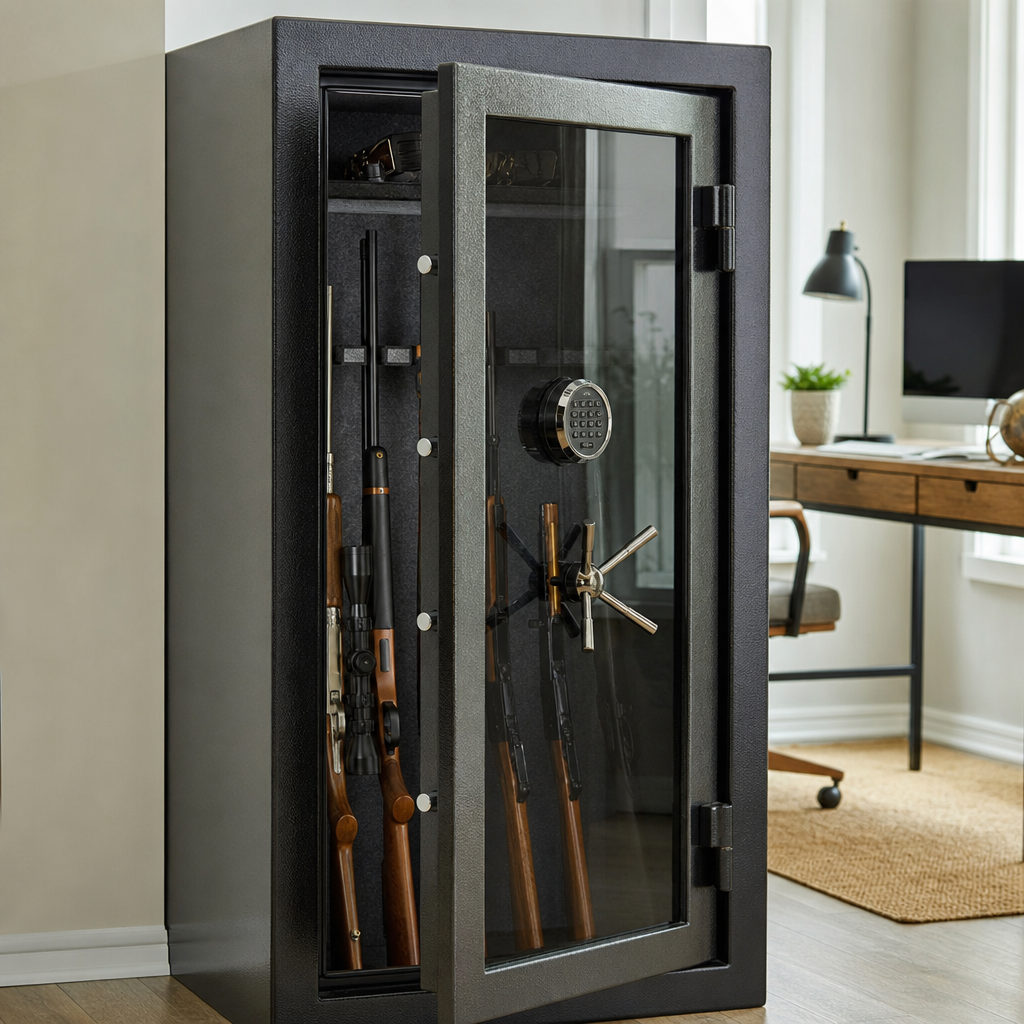
Many buyers hear the phrase “glass relocker” and immediately assume a gun safe is stronger, but the real answer to whether a gun safe with a glass relocker is less secure depends on design, installation, attack type, and the quality of the entire lockwork system. In gun safe terminology, a relocker is a secondary locking device that triggers when the primary lock is punched, drilled, or forcibly removed, blocking the boltwork so the door cannot open even if the main lock fails. A glass relocker uses a tempered or laminated glass plate mounted behind the lock area; if that plate shatters from impact or drilling, spring-loaded bolts or cables activate and deadlock the safe. The question matters because gun owners often shop by isolated features instead of by complete security construction, and marketers routinely oversimplify what actually stops burglary attacks. I have inspected safes where a beautifully advertised glass relocker sat inside a door with thin steel and sloppy hardplate coverage, and I have also seen plain mechanical relockers inside exceptionally well-built safes that would outperform flashier models in real break-in conditions.
For a hub article on gun safe myths and misconceptions, this topic is a useful starting point because it exposes a larger truth: no single feature determines whether a safe is secure. Security comes from layered resistance, including steel thickness, door fit, hardplate, lock quality, relockers, bolt support, anchoring, and the time, tools, and privacy available to an attacker. A glass relocker can absolutely improve security when engineered correctly, but it can also create misunderstandings. Some people fear accidental lockouts from door slams or moving the safe. Others assume any safe without glass is inferior. Both views miss how professional safe design works. To judge whether a gun safe with a glass relocker is less secure, you need to understand what a relocker does, what kinds exist, how burglars attack safes, and where common sales claims drift into myth. This article covers those misconceptions comprehensively and sets a clear framework for evaluating gun safe security across the entire category.
What a glass relocker actually does inside a gun safe
A glass relocker is not the lock itself and not the boltwork itself. It is a trigger mechanism designed to activate additional locking components when the lock area is attacked. In most implementations, a pane of tempered glass sits behind the dial or keypad area, often paired with wires, tabs, or spring-loaded plungers. If a burglar drills through the door and reaches the glass, or if the glass fractures from a concentrated impact around the lock body, those spring mechanisms release and block bolt movement. On higher-end safes, one glass panel may protect multiple relocking points spread across the door. The practical goal is simple: if someone defeats the visible lock, the hidden backup still keeps the door shut.
That makes a glass relocker a defensive layer, not a weakness. The misconception that it is less secure usually comes from two concerns. First, some owners think glass is fragile, so they imagine normal movement, vibration, or a door closing too hard could trigger it. Quality safes are engineered to prevent that through mounting tolerances, padding, and controlled placement. Second, some people hear stories of lockouts after shipping damage and conclude glass systems are unreliable. Shipping damage can trigger a relocker in rare cases, but that is a logistics and handling issue, not proof that the concept lowers security. Any security component can fail if abused or poorly installed.
From a technician’s perspective, the better question is not “Is glass bad?” but “How complete is the relocking system?” A safe with one small glass plate and limited hardplate may be less resistant than a safe with multiple mechanical relockers, manganese hardplate, and robust bolt cam protection. Conversely, a premium safe can combine glass relockers with other relockers for excellent drill resistance. The presence of glass alone tells you almost nothing about total security. What matters is how the manufacturer integrates it with the lock body, hardplate, internal relocking bolts, and door steel.
Glass relocker versus mechanical relocker: which is better?
Mechanical relockers usually activate when the lock body is forcibly removed, punched, or its mounting changes under attack. They rely on springs, pins, or levers rather than a breakable glass trigger. Because they are simple and proven, many commercial safes use them effectively. Glass relockers are often added because they create broader drill defense. A drill can bypass one localized trigger point, but a properly placed glass panel can respond to attacks across a wider area. That broader trigger field is the main advantage. It is why serious burglary safes have long used glass relocking systems as part of composite protection layouts.
The most secure designs often use both. In the field, I trust redundancy more than labels. If a safe has a UL-listed lock, hardplate over the lock body, at least one independent mechanical relocker, and a glass relocker tied to additional deadbolts, that is a meaningful system. If it only has a marketing bullet point that says “glass relocker included,” I keep looking. Consumers should understand that a glass relocker does not replace steel quality, lock listing, or good engineering. It complements them.
| Feature | Glass Relocker | Mechanical Relocker | What it means for security |
|---|---|---|---|
| Primary trigger | Glass breakage from drilling or impact | Lock body displacement or forced attack | Different trigger methods create useful redundancy |
| Coverage area | Can protect a wider drill zone | Usually more localized | Glass often improves resistance to exploratory drilling |
| Simplicity | More parts and setup considerations | Typically simpler | Simplicity can aid reliability in basic designs |
| Common use | Higher-end burglary protection systems | Widely used across many safe classes | Neither is automatically superior by itself |
| Best practice | Used with hardplate and other relockers | Used with hardplate and other relockers | Layered systems outperform single-feature claims |
Why the myth persists: feature shopping and marketing shortcuts
The myth around glass relockers survives because safe buying is confusing. Most buyers cannot inspect internal lockwork, compare steel gauge honestly, or decode inconsistent burglary ratings. As a result, they latch onto visible or memorable features. Retail listings encourage this by presenting a long checklist: fire rating, bolt count, electronic lock, external hinges, relocker, door organizer. That checklist format makes people think security is additive in a simple way. In reality, one weak point can negate several impressive features. Ten locking bolts do not help much if the body steel is thin. A glass relocker does not save a door with poor hardplate placement.
Another reason the myth persists is confusion between consumer gun safes and true burglary safes. Many residential gun safes are designed to balance theft delay, fire protection, interior capacity, and price. They are not all built to the same standard as a UL TL-15 or TL-30 commercial safe. When shoppers see “glass relocker” in a gun safe brochure, they may borrow assumptions from banking or jewelry safes without noticing the rest of the construction is far lighter. Then, if a burglary video shows a residential container defeated quickly with pry tools or power tools, the relocker gets blamed for not performing miracles it was never designed to perform.
That is why evaluating gun safe myths requires context. Marketing shortcuts turn nuanced engineering details into absolutes. A feature can be valuable and still be insufficient on its own. In safe security, context always decides.
Common gun safe myths and misconceptions every buyer should know
The glass relocker debate sits inside a wider set of myths that distort buying decisions. The first myth is that more locking bolts mean more security. In practice, active bolt count is far less important than bolt support, door edge design, and resistance to prying near the lock side. Some excellent safes use fewer, stronger bolts with better engagement. The second myth is that thicker doors alone make a safe secure. Attackers often target the body, lock area, or anchor points, so body steel thickness and overall construction matter just as much.
A third myth is that any fire-rated gun safe is also a strong burglary safe. Fire lining and burglary resistance are different design priorities. Gypsum-based insulation can help with heat protection but does little against grinders or pry bars. A fourth myth is that electronic locks are always less secure than mechanical dial locks. In truth, UL Type 1 electronic locks from trusted brands such as Sargent and Greenleaf, SecuRam, and La Gard can be very secure and are often more practical for daily access. Reliability varies more by quality and environment than by format alone.
A fifth myth is that a heavy safe does not need anchoring. I have seen crews tip large safes onto their backs to exploit leverage with pry bars. Anchoring is one of the most cost-effective security upgrades available. A sixth myth is that internal hinges are automatically better. External hinges can allow wider door opening and are not inherently insecure when the dead bar and bolt system are designed correctly. Finally, there is the myth that listed features guarantee listed performance. Unless the safe carries a recognized burglary rating from an established testing body, feature lists remain claims, not proof.
How burglars actually attack gun safes
Understanding attack methods answers the relocker question better than marketing language. In residential theft, the most common attacks are prying, tipping, grinding, cutting, and targeted drilling around the lock. Smash-and-grab burglars want speed. If a safe is unanchored, lightly built, or poorly hidden, they may attack whichever surface gives the fastest access. In many break-ins, the sidewall is more vulnerable than the door. That is why body steel matters so much.
Glass relockers are most relevant in targeted lock attacks, especially drilling and punching. They do little against an angle grinder cutting a large opening in thin body steel. This is not a flaw in the relocker; it simply means each defense addresses a different threat. Hardplate helps against drilling. Relockers help if drilling reaches the lock area. Thick steel and composite barriers help slow cutting. Anchoring helps prevent tipping and removal. Location in the home helps reduce attack time and privacy.
The practical takeaway is blunt: a gun safe with a glass relocker is not less secure because it uses glass. It is less secure only if the manufacturer relied on that feature while neglecting stronger attack vectors. Buyers should match safe construction to realistic burglary risk, not to one dramatic-sounding component.
How to evaluate a gun safe beyond the relocker
Start with the steel. Ask for the actual door and body thickness in inches, not vague gauge claims without context. Next, verify lock quality. A UL-listed lock from a recognized manufacturer is the baseline. Then ask about hardplate material and coverage over the lock and relockers. Manganese hardplate and strategically layered drill barriers are meaningful. After that, ask how many independent relockers exist and what triggers them. One glass relocker plus one mechanical relocker is better than either alone.
Check anchoring provisions and plan to bolt the safe to concrete whenever possible. Review the interior layout, but do not let shelves and fabric distract you from construction. If the manufacturer mentions burglary ratings, verify the exact listing. Residential Security Container classifications and true tool-resistant ratings are not interchangeable. Also ask about serviceability. A safe that triggers a relocker after severe transit damage may require professional opening, so dealer support matters.
For this gun safe myths and misconceptions hub, the larger lesson is simple. Separate security engineering from showroom storytelling. The best gun safe is not the one with the longest feature list. It is the one with balanced construction, verified components, proper installation, and realistic resistance to the attacks most likely in your environment.
So, is a gun safe with a glass relocker less secure? No. In a well-designed safe, a glass relocker is a legitimate security enhancement that adds another barrier when the lock area is attacked. It becomes a problem only when buyers or brands treat it as a substitute for thicker steel, proper hardplate, reliable locks, solid boltwork, and anchoring. Security is always a system. When you evaluate the whole system, the myth falls apart.
As you compare models in the broader Gun Safes & Safety category, use this article as your reference point for spotting oversimplified claims. Ask direct questions about construction, ratings, lock brands, relockers, and installation. Then continue through the rest of the Gun Safe Myths & Misconceptions subtopic with the same mindset: examine the mechanism, verify the claim, and choose evidence over marketing. That approach leads to a safer purchase and better protection for firearms, valuables, and the people in your home.
Frequently Asked Questions
Is a gun safe with a glass relocker less secure than one without one?
Not automatically. A gun safe with a glass relocker is not inherently less secure, and in many cases it can be more resistant to certain types of forced entry. The key is understanding that a glass relocker is only one component in the safe’s overall security system. A relocker is designed to activate if the primary lock is attacked, such as through punching, drilling, or forced removal. Once triggered, it blocks the boltwork and prevents the door from opening even if the main lock is compromised.
Where confusion comes from is that buyers often hear “glass relocker” and assume it is either a guaranteed upgrade or a fragile weak point. In reality, neither assumption is fully correct. A well-designed glass relocker can add an important layer of protection against skilled attacks aimed at the lock area. However, if the rest of the safe is poorly built, with thin steel, weak boltwork, bad hardplate placement, or sloppy lock installation, the presence of a glass relocker will not magically make it high security. On the other hand, a strong safe without a glass relocker may still be very secure if it uses other effective relocking systems and solid lock protection.
The better question is not whether a glass relocker makes a safe less secure, but whether the entire lockwork system is engineered well. Safe security depends on the relationship between the lock, relockers, hardplate, door construction, bolt carrier, hinge-side protection, and overall body steel. In short, a glass relocker should be viewed as one possible defensive feature, not a stand-alone measure of quality.
What exactly does a glass relocker do in a gun safe?
A glass relocker is a secondary anti-tamper device built into the safe’s lockwork area. Its purpose is to respond when an attacker tries to defeat the primary lock by drilling or otherwise attacking the door near the lock mechanism. Typically, a tempered glass plate is mounted inside the door behind the lock area, often with relocking components attached or positioned so that if the glass breaks, spring-loaded devices fire into place and block the boltwork. This creates an additional barrier even if the original lock is destroyed or bypassed.
The concept is straightforward: if someone attempts a destructive entry method and breaks the glass plate, the relocking mechanism engages. That means opening the safe becomes much more difficult because the attacker now has to defeat not only the main lock but also a separate internal lockout device. In quality designs, the glass relocker works alongside hardplate and other relockers to complicate drilling attacks and force the attacker to spend more time, use more specialized tools, and make more noise.
It is important to note, though, that designs vary. Some manufacturers use a single glass relocker, while others use multiple relockers, including mechanical and thermal types. The effectiveness of the glass relocker depends on placement, sensitivity, how the relocking parts interact with the boltwork, and whether the surrounding components are robustly built. So while the term sounds impressive, what matters is not just that a glass relocker exists, but how intelligently it has been incorporated into the safe’s internal defenses.
Why do some people think a glass relocker could make a gun safe weaker?
The concern usually comes from the word “glass.” Buyers naturally associate glass with fragility, so they imagine that adding a glass component inside a safe creates a new failure point. Some also worry that a hard impact, rough delivery, or door slamming could trigger the relocker accidentally and lock them out. Others assume that if a burglar knows a glass relocker is present, they can intentionally break it and somehow exploit the mechanism. These concerns are understandable, but they often oversimplify how quality relocking systems are actually designed.
In a properly engineered safe, the glass relocker is not there as a structural barrier; it is a trigger device. Its job is to detect or respond to destructive attack conditions and activate another locking element. The glass itself is not meant to “stop” the burglar. Instead, it causes the safe to move into a more secure locked condition. That means breaking the glass generally works against the attacker, not in the attacker’s favor. If a criminal drills into the lock area and shatters the glass, the relocker should deploy and make entry harder.
That said, there are legitimate quality concerns in lower-end safes. If the relocking system is cheaply installed, poorly adjusted, or inadequately protected, accidental activation or ineffective deployment could become a real issue. This is why build quality matters so much. The problem is not the concept of a glass relocker itself, but whether the manufacturer executed the design properly. When evaluating security, it is wiser to look at the safe as a system rather than focus on the presence of a single glass component.
Is a glass relocker better than other types of relockers?
Not necessarily better across the board, but often very useful when combined with other protective features. Different relockers address different attack methods. A traditional mechanical relocker may activate when the lock is punched off the door. A glass relocker is often intended to respond to drilling or destructive penetration in the lock area. Some high-quality safes use multiple relockers so that if one defense is bypassed, another still blocks the boltwork. That layered approach is generally more meaningful than choosing one relocker type in isolation.
In practice, the best security usually comes from a well-integrated system that may include hardplate, one or more mechanical relockers, a glass relocker, and strong internal boltwork geometry. Hardplate helps resist drill bits. Mechanical relockers respond to lock displacement or attack. Glass relockers add sensitivity to drilling or shock conditions around the protected area. Together, these features can significantly increase the difficulty of a targeted attack. By contrast, a safe that advertises a glass relocker but lacks solid steel construction or proper lock protection may still be vulnerable overall.
For most buyers, the takeaway is that a glass relocker should be seen as a positive feature when it is part of a broader quality design. It is not automatically superior to every other relocker, and it does not replace the need for strong materials and good engineering. If a manufacturer only mentions “glass relocker” in marketing but provides no real information about door thickness, hardplate, lock type, and boltwork design, that should be a sign to look deeper before assuming the safe is highly secure.
What should I look for when evaluating a gun safe with a glass relocker?
Start by looking beyond the label and evaluating the complete construction of the safe. A glass relocker is most valuable when it is paired with a properly protected lock area, quality hardplate, strong internal relocking components, and solid boltwork. Ask what type of lock is installed, whether there are additional relockers besides the glass unit, and how the lock body is protected from drilling and punch attacks. If the manufacturer cannot clearly explain the lock protection design, that is often more revealing than the presence or absence of a glass relocker.
You should also pay attention to steel thickness in both the door and body, weld quality, pry resistance, hinge-side protection, and whether the safe has been tested or rated by any recognized standard. A glass relocker does little good if the sidewalls can be cut easily or the door can be peeled open with basic tools. Installation matters as well. Even a well-built safe can be made easier to attack if it is not anchored properly, is placed in an exposed location, or can be tipped over and worked on at ground level with power tools.
Finally, consider the kinds of threats you are actually trying to defend against. For casual smash-and-grab burglars, overall build quality and proper anchoring may matter more than advanced relocker design. For higher-risk environments where a skilled attacker might specifically target the lock area, a glass relocker can be a meaningful extra layer of defense. The strongest buying approach is to treat the glass relocker as one checkpoint on a larger list, not as the sole indicator of whether the gun safe is secure.