
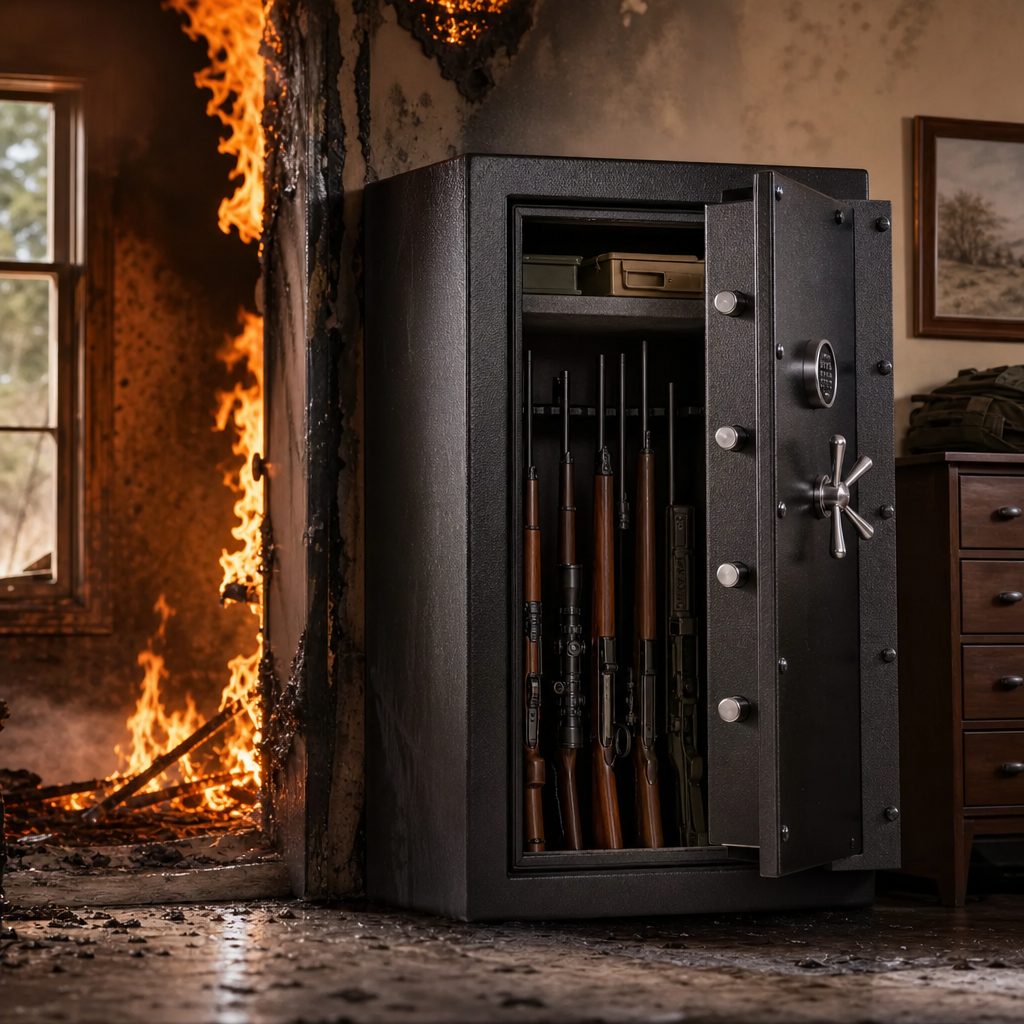
Choosing a gun safe based on fire protection is harder than most buyers expect because “fireproof” is not a precise technical term, and labels often compress complex test conditions into one simple number. In practice, fire ratings describe how long the inside of a safe can stay below a target temperature when the outside is exposed to a defined heat profile. For firearms owners, that matters because heat, smoke, water, and structural collapse can destroy guns, optics, documents, and ammunition long before a house fire is fully extinguished. I have reviewed safe specifications, test reports, and warranty terms across major brands, and the pattern is consistent: the rating only helps when you understand exactly what was tested, what standard was used, and what risks in your home are most likely.
This guide explains what fire ratings mean for gun safes, how manufacturers test them, which numbers matter, and where fire resistance fits within broader disaster-resistant storage planning. It also serves as a hub for the larger topic of fireproof and disaster-resistant storage, connecting questions buyers usually ask: How hot does a residential fire get? How long do typical fires burn? Are independent certifications better than factory tests? Does gypsum board actually protect contents? What happens after firefighters soak the safe? By the end, you should be able to read a safe listing critically, compare options fairly, and choose protection that matches your actual threat level instead of marketing language.
What a fire rating on a gun safe actually measures
A fire rating is usually expressed as time plus temperature, such as 30 minutes at 1200 degrees Fahrenheit or 90 minutes at 1680 degrees Fahrenheit. That statement means the safe was exposed to external heat for a specified duration while the interior was expected to remain under a threshold that protects paper, firearms finishes, and some accessories. The common internal benchmark for document protection is around 350 degrees Fahrenheit because paper chars near 405 degrees. Gun safes, however, are not only storing paper. Wood stocks can dry, crack, or blister, adhesives in optics can fail, lubricants break down, and polymer components may warp at lower temperatures than many buyers assume.
The key limitation is that the rating usually reflects one test profile, not every possible fire. A safe rated for 60 minutes at 1400 degrees is not guaranteed to survive a longer burn, a flashover event that spikes higher, or a collapse into a basement fire. It also does not automatically cover smoke infiltration, water intrusion, or post-fire corrosion. In the field, I have seen safes with acceptable thermal performance still cause major losses because humid ash and suppression water remained trapped inside for days. Fire resistance is therefore one part of disaster-resistant storage, not the whole answer.
How gun safe fire testing works and why standards matter
The best fire rating is one tied to a named test method rather than a generic factory claim. Independent standards such as UL 72 are well known in the safe industry, though many residential gun safes are not tested to that level because true certification is expensive and difficult. Instead, many brands conduct proprietary furnace tests. Those tests can still be useful, but only if the manufacturer tells you the furnace temperature curve, duration, internal temperature target, sensor placement, and whether the safe was preheated, loaded, or cooled with the door closed. Without those details, two “60 minute” ratings may mean very different things.
Manufacturers also differ on whether they include a hose-down phase, an impact test, or a post-fire re-entry requirement. Those details are significant. In a real fire, a safe may be blasted with water and then sit in a wet structure where rapid cooling stresses seams, door gaps, and insulation layers. A safe that performs well in a dry furnace can still fail after hose exposure if seals shrink or panels distort. That is why independent testing carries more weight: the procedure is repeatable, documented, and less vulnerable to selective presentation.
| Rating element | What it tells you | Why it matters for gun storage |
|---|---|---|
| Time | How long the safe was exposed to heat | Helps match the safe to likely fire duration in your area |
| External temperature | Maximum furnace heat during the test | Higher test heat generally indicates a tougher scenario |
| Internal temperature limit | The highest allowable temperature inside the safe | Determines whether paper, finishes, optics, and polymers may be damaged |
| Test source | Independent lab or manufacturer test | Independent methods are usually more comparable and credible |
| Seal and cooling method | How the safe handled expansion, smoke, and cooldown | Affects water, smoke, and corrosion risk after the fire |
What materials create fire resistance in a gun safe
Most residential gun safes achieve fire resistance with layers of gypsum-based board, ceramic wool, fire seals, and steel construction. Gypsum is common because it contains chemically bound water. When heated, that water is released as steam, which absorbs energy and slows temperature rise inside the safe. This is why many fire-lined safes are noticeably heavier than non-rated cabinets of similar size. Thicker steel improves structure and security, but the thermal barrier often comes from the insulation package, not the steel shell itself. Steel transfers heat quickly, so without insulation, a heavy steel box can become an oven.
Door seals are another overlooked component. Intumescent seals expand when heated and help block smoke and hot gases from entering gaps around the door. Better safes also use multiple insulation layers in the door, which is often the weakest thermal point because of hinges, bolts, and panel joints. Premium models may incorporate poured composite insulation rather than simple board liners, producing more consistent coverage. The tradeoff is cost and weight. In real installation work, I have found that many buyers underestimate how difficult it is to move a safe once fire protection upgrades push it well past 700 or 1000 pounds. Floor loading, stair access, and anchoring become part of the decision.
How much fire protection most gun owners actually need
The right fire rating depends on your structure, location, and what else is stored in the safe. In a suburban home with typical fire department response times, a 45- to 60-minute rating may be a reasonable baseline for many buyers. In rural areas, wildfire zones, or properties with delayed response, stepping up to 90 minutes or more is often justified. The National Fire Protection Association reports that modern rooms can reach flashover conditions rapidly because synthetic furnishings burn hotter and faster than older natural materials. That means a short, low-temperature rating may provide less margin than buyers expect.
Contents matter just as much as location. If the safe holds only hunting rifles with replaceable soft cases, your tolerance for heat damage may be different than if it holds tax stamps, passports, hard drives, suppressor paperwork, family photos, and expensive optics. Paper can survive at temperatures that still damage digital media, adhesives, and electronics. If you keep irreplaceable records in the same safe as firearms, consider a dedicated interior document box or media-rated insert. A common mistake is assuming one gun safe rating protects all categories of valuables equally. It does not.
Why “fireproof” marketing can be misleading
No gun safe is literally fireproof in every condition. The more accurate term is fire resistant. Yet many product pages use “fireproof safe” because buyers search that phrase. The problem is not the word itself; the problem is when it conceals the test assumptions. One brand may advertise 75 minutes at 1400 degrees based on an internal test of an empty safe in a controlled furnace. Another may advertise 60 minutes with third-party validation and tighter internal temperature controls. On a listing page, the first number looks better even if the second safe is the stronger product.
Look for specifics in the fine print. Does the company state whether the safe was tested from ambient temperature or placed into a hot furnace? Was the temperature measured at one interior point or several? Was the safe anchored, and did the test include a fall through a burned floor? Were contents inside? Brands that disclose these details are generally more confident in the rating. Brands that rely on vague phrases like “industry-tested” or “lab tested to equivalent conditions” without naming the method should be evaluated cautiously.
Fire ratings are only part of disaster-resistant storage
A true disaster-resistant plan considers more than heat. Water from sprinklers, hoses, burst pipes, storms, and flood events often causes losses after the flames are out. Smoke residue is acidic and can pit blued steel, haze optics, and stain wood. Structural collapse can deform doors or trap the safe under debris. In wildfire-prone regions, radiant heat and ember intrusion may threaten detached garages and outbuildings where many gun safes are installed. In coastal areas, post-storm humidity and salt exposure can be just as damaging as direct water contact.
That is why this subtopic should be approached as a system. A good setup pairs the right fire rating with proper placement, dehumidification, anchor strategy, document organization, and insurance documentation. If your safe sits on bare concrete in a basement, elevate it slightly to reduce minor water exposure. If it is in a garage, be realistic about temperature swings and fuel load. Keep an updated photo inventory and serial number record outside the safe, ideally encrypted in cloud storage. The best gun safe for fire and disaster resistance is not just a product; it is a set of habits that improves recovery after the worst day.
How to compare gun safe fire ratings before you buy
Start with the manufacturer’s full specification sheet, not just retailer bullet points. Confirm the stated duration, temperature, and source of the rating. Check whether the safe uses multiple layers of fireboard, composite fill, expanding seals, and protected door edges. Then examine the body and door steel gauge. A safe can have a respectable fire package but weak burglary resistance, which is a poor trade if theft is the higher risk. AMSEC, Fort Knox, Liberty, Browning, and Rhino all publish different levels of detail depending on model line, and the differences can be substantial even within one brand.
Next, evaluate warranty language. A strong fire warranty often includes repair or replacement after fire and attempted burglary, but exclusions matter. Some cover the safe shell only, not contents. Some require original purchase records or limit commercial use. Also look at logistics: delivery path, final installed location, and whether anchoring could interfere with flooring, radiant heat systems, or condo rules. Buyers often focus on the advertised fire minutes and ignore the practical reality that a too-large safe may end up in the garage because it cannot reach the intended room, reducing the actual protection level despite the higher rating.
Best practices after a fire, near miss, or water event
If a safe has been exposed to fire or heavy smoke, open it as soon as authorities say the area is safe, then remove firearms and documents carefully. Wear gloves because soot residues can be corrosive and toxic. Wipe metal surfaces with an appropriate protectant, separate wet paper from firearms, and begin drying immediately. Do not leave guns in a damp safe for days while waiting for an insurance adjuster. I have seen salvageable firearms develop serious rust overnight after a suppression event. Desiccants and dehumidifier rods help in normal use, but after a fire you need active drying and inspection.
Even if the contents look fine, inspect optics, laminated stocks, ammunition, and electronics closely. Heat can weaken adhesives, seals, and battery compartments without obvious external damage. If the safe door no longer closes squarely or the fire seal has expanded and cracked, the unit may no longer provide its original protection. Document everything with photos and model numbers for insurance. Then review your setup honestly. If the safe survived but the contents suffered from water, smoke, or excessive internal heat, upgrade your storage plan rather than simply replacing the same model. That is the central lesson behind understanding fire ratings: the label is useful only when it leads to better decisions.
Fire ratings on gun safes are valuable, but only when you read them as technical claims instead of marketing shorthand. The critical questions are simple: how long was the safe tested, at what outside temperature, to what inside temperature limit, and under which method or standard. Once you know those answers, you can compare safes on a fair basis and align the rating with your home, response times, and the sensitivity of the items you store. A higher number is not automatically better if the test is vague, the safe is poorly installed, or your real risk comes from water, smoke, or theft instead of flame alone.
For most buyers, the best approach is to treat fire resistance as one layer in a broader disaster-resistant storage strategy. Choose a credible rating, place the safe intelligently, manage humidity, protect critical records separately, and maintain an off-site inventory. That combination protects not only firearms, but also the documents and accessories that often matter just as much after a loss. Use this hub as the starting point for every fireproof and disaster-resistant storage decision under the broader Gun Safes & Safety topic, then compare specific models and testing details before you buy. A careful reading now can prevent an expensive mistake later.
Frequently Asked Questions
What does a fire rating on a gun safe actually mean?
A fire rating tells you how long a gun safe is expected to protect its contents under a specific set of test conditions. In simple terms, it is not just a statement that the safe can “handle fire.” It is a time-and-temperature claim based on how hot the outside environment gets, how long that exposure lasts, and what internal temperature the safe is designed to stay under during the test. For example, a safe labeled as having a 60-minute fire rating may have been tested to keep the interior below a threshold temperature for one hour while the exterior was exposed to a certain furnace temperature profile.
That interior temperature limit is important because the contents of a gun safe can be damaged well before they are visibly burned. Firearms can lose protective finishes, lubricants can break down, optics can be ruined, polymer components can deform, and important paper records can char or ignite at relatively modest temperatures compared to the heat of a house fire. That is why fire ratings are really about the safe’s ability to slow heat transfer, not about making the contents immune to fire.
It is also important to understand that the number on the label does not tell the whole story. A “45-minute” or “90-minute” rating only has meaning if you know the testing standard, peak external temperature, pass/fail criteria, and whether the safe was tested as a complete unit. Two safes can both claim the same number of minutes while offering very different real-world levels of protection. That is why smart buyers look beyond marketing language and ask how the rating was developed, what standard was used, and whether the claim came from an independent test or the manufacturer’s internal method.
Why is the term “fireproof” misleading when shopping for a gun safe?
“Fireproof” sounds definitive, but in the safe industry it is not a precise technical term. No gun safe is universally proof against all fire conditions, all durations, and all types of structural damage. Real fires vary enormously. A small contained fire in one room is very different from a fully involved house fire, and both are different again from a fire followed by floor collapse, water saturation from firefighters, or prolonged exposure to smoldering heat. Calling a safe “fireproof” can make buyers think the contents will always survive, when in reality protection depends on the severity and duration of the event.
Most safe labels simplify a complex test into one number because that is easier to market. The problem is that a label like “75 minutes at 1400°F” may leave out whether the internal temperature was kept below a paper-safe threshold, whether the safe was preheated gradually or rapidly, whether door seals were evaluated, and whether the safe endured impact or drop testing to simulate collapse through a burning floor. Those missing details matter. A safe that performs adequately in a controlled furnace test may perform differently in a real fire where the safe tips over, gets buried under debris, or is blasted with water.
For gun owners, this matters because the risk is broader than flames alone. Heat can damage barrels, stocks, scopes, electronics, and documents. Smoke residue can be corrosive. Steam and water can lead to rust. Ammunition can fail under extreme heat, and while stored ammunition does not typically behave like it does inside a chambered firearm, it can still be damaged and create cleanup issues. So the better way to think about a safe is not “fireproof versus not fireproof,” but rather “how much tested fire resistance does this safe provide, under what conditions, and is that level appropriate for my collection and home fire risk?”
How are gun safe fire ratings tested, and what should buyers look for in the test details?
Fire testing generally involves exposing a safe to high external temperatures in a furnace while measuring whether the interior stays below a specified limit for a certain amount of time. The exact procedure depends on the standard being used. Some tests are based on standardized furnace curves that raise temperature over time to simulate a building fire. Others may involve manufacturer-designed protocols that are less transparent. The best ratings come from recognized third-party laboratories because independent testing gives buyers more confidence that the performance claim is repeatable and not just a marketing estimate.
When reviewing test details, buyers should look at several factors. First, check the maximum external temperature and the time duration. A safe rated for 30 minutes at a lower temperature is not equivalent to one rated for 60 minutes at a higher temperature. Second, ask what internal temperature threshold was used. Different contents fail at different temperatures. Paper documents, firearms finishes, optics, plastics, adhesives, and electronic devices all tolerate heat differently. Third, confirm whether the test was performed on the entire assembled safe, not just on insulation materials or on a smaller prototype.
It is also worth asking whether the test included post-fire conditions such as impact, drop, or structural shock. In real house fires, upper floors can collapse and safes can fall into basements or be hit by debris. A safe that only survives heat exposure in an upright, undisturbed position may not tell the whole story. Finally, pay attention to seals and construction details. Expanding door seals, layered fireboard, tight door gaps, continuous welds, and heavier steel all affect how well a safe resists heat, smoke, and moisture intrusion. In short, the more transparent and specific the test information is, the more meaningful the fire rating becomes.
What fire rating should I choose for protecting guns, optics, documents, and ammunition?
The right fire rating depends on what you are storing, where you live, where the safe will be placed, and how much risk you are willing to accept. For many gun owners, a longer and better-documented fire rating is worth the investment because the contents are often more valuable than the safe itself. Firearms may be expensive, collectible, or difficult to replace, and accessories such as suppressors, optics, thermal devices, hard drives, passports, and legal paperwork can be especially vulnerable to heat and smoke. A safe with only a minimal fire rating may be enough for low-risk situations, but it may not provide much margin in a severe residential fire.
If you are storing a mix of firearms and sensitive valuables, it helps to think in layers. A gun safe with a stronger fire rating offers broader protection for the collection as a whole, but paper documents and digital media may still need additional protection inside the safe, such as smaller document chests or media-rated containers. That is because the temperature level that may still be survivable for some metal firearm components can be too high for paper records, photos, memory devices, or electronics. In other words, one fire rating does not automatically mean equal protection for every type of item inside.
Placement matters too. A safe installed on a ground-floor concrete slab often has a better chance of avoiding a catastrophic fall than one placed on an upper wood-framed floor. A safe in a garage may face different fire conditions than one in an interior room. If you live in an area with slower fire department response times or more rural properties, choosing a more robust fire rating can be especially prudent. As a practical rule, buyers should favor independently verified ratings, compare test details carefully, and choose more protection than they think they need if the contents are high-value, sentimental, or difficult to replace.
Does a higher fire rating guarantee my firearms and valuables will survive a house fire?
No, a higher fire rating improves your odds, but it does not guarantee survival in every fire. Fire ratings are based on controlled test conditions, and real-world fires can be much less predictable. The safe may be exposed to higher temperatures, longer burn times, uneven heating, debris impact, structural collapse, water intrusion, or prolonged smoldering after the main flames are out. A safe with a higher rating usually offers better insulation and more time before internal temperatures climb to damaging levels, but every safe has limits.
That said, a stronger rating is still meaningful. In many residential fire scenarios, the difference between a lower-rated and higher-rated safe can determine whether the interior remains below damaging temperatures long enough for the fire to be controlled. It can also reduce the chance of smoke and steam penetration, especially if the safe uses quality intumescent door seals that expand under heat. Better construction may further help the safe stay intact if the surrounding structure fails. So while the rating is not a promise, it is an important risk-reduction tool.
Owners should also remember that fire protection is only one part of a complete storage strategy. Proper dehumidification, elevated storage of documents, protective sleeves for optics and records, detailed insurance coverage, serial number documentation, and thoughtful safe placement all matter. If the goal is to preserve a significant firearms collection and related valuables after a disaster, the best approach is to combine a well-built safe with a credible fire rating, good installation choices, and realistic expectations about what any safe can and cannot do in an extreme event.