
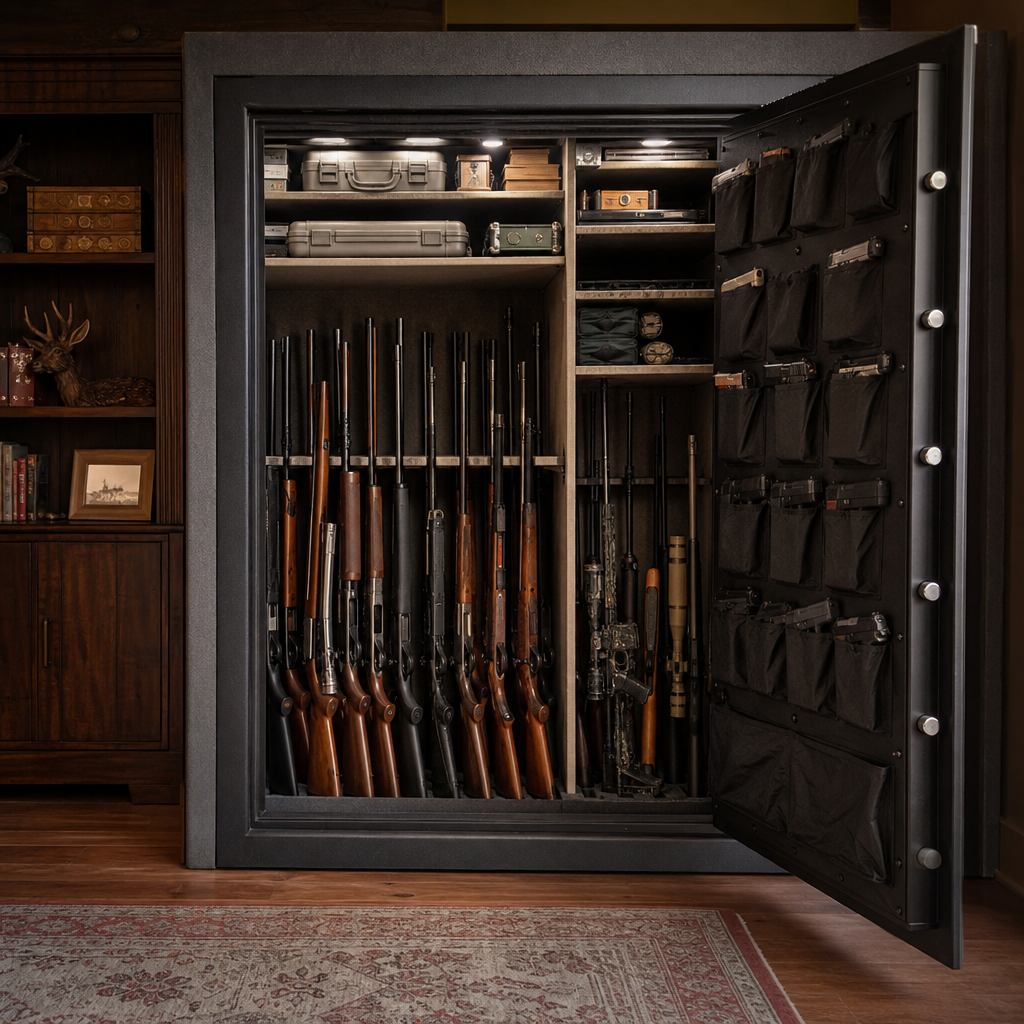
Collectors with large firearm inventories need a gun safe that functions less like a simple steel box and more like a controlled storage system built for protection, organization, and long-term collection management. In this context, a large firearm inventory usually means dozens of guns rather than a handful, including rifles, shotguns, handguns, optics, suppressors where legal, documents, and accessories that all require secure, stable storage. The best gun safe for these collectors is typically a high-capacity, heavy-gauge, fire-rated safe with modular interior configuration, serious burglary resistance, humidity control, and enough room for growth beyond the current collection. I have worked with collectors who outgrew retail-store safes in under two years, not because the listed gun count was inaccurate alone, but because scoped rifles, slings, hard cases, and accessory bins quickly consumed every claimed inch. That gap between catalog promise and real storage needs is why buyer personas matter. A collector buying for ten heirloom rifles has different priorities than someone storing fifty modern long guns and a drawer full of serialized components. Understanding those differences helps buyers choose the right safe category, avoid expensive mistakes, and build a storage setup that remains practical as the collection expands.
Why large-collection buyers need a different class of gun safe
A collector with a large inventory should not shop the same way as a first-time gun owner. Capacity is the obvious difference, but it is not the only one. Large collections raise the stakes for burglary resistance, fire protection, environmental stability, insurance documentation, and retrieval speed. If a safe holds thirty to sixty firearms, failure is not merely inconvenient; it can mean catastrophic financial loss, irreplaceable historical loss, or both. The right safe therefore starts with construction quality. Look for thicker steel bodies, robust door plates, reinforced bolt work, hard plates protecting the lock, relockers, and certified or at least credibly specified fire protection. A safe that weighs more generally resists attack better, especially when properly anchored to concrete.
Collectors also need honest thinking about storage density. Manufacturer gun counts are almost always based on tightly packed, unscoped long guns. In real use, a “40-gun” safe may comfortably hold 18 to 24 collector-owned firearms if many have optics, bipods, leather slings, oversized bolts, or unusual stock dimensions. This is why many experienced buyers immediately size up one or two classes. For a collector with a large firearm inventory, the best fit is often a 45- to 72-gun premium safe, a double-door cabinet-style safe for organized access, or even a modular vault room setup when the collection crosses into investment-grade territory. Interior flexibility matters as much as shell size. Adjustable shelving, rifle rods, pistol door organizers, and pull-out racks can transform usable capacity without compromising protection.
Another difference is lifecycle cost. A cheap safe replaced twice costs more than a properly chosen premium model bought once. Delivery, stair carries, anchoring, humidity gear, and later replacement all add up. Serious collectors benefit from treating the purchase as infrastructure. They should think in terms of five to ten years of growth, not today’s count. This subtopic, often described as gun safe buyer personas, is useful because it frames the purchase around how the owner actually stores, uses, and expands a collection. That perspective leads to better decisions than shopping by price tag or claimed capacity alone.
The collector personas that shape the best buying decision
Not every collector with many firearms needs the same safe. Over years of helping buyers compare options, I have seen six recurring personas that explain most purchase decisions. The classic heirloom collector prioritizes wood protection, low-light handling, and careful spacing to avoid stock dings. The tactical collector needs storage for optics-heavy rifles, magazines, suppressor accessories, and quick organization. The historical collector may need room for long-barreled rifles, odd dimensions, and document storage for provenance. The investor collector treats the safe as an asset-protection tool tied to insurance schedules and valuation records. The competitive shooter collector needs frequent access, efficient layout, and room for cases and support gear. The mixed-household collector stores family firearms, personal defense guns, and collectibles in one system, which creates segmentation needs inside the safe.
These personas overlap, but they produce different purchase priorities. An heirloom owner may accept lower density to prevent finish wear, while a tactical owner wants configurable racks and door storage to maximize every cubic inch. An investor collector may care more about lock auditability, fire rating methodology, and serial-number documentation storage than about fast daily access. A competitive shooter often wants a safe in the garage or gear room near loading equipment, which makes humidity swings and insulation performance more important. This hub article matters because every sub-article under gun safe buyer personas should connect back to a core point: the best gun safe is the one whose construction, layout, and placement match the real collection profile, not the imagined one.
| Buyer persona | Primary priority | Best safe type | Common mistake |
|---|---|---|---|
| Heirloom collector | Finish protection and spacing | Large premium safe with adjustable interior | Overpacking long guns |
| Tactical collector | Configurable storage for optics and gear | High-capacity modular safe | Trusting headline gun-count claims |
| Historical collector | Odd-size firearm accommodation | Tall safe with shelf flexibility | Ignoring barrel and stock length variation |
| Investor collector | Asset protection and records | Heavy burglary-rated or premium composite safe | Buying on price instead of construction |
| Competitive shooter | Frequent access and organization | Wide-body safe with door storage | Leaving no room for support equipment |
| Mixed-household owner | Segmentation and shared access rules | Dual-zone interior or multiple-safe setup | Combining all guns in one cramped space |
What type of gun safe is best for large firearm inventories
For most collectors with large inventories, the best choice is a premium wide-body long-gun safe rather than a basic residential security container marketed on capacity alone. Wide-body safes provide better shelf options, more realistic long-gun spacing, and improved door-panel storage. They also make it easier to separate collectible firearms from range guns and handguns from long guns. In practical terms, many collectors are happiest when they buy a safe rated for at least 1.5 to 2 times their current inventory. If the collection includes many scoped rifles, use the higher end of that range. A collector with twenty-five long guns and ten handguns should often start by evaluating “50-gun” premium models, not “30-gun” entry models.
Steel thickness is a decisive factor. Many entry safes use thinner bodies that deter casual theft but perform poorly against determined attacks with pry tools or portable grinders. Better safes use thicker plate or composite construction with concrete-like fill, stronger door frames, and upgraded bolt work. Lock choice matters too. A mechanical dial lock remains a proven option with long service life and minimal electronic failure points, while quality electronic locks offer speed and user code management. Cheap electronic locks are the weak point to avoid, not electronic locks as a category. Fire protection should be evaluated carefully because ratings vary by manufacturer methodology. Independent testing, continuous welds, quality door seals, and clear temperature/time specifications are more meaningful than a large sticker alone.
Collectors managing truly large inventories may be better served by a modular vault room or multiple safes instead of one giant unit. Once collections become very large, a single safe creates access bottlenecks, weight-placement issues, and organizational compromises. Splitting the collection by use case often works better: one main premium safe for primary valuables, one secondary safe for overflow or modern utility firearms, and dedicated document or ammo storage as appropriate. That is often the real answer for advanced buyer personas under the broader gun safes and safety topic: the best type may be a system, not a single product.
Features collectors should prioritize before brand names and price
Collectors often start by comparing brands, but the better sequence is to define must-have features first. Capacity should be measured in usable slots, shelf adaptability, and accessory zones, not only in advertised gun count. Interior adjustability is essential because collections change. A safe that can convert half its long-gun side into shelves for handguns, optics, and archival boxes will stay useful longer than a fixed-rack design. Door organizers are especially valuable for large collections because they free the floor area for long guns and move pistols, choke tubes, documents, and small valuables into visible storage.
Environmental control is another non-negotiable feature. Firearms stored long term are vulnerable to rust, stock swelling, adhesive breakdown in optics accessories, and mildew on slings or cases if humidity is ignored. A dehumidifier rod, rechargeable desiccant, hygrometer, and stable room placement together reduce risk significantly. I strongly recommend collectors leave extra air space inside the safe rather than packing it to the limit, because airflow around firearms matters. Lighting, power ports, and anchor holes also deserve attention. Integrated lighting helps prevent accidental contact damage when removing tightly stored guns. Power access supports dehumidification and lighting without pinching cords through the door seal.
Finally, consider service support. Delivery quality, installation experience, replacement lock availability, and warranty execution matter more than glossy brochures. Reputable dealers will discuss floor load, stair access, anchoring method, and real storage expectations. They will also be candid about the limits of residential gun safes. No safe is impenetrable. The objective is to create enough delay, visibility, and protection that theft and fire risks are materially reduced while the collection remains organized and usable.
Placement, growth planning, and the mistakes large collectors regret most
The best gun safe can still underperform if placed badly. Install the safe in a low-visibility area with structural support, manageable humidity, and secure anchoring. Basements can work well if moisture is controlled, but flood risk must be assessed. Garages offer convenience, yet temperature swings and visibility during open-door periods can create problems. Interior rooms on concrete are often ideal. Collectors should also think about moving paths before purchase. I have seen buyers order 1,200-pound safes only to discover that a tight turn or stair landing made professional installation impossible without extra cost or a different model.
Growth planning is the most common regret. Large collectors rarely stop acquiring firearms, and collections also accumulate optics boxes, spare grips, magazines, records, and appraisal documents. Buying for current inventory only is a near-certain mistake. Another regret is failing to separate ammunition, paperwork, and firearms logically. Ammunition may be better stored in a dedicated locking cabinet to preserve interior firearm space and reduce weight concentration. Insurance documentation should be backed up digitally, with photos, serial numbers, and appraisals updated regularly. Collectors with high-value inventories should confirm policy limits and any storage requirements imposed by insurers.
The final mistake is assuming all “best gun safes” serve all buyer personas equally. They do not. The best safe for a historical collector is not automatically the best for a competitive shooter or investor-grade collection. The right answer depends on inventory size, firearm dimensions, access frequency, environmental conditions, and future growth. Start with an honest count, double-check actual dimensions, evaluate realistic capacity, and choose a safe or storage system that leaves room to breathe. If you are building out your gun safes and safety plan, use these buyer personas as the hub for your next decisions, then compare specific safe sizes, lock types, and installation options with that framework in mind.
Frequently Asked Questions
What type of gun safe is best for collectors with large firearm inventories?
For collectors with large firearm inventories, the best option is typically a high-capacity, heavy-gauge steel gun safe designed for long-gun storage, modular organization, and long-term environmental control. Once a collection grows into the dozens, a basic entry-level safe usually stops being practical. Collectors need a storage system that can handle rifles, shotguns, handguns, optics, magazines, important paperwork, and accessories without forcing everything into cramped, damaging layouts. In most cases, that means choosing a premium or commercial-grade safe with a wide body, deeper interior, adjustable shelving, door-mounted storage, reinforced locking bolts, and substantial fire and pry resistance.
A collector should think beyond the advertised gun count and focus on usable storage volume. Many safes labeled for 40, 50, or even 60 guns only reach those numbers under unrealistic conditions, often assuming unscoped rifles packed tightly together. For a serious collector, a safe is best viewed as an organized vault, not just a locking cabinet. A model with flexible interior sections, handgun racks, adjustable barrel supports, and room for optics-heavy firearms is often more valuable than one with a high marketing capacity number. If the collection includes rare, historic, or high-value firearms, it also makes sense to prioritize superior build quality, internal protection, and humidity control over simply maximizing raw storage count.
For very large inventories, many collectors eventually outgrow even oversized residential safes and begin looking at multiple matched safes or a modular vault-room approach. That can be the best long-term answer when the goal is collection management as much as theft deterrence. The right safe for a large collection should provide security, organization, preservation, and room to grow, all while making the collection easier to access and maintain safely.
How large should a gun safe be if I own dozens of firearms?
If you own dozens of firearms, the safest and most practical rule is to buy significantly larger than your current collection requires. A collector with 25 to 35 guns should generally avoid shopping for a safe advertised at that exact capacity. Real-world use reduces capacity quickly because long guns often have scopes, slings, bipods, wider stocks, or other accessories that take up extra room. Handguns, suppressors where legal, ammunition storage considerations, optics boxes, records, and maintenance gear also compete for interior space. In practice, many experienced owners recommend doubling your expected needs when evaluating safe size.
For example, a collector with 30 firearms may find a safe marketed for 50 or more guns to be far more realistic. That extra space allows for proper separation between firearms, lowers the risk of stocks and finishes rubbing together, and gives you room for trays, shelving, and document storage. It also improves usability. A tightly packed safe may technically fit the collection, but it can be frustrating to access, difficult to inventory, and more likely to cause accidental bumps or scratches. A larger safe makes it easier to retrieve one firearm without disturbing several others.
Depth and width matter just as much as height. Collectors often focus only on how many long guns can stand upright, but a truly useful large-capacity safe also needs enough depth for scoped rifles and enough configurable shelf space for handguns, cases, and accessories. If the inventory includes a mix of hunting rifles, AR-platform firearms, tactical shotguns, and collectible handguns, modular organization becomes essential. The best size is usually the one that supports your current collection comfortably while leaving clear room for future acquisitions, not the one that merely fits everything today.
What security and fire protection features matter most in a gun safe for a serious collection?
For a serious collection, the most important security features are thick steel construction, a strong door and frame design, robust locking bolts, a reliable lock system, and solid anchoring capability. Many buyers focus first on lock type, but the overall structure of the safe is more important. A premium safe should resist prying, cutting, and brute-force attacks through heavier body steel, reinforced corners, protected hinges, and a door that seats tightly within a strong frame. A high-end lock is valuable, but it is only one part of the protection system. If the steel body and door are weak, the lock itself becomes less meaningful.
Collectors should also pay close attention to whether the safe can be bolted securely to a concrete foundation or similarly solid surface. Even a very heavy safe benefits from anchoring, because theft attempts often become easier if criminals can tip, move, or remove the unit. For large inventories, internal relockers, hard plates, and anti-drill protections are worthwhile features, especially when the collection has high monetary or sentimental value. A safe that houses rare firearms deserves a level of security closer to asset protection than simple household storage.
Fire protection matters because a collector is not only guarding against theft but also against irreversible loss of wood, metal, optics, records, and heirloom value. Fire ratings should be viewed carefully, since not all manufacturers test to the same standards. In general, longer fire endurance at meaningful temperatures is preferable, but collectors should also think about door seals, insulation design, and whether the safe helps limit smoke and moisture intrusion after a fire event. If the collection includes paper records, appraisals, serial number lists, or historical documentation, using a protected internal document box in addition to the safe itself can add another layer of preservation.
Is one large gun safe better than multiple safes for a large firearm collection?
It depends on the size of the collection, the layout of the home, and how the collector uses the firearms, but many serious collectors find that multiple safes offer important advantages. One very large safe can centralize security and simplify access, especially if the collection is stored in a dedicated room. It can also make inventory management easier because everything is in one place. For some collectors, a single oversized safe with a highly configurable interior is the cleanest and most efficient solution, particularly if the goal is to create a controlled, organized storage hub for long guns, handguns, optics, and documents.
However, multiple safes can improve organization, weight distribution, and long-term flexibility. A collector might dedicate one safe to primary long guns, another to handguns and valuables, and a third to overflow items or specialized pieces. That separation can reduce crowding and make daily access easier. It can also help if the collection contains firearms of very different sizes and use patterns. Instead of repeatedly shifting everything around in one packed safe, each category can have a logical storage plan. From a practical standpoint, multiple safes may also be easier to install than one extremely large, extremely heavy unit, especially in homes with flooring, stair, or space limitations.
There is also a risk-management argument for using more than one safe. Dividing the collection means that access, maintenance, and storage conditions can be tailored more precisely. That said, if several lower-quality safes are being considered instead of one truly well-built safe, quality should usually win. Collectors should compare total capacity, installation constraints, room security, climate control, and future growth before deciding. In some cases, the best answer is not strictly one or multiple safes, but a phased storage plan that starts with one large premium safe and expands into additional secure units as the collection grows.
What organization and climate-control features should collectors look for in a gun safe?
Collectors with large inventories should prioritize a safe with a configurable interior and dependable climate-control support, because preserving firearms is just as important as locking them away. Good organization begins with adjustable shelving, modular long-gun racks, handgun supports, door-panel storage, and space for accessories that would otherwise clutter the main compartment. A collector storing dozens of firearms needs a system that allows each item to have a logical place. Without that, the safe becomes inefficient, crowded, and harder to use safely. Interiors that support a mix of scoped rifles, shotguns, handguns, cases, magazines, and paperwork are far more useful than rigid one-size-fits-all layouts.
Collectors should also consider protective interior materials and spacing. Soft-lined shelves, barrel rests, and stock supports help reduce finish wear, especially in collections that include polished wood, blued steel, engraved pieces, or other delicate surfaces. Door organizers can free up major space inside the safe by holding handguns, documents, and small gear in dedicated compartments. This is particularly valuable in large collections, because it keeps the floor area and long-gun sections from becoming overloaded. Easy visual access is another overlooked benefit. When firearms are stored neatly, the owner can inspect, rotate, and inventory them more effectively.
Climate control is essential for long-term preservation. Even the best safe can become a poor storage environment if humidity is not managed properly. Collectors should look for safes that accommodate dehumidifier rods, desiccant systems, and hygrometers so interior moisture levels can be monitored and controlled. Stable humidity helps prevent rust, corrosion, mold, wood swelling, and damage to leather slings or paperwork. In areas with significant seasonal humidity swings, this becomes especially important. A large collection often represents years of investment and care, so the ideal gun safe is not just secure and spacious, but also organized and environmentally stable enough to protect that investment for the long term.