
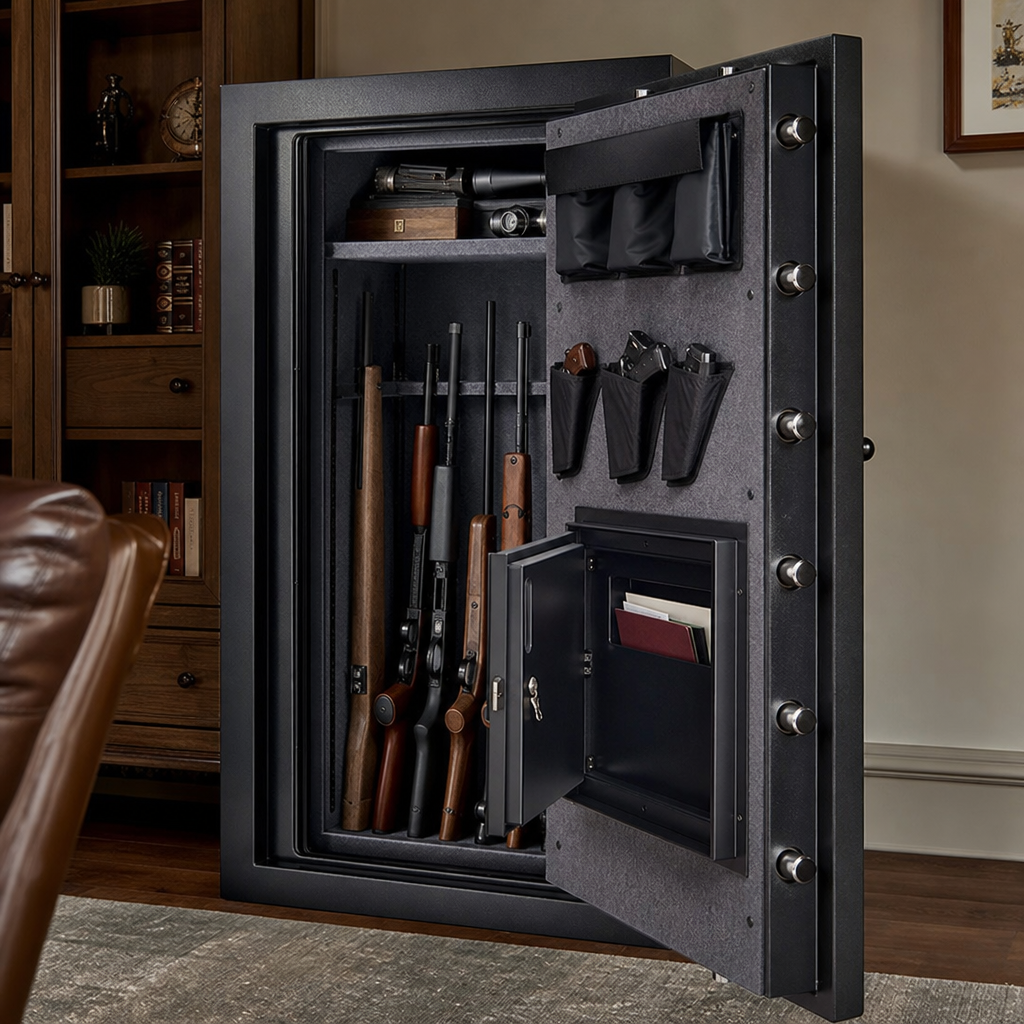
The best gun safes that offer built-in fireproof document compartments solve two storage problems at once: they secure firearms against theft and unauthorized access while protecting critical paperwork from heat, smoke, and water during a house fire. In practical terms, a gun safe is a heavy steel security container designed for long guns, handguns, ammunition, and accessories, while a fireproof document compartment is a separate insulated interior box intended for passports, deeds, titles, wills, insurance policies, tax records, cash, and digital media. Buyers often assume any large gun safe will also protect papers well, but that is not automatically true. Fire ratings vary widely, interior hot spots can damage paper before the outer shell fails, and many safes with broad “fire resistant” claims do not provide a dedicated inner compartment for documents. That distinction matters because paper chars around 451 degrees Fahrenheit, many electronic media fail at much lower temperatures, and residential fires routinely exceed 1,100 degrees at the ceiling. If you are building a buying guide shortlist for gun safes and safety, this category deserves close attention because it combines burglary protection, fire endurance, interior organization, and emergency readiness into one product decision.
I have evaluated gun safes in homes, retail showrooms, and installation projects, and the pattern is consistent: people regret underbuying more than overbuying. A safe that is too small, too light, or poorly rated becomes a bottleneck within a year. A well-chosen model with a built-in fireproof document compartment, by contrast, keeps firearms separated from valuables, speeds retrieval of records after a disaster, and reduces the need for a second lockbox that consumes shelf space. For buyers comparing options across this subtopic, the goal is not simply finding the cheapest fire-rated cabinet. The goal is matching steel thickness, locking system, insulation design, anchoring capability, internal layout, and verified fire performance to your actual collection and risk profile. This hub guide explains what to look for, how to compare models intelligently, where manufacturers stretch the truth, and which feature combinations deliver the best long-term value.
What a built-in fireproof document compartment actually does
A built-in fireproof document compartment is an insulated, lockable inner chamber mounted near the top or center of the main safe. In better designs, it uses additional fireboard, tight seals, and a separate keyed or electronic lock so documents remain isolated from firearms and small accessories. The benefit is straightforward: it creates a second layer of thermal protection and organization. In several safes I have inspected after minor fire events and water exposure, the main interior remained intact, but loose paperwork on open shelves absorbed moisture, soot, and heat much faster than records stored inside the dedicated inner box. That inner compartment does not make the safe impervious, but it buys crucial time.
It also improves day-to-day use. Important documents are easier to inventory when they are not stacked beside ammo cans, optics boxes, or handgun cases. Families can grant limited access to paperwork through a separate key while keeping the primary firearm compartment under stricter control, though buyers should verify exactly how the secondary lock works. Some models include only a simple privacy key, not a high-security barrier. As a buying guide principle, treat the document compartment as enhanced protection and organization rather than a substitute for a stand-alone UL Class 350 media safe if you need archival-grade defense for irreplaceable records or sensitive electronics.
How to evaluate security, fire protection, and capacity together
The best buying decisions balance three variables: burglary resistance, fire endurance, and usable storage. Burglary resistance begins with body steel, door construction, boltwork, hard plates, relockers, pry resistance, and anchor points. Fire endurance depends on insulation type, door seals, weld quality, and whether the manufacturer states an independent test standard or only an internal rating. Capacity concerns the honest amount of space available once shelves, door organizers, scoped rifles, and the document box are installed. Manufacturers routinely overstate gun counts by assuming slim, unscoped long guns placed impossibly close together. In real use, a “36-gun safe” may fit 18 to 24 practical firearms with accessories.
For this category, the document compartment affects capacity more than many first-time buyers expect. It usually occupies premium top-shelf space where passports, handguns, jewelry, or suppressor paperwork would otherwise sit. That is not a flaw; it is part of the tradeoff. If your collection includes optics-heavy AR platforms, tactical shotguns, and hard cases, move up at least one size tier. The right approach is to estimate your current long gun count, add 30 to 50 percent growth room, then subtract some shelf volume for documents and emergency valuables. This avoids the common mistake of buying a safe that technically stores firearms but forces paperwork into corners where it receives less protection and becomes difficult to access.
| Feature | Minimum acceptable | Better choice | Why it matters |
|---|---|---|---|
| Body steel | 12 gauge | 10 gauge or thicker | Thicker steel slows pry and punch attacks |
| Fire rating | 45 minutes at 1200°F | 75-120 minutes with named test basis | Longer, clearer ratings improve survival odds in residential fires |
| Lock type | UL-listed electronic or mechanical | UL-listed lock with hard plate and relocker | Better resistance to forced entry and lock attack |
| Anchoring | Pre-drilled anchor holes | Professional anchoring to concrete | Prevents thieves from tipping or removing the safe |
| Document compartment | Insulated inner box | Insulated inner box with separate lock and seals | Keeps papers organized and adds thermal buffering |
Fire ratings, insulation types, and what manufacturers do not tell you
Fire ratings are one of the most misunderstood parts of the gun safe market. A label such as “60 minutes at 1400°F” sounds precise, but buyers need context. Who performed the test? Was the safe heated in a furnace with a standard time-temperature curve? Was there a cool-down period? Were sensors placed in the document compartment or only in the main body? Reputable brands often describe the test method, maximum internal temperature target, and whether a house-fire simulation was used. Less rigorous claims rely on marketing language without enough details to compare products fairly.
Insulation design matters as much as the headline rating. Many residential gun safes use layers of gypsum-based fireboard because it releases steam as temperatures rise, slowing heat transfer. Higher-end safes may use proprietary concrete-like composites or denser poured insulation that generally performs better and strengthens the body. Intumescent door seals are also important; they expand in heat to block smoke and water intrusion around the door gap. In service calls and post-install inspections, I have seen cheaper seals separate at corners or compress unevenly, reducing performance. Buyers should look for continuous seals, not just broad claims of “triple protection.” If the safe will store paper, understand a hard truth: no gun safe offers the same assurance as a true data or media safe for external drives, backup tapes, or old photographs. Paper can survive conditions that destroy digital media, so if electronics matter, use secondary protection inside the document compartment.
Locking systems, access speed, and failure points
Most gun safes in this category use either a mechanical dial lock or a UL-listed electronic keypad. Mechanical locks are slower but time-tested, with no batteries to replace. Electronic locks are faster and more convenient for frequent access, especially in households that open the safe weekly. In recent years, better electronic locks from SecuRam, Sargent and Greenleaf, and La Gard have become more dependable, but quality still varies by model and installation. A premium safe with a generic lock can become frustrating fast.
The built-in document compartment introduces another access decision. Some use a separate key lock, while others leave the box unlocked inside the main safe. A separate lock improves internal control, especially for estate records or personal identity documents. However, it also creates one more key to manage and one more lock that can fail. I generally recommend a UL-listed primary safe lock and a simple but solid secondary compartment lock, provided spare keys are stored off-site. Biometric handgun safes have improved, but full-size gun safes with biometric primary locks are still less compelling than robust electronic or mechanical systems for long-term reliability. Regardless of lock type, insist on override procedures, documented warranty support, and local service availability before you buy.
Interior layout and the models that fit this use case best
The best gun safes with built-in fireproof document compartments are usually found in upper-entry and mid-tier lines from established brands rather than in ultra-budget cabinets. Brands commonly considered in this space include Liberty, Browning, Cannon, Fort Knox, Rhino, Winchester, Sports Afield, and Hollon. Product quality differs within each catalog, so buyers should judge the specific line, not just the logo. For example, Liberty’s Colonial, Franklin, and Fatboy families are often shortlisted because they pair broad dealer support with practical interiors and internal document storage. Browning’s Axis-style shelving and door organization can make better use of space when scoped rifles and paperwork must coexist. Fort Knox and Rhino tend to appeal to buyers who prioritize thicker steel and customization.
Look closely at shelf adjustability, door panel storage, pistol racks, and whether the document compartment steals vertical rifle clearance. In one installation, a buyer chose a safe with a generous top document box but discovered his longest precision rifles no longer fit with optics attached. Another customer solved this by selecting a wider safe instead of a taller one, preserving the compartment while improving practical rifle storage. That kind of layout planning matters more than brochure gun counts. For a buying guide hub, the most useful rule is simple: favor a flexible interior over maximum advertised capacity. Adjustable shelving, removable racks, and an accessible document box will serve a growing collection better than a rigid layout that looks efficient only in marketing photos.
Installation, placement, and the hidden costs of ownership
A great safe performs poorly if it is installed badly. Placement affects both security and fire survivability. Ground-floor locations on a concrete slab are usually best because they reduce floor-load concerns and make anchoring straightforward. Basements can work well for theft resistance and lower average temperatures, but they increase moisture risk, so a dehumidifier rod or desiccant becomes essential. Avoid garages unless climate, corrosion control, and visible access are managed carefully. Also remember that fire conditions vary by room; a safe tucked into a closet under a staircase may face different heat dynamics than one in an open room.
Ownership costs extend beyond the sticker price. Delivery for a 700- to 1,200-pound safe can require stair work, specialized equipment, and additional labor. Anchoring hardware, humidity control, interior lighting, power outlets, and annual lock maintenance add to the total. Insurance may offer discounts for compliant storage, but the bigger benefit is documentation after loss. Keeping titles, serial number records, tax forms, and photos in the document compartment speeds insurance claims dramatically. Before purchase, measure doorways, hall turns, floor transitions, and final placement clearance. Many buyers focus on comparing safes and forget to compare installation plans, which is how expensive returns happen.
How to choose the right safe for your household
Start with your actual risks. If children or unauthorized adults are a major concern, prioritize lock reliability, quick access for lawful users, and secure anchoring. If wildfire or rural fire response times are bigger issues, favor stronger fire construction and longer documented ratings. If identity protection and estate records are central, make sure the document compartment is genuinely insulated, easy to organize, and large enough for legal folders without folding everything into stacks. Then size the safe for five to ten years, not just today.
As a hub page for buying guides in gun safes and safety, the clearest recommendation is to shortlist models that meet four thresholds at once: credible fire rating, at least 12-gauge body steel, a trustworthy UL-listed primary lock, and a true built-in fireproof document compartment rather than a token lockbox. From there, compare interior layout, anchoring options, warranty support, dealer reputation, and delivery logistics. The main benefit of this category is peace of mind with fewer compromises: one secure location for firearms and one protected place for the records that matter most when everything else goes wrong. Review your inventory, measure your space, and choose a safe that will still fit your needs years from now.
Frequently Asked Questions
What is a gun safe with a built-in fireproof document compartment, and why would someone want one?
A gun safe with a built-in fireproof document compartment is designed to handle two important jobs in one secure unit. The main body of the safe stores firearms, magazines, ammunition, and related gear behind reinforced steel walls and a locking system intended to prevent unauthorized access. Inside that larger safe, there is also a separate insulated compartment specifically meant to protect sensitive documents such as passports, birth certificates, property deeds, vehicle titles, insurance records, wills, and other irreplaceable paperwork from high heat, smoke exposure, and, in some models, limited water intrusion during a fire event.
This setup is appealing because it centralizes home security. Instead of buying a gun safe for firearms and a separate fire box for paperwork, owners can keep both categories of valuables protected in one place. That is especially useful for households that want fast access to essential documents after an emergency without having to search in multiple locations. It also helps reduce clutter and can be more cost-effective than purchasing two high-quality storage products separately. For many buyers, the real advantage is convenience without sacrificing the distinct protective functions needed for guns and critical records.
How much fire protection can the document compartment realistically provide?
Fire protection claims should always be read carefully and realistically. A built-in fireproof document compartment is typically engineered to maintain a lower internal temperature for a stated amount of time, such as 30, 45, 60, or 90 minutes, while the exterior of the safe is exposed to a specific test temperature. That protection can be extremely valuable during a residential fire, especially when the compartment is intended for paper documents, which generally begin to char or ignite at temperatures far lower than what a full-structure fire can reach. The purpose of the insulated compartment is to slow heat transfer long enough for the fire to be controlled or for the safe to avoid prolonged direct exposure.
That said, “fireproof” should not be interpreted as indestructible under every scenario. Real-world fires vary widely in intensity, duration, room location, ventilation, and collapse conditions. Some safes are tested by independent organizations, while others rely on manufacturer testing standards, so the level of confidence can differ from brand to brand. Buyers should look for clear fire ratings, test temperatures, and duration claims, and understand what materials the compartment is intended to protect. Paper documents usually fare better than electronic media such as USB drives, hard drives, and photo negatives, which often require much lower internal temperatures than paper does. In short, the compartment can offer meaningful protection for essential paperwork, but it is still smart to keep digital backups of critical records and not assume that every fire event will mirror laboratory conditions.
Are these safes good enough for both firearm security and document protection, or is there a trade-off?
In many cases, a well-made model can do both jobs effectively, but there can be trade-offs depending on construction quality and price point. A strong gun safe should have a solid steel body, quality door construction, reliable locking mechanism, secure boltwork, and some level of pry resistance. The document compartment, meanwhile, should be properly insulated, sealed as designed by the manufacturer, and positioned so that it does not excessively compromise usable firearm storage space. Better safes balance these functions well, while lower-end products may advertise both features without being especially strong in either category.
One of the main compromises involves interior capacity. A built-in document box takes up room inside the safe, which can reduce the practical number of long guns the unit can hold compared with the manufacturer’s advertised maximum. Another consideration is access. If the document compartment is small or awkwardly placed, it may be less convenient to use regularly. There can also be a pricing trade-off: models that combine stronger anti-theft construction with credible fire protection and a dedicated interior document compartment usually cost more than entry-level gun cabinets or lightly insulated safes. For most buyers, the best approach is to prioritize theft resistance first, then evaluate the fire rating and compartment design. A safe that truly secures firearms and offers a properly insulated interior box is usually worth paying more for than a model that looks impressive on paper but lacks serious construction details.
What documents and valuables should be stored in the built-in compartment, and what should not be kept there?
The built-in fireproof document compartment is best used for essential paper records and compact valuables that would be difficult, expensive, or time-consuming to replace. Good examples include passports, Social Security cards, birth and marriage certificates, wills, trust paperwork, deeds, titles, insurance policies, military records, tax documents, estate planning files, and emergency contact information. It can also be a suitable place for small backup checkbooks, notarized records, and similar paper-based items that need both security and fire protection. Because this area is inside the gun safe, it can help ensure that highly sensitive personal documents are protected from both burglars and family members who should not have access to them.
However, buyers should be selective. Not every “fireproof” compartment is ideal for electronics or highly heat-sensitive media. USB drives, external hard drives, SD cards, DVDs, backup tapes, and certain photographs can be damaged at lower temperatures than paper can tolerate. Unless the safe specifically states that it is rated for digital media, those items may need a specialized media safe instead. It is also wise to avoid overpacking the compartment, because tightly crammed contents can make organization difficult and may interfere with proper closure if the compartment has its own door or lid. For jewelry, cash, and sentimental keepsakes, the compartment can be useful, but moisture control becomes important. Including a desiccant or dehumidifier in the main safe can help protect against humidity, especially in garages, basements, or humid climates.
What should buyers look for when choosing the best gun safe with a built-in fireproof document compartment?
Start with the fundamentals of security. Look at steel thickness, door strength, bolt design, lock type, and whether the safe can be securely anchored to the floor. A heavy safe with decent construction and proper bolting is far more resistant to theft than a lightweight unit that can be tipped, pried, or carried away. Consider whether you want an electronic keypad, mechanical dial, or biometric lock, and pay attention to the reputation of the lock and the manufacturer’s warranty and customer support. Interior layout matters too, especially if you plan to store a mix of rifles, handguns, optics, and ammunition. The presence of a document compartment is helpful, but it should not come at the expense of poor firearm organization or cramped access.
Next, evaluate the fire protection details with a skeptical eye. Look for a stated fire rating with a temperature and time duration, and give extra weight to safes with transparent testing information. Inspect the design of the interior document compartment itself: its size, insulation, door or lid style, and ease of access. Think about what you actually need to store there. If you have legal folders, property records, and passports, make sure the compartment can accommodate them without folding everything tightly. Finally, consider where the safe will live in your home. Weight, dimensions, floor support, humidity exposure, and accessibility all matter. The best choice is usually the one that fits your firearm collection, protects your critical paperwork, matches your risk level, and comes from a manufacturer with a proven track record rather than just the most aggressive marketing claims.