
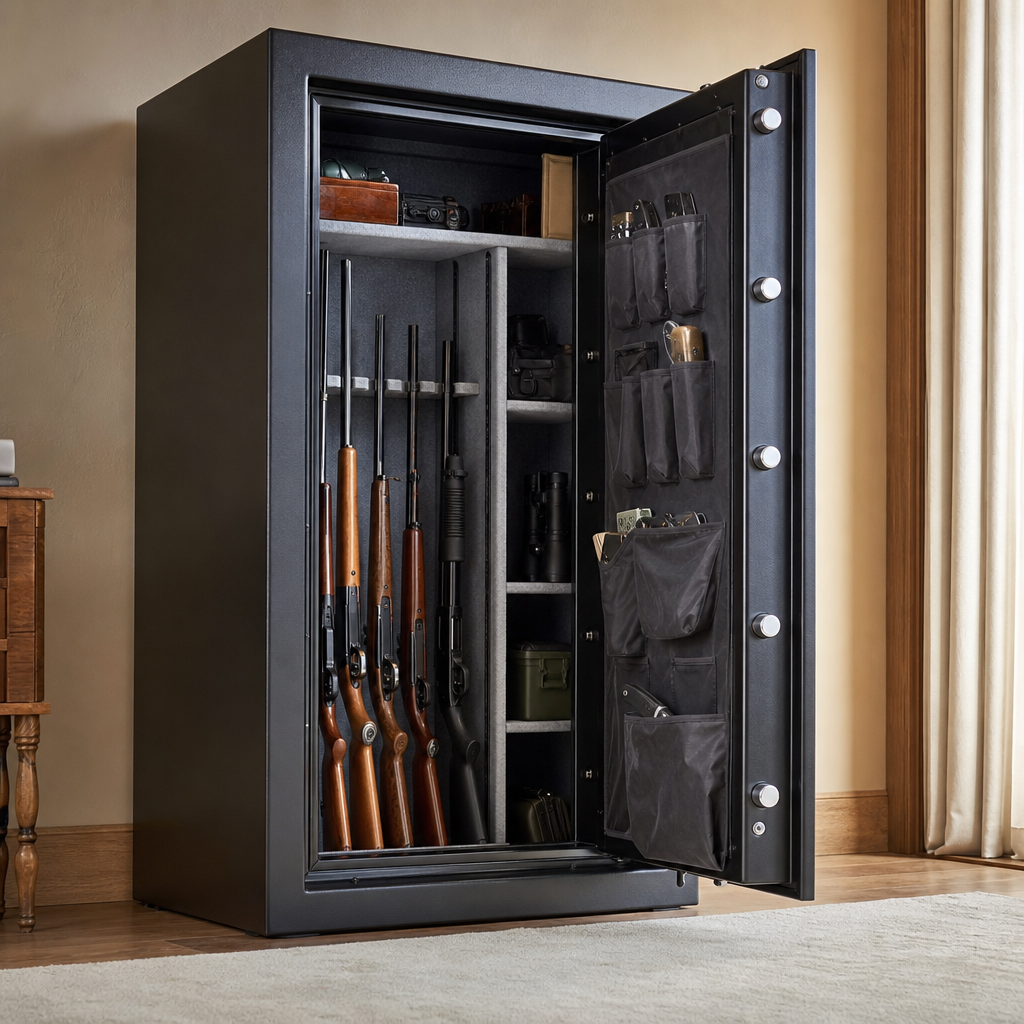
Gun safe security is often discussed in absolutes, but the real-world truth is more practical: a gun safe is a layered security device designed to delay unauthorized access, protect firearms from common threats, and support responsible ownership when paired with good habits. In my experience evaluating residential security products and helping families choose firearm storage, the biggest mistakes do not come from bad intentions. They come from myths. People assume a heavier safe is automatically burglar-proof, that any fire label means serious fire protection, or that a biometric lock solves every access problem. Those beliefs create false confidence, and false confidence is what weakens firearm security.
Before unpacking specific misconceptions, it helps to define terms clearly. A gun cabinet is usually a lighter steel container meant for basic organization and deterrence. A gun safe, especially one built to recognized burglary or fire standards, uses thicker steel, reinforced door construction, hardplates, relockers, and anchoring points. Residential Security Container ratings from UL are common in the consumer market, while true TL-rated burglary safes follow much stricter testing. Fire protection claims vary even more widely. Some manufacturers rely on internal gypsum board and proprietary seals; others publish independent test data. Understanding these differences matters because buyers are often comparing labels that sound similar but do not represent equal protection.
This topic matters for more than theft prevention. Secure storage reduces unauthorized access by children, visitors, and prohibited persons. It can support compliance with state safe storage laws, homeowner insurance requirements, and basic risk management. It also protects the owner from expensive losses tied to optics, ammunition, documents, and family heirlooms stored alongside firearms. As a sub-pillar within Gun Safes & Safety, gun safe myths and misconceptions deserve a hub article because they influence every downstream decision: safe size, lock type, installation, fire expectations, maintenance, and long-term ownership costs. If you understand what a safe can and cannot do, you make better choices, ask better questions, and build a storage plan that works under real conditions rather than marketing promises.
Myth 1: Any gun safe is burglar-proof
No consumer gun safe is magically burglar-proof. The right question is how long it can resist attack, what tools an intruder would need, and whether the safe is installed in a way that increases delay. Most residential burglaries are fast. FBI crime reporting and insurance industry loss data consistently show that thieves prefer speed, portability, and easy resale. That means many gun safes defeat the most common threat simply by being too time-consuming to open quickly. But that is not the same as being impossible to breach.
The largest performance gap in the market is between light-gauge security cabinets, standard big-box gun safes, and high-security burglary safes. A thin steel cabinet may stop casual handling by children or guests, yet it can often be pried or cut open with basic tools. A midrange gun safe with thicker steel, a formed door edge, multiple locking bolts, and a relocker is substantially better. A true burglary-rated safe goes further with tested resistance against concentrated attacks. Marketing often collapses these categories into one broad promise of “protection,” which is misleading.
The practical takeaway is simple: evaluate steel thickness, door design, boltwork, lock protection, weld quality, and anchoring provisions. If a model does not disclose body steel gauge or plate thickness, treat that as a warning sign. If it can be tipped over and attacked from the side or back, its apparent strength at the door becomes less meaningful. Delay is the goal, not invincibility.
Myth 2: Heavier always means more secure
Weight matters, but only in context. I have inspected heavy safes that used substantial drywall-based fire insulation while still relying on relatively modest steel thickness. They were difficult to move, yet not proportionally difficult to break into with pry tools or cutting tools. A safe can gain hundreds of pounds from fireboard, interior shelving, and decorative door panels without making the burglary barrier much stronger.
What matters is where the weight comes from. Plate steel in the body and door improves resistance. Reinforced hinge-side construction, anti-pry tabs, hardplates shielding the lock, and quality boltwork all matter more than gross shipping weight alone. A lighter safe built with thicker steel and better anti-pry geometry can outperform a heavier model built around cosmetic bulk and insulation.
That said, weight does play a secondary security role because it affects portability. A 700-pound anchored safe is much less likely to be removed intact than a 250-pound unanchored unit. The myth is not that weight is irrelevant. The myth is that weight by itself proves security. Serious buyers look past the brochure headline and ask for body steel thickness, door construction details, and the tested basis for any performance claims.
Myth 3: Fire ratings are standardized and directly comparable
Fire claims are one of the most misunderstood areas in gun safe buying. Many consumers assume a “60-minute fire rating” has the same meaning across brands. It does not. Some ratings come from manufacturer-run tests with limited disclosure about furnace temperature curve, sensor placement, pass criteria, and cool-down period. Others are based on independent testing, but even then, methods may differ. In fire testing, details determine whether the number has practical value.
For firearm storage, temperature and duration both matter. Wood stocks, adhesives, optics, documents, and ammunition components all respond differently to heat. Interior seals that expand under heat can help block smoke and steam, but they do not erase the importance of tested construction. In actual house fires, the safe’s location also matters. A garage, an upper story, or a room with high fuel load can create different exposure than a basement slab installation.
The best approach is to compare test methodology, not just the advertised minutes. Ask whether the rating was independently verified, what internal temperature threshold was used, whether the test included a cool-down period, and whether the entire safe or only a specimen configuration was tested. Fire protection is real, but it is not a generic sticker. Treat the label as the start of due diligence.
Myth 4: Biometric locks are always better than mechanical or electronic keypad locks
Biometric locks can be excellent for quick access, but they are not automatically superior. In daily use, fingerprint readers are sensitive to enrollment quality, finger placement, skin condition, dirt, and battery health. I have seen well-made biometric systems work reliably when users enroll multiple fingers carefully and maintain the lock. I have also seen frustration when owners assume the sensor will work perfectly after a rushed setup and no practice.
Mechanical dial locks remain highly durable and do not depend on batteries, but they are slower. Electronic keypad locks offer faster entry and straightforward code changes, though quality varies significantly between lock manufacturers. Biometric systems add convenience and can reduce access time, yet they should be judged on false reject rates, backup entry method, battery behavior, and lock brand reputation.
| Lock type | Main strength | Main limitation | Best fit |
|---|---|---|---|
| Mechanical dial | Long-term durability, no batteries | Slower access, more user error under stress | Owners prioritizing simplicity and longevity |
| Electronic keypad | Fast entry, easy code changes | Battery dependence, quality varies by model | Most households needing balance and convenience |
| Biometric | Very fast access when properly enrolled | Sensor variability, requires setup discipline | Users wanting speed and willing to maintain it |
The misconception is that one lock type wins universally. The right choice depends on your threat model, access speed needs, maintenance tolerance, and whether the safe is for long guns, bedside storage, or mixed use. Good lock selection is about reliability in your environment, not trend-driven features.
Myth 5: If a safe has many locking bolts, the door must be strong
Visible locking bolts sell safes because they look impressive, but bolt count alone is a weak indicator of strength. In many attacks, thieves do not defeat the bolts directly. They exploit thin door skins, flexible door frames, weak bolt carriers, or vulnerable body seams. A safe with fewer but better-supported bolts and stronger door construction can outperform one with an eye-catching bolt array.
Pay attention to active versus passive bolts, the thickness of the door plate, internal reinforcement, and whether the design resists pry-bar spread at the opening edge. Some bolts on the hinge side are simply dead bars that help keep the door engaged if hinges are cut, which is useful, but not equivalent to full multi-directional boltwork quality. Likewise, external hinges are not inherently insecure if the door has proper dead bars and the frame is well built.
The more useful mindset is to think in systems. Lock, relocker, hardplate, door structure, frame geometry, and anchoring work together. Counting bolts is like judging a deadbolt only by the length of the thumbturn. It focuses on what is visible instead of what actually resists attack.
Myth 6: Hiding the safe is enough protection
Concealment helps, but concealment is not a substitute for physical security. A safe hidden behind coats in a closet may avoid detection during a quick smash-and-grab burglary, and that is valuable. However, once found, an unanchored or lightly built safe can become the burglar’s next target. Many thieves search primary bedrooms, home offices, garages, and closets first because those locations often contain valuables, paperwork, and firearms.
Anchoring is one of the highest-value steps a gun owner can take. Bolting the safe to concrete, or to a reinforced floor system using manufacturer-approved hardware, prevents the common tactic of tipping the safe onto its back to improve leverage for prying. It also reduces the risk of whole-safe theft, which is far more common with smaller units than many buyers realize. Good installation also includes minimizing side and rear access, because pry attacks are easier when there is room to work tools around the body.
The strongest home setups combine concealment, anchoring, alarm coverage, and thoughtful placement. A safe in a monitored, camera-covered interior room with limited attack angles is much more secure than the same safe left freestanding in an accessible garage corner.
Myth 7: A gun safe is only for theft prevention
This myth narrows the value of secure storage too much. A gun safe primarily controls access. That means it helps prevent child access, unauthorized handling by visitors, theft by contractors or acquaintances, and impulsive misuse during household stress. Public health and injury-prevention research has repeatedly linked secure firearm storage with lower rates of unintentional injury and youth access. The safe’s purpose is broader than stopping burglars with crowbars.
It also supports organization. When firearms, bolts, magazines, suppressors where lawful, documents, and serial number records are stored systematically, owners are more likely to notice a missing item quickly and maintain cleaner inventory records for insurance and police reports. Humidity control is another overlooked function. A dehumidifier rod or desiccant system can significantly reduce corrosion risk in humid climates, especially for blued steel firearms and optics.
In other words, gun safe security is part of overall firearms risk management. Theft resistance matters, but so do access control, preservation, accountability, and compliance with family rules or legal obligations.
Myth 8: Once installed, a gun safe needs no maintenance
A safe is not a set-and-forget device. Locks need battery changes or periodic inspection. Mechanical dials benefit from occasional professional service if operation becomes inconsistent. Door seals should be checked for compression damage, especially in humid environments. Anchor bolts should be verified for tightness. Interior dehumidification systems need monitoring. Owners should also test access under realistic conditions instead of assuming the lock will work perfectly after years of neglect.
Maintenance extends to access planning. Backup keys, override procedures, combinations, and lock serial information should be managed carefully and stored securely off-site when appropriate. I have worked with owners who invested heavily in a safe but never documented lock details, leaving family members unable to gain lawful access after a medical emergency or death. Security that cannot be managed responsibly becomes its own problem.
The best routine is simple: inspect the safe twice a year, replace batteries on a schedule rather than after failure, verify humidity control, test opening and locking, and review who has authorized access. Like smoke detectors and alarm systems, safes work best when owners treat them as active equipment.
Choosing a gun safe using facts instead of myths
If you want better gun safe security, begin with your actual use case. How many firearms need storage today, and what collection growth is realistic over five years? Do you need fast-access defensive storage, long-gun organization, document protection, or all three? Is the primary threat unauthorized household access, smash-and-grab burglary, or extended fire exposure? These answers shape the right purchase more than advertising language ever will.
Then evaluate core criteria in order: construction, lock quality, installation plan, fire methodology, interior capacity, and humidity management. Favor manufacturers that disclose steel thickness and lock brands, publish meaningful specifications, and explain their fire testing clearly. If possible, inspect welds, door fit, shelving rigidity, and handle play in person. Plan for anchoring before delivery, because a safe that cannot be properly installed is the wrong safe for that location.
As the hub for Gun Safe Myths & Misconceptions, this article points to a consistent conclusion: the best safe is not the one with the loudest claims. It is the one whose construction, lock, fire protection, and installation match the real risks you face. Use myths as a checklist of what to question. Compare specifications, ask how ratings were earned, and think in layers. If you are reviewing options now, start by auditing your current storage setup and identifying the first weak point you can fix this week.
Frequently Asked Questions
1. Is a heavier gun safe always more secure?
Not necessarily. Weight matters, but it is only one part of the security picture. A heavier safe can be harder to move and may contain thicker steel, better internal reinforcement, and stronger locking components. That said, weight alone does not guarantee meaningful protection. A very heavy safe with thin door construction, weak boltwork, poor welds, or a vulnerable lock can still be defeated faster than a lighter safe built with better materials and smarter engineering.
In real-world residential security, the better question is how long a safe can resist common attack methods and how difficult it is to remove, pry, cut, or tamper with. The thickness of the steel body and door, the design of the frame, the quality of the lock, and whether the unit is properly anchored all have a direct effect on security. A moderately heavy safe that is bolted down in a discreet location often performs better in practice than an extremely heavy safe that is left unanchored in a visible part of the home.
It also helps to remember what most gun safes are designed to do. They are not magic vaults. They are delay devices that buy time, reduce easy access, and protect firearms from common risks like casual theft, smash-and-grab burglary attempts, and unauthorized handling. The most secure choice is usually a well-built safe with solid steel construction, a reliable lock, pry resistance, and proper installation rather than simply the one with the highest weight on the spec sheet.
2. If a gun safe has an electronic lock, is it less secure than a mechanical dial lock?
This is one of the most common myths, and the truth is more balanced. Electronic locks are not automatically less secure, just as mechanical dial locks are not automatically superior. Both can be effective when they come from reputable manufacturers and are used on a safe with sound overall construction. The real differences usually come down to reliability, convenience, maintenance, and user behavior rather than a simple good-versus-bad comparison.
Electronic locks offer practical advantages that matter in everyday firearm storage. They are typically faster to open, easier for many users to operate under stress, and simpler to change if access codes need to be updated. For households focused on responsible access control, this convenience can improve actual security because owners are more likely to keep the safe locked consistently. A lock that is slightly slower or more cumbersome may be theoretically appealing, but if people leave the safe unsecured out of frustration, real-world security suffers immediately.
Mechanical dial locks have a long reputation for durability and do not depend on batteries, which appeals to many buyers. However, they are not immune to wear, misuse, or failure, and they can be slower for some users to operate. Electronic locks, on the other hand, require battery awareness and quality components, but modern models from trusted brands can be highly dependable. The smartest approach is not to treat one style as universally best. Instead, choose a proven lock from a reputable maker, learn how it works, maintain it properly, and make sure the rest of the safe is built to the same standard. A great lock on a poorly built safe still leaves major vulnerabilities.
3. Can a gun safe stop any thief if it is labeled as pry-resistant or tamper-proof?
No safe should be viewed as unbeatable, and terms like pry-resistant and tamper-proof are often misunderstood. In residential settings, these labels should be interpreted as relative performance claims, not promises of invincibility. A pry-resistant design may include reinforced door edges, tighter gaps, stronger bolt engagement, and features that make common break-in attempts more difficult. That is valuable, but it does not mean the safe can withstand any attack indefinitely.
The realistic goal of gun safe security is delay. Most burglars are working under time pressure, noise concerns, and the risk of being seen. A safe that takes substantially longer to breach is often enough to make the attempt fail or force the intruder to give up. That is why design details matter so much. Door geometry, steel thickness, hard plate protection for the lock area, internal hinges versus exposed weak points, and proper anchoring can all increase the time and effort required to get inside.
Consumers should also understand that marketing language can blur important distinctions. A residential gun safe is different from a high-security commercial vault or a unit with formal burglary ratings. For most homeowners, the practical objective is to prevent quick access, reduce the odds of theft, and secure firearms from children, guests, and opportunistic intruders. The best mindset is to treat a safe as one layer in a larger plan that includes placement, anchoring, alarm systems, surveillance, and responsible access control habits. That layered approach is far more effective than relying on optimistic labels alone.
4. Do I still need to bolt down a gun safe if it is large and difficult to move?
Yes. Bolting down a gun safe is one of the most important and most overlooked steps in improving security. Many owners assume that because a safe is heavy, it cannot realistically be stolen or repositioned. In practice, that assumption creates unnecessary risk. Criminals do not always need to open a safe on-site. If they can tip it, slide it, load it with equipment, or move it to a more convenient location, they may gain time and privacy to attack it later.
Anchoring changes the equation. A properly bolted safe is harder to tip for leverage, harder to move for removal, and harder to manipulate during a pry attack. It also reduces the chance of an accident in the home, especially with taller safes that could become unstable if the door is opened aggressively or if weight distribution changes inside. Security and safety both improve when the installation is done correctly.
Placement matters just as much as anchoring. A safe tucked into a corner, closet, or other constrained space can limit access to the sides and back, making attacks more difficult. Pair that with solid floor anchoring, quality hardware, and installation that follows the manufacturer’s guidance, and the safe becomes meaningfully more resistant in the real world. For many households, a smaller well-installed safe provides better practical security than a larger free-standing one that can be shifted, rocked, or removed. In other words, installation is not a finishing touch. It is a core part of what makes the safe effective.
5. Is buying a gun safe enough to ensure responsible firearm security at home?
Buying a gun safe is a major step, but it is not the finish line. A safe supports responsible ownership, but it only works well when paired with consistent habits and a broader home security mindset. Many of the biggest failures in firearm storage do not come from defective safes. They come from preventable behaviors such as leaving the safe unlocked, sharing access too casually, using weak or obvious codes, failing to replace batteries in electronic locks, or storing keys in predictable places.
Responsible security starts with using the safe every time, not just when it feels convenient. It includes controlling who has access, reviewing where backup keys or override tools are kept, and making sure the safe’s location is not obvious to visitors or service personnel. It also means matching the storage method to the household. A family with children, frequent guests, or changing access needs may require different lock preferences and internal organization than a single-owner household. The goal is secure storage that works reliably under everyday conditions, not just in theory.
It is also wise to think in layers beyond the safe itself. Home alarm systems, reinforced doors, cameras, discreet placement, inventory records, and regular maintenance all strengthen the overall security plan. If the safe includes fire protection features, owners should understand what those ratings mean and what they do not. If quick access is needed for defensive purposes, practice and safe routine matter just as much as lock type. The most effective approach is practical and disciplined: choose a quality safe, install it properly, maintain it, and build habits around it that reduce risk day after day. That is how a gun safe becomes part of real security instead of just a heavy box in the corner.