
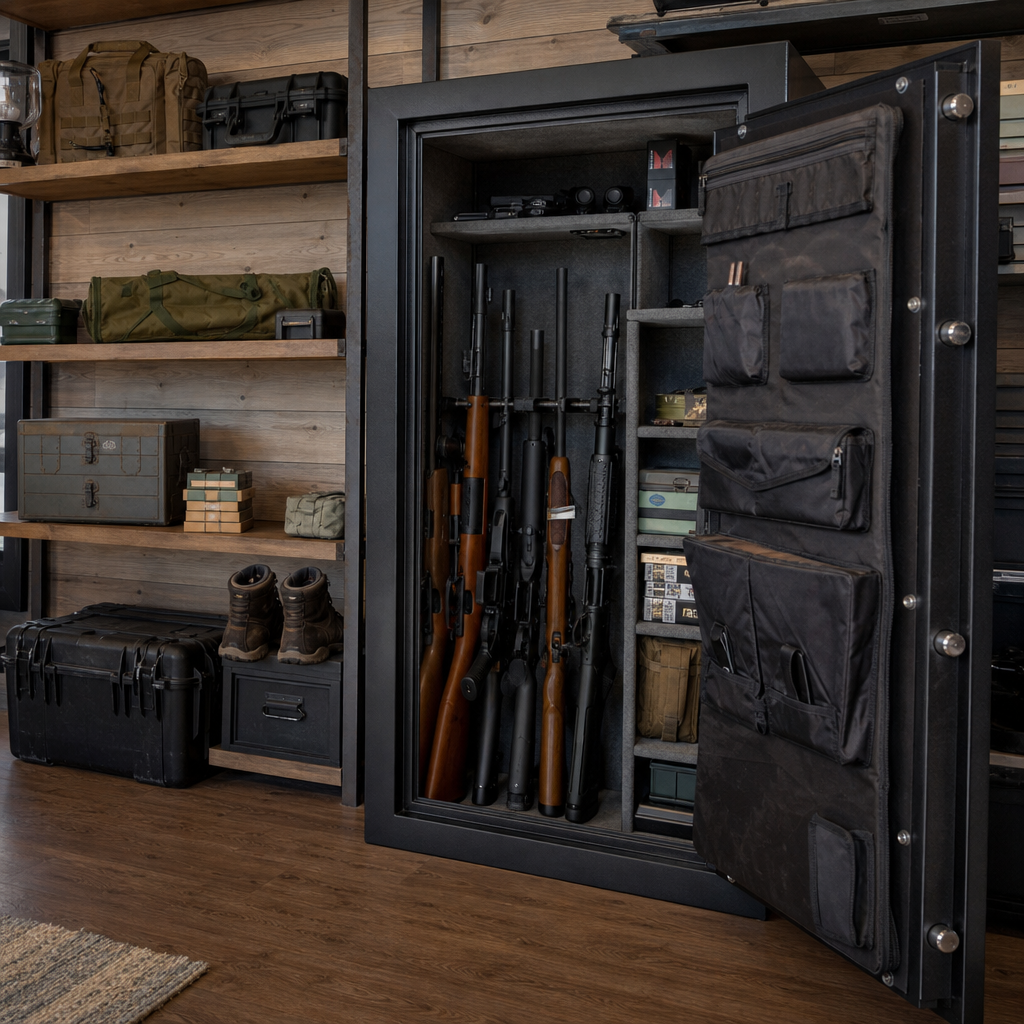
Do gun safes protect against EMP attacks? Usually, no. A standard gun safe is designed to resist theft, fire, and unauthorized access, not to function as a tested Faraday enclosure. That distinction matters because many owners assume thick steel automatically blocks electromagnetic pulse energy. In practice, EMP protection depends on conductivity, continuity, grounding strategy, seam design, latch contact, cable penetration, and the specific pulse environment. If you store optics, night vision, radios, thermal devices, electronic locks, or backup hard drives inside a safe, understanding what a gun safe can and cannot do is essential.
An EMP, or electromagnetic pulse, is a short burst of electromagnetic energy capable of inducing damaging voltage and current in electronic circuits and long conductors. People usually mean one of three threats: a high-altitude nuclear EMP, often broken into E1, E2, and E3 components; a non-nuclear intentional electromagnetic interference device; or a severe geomagnetic disturbance caused by solar activity. These are not identical hazards. Fast E1 pulses threaten microelectronics, E2 resembles lightning in some respects, and E3 behaves more like a slow geomagnetic event that couples into long lines such as power grids and pipelines. A safe that might reduce radio-frequency leakage is not automatically a complete defense against all three.
I have worked with secure storage products and RF-shielding projects long enough to see the same misunderstanding repeatedly: people confuse “metal box” with “Faraday cage.” A true shielding enclosure needs continuous conductive paths around the protected volume, minimal gaps, carefully treated doors, and insulation so stored devices do not touch the conductive shell. Gun safes rarely advertise shielding effectiveness in decibels across relevant frequencies because they are not engineered or tested to IEEE 299 or military-style electromagnetic standards. That does not make them useless. It means their role must be defined accurately.
This article serves as a hub for gun safe myths and misconceptions, with EMP protection as the anchor question. Along the way, it addresses related beliefs about fire ratings, waterproof claims, electronic locks, dehumidifiers, and where “security” marketing often outruns engineering. If you are comparing safes, planning layered preparedness, or deciding whether to place sensitive electronics inside your existing safe, the goal is simple: separate realistic protection from internet folklore, then make upgrades that produce measurable results.
Why Most Gun Safes Are Not True EMP Shields
The idea sounds plausible. Steel surrounds the contents, so pulse energy should stay outside. Unfortunately, shielding performance is not determined by metal thickness alone. At EMP-relevant frequencies, the weak points are usually openings and discontinuities: door gaps, lock penetrations, hinge channels, boltwork clearances, accessory holes, and power cords for dehumidifiers or lights. Even small seams can act like slot antennas, allowing significant energy to couple into the enclosure. A residential security container with a decorative door gap and expanding fire seal may be excellent for burglary delay and heat resistance while performing poorly as a high-frequency shield.
Door construction is the biggest issue. Many gun safes rely on mechanical contact at only a few points around the perimeter. Paint, powder coating, and intumescent fire material interrupt conductivity. The locking bolts secure the door against pry attacks, but they do not create the continuous low-impedance bond required for a reliable shield. By contrast, purpose-built RF enclosures use conductive fingerstock, EMI gaskets, knife-edge contacts, honeycomb vents, and filtered penetrations. Those design features are expensive and uncommon in consumer gun safes because they solve a different problem than burglary resistance.
Another misconception is that grounding turns any metal container into EMP protection. For small enclosures intended to shield portable electronics, grounding is often unnecessary and can even introduce complexity if done poorly. The essential function is to route induced current around the protected volume through a continuous conductive shell. If the shell has large gaps, weak bonding, or insulated door surfaces, a ground rod will not fix the enclosure. During severe pulse events, long grounding conductors can themselves become coupling paths. Good shielding starts with enclosure integrity, not with an afterthought wire to earth.
Electronic lock owners should pay special attention here. Many modern gun safes use keypad or biometric locks with internal circuit boards, solenoids, and battery compartments. If an EMP event damages the lock electronics, the safe may still physically protect contents but become difficult to open without an override key or locksmith procedure. This does not mean electronic locks are inherently bad. It means the lock type is separate from the shielding question, and resilience planning should include access contingencies.
What Limited Protection a Gun Safe May Still Provide
Saying most gun safes are not true EMP shields does not mean they provide zero benefit. Large metal enclosures can offer some attenuation, and for lower-energy interference or incidental exposure, that reduction may matter. In my experience, the real-world result varies widely by brand, door fit, interior layout, and whether cables enter the safe. A heavy steel body with a tight mechanical door may reduce certain frequencies better than a thin cabinet with visible gaps. But because manufacturers almost never publish shielding effectiveness curves, the owner is guessing unless independent testing is performed.
There is also a difference between protecting the firearm itself and protecting accessories attached to it. Conventional firearms with iron sights and mechanical triggers are largely unaffected by EMP. The vulnerable parts are red-dot sights, laser modules, thermal optics, digital hearing protection, weapon lights with charging circuitry, handheld radios, spare vehicle key fobs, and rechargeable battery systems. If your concern is preserving a basic rifle or shotgun, EMP is close to irrelevant. If your concern is preserving a thermal scope, digital night vision unit, or encrypted handheld radio, storage details matter much more.
Fire-lined safes may introduce an additional tradeoff. Gypsum-based fireboard and layered seals are useful against heat, but they do not improve electromagnetic sealing. Some interiors even increase moisture retention after humid transport or after a fire seal has been exposed to ambient humidity. Owners often assume every extra layer means extra protection. In reality, the best storage strategy depends on the threat: anti-theft hardware, fire insulation, humidity control, and RF shielding each require different design choices. One box rarely excels at all of them simultaneously.
If you want a practical middle ground, use the safe as a physical-security outer shell and place vulnerable electronics inside separate shielded containers within it. That layered approach aligns the safe with what it already does well: slowing theft, restricting access, and protecting supporting gear. The inner container handles the electromagnetic problem.
Common Gun Safe Myths and the Reality Behind Them
EMP protection is just one example of a wider pattern in the gun safe market: buyers regularly assume that a label or marketing phrase means more than it actually does. The table below summarizes the myths I hear most often and the more accurate interpretation a careful owner should use when evaluating storage options.
| Myth | Reality | What to Check |
|---|---|---|
| Any steel safe is a Faraday cage | Shielding depends on seams, conductivity, and penetrations, not just metal walls | Door gaps, painted contact surfaces, cord pass-throughs, independent RF testing |
| A 60-minute fire rating is universal | Manufacturers use different test methods, temperatures, and pass criteria | Testing standard, peak temperature, internal temperature threshold, third-party certification |
| Heavier always means more secure | Weight may come from drywall fire lining rather than thicker steel or better boltwork | Body steel gauge, door plate thickness, relockers, anchor provisions |
| Electronic locks are unreliable by default | Quality locks from established brands can be dependable, but batteries and electronics add failure modes | UL listings, mechanical override options, battery access, service network |
| Waterproof means submersible forever | Most claims are limited by depth, duration, and condition of door seals | Exact immersion rating, seal maintenance, warranty language |
| Dehumidifiers solve all rust issues | Moisture control also depends on room climate, airflow, insulation, and desiccant maintenance | GoldenRod placement, hygrometer readings, silica recharge schedule, room humidity |
Fire ratings deserve special skepticism. Some manufacturers state “90 minutes at 1,680 degrees” without naming the test protocol. That number may come from an internal test rather than UL 72-style procedures. Internal temperatures, cool-down phases, and sensor locations all matter because paper chars around 451 degrees Fahrenheit, while polymers, optics adhesives, and ammunition packaging can fail much earlier than steel firearms. In other words, a fire rating is useful only when you know who tested it, how it was tested, and what “pass” actually meant.
Capacity claims are another routine disappointment. A “24-gun safe” often fits far fewer long guns once scopes, slings, bipods, and modern chassis stocks are involved. I usually tell owners to cut advertised long-gun capacity by a third, sometimes by half, if they have accessorized rifles. Overcrowding also increases the chance of finish wear, broken optics caps, and poor airflow. Safe selection should be based on your realistic inventory three to five years ahead, not on the optimistic rack diagram printed in the catalog.
How to Build Real EMP Resilience for Firearm Accessories
If EMP resilience is a genuine requirement, the best solution is not to hunt for magical safe marketing. It is to create a layered storage plan. Start by identifying what actually needs protection: spare red dots, infrared lasers, thermal clip-ons, night vision power supplies, radios, battery chargers, portable solar controllers, encrypted communication devices, and digital documents stored on SSDs or flash media. Mechanical guns, magazines, slings, holsters, and iron sights do not need the same treatment.
Next, use a nested shielding approach. Small metal ammo cans can be adapted into practical shielded containers if the lid seam is electrically continuous and the contents are insulated from the metal shell. Many owners add conductive gasket material, remove paint at critical contact points, and line the interior with cardboard, foam, or closed-cell insulation so devices never touch bare metal. Commercial Faraday bags from brands such as Mission Darkness or MOS Equipment are another option, especially when you want portability. For the highest confidence, store the bagged items inside a secondary conductive container, then place that container inside the gun safe for theft resistance.
Testing matters. A simple phone call test inside a container is not a valid EMP certification because cellular frequencies, power levels, and network behavior vary, and some phones stop ringing for reasons unrelated to shielding. A better consumer check uses multiple signals, such as FM radio, Wi-Fi, Bluetooth, and GPS, but even that only gives rough evidence. Real evaluation requires calibrated instruments and shielding-effectiveness measurements across a frequency range. If a vendor claims EMP protection, ask for test data, not anecdotes.
Finally, plan for usability after the event. Store spare batteries in original packaging or insulated pouches, keep printed manuals for critical optics or radios, and include non-electronic backups wherever practical. A rifle with iron sights, a paper frequency plan, and a mechanical compass are not glamorous, but resilience is about graceful degradation. The most robust setup is the one that still works when the sophisticated layer fails.
Choosing a Gun Safe Without Falling for Misconceptions
For most buyers, the right question is not “Which gun safe blocks EMP?” but “Which safe best matches my actual risks?” In suburban homes, the priority order is usually unauthorized access, smash-and-grab burglary, house fire, and moisture. EMP resilience is a niche requirement unless you specifically store vulnerable electronics that would be expensive or mission-critical to replace. Start with steel thickness, lock quality, anchor strategy, and fit to your space. A safe that can be tipped onto a dolly and removed in minutes is a poor investment regardless of its accessories.
Look for transparent specifications. Body steel should be stated clearly in gauge or inches, door construction should explain whether it uses composite layers or a solid plate, and the lock should come from a recognized manufacturer such as Sargent and Greenleaf, SecuRam, or La Gard. Ask whether the safe has hard plates, relockers, and pre-drilled anchor holes. Check where it is built and how warranty service works in your area. Marketing language about “military style,” “tactical,” or “ultimate security” means very little without hardware details behind it.
Placement also affects performance. A safe installed on a ground-floor concrete slab, bolted down, in a low-visibility location with controlled humidity will usually outperform a larger, flashier unit placed loosely in a garage with seasonal condensation. Add a hygrometer, monitor relative humidity, and use desiccants or a convection-style dehumidifier appropriately. Maintenance is part of safe ownership, not an optional extra.
The bottom line is straightforward. Gun safes are essential tools for responsible firearm storage, but they are not magical containers. Most do not provide verified EMP protection, and assuming otherwise can leave sensitive electronics exposed. Use the safe for security, fire resistance, and organization. For EMP concerns, add dedicated shielded storage inside the safe, test claims carefully, and prioritize realistic threats over internet myths. If you are building out your gun safes and safety plan, audit your current setup today: list what is mechanical, what is electronic, and what protection each item truly needs.
Frequently Asked Questions
Do gun safes protect against EMP attacks by default?
In most cases, no. A standard gun safe is not built or tested as an EMP shield. Its primary job is to slow down theft, resist heat during a fire, and prevent unauthorized access. Those are very different design goals from blocking electromagnetic pulse energy. While many gun safes are made from thick steel, metal alone does not automatically make an enclosure effective against EMP. Real EMP protection depends on whether the enclosure acts like a continuous Faraday cage, which means it needs reliable electrical continuity across the entire shell, including the door, seams, hinges, locking surfaces, and any openings.
This is where many assumptions break down. A safe may have gaps around the door, insulating paint, fireboard layers, rubber seals, electronic lock components, and multiple points where the metal does not make clean conductive contact. Even small discontinuities can reduce shielding effectiveness, especially against higher-frequency components of an EMP event. If a safe has power cables, dehumidifier ports, antenna leads, or other penetrations, those can also provide paths for energy to enter. So although a gun safe may offer some incidental attenuation simply because it is a large metal box, that is not the same as verified EMP protection. If you need to protect sensitive electronics such as optics with illuminated reticles, night vision devices, thermal gear, radios, or spare electronic parts, it is safer to use dedicated EMP-protective storage methods inside the safe rather than relying on the safe itself.
Why doesn’t thick steel automatically make a gun safe a Faraday cage?
Because shielding performance is about more than material thickness. Conductive metal is part of the equation, but an effective Faraday enclosure also requires continuity and controlled geometry. In simple terms, the enclosure must give electromagnetic energy a predictable path around the protected interior rather than allowing that energy to leak through joints, seams, apertures, or poorly bonded surfaces. A gun safe may have thick walls, but the door gap alone can be a major weak point if the mating surfaces do not maintain consistent conductive contact all the way around.
Paint and powder coating are another overlooked issue. These finishes can act as insulators unless the safe has specifically designed bonding points that cut through the coating and maintain metal-to-metal contact. Fire seals may expand during heat exposure, which is valuable for fire resistance, but they are not designed to improve EMP shielding. Electronic keypad locks can introduce additional vulnerabilities, and any external cable connection can compromise the enclosure unless properly filtered and bonded. Even the latch system matters. If the locking bolts clamp the door securely but do not create continuous conductive contact around the perimeter, the safe still may not perform like a true Faraday cage.
That is why tested shielding enclosures are usually engineered with spring-finger stock, conductive gaskets, carefully designed seams, and known attenuation ratings over specific frequency ranges. By contrast, most gun safe manufacturers do not publish EMP test data. So while steel contributes to shielding, thick steel by itself does not guarantee that the contents inside are protected from a meaningful pulse event.
What items inside a gun safe are most vulnerable to an EMP event?
The highest-risk items are usually electronics, especially those with sensitive semiconductors, circuit boards, microprocessors, batteries, charging circuits, or external wiring. In the firearms world, that can include red dot sights, holographic sights, illuminated scopes, laser aiming modules, rangefinders, thermal optics, digital night vision, communication gear, rechargeable weapon lights, and spare electronic accessories. Some modern safes also contain vulnerable items of their own, such as electronic locks, interior lighting systems, and powered dehumidifiers.
Items that are purely mechanical are generally less of a concern. Traditional firearms without electronic components are far less likely to be affected directly. Mechanical iron sights, manual tools, non-electronic cleaning gear, and basic ammunition are not usually what people worry about in an EMP scenario. The real concern is preserving mission-critical electronics that support identification, aiming, communication, and low-light capability. If a person stores a rifle and assumes the safe protects everything attached to it, they may be overlooking the fact that the optic or accessory mounted on that rifle is the component most likely to be at risk.
Another important distinction is scale. An item does not have to be plugged into the wall to be vulnerable. Smaller standalone devices can still be affected depending on the pulse characteristics and the item’s internal design. That is why many preparedness-minded owners isolate critical electronics in additional layers of protection, such as properly constructed Faraday bags, conductive boxes, or tested EMP containers, and then place those protected items inside the gun safe for theft and fire resistance.
Can you make a gun safe more effective against EMP, or should you use separate protection inside it?
The most practical answer is to use separate EMP protection inside the safe. In theory, a gun safe could be modified to improve shielding, but doing it correctly is more complex than most people expect. You would need to address door seams, metal-to-metal bonding, latch contact, conductive gasketing, cable penetrations, coatings, and any attached electronics. You would also need a way to verify that the modifications actually work across relevant frequencies. Without testing, it is easy to spend time and money on changes that create only the appearance of protection.
For most owners, the better strategy is layered protection. Keep the gun safe for what it does well: security, controlled storage, and in many cases some level of fire resistance. Then place sensitive electronics inside tested Faraday bags, conductive pouches, metal containers with proper insulating liners, or other dedicated EMP-protective enclosures before putting them into the safe. The insulating liner matters because the protected device should not rest directly against the conductive outer shell. That separation helps prevent direct conductive coupling and is a standard part of good Faraday storage practice.
This layered approach has several advantages. It allows you to protect only the items that actually need EMP mitigation, it avoids compromising the safe’s existing function, and it gives you flexibility if you change equipment over time. It also reduces the risk of relying on assumptions. A standard gun safe may provide some incidental shielding, but a dedicated inner protective layer gives you a much more defensible strategy for optics, night vision, backup radios, spare batteries with electronics, and other sensitive gear.
How can you tell whether a gun safe has real EMP shielding capability?
The best indicator is documented testing, not marketing language. If a manufacturer claims EMP resistance or Faraday-like performance, ask for specific test data. Useful information includes the test standard used, the frequency range evaluated, the attenuation achieved in decibels, the test setup, and whether the safe was tested as a complete system with its door, lock, seams, and any penetrations in place. Broad statements such as “all-steel construction” or “military-style protection” are not substitutes for measured shielding performance.
You should also look closely at the design details. Does the door have a conductive gasket or engineered contact surface around the full perimeter? Are the seams welded or otherwise bonded continuously? Are painted areas interrupted where electrical contact is required? Are there ports for power cords or dehumidifiers, and if so, how are they filtered or shielded? Does the lock system introduce electronic vulnerabilities? These questions matter because EMP protection is often lost at the exact points where standard safes are designed for convenience or fire performance rather than electromagnetic isolation.
If no test data is available, the honest assumption should be that the safe is not a verified EMP enclosure. That does not mean it provides zero benefit, but it does mean you should not trust it as your only line of defense for critical electronics. For preparedness purposes, verified performance beats guesswork every time. If preserving sensitive gear is important, use dedicated Faraday protection for the devices themselves and treat the gun safe as the outer layer for physical security and storage management.