
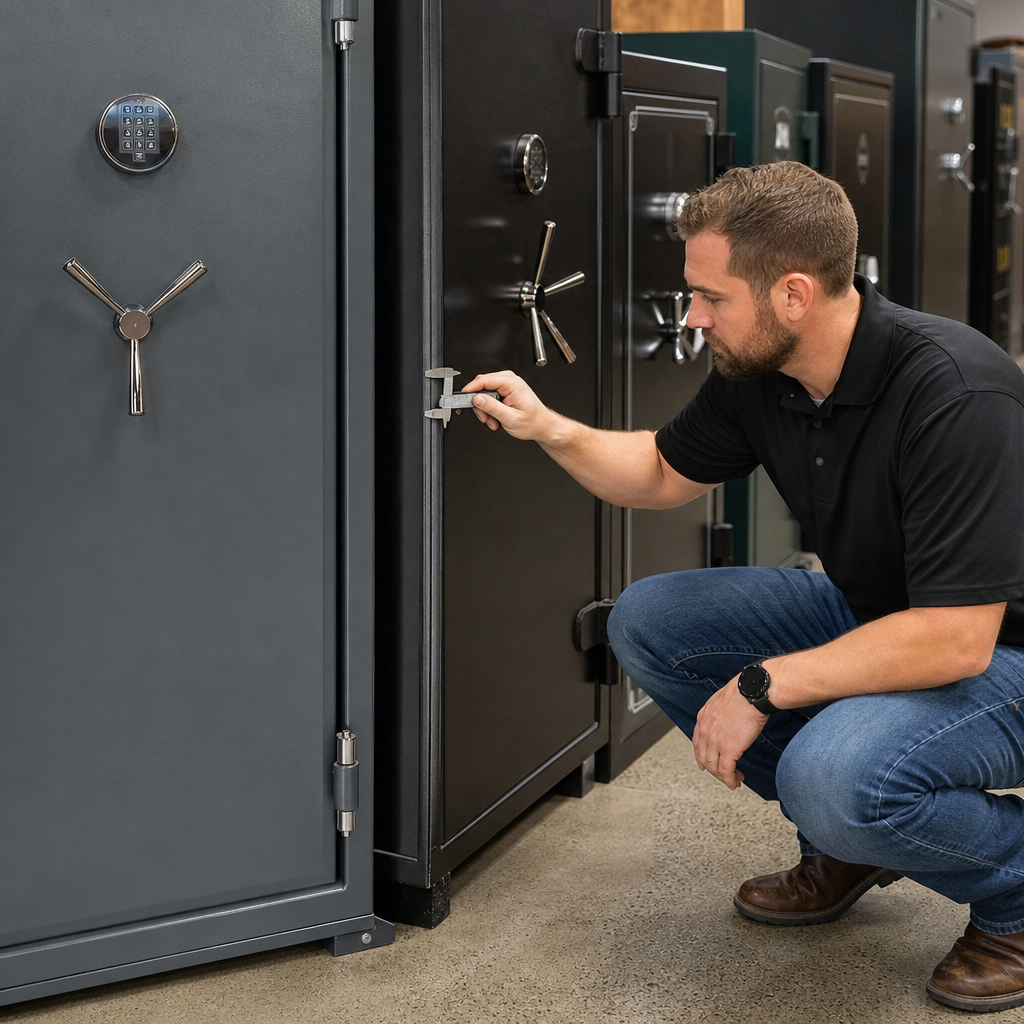
Choosing a gun safe by brand reputation alone is a mistake; steel thickness is one of the clearest indicators of how much real protection you are buying. In practical terms, steel thickness affects how well a safe resists pry attacks, drilling, deformation around the door frame, and long-term wear from heavy locking hardware. When shoppers compare gun safe brands, they often focus on size, interior layout, fire rating, or lock type first, yet the gauge of the steel body and door frequently determines whether those features sit inside a genuinely secure shell or a lightly reinforced cabinet.
Steel thickness is usually expressed either in gauge or in decimal inches. Lower gauge numbers mean thicker steel. For example, 12-gauge steel is thicker than 14-gauge, and 10-gauge is thicker than 12-gauge. Many residential gun safes on big-box floors use 14-gauge or 12-gauge bodies, while stronger mid-tier models may move to 11-gauge or 10-gauge. Premium safes may use 3/16-inch or 1/4-inch plate steel in critical areas, especially doors. Because manufacturers do not always present these numbers consistently, comparing gun safe brands requires translating marketing language into measurable construction facts.
This matters for more than burglary resistance. Thicker steel can support better welds, stronger bolt retention, more rigid doors, and tighter tolerances around relockers and hard plates. It also affects weight, installation planning, and cost, so the thickest option is not automatically the best fit for every home. I have walked buyers through side-by-side comparisons where two safes looked nearly identical online, but one had a body roughly 40 percent thicker than the other and a substantially more robust door structure. This article is the hub for evaluating gun safe comparisons and brand spotlights through the lens of steel thickness, so you can judge construction quality with confidence and narrow your search intelligently.
Understand What Steel Thickness Really Tells You
Steel thickness is a proxy for structural integrity, not a complete security rating by itself. A safe with a thick body but weak door gaps, poor weld quality, or an underbuilt locking system can still underperform. However, when you compare otherwise similar residential gun safes, thicker steel almost always provides a meaningful advantage. It increases resistance to pry bars, slows abrasive cutting, reduces flex when attackers target corners, and helps the shell stay square over time. Those benefits become especially important in long-gun safes because tall bodies create leverage points that thieves exploit.
The first step is to separate three parts of construction: body steel, door steel, and composite or layered construction. Body steel refers to the walls of the safe cabinet. Door steel refers to the slab or outer plate on the entry side. Composite doors may combine thinner outer steel with fireboard and internal reinforcement, while plate doors use a single thick plate or multiple welded plates. When a brand advertises a “4-inch door,” that usually describes total door thickness, not solid steel thickness. Shoppers should ask for the actual steel plate measurement in inches or gauge.
Brands also use upgrades strategically. A manufacturer may keep the body at 12-gauge while offering a 3/16-inch door to strengthen the most attacked area without making the entire safe prohibitively heavy. That can be a reasonable compromise in the mid-market. In contrast, some entry-level products emphasize decorative hinges, door organizer kits, or glossy paint while providing only 14-gauge steel. Those features improve usability, but they should not distract from the shell. If your comparison starts with steel thickness, you immediately filter out many weak options.
How to Convert Gauge, Inches, and Marketing Claims
Direct comparisons break down when one brand lists 11-gauge, another lists 0.135 inches, and a third says “heavy-duty steel construction.” The solution is to normalize the data. Common sheet steel approximations used in gun safes include 14-gauge at about 0.075 inch, 12-gauge at about 0.105 inch, 11-gauge at about 0.120 inch, and 10-gauge at about 0.135 inch. Above that, brands often switch to fractional inch measurements such as 3/16 inch, roughly 0.1875 inch, or 1/4 inch, roughly 0.25 inch. Once all listings are translated into inches, weak marketing language becomes easier to spot.
A related issue is whether the stated thickness applies to the whole body or just one section. Some brands promote a “7-gauge steel door edge” or “reinforced lock plate” while the rest of the body remains much thinner. That reinforcement can still be valuable, but it is not equivalent to a 7-gauge body. I recommend building a simple comparison sheet with separate fields for body steel, door outer plate, total door thickness, locking bolts, hinge style, fire lining, and weight. When I have done this for buyers comparing Liberty, Browning, Fort Knox, Rhino, AMSEC, Winchester, and Cannon, the strongest values usually become obvious within a few minutes.
| Specification | What to Verify | Why It Matters |
|---|---|---|
| Body steel | Gauge or decimal thickness for the entire cabinet | Primary resistance to side and rear attacks |
| Door steel | Outer plate thickness, not total door depth | Key defense against prying and drilling |
| Composite construction | Whether multiple steel layers are used | Can outperform a single thin plate if engineered well |
| Weight | Total shipped weight relative to dimensions | Often confirms whether stated steel thickness is plausible |
| Certifications | UL Residential Security Container or higher | Independent baseline for attack resistance |
Be skeptical of vague phrases like military style, premium defensive barrier, or rugged formed steel. Those may describe a legitimate design, but they are not measurements. Reputable brands can tell you exactly what steel they use. If a dealer cannot provide body and door thickness, move on. Transparent specifications are one of the easiest ways to separate serious safe manufacturers from import-driven label brands that rely on appearance more than construction.
Compare Brand Tiers Instead of Brand Names Alone
One of the biggest mistakes in gun safe comparisons is assuming a brand has a single standard of construction. In reality, most brands sell multiple lines that vary dramatically. Liberty is a good example: entry lines and premium lines do not use the same body steel. AMSEC ranges from residential gun safes to high-security burglary-rated units with very different materials. Browning, Winchester, Cannon, and Sports Afield also span several price points. Comparing “Brand A versus Brand B” without identifying exact series and model numbers is too broad to be useful.
A smarter approach is to compare tiers. Entry-level safes often use 14-gauge to 12-gauge bodies and prioritize capacity per dollar. Mid-tier models commonly move into 12-gauge, 11-gauge, or 10-gauge steel, sometimes paired with thicker plate doors and better boltwork. Premium models step into 3/16-inch or 1/4-inch bodies, plate doors, upgraded hard plates, and UL-listed lock packages. Once you categorize a safe by its construction tier, brand marketing becomes less influential and objective comparison becomes easier.
Real-world examples illustrate this well. A large-capacity warehouse-club safe may advertise space for thirty or forty long guns, a glossy door organizer, and an electronic lock at an attractive price, yet use a 14-gauge body. A more expensive dealer model with lower stated capacity may use 11-gauge steel and a stronger door frame, making it materially harder to breach. That does not mean the cheaper model has no place; it may suit a low-risk setting where the main goal is child access prevention and basic smash-and-grab deterrence. But the buyer should understand the tradeoff clearly.
Look Beyond Thickness to Door Design and Attack Paths
Steel thickness matters most when paired with sound engineering around common attack points. The door opening is the first place to inspect. A body made from 10-gauge steel can still be compromised if the door frame flexes excessively or if the active bolts engage shallow receivers. Look for formed door jambs, continuous welds, reinforced corners, and hard plate protection over the lock and spindle area. Internal hinges can reduce exposed attack surfaces, but well-built external-hinge safes can also be secure if the door has dead bars and robust engagement on the hinge side.
Pry attacks are especially relevant in residential burglaries because they are fast, noisy, and require simple tools. Thicker body steel helps, but door gap size, jamb geometry, and bolt carriage support are equally important. In several side-by-side inspections I have done, the safer product was not the one with the flashiest bolt count. Massive locking bolts look impressive in a showroom, but if the surrounding steel is thin or the bolts are mostly cosmetic on one side, they offer less benefit than buyers expect. The quality of the frame that receives those bolts is what resists separation.
Drill resistance is another issue often confused with overall steel thickness. Standard body steel, even when thick, is not the same as hardened drill-resistant plate protecting the lock and relocker mechanism. Brands such as AMSEC and Fort Knox are often stronger in this area on upper-tier models because they specify hard plates, relockers, and more substantial lock shielding. When comparing gun safe brands, note whether anti-drill features are standard, optional, or absent. A safe intended to resist knowledgeable attack should have more than a thick shell.
Use Weight, Certification, and Price as Reality Checks
If stated steel thickness seems impressive but the safe weight looks unusually low for its dimensions, investigate further. Weight is not a perfect indicator because fireboard, door organizers, and interior packages add mass, but it is still a useful reality check. For example, two safes with similar exterior dimensions should not differ by several hundred pounds without a clear explanation in steel content or fire insulation. If the heavier unit also lists thicker body steel and a plate door, the numbers usually support each other.
Independent ratings add another layer. Many consumer gun safes are classified as UL Residential Security Containers rather than true burglary safes. That baseline is still useful, but it is not equivalent to a TL-rated safe. A Residential Security Container is designed to resist a limited attack using common tools for a specific test period. For many households, that is a practical standard, especially when the safe is bolted down, hidden from immediate view, and supported by an alarm system. Buyers seeking stronger burglary protection should consider brands and models that move beyond basic cabinet-level construction and, where budget allows, investigate commercial burglary ratings.
Price usually follows steel, but not perfectly. Dealer support, domestic manufacturing, interior finish, lock brand, and freight all affect cost. I have seen shoppers overpay for decorative upgrades while passing on objectively stronger steel in a less glamorous model. A disciplined comparison asks a simple question: how much of the budget is buying actual barrier material? If one safe costs several hundred dollars more but upgrades the body from 14-gauge to 10-gauge and the door from thin formed steel to a genuine plate design, that premium often buys meaningful security rather than cosmetics.
Build a Shortlist of Brands by Use Case
The best gun safe brand for steel thickness depends on your risk profile and intended use. For basic household storage, brands with transparent 12-gauge or 11-gauge specifications can provide a solid balance of cost and security. For collectors, owners with high-value optics, or households in areas with longer police response times, moving to 10-gauge bodies or thicker is prudent. For users who prioritize burglary resistance above capacity, brands known for heavier plate construction, stronger door assemblies, and commercial safe heritage deserve close attention.
As a hub for gun safe comparisons and brand spotlights, this topic should branch into line-by-line reviews, body-versus-door comparisons, domestic versus imported construction, and practical buying guides for specific budgets. The core principle stays constant: compare measurable steel specifications first, then judge lock quality, fire protection, interior layout, warranty support, and dealer service. That sequence prevents you from being swayed by brochures and showroom features before evaluating the barrier itself.
When you compare gun safe brands based on steel thickness, you make the decision on the part of the safe that thieves must physically defeat. Start by converting every claim into actual thickness, separating body steel from door steel, and checking whether the listed weight supports the construction story. Then evaluate the surrounding design: door frame strength, hard plate protection, bolt engagement, certifications, and installation method. A thinner safe from a familiar brand name is still a thinner safe. A better-built model with honest specifications will usually reveal itself quickly once the numbers are lined up side by side.
The practical takeaway is simple. Do not shop by logo, capacity sticker, or total door depth. Shop by body gauge, plate thickness, attack-point reinforcement, and verified build quality. If you are narrowing options under the broader Gun Safes & Safety category, use steel thickness as your first filter and let every other feature follow from there. Build a shortlist, ask dealers for exact measurements, and compare models on paper before you ever compare upholstery or accessories. That process leads to a safer purchase, better long-term value, and a gun safe that delivers real security when it matters.
Frequently Asked Questions
Why is steel thickness such an important factor when comparing gun safe brands?
Steel thickness is one of the most practical ways to judge how much physical security a gun safe can deliver, because it directly affects how well the safe resists common forms of forced entry. A thicker steel body is generally harder to bend, pry apart, puncture, or deform under pressure. That matters in real-world attacks, where burglars often target weak side panels, door edges, and seams rather than attempting to defeat the lock itself. When a safe uses thinner steel, the metal can flex more easily around the door frame or sidewalls, giving an attacker a better chance of creating enough separation to insert pry tools and work the door open.
Thickness also matters over the long term. A gun safe door carries substantial weight, especially when it includes hard plates, multiple locking bolts, and internal fire lining. If the surrounding structure is made from heavier steel, it tends to hold alignment better over years of use. That can reduce sagging, warping, and stress around hinges and boltwork. In other words, thicker steel supports not only break-in resistance but also durability and consistency.
When comparing brands, steel thickness gives shoppers a more objective benchmark than branding, marketing language, or cosmetic features. Interior shelving, electronic locks, and fire labels all have value, but they should not distract from the fact that the safe is first and foremost a security container. If one brand offers a larger safe with more accessories but uses substantially thinner steel than a competing model, that difference may have a greater impact on real protection than the extra features. Steel thickness is not the only factor that matters, but it is one of the clearest indicators of substance behind the sales pitch.
How do I compare steel gauge ratings between different gun safe brands accurately?
The most important rule is to verify whether each brand is listing the actual steel gauge of the body and door, and whether those numbers refer to a single steel layer or a composite construction. Many shoppers see terms like “10-gauge body” or “12-gauge door” and assume every manufacturer is measuring the same way, but that is not always true. Some brands describe the outer steel shell only, while others reference a combined structure that may include fireboard, inner liners, or additional reinforcement plates. For an accurate comparison, you want to know the thickness of the actual steel barrier, not just the total wall thickness of all materials combined.
It also helps to understand that lower gauge numbers mean thicker steel. For example, 10-gauge steel is thicker than 12-gauge steel, and 7-gauge is thicker than 10-gauge. That can be confusing for first-time buyers, so taking a moment to confirm the gauge system prevents mistaken comparisons. If one brand lists steel in inches and another in gauge, convert the specifications so you are comparing like for like. Even a difference of a few gauges can represent a meaningful jump in rigidity and attack resistance.
Pay close attention to the door, the body, and the door frame area separately if possible. Some brands use a thicker door but a thinner body, which can create an impressive-looking front while leaving the sides and top more vulnerable. That may still be acceptable depending on where the safe will be installed, especially if it is placed in a tight corner and bolted down, but it should be a conscious decision rather than something overlooked. If a manufacturer is vague, ask for exact specifications, including body steel gauge, door plate thickness, reinforcement around the lock, and whether any critical areas use additional hard plate or inner steel liners. The more transparent the brand is, the easier it is to make a trustworthy comparison.
Is a thicker door enough, or should I focus just as much on the steel thickness of the safe body?
You should absolutely evaluate both. A thick door is valuable because the door is the most obvious attack point and contains the lock, relockers, boltwork, and frame interface. However, if the body uses significantly thinner steel, the overall security can still be compromised. In many break-ins, attackers do not try to defeat the front of the safe directly if the door appears strong. Instead, they may attack the sidewalls, top, or rear panel, especially if those surfaces are accessible. Thin body steel can be cut, peeled, or bent more easily, and once the safe shell begins to deform, the security advantages of a heavy door become less meaningful.
Think of the safe as a system rather than a single panel. The strength of the door, body, frame, hinges, and locking channels all work together. If one brand advertises an impressively thick door but uses light-gauge steel for the rest of the cabinet, it may be prioritizing showroom appeal over balanced protection. By contrast, a safe with a solid door and a meaningfully thicker body usually offers more consistent resistance across multiple attack methods, including prying and side-entry attempts.
This is also where installation plays a major role. If the safe is bolted to concrete and positioned where the sides are difficult to access, body thickness may seem less urgent than door strength. Even so, body steel still matters for rigidity, structural integrity, and long-term durability. A well-built safe should not rely entirely on placement to make up for thin materials. The strongest comparisons between brands look at the entire steel package, not just whichever number is highlighted most prominently in advertising.
What other construction details should I compare along with steel thickness when evaluating gun safe brands?
Steel thickness is a major factor, but it should be considered alongside the quality of the safe’s overall construction. Start with the door frame design and pry resistance. A thicker steel shell is more effective when paired with a robust door jamb, tight tolerances, and locking bolt engagement that distributes force well. If the frame design is weak or the gaps around the door are excessive, the safe may still be vulnerable even if the raw steel gauge looks respectable on paper.
Next, examine the lock protection and hard plate. Drill resistance depends not just on body thickness but on whether the lock and critical components are shielded by hardened steel plates, relockers, or reinforced internal barriers. A brand that combines thicker steel with thoughtful anti-drill engineering is usually delivering more meaningful security than a brand that relies on one headline specification. Weld quality matters too. Continuous welds, strong seams, and clean structural assembly help the safe maintain strength under force. Poorly executed welds can become weak points regardless of panel thickness.
You should also compare how the safe is anchored and how much it weighs relative to its size. Heavier safes often use more steel, though weight alone is not proof of security because fire lining and interior materials add mass as well. Interior fit and finish, lock type, fire rating, and storage layout still matter, but they should come after confirming that the core shell is genuinely robust. In short, the best brand comparison looks at steel thickness as the foundation, then checks whether the surrounding construction supports and complements that foundation in a credible way.
How can I tell if a gun safe brand is using steel thickness honestly in its marketing?
The clearest sign of honest marketing is specificity. Reputable brands usually state the body gauge, door steel thickness, and key reinforcement features without hiding behind vague phrases like “industrial-strength steel” or “heavy-duty construction.” If a company is proud of its materials, it should be willing to publish exact numbers and explain what those numbers refer to. A good listing might tell you the body is 10-gauge steel, the door includes a thicker outer plate, and the lock area is backed by hard plate. A weaker listing may mention “thick walls” without clarifying whether that thickness comes from actual steel or non-metal fire insulation.
Another good habit is to compare the specifications page with the product weight, cutaway images, and any available third-party reviews or dealer explanations. If a safe is marketed as having exceptionally heavy steel but seems unusually light for its dimensions, that may be a reason to dig deeper. The same goes for brands that emphasize total wall thickness rather than steel thickness specifically. A wall can be thick because it contains layers of insulation and paneling, but that does not automatically mean it provides better burglary resistance.
Finally, pay attention to consistency and transparency across the brand’s product line. Trustworthy manufacturers tend to present technical information in a straightforward way and make it easy to compare entry-level, mid-tier, and premium models. Brands that obscure steel details, use inconsistent terminology, or steer every conversation back to cosmetic features may be trying to avoid direct scrutiny. If you are serious about comparing gun safe brands based on steel thickness, the best approach is to reward clarity. The more openly a manufacturer explains its steel construction, the easier it is to separate real protection from marketing language.