
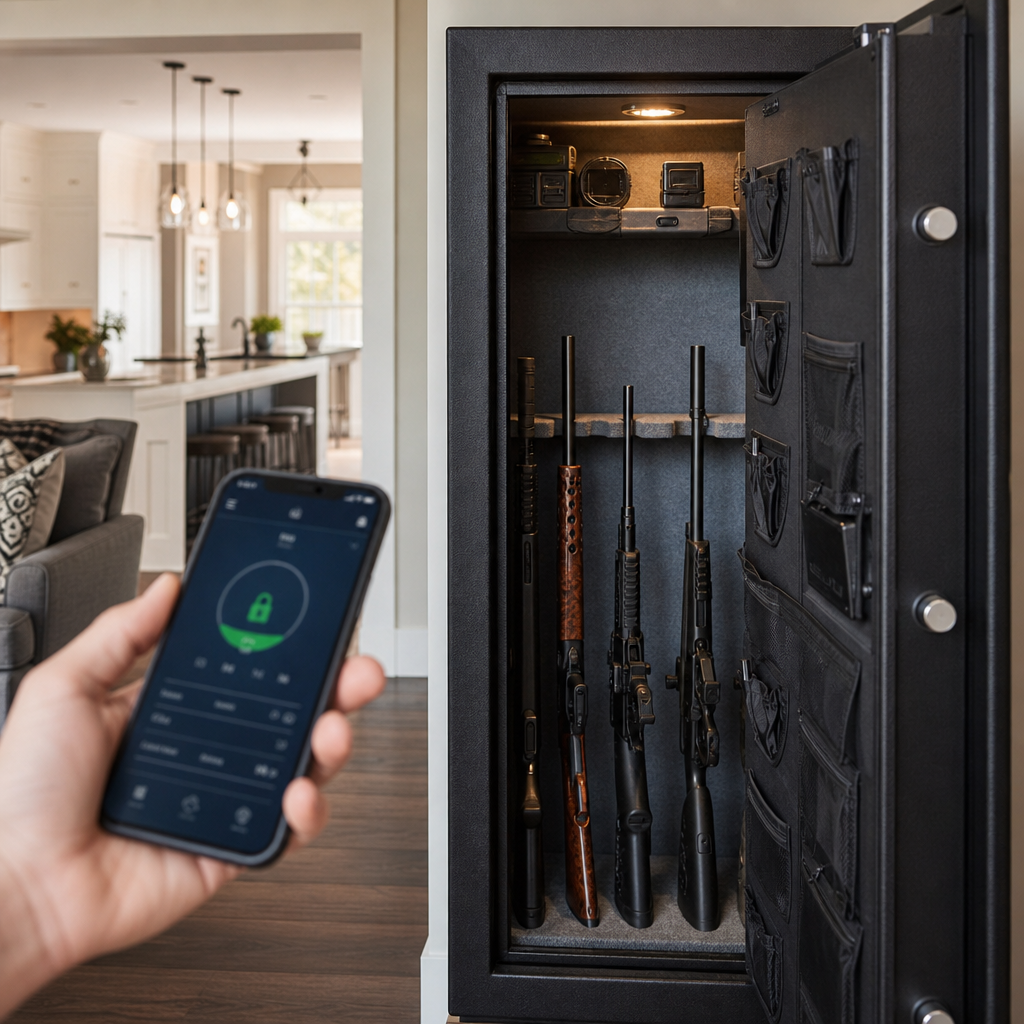
Integrating a gun safe with a home automation system turns a passive steel box into an active part of a broader household security plan. In practical terms, integration means connecting the safe, or devices around it, to sensors, alerts, access controls, and monitoring tools that communicate through a smart home platform. Home automation refers to systems such as Home Assistant, Alarm.com, SmartThings, Control4, Apple Home, or Hubitat that automate events based on triggers, schedules, and user permissions. For firearm owners, this matters because speed, accountability, and environmental protection all improve when a safe can report tampering, log access, detect unsafe humidity, and fit into the same routines that already manage alarms, lights, locks, and cameras.
I have worked on several safe monitoring projects in homes, workshops, and detached garages, and the key lesson is simple: the best setup does not start with a power drill. It starts with understanding the safe’s fire rating, lock type, warranty limits, and the owner’s actual use case. A bedside pistol safe used daily needs different automation than a 1,200-pound long-gun safe in a basement. Some owners want quiet push notifications when a teenager opens a utility room door. Others want a full event chain: if vibration is detected on the safe after midnight, interior lights turn on, cameras bookmark footage, and the security panel sounds a perimeter warning. Good design balances convenience with legal responsibility, especially in households with children, guests, or service workers.
This article is the hub for custom and DIY gun safe modifications within the broader gun safes and safety topic. It explains what can be automated, what should remain mechanical, which modifications are low-risk, and where owners often create problems by bypassing proven lock hardware. It also covers smart humidity control, tamper sensing, power planning, network choices, and methods for linking a safe to a home security ecosystem without weakening the container itself. If you want a reliable, modern setup, the goal is not to make the safe look futuristic. The goal is to improve awareness, preserve secure storage standards, and build a system that still works during outages, router failures, or attempted tampering.
Start With the Safe, Lock, and Risk Profile
Before adding any smart component, identify exactly what you own. The label and documentation should tell you whether the unit is a residential security container, a burglary-rated safe, or a fire-resistant gun safe marketed primarily for home use. Lock types usually fall into three groups: mechanical dial, electronic keypad, and biometric keypad. Each has different integration limits. Mechanical dials are reliable and self-contained but offer almost no direct smart connectivity. Electronic keypads may support lock state outputs in commercial environments, though most consumer gun safes do not expose them. Biometric models add convenience, yet quality varies significantly, and many low-cost units trade durability for features.
Your risk profile matters just as much as the hardware. In one installation, a family with hunting rifles mainly needed dehumidification alerts and a door-open notification because the safe was in a finished basement. In another, a homeowner storing defensive firearms near an entry point wanted aggressive tamper monitoring tied to a monitored alarm panel. Think through location, daily access frequency, who lives in the home, whether minors are present, local storage laws, and whether the safe room already has cameras or intrusion sensors. This assessment shapes every modification. If quick access is critical, focus on reliable alerts and lighting rather than complicated motorized unlocking. If long-term storage is the priority, environmental monitoring and audit trails should come first.
At this stage, read the safe manufacturer’s warranty language carefully. Many brands void coverage if you drill the body, alter the lock mounting pattern, interfere with relockers, or modify fire seals. That is why the most effective custom and DIY gun safe modifications often happen around the safe, not through its critical structure. Add-on sensors, independent power, and room-level automation usually deliver the benefits owners want without compromising theft resistance or insulation performance.
Choose the Right Automation Architecture
A safe integration can be cloud-based, local, or hybrid. Cloud systems such as Alarm.com or some branded camera ecosystems are easy to deploy and send polished mobile alerts, but they depend more heavily on vendor servers and internet availability. Local systems such as Home Assistant or Hubitat offer better privacy, broader device support, and faster on-site automations, especially when paired with Zigbee or Z-Wave sensors. Hybrid designs are common: the alarm panel handles life-safety and security notifications, while a local controller manages secondary automations like lights, humidity thresholds, and camera bookmarks.
Protocol choice affects reliability. Z-Wave has a strong track record for security sensors and lock-adjacent devices in residential automation. Zigbee is efficient and widely supported, though mesh quality depends on powered repeaters in the home. Wi-Fi sensors are simple to install but often increase battery maintenance and can be less dependable in metal-heavy environments. A steel safe can attenuate wireless signals, so I usually place sensors on the exterior frame or in the closet or room around the safe rather than deep inside the compartment unless an external antenna or wired contact is used.
If you already have a monitored alarm system, consider using it as the backbone. A wired recessed contact on the safe door frame, a shock sensor on the safe body, and a room motion detector can all report to the same panel. The home automation layer then listens for those events and triggers nonessential actions. This separation is smart engineering. Security functions stay on a hardened platform with battery backup, while convenience features remain flexible.
Best DIY Modifications That Add Monitoring Without Weakening Security
The most useful safe upgrades do not unlock the safe remotely. They improve awareness. Start with a magnetic contact or tilt sensor to detect door-open events. If direct mounting on the safe body is difficult, mount a contact on the surrounding cabinet, alcove door, or closet that houses the safe. Next, add a vibration or shock sensor to identify impact from prying, hammering, or attempted movement. Some owners also install load or tilt detection on the floor under smaller safes to know if the unit is being shifted.
Interior lighting is another high-value modification. Low-voltage LED strip lighting activated by a door sensor makes it easier to access stored items safely, especially in low light. Use adhesive channels or noninvasive clips rather than drilling through interior walls. For power, a listed low-voltage adapter routed through an existing access point is preferable to improvising with extension cords. If the safe lacks a factory pass-through, battery-powered LED systems can work, though you will trade runtime and maintenance for installation simplicity.
Environmental monitoring is essential for firearm preservation. A digital temperature and humidity sensor placed inside or just outside the safe can trigger alerts when relative humidity rises above a defined threshold, often 50 percent for corrosion-sensitive storage conditions. Pair that with a GoldenRod-style dehumidifier, rechargeable desiccant, or a small PTC warming element approved for enclosure use. In humid basements, I have seen owners save optics, magazines, and blued finishes simply by acting on early alerts instead of discovering rust months later.
| Modification | Primary Benefit | Best Installation Method | Main Caution |
|---|---|---|---|
| Door contact sensor | Instant open/close alerts | Adhesive or bracket mount on frame area | Avoid interfering with door seal or bolt travel |
| Shock or vibration sensor | Tamper detection | Exterior body mount tied to alarm or hub | Tune sensitivity to reduce false alarms |
| Interior LED lighting | Safer access and visibility | Low-voltage adhesive channels | Protect wiring from shelves and long guns |
| Humidity sensor | Rust prevention | Wireless probe or wired sensor inside safe | Metal enclosure may reduce signal strength |
| Dehumidifier | Stable storage environment | Factory pass-through or approved cable route | Do not damage fire lining or door seal |
Smart Access Control: What to Automate and What Not to Automate
The most important rule is straightforward: do not create a remote unlock function for a firearm safe unless the lock and control system were designed, tested, and listed for that purpose. In consumer installations, that usually means you should not attach hobby servos, smart relays, or improvised solenoids to the lock mechanism. I have inspected DIY builds where a relay bypassed an electronic keypad circuit. They worked for a while, then failed unpredictably, drained batteries, or created a security weakness that a burglar could exploit once discovered.
Safer automation focuses on access logging, not access bypass. For example, a keypad safe can be paired with an external door sensor and a camera aimed at the room entrance, not the combination entry itself. When the safe opens, the system logs the timestamp, sends a notification, and stores a short encrypted clip. If the user has a daily routine, a nearby smart switch can activate task lighting when the safe room door opens before dawn. None of that alters the lock. It simply creates accountability and better visibility.
If you need advanced access control, look at commercial-grade enclosures and locks from established lock manufacturers rather than retrofitting a mass-market gun safe with untested hardware. Residential users often overestimate the value of remote unlocking and underestimate the importance of fail-secure behavior. During a power loss, network outage, or software crash, the safe must remain secure and locally operable by authorized users.
Power, Backup, and Network Resilience
Any automated safe setup is only as dependable as its power and communications plan. Start by deciding which devices must continue working during an outage. At minimum, the security panel or hub, internet gateway if cloud alerts matter, and nearby cameras should be on a UPS sized for realistic runtime. Many owners forget the modem, then wonder why push alerts stop even though the hub is still powered. For detached garages or outbuildings, consider cellular backup through a monitored panel or router.
Battery strategy deserves equal attention. Wireless contacts, humidity sensors, and vibration sensors often run for months or years, but metal placement, cold temperatures, and chatty reporting intervals shorten life. Use devices that expose battery percentage or low-battery states to your automation dashboard. Create a recurring maintenance reminder every six months. In my own projects, that simple reminder prevents most surprise failures.
Network segmentation is worth doing if your smart home is large. Put cameras and IoT devices on a guest VLAN or isolated SSID when your router supports it. Use strong unique passwords, enable multi-factor authentication on cloud accounts, and update firmware on hubs, cameras, and alarm communicators. A smart safe environment should increase security, not introduce preventable cyber risk. Local automations also help resilience because they continue working even if an outside service is unavailable.
Installation Mistakes, Legal Considerations, and Long-Term Maintenance
The biggest installation mistake is drilling first and asking questions later. Fireboard, composite barriers, door seals, hard plates, and relockers can sit exactly where a DIY owner assumes there is empty space. Another common error is using aggressive adhesives or screws that interfere with carpeted interiors, shelving movement, or door closure. Test every modification with repeated open-close cycles before trusting it. If the safe has a powered lock, confirm battery replacement remains easy and that added lights or sensors do not block access panels.
Legal responsibilities vary by state, especially where child access prevention and negligent storage laws apply. Automation can support compliance, but it does not replace proper secure storage. A phone alert arriving after unauthorized access is still a failure if the firearm was not adequately secured. Keep mechanical override keys, combinations, and recovery codes protected in accordance with the lock manufacturer’s guidance, and never label them in ways that advertise their purpose.
Long-term maintenance should be scheduled like any other protective system. Test sensors monthly, review event logs, inspect for corrosion, replace desiccants, confirm camera retention, and verify that notifications still reach the right people. If you change phones, routers, or Wi-Fi names, re-test everything. The best custom and DIY gun safe modifications are boring in the best sense: they work consistently, require little intervention, and never compromise the safe’s core job of denying unauthorized access while preserving firearms and related equipment.
Integrating a gun safe with a home automation system works best when the project is treated as a security engineering exercise, not a gadget experiment. Start with the safe’s rating, lock type, and warranty boundaries. Build around clear goals such as tamper alerts, open-close logging, environmental protection, lighting, and room-level surveillance. Use proven platforms, favor local control where practical, and keep critical security functions separate from convenience automations. Most important, avoid DIY remote unlocking schemes that weaken reliability or create a new avenue of attack.
As a hub for custom and DIY gun safe modifications, this topic comes down to a simple principle: add intelligence without subtracting security. Well-chosen sensors, dehumidification, backup power, and resilient networking make a safe easier to manage and harder to defeat. Poorly planned lock alterations do the opposite. If you are mapping your next upgrade, begin with noninvasive monitoring, document every change, and test under normal use and outage conditions. Then expand carefully, one dependable layer at a time.
Use this guide as the starting point for your broader gun safe safety plan, and review each future modification against the same standard: does it improve awareness, preservation, and accountability without compromising the safe itself? If the answer is yes, you are building the right kind of smart protection.
Frequently Asked Questions
What does it actually mean to integrate a gun safe with a home automation system?
Integrating a gun safe with a home automation system means making the safe part of a larger connected security environment instead of treating it as a completely isolated storage box. In most cases, the safe itself is not directly “smart” from the factory, so integration usually happens by adding devices around it, such as door contact sensors, vibration sensors, tilt sensors, cameras, smart locks on the room, motion detectors, environmental monitors, and automation rules inside a platform like Home Assistant, Alarm.com, SmartThings, Control4, Apple Home, or Hubitat. These tools allow the system to recognize events such as the safe door opening, repeated failed access attempts, motion near the safe at unusual hours, or humidity conditions that could affect firearms and documents.
Once connected, the automation platform can respond in useful ways. For example, if the safe is opened when the security system is armed, the system can send an instant alert, trigger indoor cameras to record, turn on lights in the room, log the time of access, and notify the homeowner or monitoring service. If the safe area experiences excess moisture, the system can generate a maintenance reminder before rust becomes an issue. In a well-designed setup, integration is less about gimmicks and more about layered awareness, documented access events, faster response to suspicious activity, and better coordination between physical security and digital monitoring.
What devices and components are commonly used to connect a gun safe to a smart home platform?
The most common components fall into a few categories: detection, notification, access control, and platform compatibility. For detection, homeowners often use magnetic contact sensors to tell whether the safe door is open or closed, vibration or shock sensors to detect tampering, motion sensors to monitor activity near the safe, and environmental sensors to track temperature or humidity. Some setups also include leak sensors if the safe is in a basement, plus smart cameras aimed at the entry point to the room or the safe location. These devices usually connect over Z-Wave, Zigbee, Wi-Fi, Matter, Thread, or proprietary alarm-system protocols, depending on the automation ecosystem being used.
For notification and response, people typically rely on mobile push alerts, text messages, alarm sirens, automated lighting scenes, recording triggers, and event logs. In more advanced systems, the safe area can be tied to a monitored security panel so that after-hours access or tampering generates a professional monitoring event. Some users also add access-related layers around the safe, such as a smart lock on the closet, office, or gun room door, keypad-controlled entry, or presence-based automations that only allow certain actions when an authorized user is home. The most important consideration is choosing components that are reliable, locally controllable when possible, and fully supported by your automation platform, because a security workflow is only as dependable as the devices and integrations behind it.
Is it safe to automate any part of gun safe access, or should automation be limited to monitoring and alerts?
For most homeowners, the safest and most responsible approach is to use home automation primarily for monitoring, logging, environmental management, and alerts rather than fully automating direct access to the safe. That means using smart home tools to detect when the safe is opened, record associated events, illuminate the area, notify authorized users, and monitor conditions around the safe, while leaving the actual unlocking process to the safe’s built-in mechanical or electronic lock. This approach preserves the safe’s primary security model and reduces the risk of a software bug, network outage, weak password, misconfigured routine, or compromised smart device affecting firearm access.
If any access-related automation is considered, it should be approached conservatively and with strong safeguards. For example, it may be appropriate to automate the room around the safe rather than the safe lock itself, such as unlocking a nearby interior door for an authorized adult during specified conditions, or turning on camera recording and task lighting after a verified entry event. Directly tying safe access to a voice assistant, geofencing routine, simple phone tap, or cloud-dependent trigger is generally not considered best practice for something as sensitive as firearm storage. The strongest setups prioritize fail-secure behavior, multi-factor authentication where relevant, detailed logs, local control where possible, and compliance with all firearm storage laws and household safety responsibilities.
How can a smart home system improve security around a gun safe without creating new vulnerabilities?
A smart home system improves security most effectively when it adds visibility and response while keeping the attack surface small. In practice, that means using automation to monitor the safe area, detect anomalies, and notify the right people quickly, rather than adding unnecessary remote unlock features or exposing devices directly to the internet. A good design might include a contact sensor on the safe door, a vibration sensor attached to the body of the safe, a camera covering the room entrance, a smart light that activates when motion is detected nearby, and a rule that sends immediate alerts if the safe is accessed while the home is in away mode or overnight mode. This creates an audit trail and speeds awareness without weakening the safe’s core physical security.
To avoid creating new vulnerabilities, use strong account passwords, unique device credentials, two-factor authentication, secure home networking, and regular firmware updates. Whenever available, choose local-control integrations over cloud-only dependencies, because local automations are often faster, more private, and less likely to fail during internet outages. Segmenting smart devices on a separate network or VLAN can also reduce risk. It is also wise to limit who can view notifications, camera feeds, or automation controls, especially in households with multiple users. Security in this context is about disciplined system design: reliable sensors, careful permissions, minimal exposure, and automations that support responsible firearm storage rather than convenience-first shortcuts.
What is the best way to set up alerts, automations, and monitoring rules for a gun safe?
The best setup starts by defining specific use cases instead of adding random smart devices. First, decide what events matter most: safe door opening, prolonged open state, vibration or tampering, movement nearby during off-hours, environmental risks, and unauthorized room access. Then build automations around those events using clear conditions. For example, if the safe door opens while the home is in away mode, send an immediate push notification, trigger an indoor siren, turn on lights in the room, and start camera recording. If the safe remains open for more than a few minutes, send a follow-up reminder. If humidity rises above a safe threshold, generate a maintenance alert to inspect dehumidification equipment or desiccants. This kind of rule-based structure gives you meaningful coverage without overwhelming you with false alarms.
It is also important to think in terms of schedules, household roles, and escalation paths. You may want different rules during daytime, nighttime, vacations, or when only certain family members are home. A well-built system can log every safe-related event with timestamps, distinguish between expected and unexpected activity, and send different notifications depending on severity. Test all automations regularly to make sure sensors report correctly, batteries are fresh, cameras capture useful angles, and alerts reach the intended devices. The most effective monitoring strategy is one that is simple enough to maintain, strict enough to catch unusual behavior, and tailored to your actual routines, legal obligations, and firearm safety standards.