
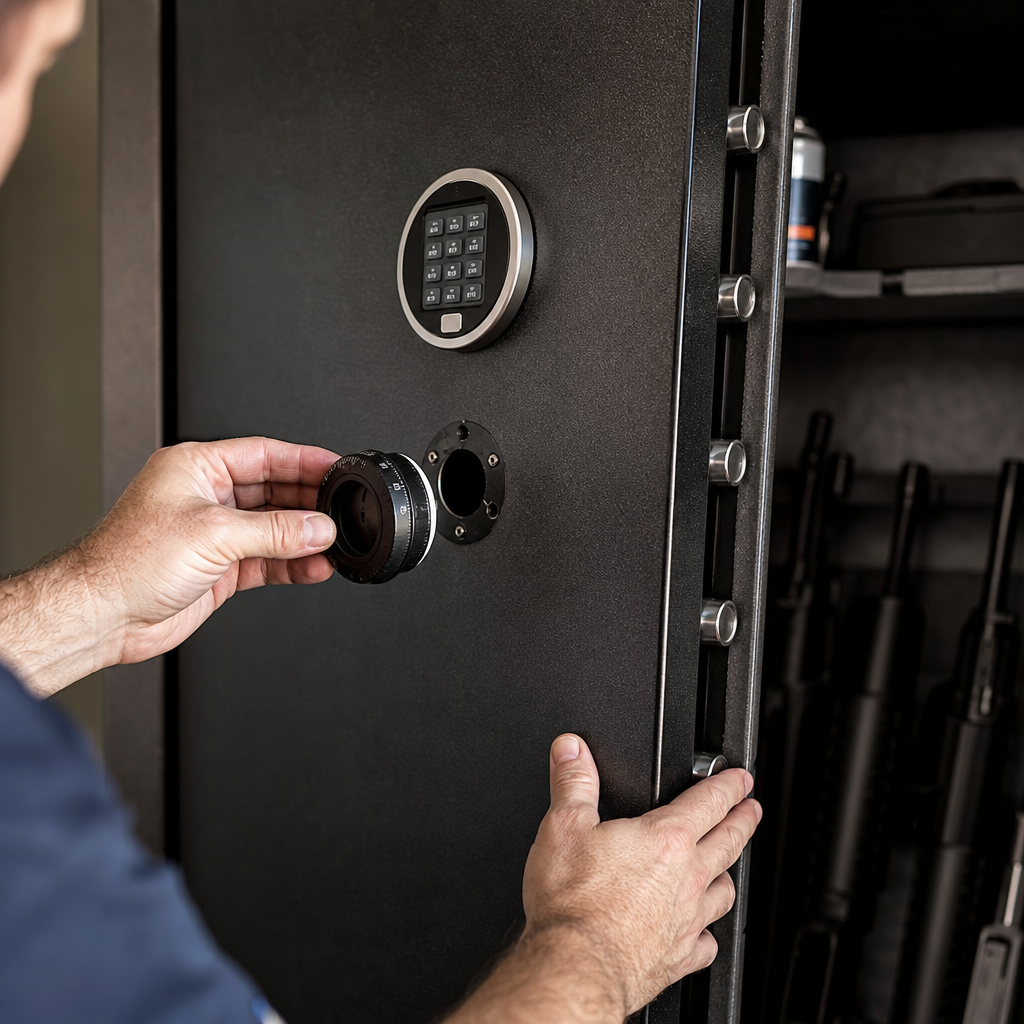
Installing a backup mechanical lock for digital gun safes gives owners a practical way to maintain access when electronics fail while also creating a broader roadmap for custom and DIY gun safe modifications. A digital gun safe uses an electronic keypad, biometric reader, or touchscreen to release the boltwork. A backup mechanical lock is a secondary key, dial, or cam-based mechanism that can open the safe when batteries die, wiring corrodes, a solenoid sticks, or the keypad fails after years of use. In my experience working around residential security hardware and reviewing safe retrofits, this is one of the most requested upgrades because it addresses the single biggest anxiety owners mention: being locked out of a safe they depend on for lawful, secure storage.
This topic matters because access reliability and unauthorized-entry resistance must coexist. A modification that makes emergency opening easier for the owner can also weaken the enclosure if it is badly planned. That is why backup lock installation belongs inside a wider custom and DIY gun safe modifications strategy rather than being treated as an isolated weekend project. Gun owners also modify interiors for scoped rifles, add humidity control, reinforce anchor points, upgrade lighting, improve fire sealing, and replace factory locks with higher-grade hardware. Each change affects usability, security, warranty coverage, and in some jurisdictions legal compliance with storage rules. A well-designed hub page should answer the immediate question about adding a mechanical override and also connect the decision to safe construction, lock standards, drilling limits, relocker behavior, and post-installation testing.
The core principle is simple: treat the lock as part of a system that includes the door steel, hardplate, boltwork, relockers, frame alignment, and the habits of the person using it. If any one piece is ignored, the modification can create new problems. Done correctly, however, a backup mechanical lock adds resilience, reduces service calls, and can extend the useful life of a digital gun safe without forcing a full replacement.
When a backup mechanical lock makes sense
A backup mechanical lock is worthwhile when the safe is used frequently, stores defensive firearms, or sits in an environment that is rough on electronics. Basements with seasonal humidity swings, garages with dust and heat, and cabins that sit unused for months are common examples. I have seen inexpensive keypad units fail because of battery leakage, worn membrane buttons, loose ribbon cables, and corrosion at the battery terminals. Even on better safes, the electronic lock body may outlast the keypad but still become unreliable if the spindle alignment shifts slightly after years of door use.
Owners often ask whether a backup lock is better than simply replacing the digital lock with a mechanical dial. The answer depends on priorities. A pure mechanical lock reduces electronic failure points, but it is slower for daily access and may be less convenient for households that need a quick code change. A dual-access arrangement preserves convenience while adding redundancy. It is especially useful when the safe stores both long guns and documents, because a lockout becomes more than a firearms-access issue. If the safe has a recognized lock from Sargent and Greenleaf, La Gard, SecuRam, or AMSEC-compatible platforms, retrofit paths are usually clearer than they are with off-brand imported safes that use proprietary mounting patterns.
Not every safe should be modified. Thin-bodied cabinet-style units sold as entry-level gun storage often lack the door thickness and internal clearance needed for a secure secondary lock. Some electronic safes already include a tubular key override, but many of those overrides are low-security convenience features rather than robust mechanical backups. If your safe carries an active warranty, drilling the door or changing the lock body can void coverage. If the safe is listed to UL 768 for combination locks or uses a manufacturer-certified lock package, replacing or supplementing parts without guidance may also affect insurance or warranty claims after a burglary attempt.
Assessing safe construction before any drilling or retrofit
Before planning a custom lock install, inspect the safe as a technician would. Remove the interior door panel and identify the current lock body, spindle location, linkage path, relockers, hardplate, and any internal wiring. Measure door thickness, the clearance between the panel and boltwork, and the available flat mounting surface. A proper assessment prevents the most common DIY mistake: drilling into a relocker plate or through a section of door skin with no structural support. Many gun safes are built with outer steel, gypsum fireboard, inner liners, and a lock cavity around the boltwork. What looks like open space from the outside may actually hide a relocker spring or glass plate.
The quality of the safe determines how ambitious a modification can be. A formed-sheet door on a budget safe behaves differently from a plate-steel composite door. The first may flex enough to affect lock alignment, while the second offers better support for a new dial ring or key cylinder. Look for hardplate protecting the main lock. If it covers the ideal mounting location for the backup mechanism, forcing a new opening elsewhere may create a weak path for attack tools. In practice, I recommend mapping the entire inside face with painter’s tape and marking every moving and fixed component before deciding on a drill point.
Also evaluate anchoring and placement. A safe that can be tipped over gives attackers better leverage and drill angles. If you are already opening the interior to modify the door, it is smart to review anchor bolts, shim any cabinet twist, and verify the door hangs square. Alignment matters because some apparent lock failures are really door-pressure issues. Owners who have to lift the handle, pull the top corner, or relieve side pressure before the keypad works should fix the frame relationship first. A backup lock will not solve a misaligned boltwork system.
Choosing the right mechanical backup lock
The best backup mechanical lock is the one that matches the safe’s construction, the owner’s skill level, and the intended security outcome. For most retrofit projects, the realistic options are a key-operated cam lock, a high-security tubular or dimple key lock linked to the boltwork, or a full mechanical combination lock added in place of or alongside the digital lock. A true dual-lock system where either lock independently retracts the boltwork is more complex than many owners expect. It usually requires custom linkage, careful sequencing, and enough internal space to prevent one lock from binding the other.
Security varies widely. Simple override keys found on low-cost electronics are convenient but often vulnerable to impressioning, destructive entry, or generic keyway attacks. Better choices use hardened components, restricted keyways, and internal mounting nuts shielded from direct attack. A Group 2 mechanical combination lock from a recognized manufacturer remains the benchmark for reliability, although retrofit complexity is higher. If the safe door already has the standard 41-series mounting footprint common to many safe locks, replacing the digital body with a mechanical lock may be simpler and more secure than adding a second lock.
| Option | Best use | Main advantage | Main limitation |
|---|---|---|---|
| Keyed cam or tubular override | Low-cost emergency access | Fast opening, simpler installation | Usually lower attack resistance |
| High-security key lock tied to boltwork | Midrange retrofit | Better key control and durability | Requires precise linkage work |
| Mechanical dial replacing digital lock | Reliability-focused owners | Excellent long-term dependability | Slower daily access |
| Custom dual-lock system | Advanced builds | Redundancy without losing convenience | Most complex and expensive option |
When selecting parts, favor established lock makers and avoid generic kits with vague metallurgy, unclear tolerances, and no installation documentation. Ask whether replacement keys can be controlled, whether the lock is serviceable, and whether the installer can provide a drill template specific to your door layout. Those details matter more than marketing claims.
Installation process, tooling, and common failure points
A careful installation starts with documentation. Photograph the lock area, wiring runs, and boltwork at every stage. Disconnect batteries, remove interior panels, and secure the door so it cannot swing unexpectedly while you work. Use transfer punches, calipers, and a center punch rather than guessing at hole locations. If the project requires drilling through hardened areas, use quality cobalt bits or a carbide solution appropriate to the hardplate and run the drill at controlled speed with cutting fluid. Heat buildup can damage paint, insulation, and nearby electronic components.
The most important rule is to preserve the integrity of the original lock path unless the new design intentionally replaces it. I have seen DIY installs fail because owners mounted a key cylinder slightly off-axis, causing the tailpiece to drag on the inner panel and only work when the door was open. Others drilled a clean external hole but left sharp burrs inside, which cut wire insulation and created intermittent keypad failures months later. Mechanical tolerance stack-up is unforgiving. A millimeter of error at the door face can become binding at the linkage.
Linkage design deserves extra attention. The backup lock should either independently actuate the boltwork or reliably release the primary lock’s blocking element. Improvised brackets made from thin hardware-store steel often flex under torque and eventually deform. Better practice is to use appropriately thick steel, machine bushings where needed, and test for full travel with the interior panel removed. If the safe includes relockers, verify that your modifications do not prevent them from firing when attacked and do not accidentally trigger them during installation.
After mechanical fitment, test with the door open at least twenty full cycles using both normal and backup access. Then test under slight handle pressure, because real doors shift under bolt preload. Replace insulation and interior panels without pinching wiring or obstructing moving parts. Finally, change default codes, label key control procedures privately, and store any override key outside the safe in a secure but accessible location. Keeping the emergency key inside the safe defeats the whole purpose.
How backup lock projects fit into broader DIY gun safe modifications
This page is the hub for custom and DIY gun safe modifications, so the lock project should be viewed alongside related upgrades. Interior reconfiguration is the most common companion project. Owners add rifle rods, barrel rests, door organizers, and shelving cut around optics to increase usable capacity without compromising safe handling. When a door panel is already removed for lock work, it is efficient to route low-voltage wiring for LED lighting, install magnetic switches, and add fabric-backed organizers that avoid interfering with the boltwork.
Environmental control is another major category. GoldenRod dehumidifiers, rechargeable desiccants, and wireless hygrometers help protect blued steel, wood stocks, documents, and ammunition packaging. If a retrofit introduces a new penetration through the door, seal management matters. Fire-lined safes rely on layered construction, and careless drilling can create moisture paths or reduce fire performance locally. Use grommets, proper sealants compatible with the safe’s finish, and avoid blocking existing door seals. For owners storing collectibles, a stable relative humidity target around fifty percent is usually safer than aggressive drying that shrinks wood grips or stocks.
Security reinforcement is the third companion topic. Many owners add better anchor hardware, upgrade hinge-side support on lighter safes, or improve closet concealment around the safe installation. A lock upgrade cannot compensate for a safe that is easy to remove with a dolly. Likewise, convenience upgrades such as powered lighting or biometric modules should never outrank basic resistance measures. The sensible order is structure first, lock reliability second, interior usability third, and cosmetic additions last. That sequence produces a safer, more durable result and avoids spending money on accessories before the core enclosure is dependable.
This hub also connects to maintenance. Batteries should be replaced on a schedule, keypad contacts kept clean, boltwork lightly lubricated where the manufacturer permits, and hinge or frame alignment checked annually. The best modification is one that remains serviceable. If you have to dismantle half the interior to replace a battery or retrieve a key number, the design needs refinement.
Safety, legal, and warranty considerations
Any gun safe modification has consequences beyond convenience. First is safe firearm storage practice. A backup mechanical lock should not make unauthorized access easier for children, guests, or thieves. Key control must be strict, spare keys should be tracked, and the override path should not be obvious from the safe exterior. Some owners disguise a key cylinder behind branding plates or trim rings, but concealment alone is not security. The hardware still needs real attack resistance.
Second is compliance. State and local storage laws vary, and some requirements focus on preventing access by minors or prohibited persons. If the safe is used to satisfy a legal storage obligation, confirm that the modification does not reduce compliance. Third is warranty and certification impact. Manufacturers may decline coverage if nonauthorized drilling alters fire insulation, lock mounting, or anti-drill protection. Ask for written guidance before starting. If the safe protects high-value collections, talk with your insurer as well.
Finally, know when to stop and call a safe technician. If the lock area includes glass relockers, proprietary cast parts, or complex dual-linkage mechanisms, professional labor is cheaper than replacing a ruined door. The goal is reliable access with preserved security, not a clever modification that works only until the next battery change.
Installing a backup mechanical lock for digital gun safes is one of the most practical upgrades in the custom and DIY gun safe modifications category because it addresses a real failure mode without requiring a full safe replacement. The decision should start with an honest assessment of the safe’s construction, lock footprint, door clearance, and warranty status. From there, choose a backup method that matches the security level you actually need: a modest key override for convenience, a stronger keyed mechanism tied to the boltwork, or a full mechanical lock conversion when long-term reliability matters most.
The larger lesson is that every modification affects the whole system. Lock changes interact with hardplate placement, relockers, fire lining, frame alignment, interior layout, and humidity control. Owners who approach the job methodically, document the interior, use recognized lock brands, and test thoroughly get the best results. Owners who drill first and solve fitment later often create new access problems or weaken the door. That is why this hub treats backup lock installation as part of a complete gun safe upgrade plan rather than a one-off hack.
If you are planning work on your safe, begin with inspection and measurements, then map your next related improvements in order of importance: structure, lock reliability, environmental protection, and storage efficiency. Use this hub as your starting point for smarter gun safe modifications, and when the lock path looks uncertain, bring in a qualified safe technician before metal is cut.
Frequently Asked Questions
Why would I install a backup mechanical lock on a digital gun safe?
Installing a backup mechanical lock adds a second, non-electronic way to open your safe if the primary digital system stops working. That matters because electronic lockouts are not rare over the lifespan of a safe. Dead batteries, damaged keypads, worn wiring, humidity-related corrosion, failed circuit boards, stuck solenoids, and simple age can all prevent a digital lock from retracting the boltwork when you need access most. A properly installed mechanical backup gives you a manual override that does not depend on battery power, software, sensors, or electrical contacts.
It also improves long-term serviceability. Digital gun safes are convenient, fast, and often easy to use in low light, but convenience can create a single point of failure if there is no alternate entry method. A backup mechanical lock reduces that risk and gives owners more confidence in the safe as a practical storage system rather than a sealed electronic box. For many people, this modification fits into a broader approach to custom and DIY gun safe upgrades, alongside interior lighting, dehumidification, shelving improvements, anchor reinforcement, and access-control changes. The key point is that a mechanical backup is not just an add-on for emergencies; it is a resilience upgrade that makes the safe more dependable over time.
Can any digital gun safe be retrofitted with a backup mechanical lock?
Not every digital gun safe is a good candidate for a retrofit, and that is one of the most important things to understand before starting. Whether a backup mechanical lock can be added depends on the safe’s door construction, lock mounting area, relocker design, internal clearances, boltwork layout, hardplate placement, fire lining, and overall build quality. Some safes have enough room and structural integrity to accept a secondary lock body and linkage, while others do not. On thinner, lower-cost cabinet-style products, adding a mechanical lock may weaken the door, interfere with the existing lock system, or simply be impractical because there is not enough space to route and mount the hardware correctly.
You also have to consider how the original digital lock operates. Some electronic locks directly trigger a solenoid or motor-driven mechanism, while others work with more traditional boltwork. A successful retrofit requires the backup lock to engage the opening system safely and predictably without defeating existing security features or creating accidental bypasses. In many cases, the issue is not whether a hole can be drilled for a key cylinder or dial spindle, but whether the new mechanism can be integrated without compromising anti-tamper components, relockers, or the safe’s ability to resist forced entry.
For that reason, the best approach is to evaluate the specific safe model before buying parts. Review the manufacturer’s documentation, inspect the inside of the door panel if accessible, and determine how much free space exists around the lock area. If dimensions, internal layout, or materials are unclear, a safe technician or locksmith with safe experience can tell you quickly whether the retrofit is realistic. In some situations, replacing the existing electronic lock with a better-quality lock that already includes a key override or choosing a hybrid lock solution is smarter than trying to add an entirely separate mechanical backup.
What types of backup mechanical locks are typically used for this kind of modification?
The most common backup mechanical options are tubular key locks, cam locks, key override cylinders designed to work alongside electronic locks, and in some cases traditional mechanical dial locks. Each type has tradeoffs in security, installation difficulty, space requirements, and day-to-day usability. A simple cam lock may be compact and easier to fit into a door panel, but it is not automatically suitable for controlling safe boltwork unless it is specifically selected and engineered for that purpose. Key override cylinders are often used as emergency release mechanisms on smaller safes and can work well if the lock body, cam travel, and engagement points are matched correctly. Traditional dial locks are highly durable and independent of electronics, but they usually require more installation depth, more precise mounting, and a more involved integration with the safe’s existing mechanism.
The right choice depends on how you want the backup system to function. Some owners want a true independent opening method that directly retracts or releases the boltwork. Others want a mechanical device that restores operation to the electronic mechanism by bypassing a failed keypad or allowing manual release of a blocked component. The hardware must be chosen based on the safe’s physical design, not just on convenience. A lock that works well on a document safe or utility cabinet may be completely unsuitable for a gun safe door with fireboard, hardplate, and active boltwork.
Quality matters as much as lock type. Cheap off-brand components can introduce new failure points, rough operation, or weak attack resistance. If you are modifying a gun safe, use reputable lock manufacturers and hardware intended for security applications. A backup lock should not become the weakest point of the system. Ideally, it should be durable, discreet, difficult to manipulate, and integrated in a way that preserves as much of the original security structure as possible.
What are the biggest risks or mistakes to avoid during installation?
The biggest mistake is treating the project like a simple hardware swap when it is actually a structural and security-sensitive modification. Drilling into a safe door without knowing what is behind the steel can damage the existing lock, sever wiring, hit hardplate, interfere with relockers, crack fire lining, or create an opening that weakens the door. Misalignment is another common problem. Mechanical locks require precise placement and smooth engagement. If the spindle, cylinder, cam, or linkage is even slightly off, the backup system may bind, fail intermittently, or place stress on the existing mechanism. That kind of partial success is dangerous because it can appear to work during testing but fail under real conditions later.
Another major risk is unintentionally reducing security. If the backup lock is installed in a highly visible or poorly protected location, or if the mounting area is not reinforced, the modification can create a new attack point. Likewise, if the backup mechanism bypasses too much of the original lock system, it may undermine anti-tamper features the safe relied on before. Some owners also overlook environmental factors. A mechanical backup is supposed to help when electronics fail, but if the new lock is vulnerable to corrosion, dirt, poor lubrication choices, or internal interference from insulation dust and metal filings, it may not be reliable when needed.
Testing is where many DIY installations succeed or fail. You should test the modified safe repeatedly with the door open before ever shutting and locking it. Cycle the electronic lock, then the backup lock, then both in different sequences. Simulate low-battery or no-power conditions if possible. Make sure the boltwork retracts fully and that nothing hangs up under light pressure. If the safe uses relock devices or spring-loaded components, verify that the modification does not trigger them unintentionally. Careful planning, precise measurements, controlled drilling, and repeated open-door testing are essential to avoid turning a useful upgrade into an expensive lockout.
Should I install a backup mechanical lock myself, or is this a job for a professional?
If you have real experience with safe hardware, metalworking, layout accuracy, and lock installation, a DIY retrofit may be possible on the right safe. But for most owners, this is a professional-level modification. Gun safes are not built like ordinary cabinets, and the lock area is one of the most critical parts of the entire unit. A professional safe technician or locksmith understands boltwork geometry, relock systems, hardplate drilling, proper lock placement, and the operational tolerances required for reliable opening. That expertise dramatically lowers the chance of damaging the safe or creating a security weakness.
Hiring a professional is especially wise if the safe is expensive, fire-rated, under warranty, or used for defensive firearms where dependable access matters. Many manufacturers will void warranties if the door is altered, and some safe designs are simply too complex to modify safely without model-specific knowledge. A qualified technician can also recommend whether a mechanical backup is truly the best solution, or whether upgrading the electronic lock itself, adding an external battery access option, or converting to a hybrid lock would be more effective. In some cases, what seems like a backup-lock project is better solved through maintenance, lock replacement, or a different safe setup entirely.
If you do decide to handle it yourself, approach it like a precision security project, not a casual weekend task. Document the safe’s internal layout, use accurate templates and measurements, protect internal components from metal debris, and test everything extensively before closing the door. The best DIY work is careful, conservative, and based on understanding how the whole safe operates. When there is any uncertainty, bringing in a professional is usually cheaper and safer than dealing with a failed installation or a self-inflicted lockout later.