
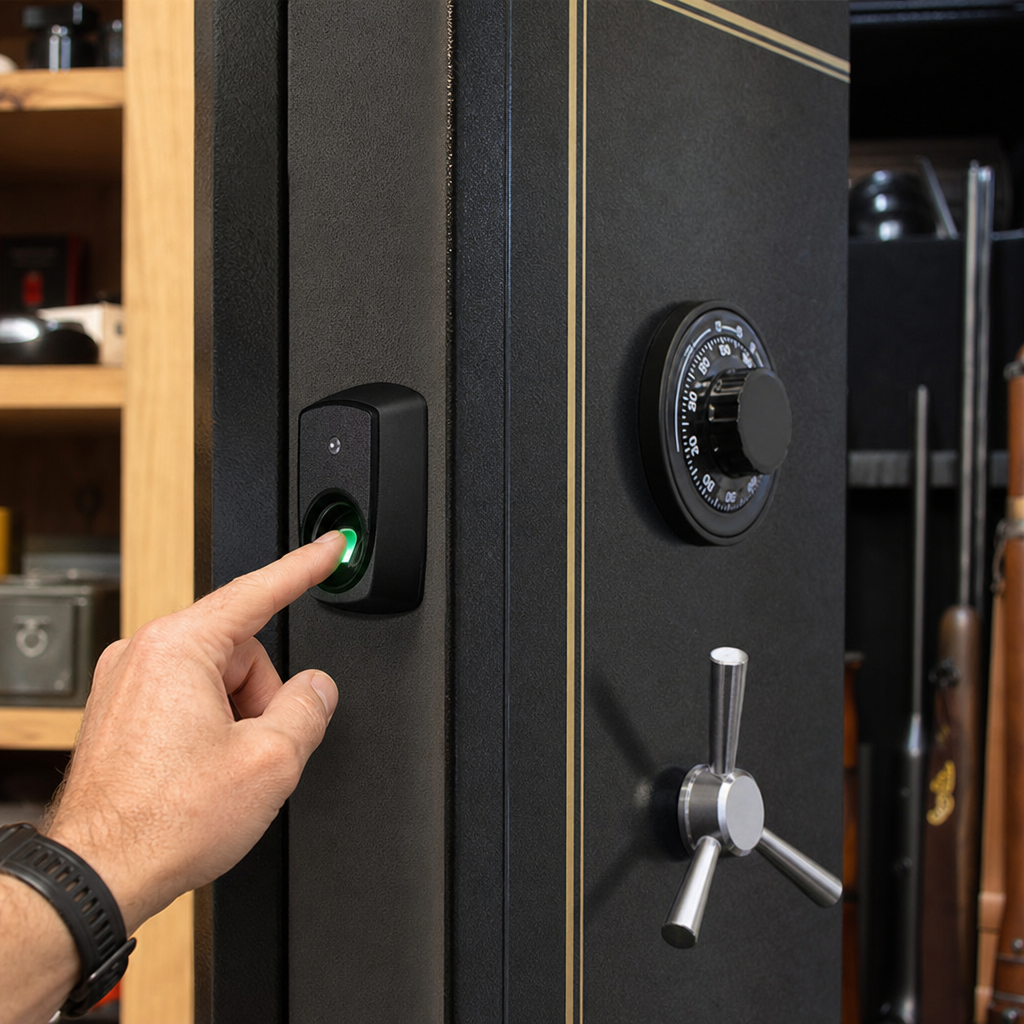
Installing a fingerprint scanner on a traditional gun safe can turn a slow, key-based box into a faster, more controlled access system, but the project only works when security, fit, and reliability are handled correctly from the start. In the gun safes and safety category, this topic sits inside custom and DIY gun safe modifications because it combines mechanical retrofit work, lock selection, access control, power management, and safe-door integrity. A fingerprint scanner, also called a biometric lock, reads unique ridge patterns on a finger and compares them to stored templates before releasing a bolt, solenoid, or motorized locking mechanism. A traditional gun safe usually refers to a safe built around a key lock, mechanical dial, or basic electronic keypad rather than a factory-installed biometric reader.
This modification matters for one practical reason: speed under stress. Owners often want faster entry for home defense while still restricting access from children, visitors, and unauthorized users. In my experience working with safe upgrades, the appeal is obvious, but so are the mistakes. People buy a consumer biometric module, drill a door without mapping internal relockers, and end up weakening a safe that was built to resist attack. Others install a scanner that works well on a workbench but fails after dust, dry skin, cold weather, or weak batteries affect the sensor. The goal is not simply to add modern convenience. The goal is to preserve the safe’s security rating, maintain dependable access, and choose a retrofit approach that fits the safe’s structure.
Custom and DIY gun safe modifications cover more than biometric entry. They include lighting, dehumidification, interior racks, door organizers, anchor systems, power pass-through kits, and lock replacement. Fingerprint scanner retrofits act as a hub topic because they touch nearly every other modification decision. Adding biometric access may require new wiring, battery placement, internal clearance checks, keypad relocation, handle travel testing, and backup override planning. It also forces owners to answer essential questions: Is the current lock U.L. listed? Does the door have hardplate protection? Is the safe still under warranty? Can the lock body be changed without affecting the boltwork?
Done correctly, a biometric upgrade can improve usability without compromising protection. Done poorly, it can create a false sense of security or even lock the owner out. The most reliable path is to understand the safe’s lock architecture first, then choose an installation method that matches it. Some safes accept a direct lock-body replacement from manufacturers like SecuRam, Sargent and Greenleaf, or La Gard. Others require a secondary access control system or professional fabrication. The sections below explain how to evaluate compatibility, select the right components, install the scanner safely, and connect this project to the broader world of DIY gun safe modifications.
Understanding Safe Compatibility Before You Drill or Buy
The first rule of installing a fingerprint scanner on a traditional gun safe is simple: identify the existing lock and boltwork layout before purchasing anything. Most residential gun safes use one of three systems: a Group II mechanical dial lock, an electronic swing-bolt lock, or an electronic deadbolt-style lock. The exterior keypad or dial is only the user interface. The real security component sits inside the door, where the lock body interacts with a fence, cam, or bolt linkage. A retrofit biometric lock must match the mounting footprint, spindle or cable path, handing, and bolt movement requirements of that internal mechanism.
Many modern safe locks follow common mounting patterns, especially the industry-standard footprint used by major lock makers, but that does not mean every biometric unit is drop-in compatible. On several retrofits I have seen, the keypad aligned perfectly while the internal lock body interfered with a relocker plate or the door panel. Fire-lined gun safes often have tighter tolerances than buyers expect. The insulation board, inner steel liner, and decorative panel can leave very little depth for a larger biometric lock case. Before ordering, remove the interior door panel and measure lock-body depth, mounting screw spacing, cable routing, handle clearance, and backset relative to the bolt mechanism.
Warranty and certification also matter. If the safe is still covered by the manufacturer, drilling new holes or replacing a listed lock may void coverage. Some lock upgrades preserve a recognized listing, while bargain biometric kits may not. That does not automatically make them unsafe, but it changes the risk profile. A traditional gun safe designed around a tested lock should not be downgraded by an unverified component. If the safe stores defensive firearms, reliability under repeated daily use is more important than app-based features, fingerprint capacity, or a glossy touchscreen.
Choosing the Right Fingerprint Scanner Retrofit
The best fingerprint scanner retrofit for a traditional gun safe is usually a biometric safe lock from an established lock manufacturer, not a generic cabinet latch adapted to steel. Capacitive fingerprint sensors generally outperform cheaper optical sensors in dusty or low-light home environments because they read fine electrical differences in the ridges instead of relying only on an image. Good units also pair biometric entry with a keypad, dual-admin programming, penalty lockout after repeated failed attempts, and a mechanical override or external power option. Redundancy is not optional on a gun safe. If a sensor rejects a dry finger at the wrong moment, the owner still needs a secure backup path.
Features should be judged by failure behavior, not marketing. A scanner should default to locked on low power, reject malformed prints, store templates in encrypted memory, and give clear status feedback. Search for lock bodies that meet safe-lock standards from recognized manufacturers and that are intended for deadbolt or swing-bolt safe applications. Examples commonly considered by safe owners include biometric offerings or keypad replacements from SecuRam, S&G, and La Gard, depending on the safe model. Compatibility must still be verified with the safe manufacturer or a licensed safe technician.
| Option | Best Use | Main Advantage | Main Limitation |
|---|---|---|---|
| Direct biometric lock replacement | Safes with compatible lock footprint | Cleanest install with preserved boltwork | Limited by internal clearance and model fit |
| Biometric keypad plus electronic lock body | Upgrading old electronic safes | Better user interface and multiple entry methods | May require cable routing changes |
| Secondary biometric access enclosure | Owners avoiding safe-door drilling | No structural modification to safe body | Adds a step before reaching the safe |
| Professional custom fabrication retrofit | High-end or unusual legacy safes | Tailored solution for nonstandard doors | Highest cost and longest install time |
For a hub page on custom and DIY gun safe modifications, this choice connects directly to related projects. If the scanner uses internal batteries, plan battery access alongside interior door organizers. If the lock needs a cable path, think about power pass-through routing and how fire lining will be resealed. If access speed is the objective, compare this upgrade with simpler keypad lock replacement articles and hinge-side reinforcement guides. Every modification should support the safe’s primary job: preventing unauthorized access while allowing the owner to open it when needed.
Installation Process: Safe, Precise, and Reversible When Possible
A successful installation begins with the safe empty, the door fully supported, and the interior panel removed so the entire lock area is visible. Never drill a gun safe door blindly. Many doors contain relockers, glass plates, hardplate, linkage bars, and moving handles that can be damaged or triggered by an incorrect hole. Start by photographing the existing setup, labeling screws, and recording the lock model number. Then disconnect or remove the old keypad or dial assembly according to the manufacturer’s service instructions. If the safe uses a mechanical dial, the spindle length, cam position, and mounting plate geometry must be evaluated before any biometric replacement is attempted.
Dry-fitting the new lock body is the most important step. Confirm that the bolt extends and retracts freely, the mounting screws seat flush, and the cable does not pinch when the inner panel is reinstalled. The handle should operate the boltwork smoothly without forcing the lock bolt. On swing-bolt designs, the lock only blocks movement; it does not drive the bolts. That distinction matters because misalignment in the safe’s boltwork can look like a bad scanner when the real issue is friction in the linkage. I always test several open-door cycles before programming fingerprints. If the lock hesitates with the door open, it will not improve once the panel is back on.
Programming should be done methodically. Enroll multiple fingers from each authorized user, including the thumb and index finger from both hands. Most false rejections come from poor enrollment, not defective hardware. Users should place the finger flat, centered, and consistently during setup. After enrollment, test each print at least ten times. Then test keypad backup access, low-battery alerts, and any external 9-volt emergency power contact if the model supports one. Only when every access method works repeatedly should the door be closed and locked for final testing.
Common Problems, Security Tradeoffs, and When to Call a Pro
The most common problem after a DIY biometric gun safe upgrade is inconsistent fingerprint recognition. Dry skin, dirty sensors, callused fingertips, and angled finger placement can all reduce match quality. This is why serious biometric locks combine fingerprints with a code. Another issue is power management. Internal batteries are secure but inconvenient if replacement requires opening the safe. External battery contacts solve that problem but add another exposed component. Neither approach is perfect, so the right choice depends on the safe’s use pattern and the owner’s maintenance discipline.
There are also structural tradeoffs. Drilling the wrong part of a safe door can bypass fire seals, weaken panel stiffness, or interfere with hardplate protection around the lock. On a lower-cost residential security container, that may reduce practical resistance more than owners realize. Some modifications are reversible, such as replacing a keypad with a compatible biometric keypad. Others are permanent, especially custom mounting work. If the safe protects high-value collections or NFA-regulated firearms, professional installation is usually the better decision because the stakes of lock failure are higher.
Call a safe technician or locksmith when the safe has a mechanical dial with relocker complexity, when the lock footprint is uncertain, when drilling near hardplate is required, or when the manufacturer will only support approved installers. A pro can also inspect boltwork timing, relocker status, and door sag, issues that frequently surface during lock upgrades. In broader custom and DIY gun safe modifications, knowing when to stop is a skill. LED lighting, moisture control, and shelving are forgiving projects. Lock retrofits are not. Precision matters more than enthusiasm.
Building a Smarter Gun Safe Modification Plan
Installing a fingerprint scanner should be part of a complete gun safe improvement plan rather than a standalone gadget purchase. Start with the safe’s mission. If it is a bedside quick-access safe, biometric speed may justify the upgrade. If it is a long-gun safe opened once a month, a high-quality keypad or mechanical dial may be more durable and just as effective. Then look at related modifications that improve daily use without undermining security: anchored installation, humidity control with a GoldenRod or desiccant system, motion-activated LED lighting, barrel supports, and better document storage. These projects often produce more value than an access upgrade alone.
This subtopic hub exists because custom and DIY gun safe modifications work best when they are planned in layers. Access control, interior organization, environmental protection, and physical anchoring should reinforce each other. A biometric scanner on an unanchored safe is not a complete safety solution. Neither is a beautifully organized interior with a lock that is hard to use under pressure. The strongest approach is balanced: choose proven hardware, confirm compatibility, protect the safe’s structure, and test every change repeatedly. If you are considering a fingerprint scanner on a traditional gun safe, begin with measurements, model verification, and a realistic view of how the safe is used. Then decide whether a direct retrofit, a professional upgrade, or a simpler lock replacement gives you the most dependable result. Build the project carefully, document the work, and use this hub to map your next safe modifications with the same standard.
Frequently Asked Questions
Can you add a fingerprint scanner to any traditional gun safe?
In many cases, yes, but not every traditional gun safe is a good candidate for a biometric retrofit. The biggest factor is the safe’s existing lock and door design. Some safes can accept an electronic or biometric lock upgrade through standard lock footprints, while others use proprietary hardware, unusual boltwork layouts, or thin sheet-metal doors that make retrofitting more complicated. Before buying a fingerprint scanner, you need to confirm that the safe door has enough internal clearance for the lock body, wiring, battery compartment, and any mounting plate required by the new unit. You also need to verify that the scanner can work with the safe’s existing relocking mechanism and bolt throw without weakening the locking system.
Fit is only part of the equation. A successful upgrade also depends on preserving the safe’s security and fire protection features. Drilling unnecessary holes, interfering with hard plates, or rerouting components without understanding the internal construction can reduce resistance to forced entry or damage fire insulation inside the door. For that reason, many owners start by checking the safe manufacturer’s documentation or contacting the manufacturer directly to ask whether a biometric lock retrofit is approved. If the safe is older, custom-built, or uses a less common lock style, having a locksmith or safe technician inspect it before installation is a smart move.
It is also important to separate “possible” from “worth doing.” A low-cost safe with marginal door construction may technically accept a biometric device, but the upgrade may cost almost as much as the safe itself and still leave you with a platform that has limited long-term durability. On the other hand, a well-built mechanical safe can often be modernized effectively if the biometric unit is reliable, properly matched to the lock mechanism, and installed without compromising the safe door. In short, most traditional gun safes can be evaluated for a fingerprint scanner upgrade, but compatibility should be confirmed carefully rather than assumed.
What should you look for in a fingerprint scanner or biometric lock for a gun safe?
The best biometric lock for a traditional gun safe is not just the one with the most features; it is the one that balances fast access, consistent fingerprint recognition, secure construction, and dependable backup entry. Start with sensor quality. Cheap scanners often work well in ideal conditions but struggle with dirty fingers, minor cuts, dry skin, humidity, or repeated daily use. A stronger option will have a higher-quality sensor, faster processing, and the ability to store multiple fingerprints so more than one authorized user can gain access. It is also wise to choose a unit that allows multiple finger enrollments per person, such as both thumbs and index fingers, because that improves reliability under stress.
Beyond the sensor itself, focus on the lock’s overall build and how it integrates with the safe. Look for a lock designed specifically for safes rather than a general consumer access device. Safe-oriented biometric locks are typically built around recognized mounting standards, stronger internal components, and more secure tamper resistance. They should include a mechanical key override, external emergency power option, or another backup method in case of battery failure or scanner malfunction. Without a backup entry system, a dead battery or damaged sensor can create a serious lockout problem at exactly the wrong time.
Power management is another major selection point. Since biometric scanners require electricity, you want clear low-battery warnings, easy battery replacement, and preferably a design that does not require opening the safe to change the batteries. Some units use internal batteries, while others offer external contact points or backup power ports. Also check the lock’s operating history and reputation. In this category, real-world reliability matters more than flashy marketing claims. Product reviews from safe owners, guidance from locksmiths, and manufacturer support quality all matter. A well-chosen biometric lock should be fast, secure, durable, and supported by a clear recovery plan if electronics fail.
Will installing a fingerprint scanner make a gun safe less secure?
It can, if the installation is poorly planned or if the lock itself is low quality, but a proper retrofit does not automatically make a safe less secure. The real issue is whether the biometric system is integrated in a way that maintains the safe’s original protective design. If installation requires drilling in the wrong location, bypassing hardened components, weakening the door panel, or interfering with relockers and boltwork, then security can absolutely be reduced. Likewise, a bargain biometric lock with weak tamper resistance or unreliable internal parts may introduce new vulnerabilities that were not present with the original mechanical lock.
At the same time, a good biometric upgrade can improve practical security in daily use. Many owners are more likely to keep a gun safe locked consistently when access is faster and more convenient. That matters because an inconvenient key or dial lock sometimes leads to unsafe habits, such as leaving the safe unlocked during certain hours or storing the key in a predictable place nearby. A dependable fingerprint scanner can reduce those shortcuts while still limiting access to authorized users. In that sense, biometric access may improve real-world control, especially for households that need both secure storage and quick retrieval.
The key is choosing a quality lock and installing it correctly. The scanner should not become the weak point of the system. It should have backup access, secure mounting, good tamper protection, and compatibility with the safe’s existing locking hardware. It should also be tested regularly under realistic conditions. If preserving the highest possible anti-tamper performance is the top priority, or if the safe protects high-value firearms and documents, professional installation is often the best choice. Security is not just about the presence of a biometric scanner; it is about whether the full upgrade is engineered to support, rather than undermine, the safe’s original function.
How difficult is it to install a fingerprint scanner on a traditional gun safe yourself?
The difficulty level ranges from fairly simple to highly technical depending on the safe and the type of biometric lock being installed. If the new lock is a direct replacement for a standard safe lock footprint and the safe manufacturer supports electronic upgrades, a confident DIY owner with the right tools may be able to complete the project successfully. In these cases, the work usually involves removing interior door panels, disconnecting the old lock, mounting the new lock body, attaching the keypad or scanner assembly, routing any cable, and testing the boltwork carefully before closing the door fully. Even then, patience is critical because small alignment issues can create major lock problems.
The job becomes much more difficult when the safe uses a non-standard lock pattern, has limited internal space, includes complex relockers, or requires drilling or modification of the door. That is where many do-it-yourself projects go wrong. Owners may underestimate how tightly packed the inside of a safe door can be, or they may not realize that moving one component can interfere with another. Wiring pinch points, cable damage, scanner misalignment, and bolt pressure issues are all common causes of failed installations. A fingerprint scanner that looks properly mounted from the outside may still perform poorly if the internal mechanics are under strain.
Another concern is testing procedure. With any safe lock change, one of the most important rules is to test the lock repeatedly with the door open before ever closing and engaging the bolts fully. That lets you confirm that fingerprint recognition, backup entry, bolt movement, and lock timing all work consistently. If you are not comfortable reading installation diagrams, measuring clearances, drilling metal accurately, or diagnosing lock behavior, professional help is usually money well spent. DIY installation is possible in the right scenario, but it should be approached as a precision security retrofit, not a casual accessory swap.
How do you make sure a biometric gun safe lock stays reliable over time?
Long-term reliability comes down to setup, maintenance, and realistic expectations. The first step is proper fingerprint enrollment. Do not rush this part. Register multiple fingers for each authorized user, and if the lock allows it, capture the same finger several times at slightly different angles and pressures. That gives the scanner a better reference set and improves recognition when hands are cold, slightly dirty, or moving quickly. It is also helpful to enroll the fingers most likely to be used in a real access situation rather than just whichever finger is convenient during setup.
Routine maintenance matters just as much. Keep the scanner surface clean and free of oils, dust, and residue, because buildup can reduce accuracy. Replace batteries before they become critically low instead of waiting for warnings to become urgent. If the lock includes a mechanical override key, emergency code, or external power port, test that backup method periodically so you know it works before an actual emergency. The same goes for the safe’s mechanical action: bolts should move smoothly, the handle should not bind, and the lock should not be forced if it hesitates. Electronic problems are not always electronic; sometimes they are caused by mechanical drag inside the door.
Environmental conditions also play a role. Garages, workshops, and outbuildings can expose the scanner and internal electronics to temperature swings, humidity, dust, and vibration, all of which affect performance over time. If the safe is stored in a harsher environment, choose a lock rated for that use and inspect it more often. Finally, keep expectations grounded. No biometric system is perfect every single time, so the goal is dependable performance with a backup plan, not blind trust in the sensor alone. A reliable biometric safe setup combines a quality lock, careful installation, fresh power, clean sensor maintenance, consistent testing, and a verified fallback entry method.