
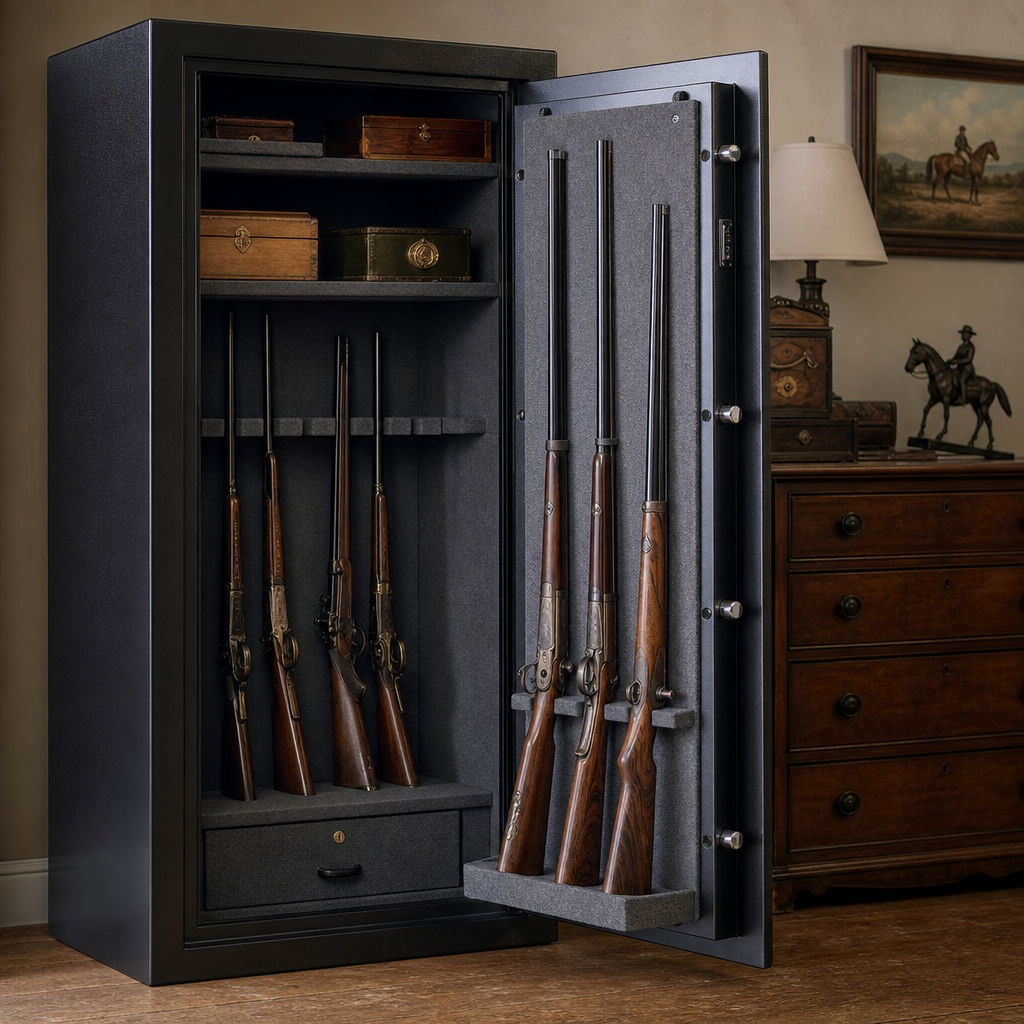
Antique firearm collectors need a gun safe that does more than stop theft. It must protect irreplaceable wood, bluing, case colors, engravings, paper provenance, and historical value from humidity swings, fire, improper handling, and poor storage design. When asking what type of gun safe is best for antique firearm collectors, the real answer depends on the collector’s profile, because a person preserving two family heirlooms has different needs than a curator managing a room of 19th-century Winchesters. In practice, the best choice is usually a high-quality fire-rated safe or vault cabinet with stable humidity control, soft interior support, flexible long-gun spacing, and security appropriate to the collection’s market value.
That buyer-persona approach matters because antique firearms are not ordinary sporting arms. They may be black powder rifles, early revolvers, military surplus pieces with original stocks, presentation-grade shotguns, or serialized collections documented by letters, auction records, and appraisals. Their value often rests as much on originality as on function. I have helped collectors reorganize safes where modern foam sleeves trapped moisture against Damascus barrels, where overly tight barrel rests rubbed fragile finishes, and where fireboard-lined interiors gave a false sense of long-term preservation without any humidity strategy. The right safe prevents those mistakes before they become expensive.
For this audience, key terms should be clear. A residential security container is the common consumer “gun safe” sold by big retailers; it offers basic burglary resistance but is not equivalent to a true commercial safe. Fire rating describes how long a safe is tested to limit interior heat during a fire, though test standards vary by manufacturer. Relative humidity is the percentage of moisture in the air; for antique firearms, steady conditions usually matter more than chasing an ultra-low number. Dehumidifiers, desiccants, vapor-phase corrosion inhibitors, door seals, and interior materials all affect preservation. Safe capacity also needs skepticism, because a “24-gun” model rarely stores 24 scoped or irregular long guns comfortably.
This hub article covers the main gun safe buyer personas within the antique collecting market and explains which safe types fit each one. It also helps readers connect related decisions across the broader Gun Safes & Safety topic: burglary protection, fire protection, climate control, inventory documentation, placement, and insurance readiness. If you understand your collecting style first, you can buy one safe that fits your collection instead of replacing an inadequate one in two years.
The Family Heirloom Keeper: Small Collection, High Sentimental Value
The first buyer persona is the heirloom keeper. This collector may own one to five antique firearms: a Civil War-era musket from a great-grandparent, an early Colt revolver, or a vintage side-by-side shotgun that comes out only for family storytelling. Market value can range from modest to significant, but emotional value is usually the priority. For this persona, the best safe type is a compact fire-rated safe or premium security cabinet with better-than-entry-level steel, an outlet for a dehumidifier rod, and enough interior clearance to avoid crowding.
Why not simply use a display case? Because antique firearms deteriorate fastest when they are handled casually, exposed to room humidity, and left vulnerable during a break-in or house fire. A compact safe in the 12- to 20-long-gun category often works well even for just a few pieces because advertised capacity overstates reality. The extra room lets the owner add archival document storage for letters, photos, factory records, and appraisal files. Models from established brands such as Fort Knox, Liberty, Browning, AMSEC, and Hollon often offer interior upgrades that matter more than raw capacity.
This persona should prioritize moderate fire resistance, stable humidity, and simple access over massive vault size. A safe with plush but non-abrasive interior fabric, adjustable shelving, and a power pass-through for a GoldenRod-style dehumidifier is a strong starting point. Add rechargeable desiccants and a digital hygrometer, and keep humidity generally around 45% to 55%. Extremely dry conditions can stress old wood stocks, while damp conditions invite rust and mold. For a family heirloom owner, the safest purchase is usually one quality mid-size safe rather than a cheap metal cabinet and a separate document box.
The Active Historian: Researcher, Shooter, and Hands-On Conservator
The active historian is different. This collector studies markings, attends gun shows, compares serial ranges, and may carefully fire selected black powder or early cartridge arms. Their collection changes regularly as pieces are bought, sold, and traded. They need organization, not just storage. The best safe type for this persona is a modular interior safe with adjustable racks, shelving for accessories, and enough depth for mixed formats including long guns, revolvers in soft wraps, and boxed parts.
Collectors in this group often make two mistakes: buying a safe optimized for modern scoped rifles, or overpacking a large safe until firearms touch each other. Antique guns come in odd dimensions. Ramrods, tall hammers, crescent buttplates, and long barrels do not fit generic rack spacing well. A wider safe with fewer advertised slots is usually better than a tall narrow model with inflated capacity claims. If the collector also maintains provenance binders, auction catalogs, and cleaning tools, the interior should separate paper and metal storage so oils and solvents never share space with documents.
Lock choice matters here. I usually recommend a high-quality mechanical dial or a commercial-grade electronic lock from SecuRam or Sargent and Greenleaf. Antique collectors often access safes frequently, and cheap electronic locks are a failure point. Mechanical dials are slower but proven; premium electronic locks are convenient if backed by reliable service. Either way, bolt-down installation is essential. A 700-pound safe still moves with pry bars and appliance dollies if it is not anchored.
The Investment-Grade Collector: High Value, Insurance, and Layered Security
The investment-grade collector treats firearms as serious assets. Think documented Colt Single Action Army revolvers, cased presentation pieces, high-condition Winchester lever actions, or rare military rifles with matching numbers and provenance. Here, the best safe type moves beyond basic residential containers toward heavy-body safes, higher burglary ratings, or even a dedicated vault room if collection value justifies it. Insurance carriers and appraisers care about this distinction because security is part of risk management.
This persona should compare safe classes by steel thickness, door construction, lock quality, relockers, hard plates, hinge-side protection, and tested fire claims rather than marketing language alone. A heavier safe with composite door construction and robust boltwork provides materially better burglary resistance than a decorative big-box model. Placement also matters. Installing the safe in a climate-controlled interior room, not a damp garage, improves both preservation and security. Pair the safe with monitored alarm coverage, discrete delivery, serial-number inventory, and annual appraisal updates.
| Collector Persona | Best Safe Type | Main Priority | Key Features |
|---|---|---|---|
| Family heirloom keeper | Compact fire-rated safe | Preservation and simple security | Dehumidifier access, soft interior, document shelf |
| Active historian | Modular interior safe | Organization and frequent access | Adjustable racks, flexible shelving, reliable lock |
| Investment-grade collector | Heavy-body safe or vault room | Burglary resistance and insurance readiness | Thicker steel, relockers, inventory controls, alarm integration |
| Museum-style curator | Vault room plus specialty cabinets | Collection-scale preservation | Zoned humidity control, archival storage, handling workflow |
For high-value collections, interior contact surfaces deserve close scrutiny. Some fabrics and foams off-gas or hold moisture. Silicone-treated gun socks can help during transport or temporary spacing, but they are not a substitute for environmental control. If a firearm has active rust, unstable finishes, or flaking stock varnish, the safe is not the first fix; conservation assessment comes first. Security and preservation work together, but they are not the same discipline.
The Museum-Style Curator: Large Collections and Preservation Workflow
The museum-style curator may be a private collector with dozens of antique arms, an estate manager, or a small institution. At this scale, a single consumer safe is rarely the best answer. The ideal setup is often a vault room or secure gun room combined with specialized cabinets, archival shelving, and environmental monitoring. That is because collection management becomes a workflow problem: intake, cataloging, quarantine for newly acquired pieces, condition checks, and controlled access all need space.
In these projects, I have seen the best results from climate-stable interior rooms with dedicated HVAC support, insulated walls, monitored humidity, and commercial safes or secure cabinets for the most valuable subsets. Target conditions should stay steady through seasons, not swing wildly between summer dampness and winter dryness. Wireless sensors from companies like SensorPush or Govee can log conditions, while data is reviewed over time rather than guessed from a single reading. For valuable collections, records are as important as locks: photographs, acquisition source, serial numbers, dimensions, condition notes, and insurance schedules should live both on-site and encrypted off-site.
This persona also benefits from separating categories. Long guns with protruding hammers store differently from cased handguns, edged weapons, powder flasks, and paper ephemera. A vault room supports that zoning. It also reduces the packing density that causes stock dents and finish wear. If collection access involves researchers, family members, or staff, install clear handling procedures and limit who knows the full inventory and layout.
Features That Matter Most for Antique Firearms
Across all buyer personas, several features consistently matter more for antique firearm collectors than flashy branding. First is environmental stability. Wood and metal age best in a narrow, controlled range, and sudden changes are more damaging than slightly imperfect but steady conditions. Second is interior fit. Antique firearms need spacing that protects sights, rods, levers, and stock finish. Third is real security, meaning quality steel, boltwork, anchoring, and a lock that will still be serviceable years from now.
Fire protection is important, but collectors should understand its limits. Most consumer fire ratings are manufacturer-specific and test methods differ. Heat, steam, and firefighting water can still damage antiques even if the safe survives. That means a higher fire rating is good, but it should not be the only buying criterion. If two safes are similar, choose the one with better construction and interior adaptability rather than trusting a sticker alone. Also consider door organizer panels carefully; they are useful for documents and handguns, but bulky pockets can interfere with long-gun clearance.
Finally, think ahead. Collections grow. Provenance paperwork multiplies. Insurance standards tighten. The best gun safe for antique firearm collectors is usually one size larger, one quality tier higher, and one level more climate-aware than the buyer first planned. That extra margin prevents overcrowding and supports safer long-term stewardship.
How to Choose the Right Safe and Build Around It
Start by matching the safe to the persona that best describes you today, then buy for the collection you expect within five years. Place the safe in a conditioned interior location, bolt it down, add a dehumidifier, monitor humidity, and leave enough empty space for airflow and safe handling. Store provenance in protective sleeves or archival folders on separate shelves. Review your insurance documentation annually and photograph each firearm in current condition.
As a hub within Gun Safes & Safety, this topic connects to every practical decision collectors make after purchase: safe placement, humidity control, lock selection, fire ratings, inventory systems, and home security layers. Antique firearms reward careful storage because condition is value. A rubbed stock, orange rust under a barrel band, or warped paper label can reduce historical and financial worth quickly. Choose a safe built for preservation as well as protection, and treat the interior as a managed environment, not just a locked box. If you are comparing models now, list your collector persona, collection size, and climate risks first, then evaluate safes against those realities before you buy.
Frequently Asked Questions
What type of gun safe is best for antique firearm collectors?
The best gun safe for antique firearm collectors is usually a high-quality fire-rated safe or vault cabinet that prioritizes stable interior conditions, flexible storage, and gentle handling as much as burglary protection. Antique firearms are not just valuable objects; they are fragile historical artifacts. Older walnut stocks, hand-checkered grips, blued steel, case-colored receivers, original slings, and paper documentation can all be damaged by poor humidity control, overcrowding, and abrupt temperature changes. That means the right safe is rarely the “biggest box with the thickest steel” alone. It needs to create a protective micro-environment.
For a small private collection, a premium gun safe with an adjustable interior, soft contact points, solid fire protection, and room for dehumidification equipment is often the best choice. For larger or more advanced collections, a modular vault room or high-end safe with museum-style storage features may be better, especially if the collector owns long guns with delicate finishes, accessories, and original provenance files. Collectors with only a couple of family heirlooms may not need commercial-grade capacity, but they still benefit from a safe that protects against moisture, house fires, and casual mishandling.
In practical terms, the best safe for antique firearms usually includes reliable fire resistance, enough space to avoid guns touching one another, interior materials that will not abrade old finishes, and a humidity-control plan. Antique collectors should also favor safes with shelving or configurable racks so firearms, cased sets, and paperwork can be stored separately but together in a controlled environment. A safe chosen specifically for preservation will outperform a generic “gun box” every time.
Why is humidity control so important for antique firearms in a gun safe?
Humidity control is one of the most important factors in preserving antique firearms because old materials respond poorly to dampness, dryness, and rapid environmental swings. Steel parts can rust or pit, even when they appear clean and oiled. Wood stocks can swell, crack, warp, or loosen at the action. Leather slings and vintage cases can stiffen, mold, or deteriorate. Paper records such as factory letters, auction receipts, and family provenance can yellow, curl, or mildew. In many collections, humidity damage causes more long-term loss than theft.
The reason this matters so much in a safe is that a sealed metal enclosure can become a trap for moisture if it is not actively managed. A safe placed in a basement, garage, or exterior wall area may experience condensation and internal humidity spikes. Antique firearms are especially vulnerable because their finishes may be thinner, more delicate, or less corrosion-resistant than those on modern production guns. Original bluing, browned barrels, engraving, and case colors can all suffer if corrosion starts.
The best approach is to maintain a stable relative humidity level rather than chasing extremes. Many collectors aim for a controlled, moderate environment that avoids both excessive moisture and over-drying. This usually means using an electric dehumidifier rod, rechargeable desiccants, or a dedicated safe climate-control system, while also monitoring conditions with a hygrometer. The key is consistency. Antique collectors should check their safe regularly, especially during seasonal changes, and avoid storing firearms in foam-lined soft cases or leather scabbards inside the safe for long periods, since those materials can hold moisture against metal and wood. A gun safe without humidity management is not really set up for serious antique preservation.
Is fire protection different for antique gun collections than for modern firearms?
Yes, fire protection matters differently for antique collections because collectors are trying to preserve originality, finish, and historical integrity, not just a firearm’s basic function. A modern firearm that survives a fire with cosmetic damage may still be replaceable. An antique Winchester, Colt, Parker, or family war trophy with original finish and documented history is not. Once heat damages the stock, destroys the finish, weakens solder joints, or ruins paper provenance, the historical and collector value may be permanently reduced.
That is why antique collectors should pay close attention not only to whether a safe is fire-rated, but to how meaningful that rating is. Marketing claims can be misleading. A better safe will provide a credible fire rating for a realistic duration and temperature, while also sealing reasonably well against heat and smoke. Smoke, steam, and firefighting water can be just as harmful as flame. Documents, vintage labels, and accessories are especially vulnerable, so collectors often benefit from keeping provenance papers in a separate fire-protective document box or archival container inside the main safe.
Collectors should also remember that fireboard-lined safes can release moisture during a fire event, which is part of how many fire linings work. That can still be far better than exposing antiques to open flame, but it reinforces the need to think beyond simple advertising labels. If the collection is significant, the best solution may be a true vault room, a premium safe with stronger fire credentials, or multiple layers of protection. In short, antique firearm owners should evaluate fire protection as a preservation issue, not just a survival issue.
What interior features should collectors look for in a gun safe for antique firearms?
Interior design is where many gun safes either protect antique firearms properly or quietly create damage over time. Collectors should look for adjustable, non-abrasive storage systems that allow enough spacing between firearms, support long guns securely, and accommodate odd dimensions common with older rifles and shotguns. Many antiques have slimmer fore-ends, longer barrels, period optics, fragile sights, or protruding hammers that do not fit well in standard rack layouts designed for modern scoped rifles. If guns are crowded or forced into awkward positions, handling risk goes up every time the safe is opened.
Soft, neutral interior surfaces are important, but so is structural flexibility. A safe with configurable shelving lets a collector separate long guns from handguns, edged accessories, ammunition, and paper records. This reduces accidental contact and makes inspections easier. Pull-out racks, barrel supports, and individual cradles can be especially useful for high-value pieces. Collectors should also make sure the door organizer, if there is one, will not press against delicate stocks, hammers, or sights when the safe is closed.
Another major consideration is access. A well-designed interior should let the owner remove one firearm without bumping three others. Antique firearms should not be stacked, leaned together, or wedged behind modern guns and gear. Dedicated space for gloves, silicone-free cleaning cloths, archival sleeves for documents, and humidity equipment is also helpful. In higher-end collections, museum-style storage principles are worth applying: low-contact support, clear organization, and minimal unnecessary movement. For antiques, convenience and preservation should work together.
Should an antique firearm collector choose a traditional gun safe, a vault room, or a custom storage solution?
The right choice depends on the size, value, and goals of the collection. A traditional premium gun safe is often the best fit for collectors with a modest number of antique firearms who want strong protection without remodeling their home. It offers a practical balance of security, fire resistance, and climate management, especially if the safe is placed in a stable interior location and equipped properly. For many collectors, this is the most realistic and effective option.
A vault room becomes more attractive when the collection is large, unusually valuable, or includes more than just firearms. If a collector also stores original boxes, powder flasks, holsters, military artifacts, records, and display pieces, a room-sized solution can provide better organization, better spacing, and more controlled environmental conditions. Vault rooms also reduce the crowding problem found in many safes, where advertised capacity is far less than what is truly safe for collectible storage. For advanced collectors, a vault room can function more like a private archive than a simple security container.
Custom storage solutions are often the best answer when the collection includes especially rare, delicate, or irregular items. This might mean custom racks for cased dueling pistols, shelving for provenance files, drawers for accessories, and independently controlled humidity systems. Some collectors combine approaches: a primary vault or safe for the firearms themselves, a separate fire-protective cabinet for documents, and archival storage for photos and paperwork. That layered strategy often works best because antique collections are rarely made up of guns alone. The best choice is the one that matches the collection’s preservation needs today while leaving room for future growth.