
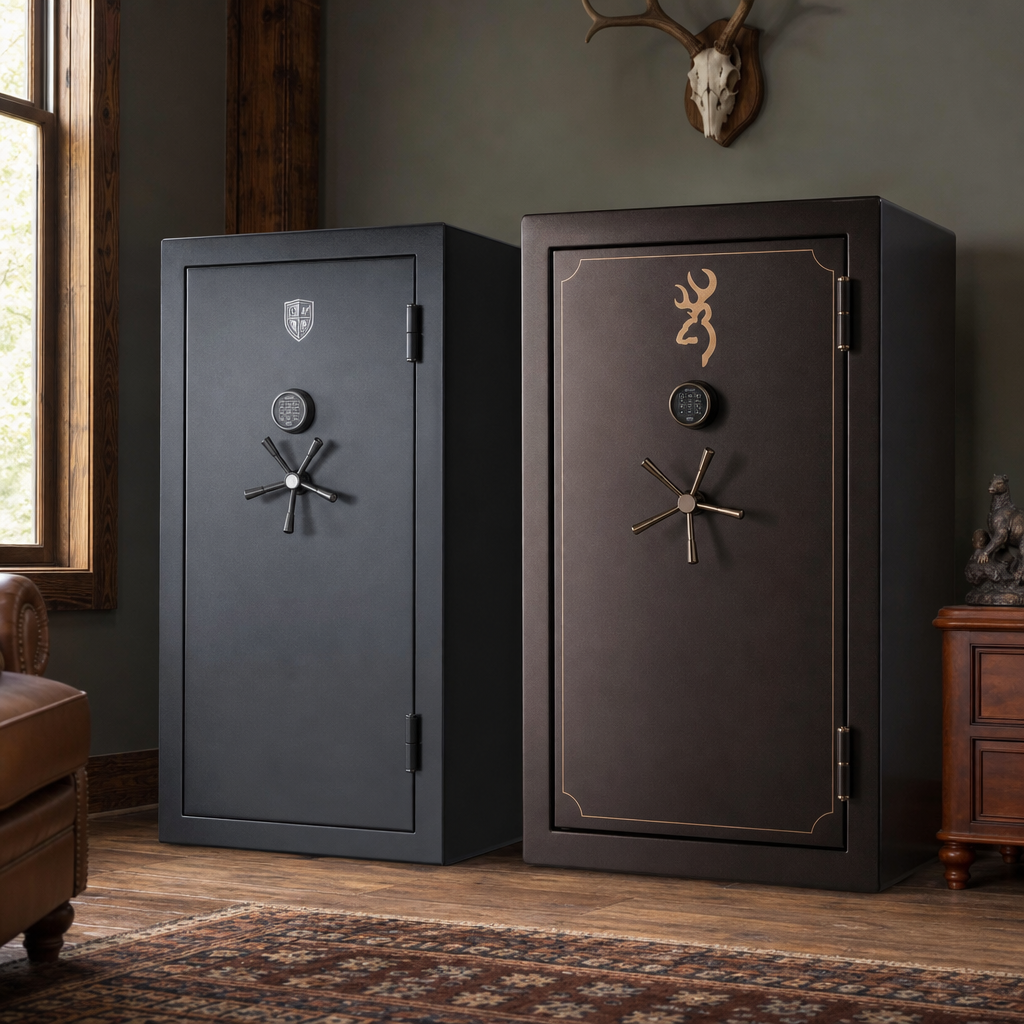
Choosing between Steelwater and Browning for burglar protection comes down to more than brand reputation; it requires understanding steel thickness, door construction, locking systems, bolt design, anchoring, and the burglary standards that determine how a gun safe actually performs under attack. In the gun safes and safety category, comparison pages often focus on fire ratings or glossy interiors, but burglary resistance is the factor that matters most when the goal is preventing theft of firearms, documents, and valuables. This hub for gun safe comparisons and brand spotlights explains how Steelwater and Browning differ, where each brand is strong, and what buyers should evaluate before spending serious money.
When people say burglar protection, they usually mean delay time: how long a safe can resist pry attacks, punch attacks, drilling, cutting, and attempts to remove the unit entirely. Few residential gun safes are truly burglary rated in the same way a commercial TL-rated safe is rated under UL 687. Most gun safes on the consumer market are residential security containers or hybrids with heavier construction and added anti-pry features. That distinction matters because a large advertised bolt count does not equal high security, and a long fire rating does not guarantee strong theft resistance. I have walked customers through both brands, and the same confusion appears every time: they compare size and finish first, then discover later that body steel, door plate thickness, and fit tolerances are what separate a decent gun safe from a genuinely difficult target.
Steelwater and Browning both occupy important positions in the midrange and upper-midrange market. Browning is one of the most recognized names in gun storage, with broad dealer distribution, polished interiors, and models across multiple price tiers. Steelwater built its reputation by emphasizing heavier steel, upgraded locking components, and straightforward specifications that appeal to buyers who prioritize break-in resistance. For anyone researching the broader subtopic of gun safe comparisons and brand spotlights, this article also serves as a framework for evaluating Liberty, Fort Knox, American Security, Winchester, Rhino, and Cannon. The same rules apply across the category: verify the steel gauge, understand the door build, ask whether the safe has hard plate and relockers, and confirm it can be anchored into concrete. Once you evaluate Steelwater and Browning through that lens, the burglar protection question becomes much clearer.
What Determines Burglar Protection in a Gun Safe
The biggest factors in burglar protection are body steel thickness, door thickness, locking mechanism quality, boltwork design, internal reinforcements, and installation. Body steel is especially important because many residential attacks target the sidewalls with pry bars or abrasive cutting tools. A 12-gauge body is meaningfully stronger than 14-gauge, and a 10-gauge body is stronger again. The difference is not cosmetic. Thicker steel takes longer to flex, cut, or peel, and that extra time can be the difference between a failed smash-and-grab and a full theft.
Door construction matters just as much. Some safes advertise impressive overall door thickness that includes drywall and paneling rather than solid steel. For burglary resistance, what matters is steel plate or formed steel in the door, plus anti-pry tabs, a robust frame, and a close door gap that limits tool access. Hard plates, ball-bearing drill stops, and relockers also matter because many real burglaries involve direct attacks on the lock and spindle area. If a safe has decent steel but weak lock protection, a skilled thief may bypass it faster than the owner expects.
Bolt count is widely misunderstood. More bolts can help distribute locking points, but oversized marketing around 16, 18, or 20 bolts often hides weaker fundamentals. Active bolts on all four sides sound impressive, yet they do not compensate for a thin body shell or a flexible door frame. In practice, fixed hinge-side bars, solid locking bars, and resistance to pry spread are more important than the highest advertised bolt number. Anchoring is also nonnegotiable. Even a heavy safe can be tipped, pried from a weak floor, or removed with a dolly if it is not bolted down properly.
Steelwater: Strengths, Construction, and Security Focus
Steelwater safes are usually discussed first by security-focused buyers because the brand tends to publish concrete specifications that highlight steel thickness and anti-burglary components. Many of its models use heavier bodies than competing safes at similar prices, often in the 12-gauge range and sometimes heavier on specific product lines. The brand is also known for composite-style doors on some models, gear-driven or robust boltwork systems, multiple relockers, hard plates, and practical anti-pry details. Those features are directly relevant to burglar protection, not just brochure language.
In my experience reviewing product sheets and dealer listings, Steelwater appeals to buyers who would rather sacrifice a little showroom polish for thicker steel and stronger lock protection. Their safes often include EMP-resistant electronic locks, hard plate protection, and reinforced door edges. Some models advertise high bolt counts, but the more meaningful advantage is that the surrounding structure tends to support those bolts with credible steel and frame construction. When a pry attack starts at the upper corner of a door, the frame and door edge determine whether the gap opens enough to insert larger tools. That is where Steelwater frequently compares well.
Another advantage is value concentration. Steelwater often directs a greater share of the purchase price into the shell, door, and lock protection rather than premium branding or interior customization. For a buyer whose first question is “Which safe is harder to break into?” that is a rational design philosophy. The tradeoff is that dealer networks can be narrower, availability can vary by region, and exact fit and finish may not feel as refined as premium showroom-oriented brands. None of that reduces the fact that, on burglar protection alone, Steelwater is regularly shortlisted because the specifications tend to support the marketing.
Browning: Strengths, Design, and Where Its Security Varies
Browning has broader brand recognition and a wider catalog, which means burglar protection can vary significantly from one series to another. This is the first thing buyers need to understand. A comparison between Steelwater and Browning is not one single matchup; it is a comparison between Steelwater models and specific Browning lines. Browning offers attractive storage systems, adjustable interiors, and dealer-supported buying experiences that many households value. In practical ownership terms, Browning often wins on accessibility, interior organization, and finish options.
From a security standpoint, Browning produces some respectable safes, but buyers must inspect the body gauge and door details carefully because certain entry and midlevel lines may rely on lighter steel than a security-first customer expects. Browning’s DPX storage system and interior configurations are genuinely useful for capacity, but interior convenience does not increase burglar resistance. If a model uses thinner body steel, wider door gaps, or less aggressive lock hardening than a competing Steelwater at the same price, then the real-world theft protection may be lower even if the Browning feels more luxurious.
That does not mean Browning is weak across the board. Some Browning safes have strong door systems, decent boltwork, and very good overall quality control. The company’s long-standing presence in the category also means replacement parts, dealer support, and installation access may be easier in many markets. For some buyers, those ownership factors matter. But when evaluating Browning for burglar protection specifically, the answer is not “Browning is secure because the brand is famous.” The answer depends on steel gauge, lock defense, and anchoring just as it does with any other gun safe brand.
Steelwater vs. Browning: Side-by-Side Burglar Protection Factors
The most useful way to compare these brands is to isolate the factors that affect forced-entry delay time. The table below reflects how informed buyers should evaluate equivalent midrange models, not just marketing headlines.
| Factor | Steelwater | Browning | Why It Matters |
|---|---|---|---|
| Body steel | Often heavier at the price point | Varies widely by series | Thicker steel resists prying and cutting longer |
| Door construction | Usually security-emphasized with reinforced edges | Can be strong, but verify by model | Door strength determines pry resistance |
| Lock protection | Commonly includes hard plate and relockers | Present on many models, but not uniform | Protects against drilling and punch attacks |
| Interior/storage | Functional, less premium-focused | Excellent organization and finish options | Useful for access, but secondary to security |
| Dealer access | More limited in some regions | Broad retail and dealer presence | Affects shopping, delivery, and service |
| Security value | Often stronger on burglary specs per dollar | Depends heavily on line selection | Prevents overpaying for cosmetic features |
If the comparison is centered strictly on burglar protection, Steelwater often has the edge in similarly priced models because it tends to allocate more of the budget toward steel and anti-attack hardware. Browning can absolutely be competitive, but buyers need to step up to the right series and verify the specifications rather than assuming consistency across the catalog. That pattern is common in gun safe brand spotlights: large brands cover more market tiers, while security-first brands stay focused on fewer priorities.
Real-World Break-In Scenarios and Which Brand Handles Them Better
Most residential gun safe attacks are not sophisticated safecracking events. They are rapid pry attempts with long bars, hammer attacks on lock areas, grinder attacks, and efforts to tip and remove the safe. In a corner pry attack, body rigidity and door-frame fit matter most. Steelwater usually performs better on paper here because heavier body steel and reinforced door structures make it harder to spring the opening. If a thief cannot open enough gap to deepen the pry bar bite, the attack often fails or becomes too loud and time-consuming.
Against drilling around the lock area, both brands can offer meaningful protection if the specific model has hard plate and relockers. This is one area where buyers should ask direct questions. Does the lock have a drill-resistant hard plate? Are there one or more relockers? Is the boltwork shielded? If a Browning dealer can show those details on a given model, the security picture improves. If not, Steelwater’s more explicit anti-drill package may be the safer choice.
For removal attacks, installation decides the outcome. A safe that is not anchored can lose the burglary battle regardless of brand. I have seen buyers obsess over bolt count while planning to place a 700-pound safe loose on a garage slab. That is a mistake. Once thieves tip a safe onto its back, leverage improves, vulnerable seams become easier to attack, and total removal becomes possible. Whether you choose Steelwater or Browning, anchoring with appropriate concrete hardware and placing the safe in a constrained location dramatically increases protection.
How This Comparison Fits the Broader Gun Safe Brand Spotlight Category
As a sub-pillar hub for gun safe comparisons and brand spotlights, this Steelwater vs. Browning review should guide how readers compare every major safe brand. First, separate burglary performance from fire marketing. Second, compare specific model lines, not logos. Third, read the spec sheet for body gauge, door steel, lock type, hard plate, relockers, and anchor holes. Fourth, factor in delivery path, floor load, and final installation. Those same steps will help when comparing Liberty vs. Browning, Steelwater vs. Winchester, American Security vs. Fort Knox, or Rhino vs. Cannon.
This category also benefits from understanding where consumer gun safes sit in the larger safe market. A true TL-15 or TL-30 commercial safe tested under UL standards is built for a different threat level and usually a different purpose. Most homeowners shopping for firearm storage are deciding among residential gun safes that blend theft resistance, fire insulation, and usable capacity. That makes honest comparison essential. Marketing can exaggerate security through oversized doors, decorative hardware, or inflated capacity claims. Brand spotlights are useful only when they cut through that noise and explain what actually resists an attack.
For readers building out a research path, the smartest next comparisons are model-specific: compare equal sizes, equal price bands, and equal intended use. A basement safe for long guns and documents should be judged differently from a garage safe in a high-humidity climate, or a fast-access rifle safe for a working ranch. Good comparison content narrows the field by threat model. In that framework, Steelwater is usually the recommendation for buyers prioritizing stronger burglar protection per dollar, while Browning stays relevant for buyers who want better dealer support, stronger interior organization, and selective upgrades in the right series.
Final Verdict: Which Safe Offers Better Burglar Protection?
If burglar protection is the deciding factor, Steelwater is usually the better choice over Browning in comparable price tiers. The reason is simple: Steelwater more consistently emphasizes heavier steel, reinforced door construction, hard plate protection, relockers, and other anti-attack features that matter in actual break-in attempts. Browning can be a solid option, but its lineup is broader, and that means security performance varies more by series. Buyers who choose Browning need to be deliberate and verify specifications carefully rather than relying on brand familiarity alone.
The broader lesson for anyone researching gun safe comparisons and brand spotlights is that theft resistance is built from fundamentals, not marketing highlights. Look first at steel gauge, door design, lock defense, and anchoring capability. Then consider interior layout, finish quality, and dealer experience. That sequence keeps the evaluation focused on real protection. A safe’s job is to buy time, increase effort, create noise, and discourage removal. On those terms, Steelwater often delivers stronger value for security-focused households.
Before you buy, compare the exact Steelwater and Browning models on your shortlist side by side, confirm the published steel specifications, and plan for professional anchoring in the final location. If you use this article as your hub for evaluating gun safe brands, you will avoid the most common mistake in the category: paying for appearance when you meant to pay for burglar protection.
Frequently Asked Questions
1. Between Steelwater and Browning, which brand generally offers better burglar protection?
Neither brand automatically wins in every case, because burglar protection depends on the exact safe model, not just the logo on the door. That said, the better choice is usually the one with heavier steel construction, a stronger door and frame design, more robust locking and relocking features, and a body that can be properly anchored in place. If you are comparing two similarly sized safes and one uses thicker steel in both the body and the door, that safe generally has the edge in resisting pry attacks, cutting attempts, and physical force.
For shoppers comparing Steelwater and Browning specifically, the smartest approach is to look past marketing descriptions like “tactical,” “premium,” or “deluxe” and focus on measurable anti-theft details. Start with body steel gauge, door plate thickness, total door construction, hinge-side protection, number and size of locking bolts, hardplate over the lock, relockers, and whether the safe carries any recognized burglary rating. A safe with a beautifully finished interior and a long fire claim can still be relatively vulnerable if the steel is thin or the door design is weak. In practical terms, the safe that is harder to pry open, harder to tip over, and harder to attack around the lock is the one offering better burglar protection, regardless of whether it is made by Steelwater or Browning.
2. What construction details matter most when comparing Steelwater and Browning for theft resistance?
The most important construction detail is steel thickness. This affects how well the safe body resists bending, peeling, puncturing, and cutting. Many buyers focus heavily on external size and interior capacity, but from a burglar-protection standpoint, the thickness of the steel shell is one of the first things to verify. Thicker body steel usually means better resistance to pry bars and tools, while a stronger, more complex door structure helps prevent flexing and separation at the frame.
Door construction is equally important. A safe door is often described in ways that sound impressive, but what matters is whether it uses solid plate steel, formed composite construction, internal reinforcement, and effective protection around the lock area. The lock region is a common attack point, so hardplate, relockers, and reinforced door design are major advantages. You should also pay attention to how the bolts engage the frame. Large locking bolts look impressive in advertisements, but bolt count alone does not determine security. The strength of the bolt carriage, the depth of engagement, and the rigidity of the door and frame are usually more important than simply having more bolts.
Another major factor is overall fit and structural integrity. A safe with tight door gaps, strong welds, and minimal flex is typically more resistant to attack than one that relies on cosmetic features. Finally, anchoring matters. Even a fairly strong safe becomes much less secure if thieves can tip it onto its back, gain leverage, or remove it entirely for later attack. So when comparing Steelwater and Browning, prioritize body steel, door design, lock protection, boltwork quality, frame strength, and anchoring provisions over appearance-driven features.
3. Are locking bolts and locking systems a reliable way to judge whether a Steelwater or Browning safe is more secure?
They are part of the picture, but they should never be the only thing you use to judge security. Many gun safe listings heavily advertise the number of locking bolts, oversized chrome bolts, or multi-sided bolt coverage. Those features can be helpful, but they are often used as easy-to-market numbers that distract from more meaningful security differences. A safe with many bolts but a thinner body or a door that can be flexed may not perform as well as a safe with fewer bolts and a much stronger overall structure.
The locking system itself matters more when you examine what protects it. You want to know whether the safe includes a quality lock, whether the lock is shielded by hardplate, whether there is at least one relocker that triggers if the lock is attacked, and whether the internal boltwork is built to resist tampering. Mechanical and electronic locks can both be secure when they are well made and properly installed, so the real issue is not just lock type, but the protective engineering around it.
In a Steelwater vs. Browning comparison, ask how the lock area is defended if someone drills, punches, or pries at the door. Also ask whether the active bolts are matched by a strong dead bar or reinforced hinge-side design so the door cannot simply be peeled away. In real burglary scenarios, thieves often go after weak structure, leverage points, and anchor failure rather than “picking” a lock in the traditional sense. So locking bolts and lock branding matter, but they should be evaluated alongside steel thickness, door rigidity, relocker protection, and the safe’s ability to resist pry attacks.
4. How important are burglary ratings and standards when deciding between Steelwater and Browning?
Burglary ratings and recognized standards are extremely important because they provide a more objective way to assess how a safe may perform under attack. Without a meaningful rating, buyers are left comparing manufacturer claims, steel descriptions, and sales language that may not reflect real-world forced-entry resistance. While many residential gun safes are not true high-security safes in the commercial sense, any independently verified burglary classification gives you better information than marketing alone.
When comparing Steelwater and Browning, check whether the exact models you are considering have any recognized burglary-related certification or testing. A safe that has undergone independent evaluation is generally easier to trust than one described only with vague terms like “anti-theft” or “heavy-duty.” Even if two safes seem similar on paper, a verified standard can reveal important differences in construction quality, attack resistance, and overall design seriousness.
At the same time, ratings should be interpreted correctly. A burglary label does not mean a safe is impossible to break into, and a lack of rating does not automatically mean the safe is poor. It simply means you need to lean more heavily on hard specs: body gauge, door plate, lock protection, boltwork, anchoring options, and total weight. For consumers focused primarily on preventing theft rather than organizing firearms or maximizing fire claims, burglary standards should be one of the first filters in the decision process. They help cut through appearance-based comparisons and shift attention to actual resistance against forced entry.
5. If burglar protection is the top priority, what should buyers do before choosing a Steelwater or Browning safe?
First, narrow your comparison to specific models rather than comparing the brands in general. Both Steelwater and Browning offer products across different feature levels, and the anti-theft performance can vary significantly from one safe to another. Once you have a few candidate models, request or verify the exact construction specs: body steel thickness, door thickness and composition, net weight, lock type, relocker presence, hardplate, boltwork details, and anchor hole configuration. If a specification is vague, that is a sign to ask more questions before buying.
Second, think about how the safe will actually be installed. Placement and anchoring are critical to burglar protection. A moderately strong safe that is tightly anchored in a low-visibility, hard-to-access location can be a much better theft deterrent than a heavier-looking safe left free-standing in an open garage. Install the safe where thieves have less room to use pry bars, less time to work, and less ability to remove the unit. Concrete anchoring is especially important because it prevents tip-over attacks and smash-and-grab removal.
Third, evaluate the safe as one layer of security, not the entire solution. Alarm systems, camera coverage, reinforced doors, controlled room access, and discretion all reduce the chance that burglars will have the time and confidence needed to attack a safe. If your primary concern is stopping theft, choose the Steelwater or Browning model that offers the strongest steel and door construction for your budget, verify any burglary-related testing, and make sure it is professionally anchored. In the end, the “better” safe is the one that combines stronger physical construction with smarter installation, because burglar protection depends on both the product and how it is deployed.