
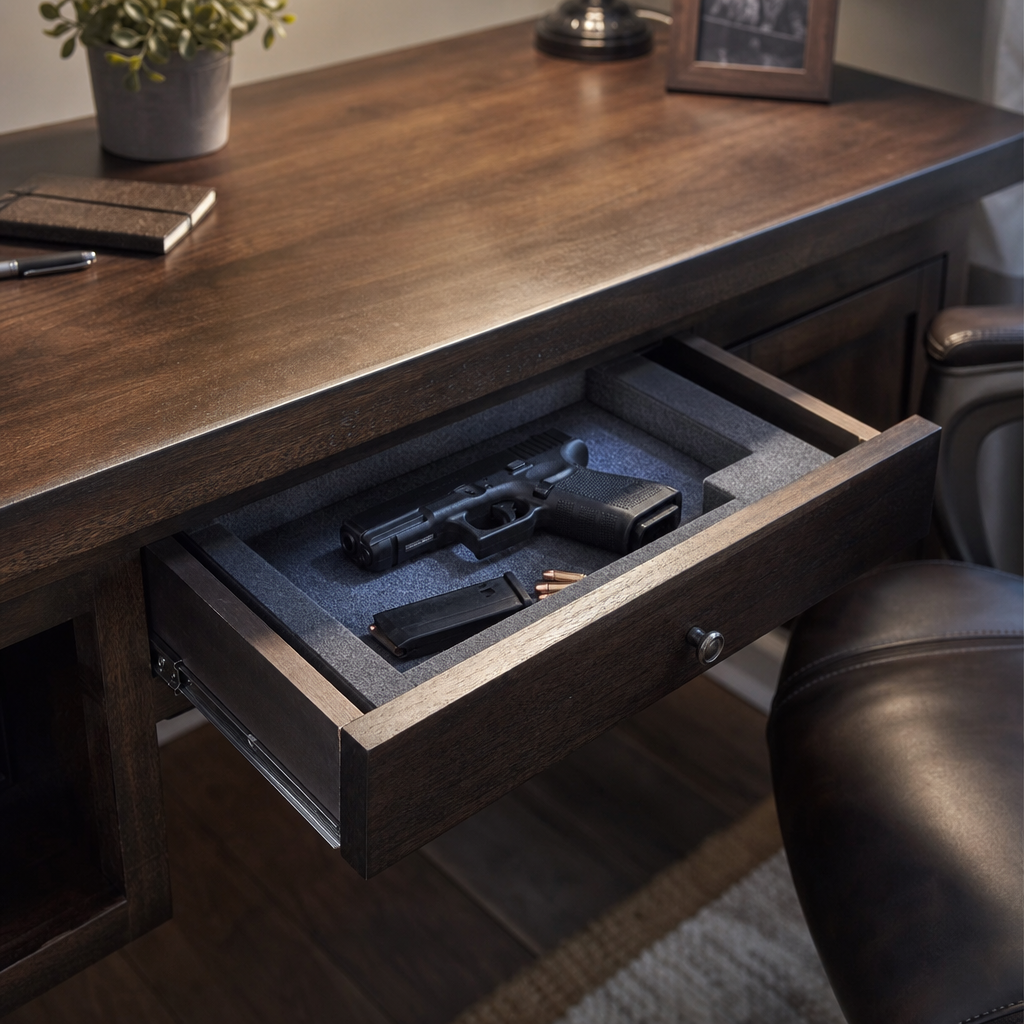
A DIY hidden gun storage safe inside a desk can add discreet access and layered security, but it only works when concealment, structural strength, locking hardware, and lawful firearm storage are planned together from the start. In practical terms, this project is a custom compartment built into an existing desk or purpose-built workstation, reinforced to resist casual discovery, fitted with a controlled access lock, and designed to protect a firearm from unauthorized users, especially children and guests. I have built hidden compartments in office furniture and shop cabinets, and the main lesson is always the same: the hidden feature is the easy part; the hard part is making it reliable, safe, and compliant with real storage obligations. For gun owners, that distinction matters because a secret drawer that opens with a magnet is not automatically a safe. A true hidden desk gun safe must address access control, tamper resistance, retention, and safe firearm orientation. It also needs to fit the desk’s actual structure, including apron rails, drawer slides, cable paths, and load points, so that the modification does not weaken the furniture or reveal itself through poor fit and finish.
This article serves as the hub for custom and DIY gun safe modifications within the broader gun safes and safety category. It explains how to build a hidden desk safe, what materials and lock types work, how to reinforce weak furniture, how to choose locations that stay concealed during normal use, and when a DIY solution should give way to a certified commercial product. It also answers the practical questions people ask first: Can a desk compartment be secure enough for a handgun? What lock should be used? How do you prevent printing, rattling, accidental trigger contact, and moisture buildup? The short answer is that a desk-based hidden gun storage system can work well for one defensive handgun, magazines, documents, and a compact light, but only if the builder treats the desk as an enclosure to be engineered rather than a piece of furniture to hollow out. Good design begins with the purpose, the legal environment, and the users in the home, then moves to dimensions, locking, reinforcement, concealment, and testing.
Start with legal, safety, and design requirements
Before cutting wood, define what the compartment must do. Many states impose child access prevention standards, negligent storage liability, or requirements tied to unauthorized access. Even where the law is less prescriptive, the baseline remains clear: a firearm stored in furniture must be unloaded or stored according to your defensive plan, isolated from unauthorized users, and inaccessible to children. In homes with minors, I recommend treating the project as a quick-access lockbox integrated into furniture rather than a mere hidden compartment. That means a positive locking mechanism, reinforced enclosure walls, and repeatable one-handed access for the authorized user only.
Next, decide whether the desk safe will store a single handgun, a handgun plus spare magazine, or additional valuables. A compact pistol with an optic can require more internal height than many builders expect. Measure the firearm in the exact condition it will be stored, including holster if used, mounted light, red dot, and suppressor-height sights. Add clearance for foam lining, retention brackets, and fingers reaching in quickly. I usually model the interior with cardboard first because desk cavities are irregular, especially around center drawers, keyboard trays, modesty panels, and support rails.
Concealment should never replace safe handling. The trigger must be protected from contact at all times, which is why a molded holster shell, kydex bracket, or fixed muzzle-down cradle is better than loose foam alone. Also plan for humidity control. Desks near exterior walls, vents, or windows can cycle moisture more than expected. A small rechargeable desiccant unit or rust-inhibiting liner can prevent corrosion in an enclosed compartment.
Choose the right desk and the best hiding location
Not every desk is a good candidate. Hollow-core laminate desks sold for light office use often rely on thin particleboard and cam locks. They can conceal a compartment, but they do not provide meaningful resistance once discovered. Solid wood desks, plywood carcass desks, and welded steel-frame desks with wood panels are much better because they offer anchor points for internal frames and heavier hardware. The best desks have unused cavities beneath a false bottom, behind a center drawer face, inside a kneehole modesty panel, or within a thick pedestal sidewall.
In practice, the most effective hidden locations are not the most dramatic. A shallow compartment directly under the desktop can work if the underside is visually broken up by aprons, cable trays, or a keyboard shelf. Another strong option is a false back in a pedestal cabinet, where the visible drawers remain functional while a locked chamber sits behind them. For standing desks, avoid moving columns and cable chains, and keep the hidden safe clear of lifting mechanism travel. If the desk is used daily, choose a compartment that does not force awkward body movement. Reaching under the left side panel while seated is much faster and less conspicuous than kneeling to access the floor-level plinth.
One rule I follow is that the compartment should disappear during ordinary cleaning, vacuuming, and drawer use. Gaps, mismatched grain, fresh screws, and asymmetrical panel reveals are what expose DIY work. If a panel is removable, its seams should align with existing design lines. If a drawer front is used as a false face, preserve the same reveal width as adjacent drawers.
Build a reinforced enclosure, not just a secret cavity
A real hidden gun storage safe inside a desk needs an internal box. That box can be made from 14 to 16 gauge steel, 3/4-inch hardwood plywood laminated in layers, or a hybrid of plywood shell with steel strike plates around the lock area. Steel is superior for pry resistance and long-term wear, but plywood is easier to fabricate with common tools and can still be robust if reinforced correctly. The weak point in most DIY builds is not the wall material; it is the door edge and latch side.
My preferred construction for wood desks is a concealed plywood lockbox anchored through structural members with carriage bolts, threaded inserts, or plus-nuts where metal framing exists. The opening panel gets a hardwood perimeter frame to resist flex, and the latch side receives a steel angle backing plate so the bolt cannot tear out under leverage. Piano hinges are reliable for long doors, but concealed SOSS-style hinges or internal torsion hinges improve stealth. Use mechanical stops so the door opens to a repeatable position without slamming into the desk structure or exposing the firearm awkwardly.
If the desk itself is lightweight, add an internal subframe. A simple rectangular frame in maple, oak, or 1×1 steel tubing can spread loads and keep the desk from racking after material is removed. This matters when builders cut out center supports to make room for the compartment. Remove too much, and the desk telegraphs the modification by wobbling. Done correctly, the desk should feel stronger after the safe is installed.
| Component | Recommended Spec | Why It Matters |
|---|---|---|
| Enclosure walls | 14–16 gauge steel or double-layer 3/4-inch plywood | Improves resistance to casual pry attacks and screw pullout |
| Door panel | Framed panel with steel latch backing | Prevents flexing at the locking side |
| Hinges | Internal piano hinge or concealed hinge | Reduces visible hardware and tampering points |
| Fasteners | Through-bolts, threaded inserts, or rivet nuts | Far stronger than wood screws into particleboard |
| Interior retention | Kydex holster shell or fixed cradle | Protects the trigger and controls orientation |
| Moisture control | Rechargeable desiccant or VCI liner | Limits rust in enclosed furniture cavities |
Select a lock that balances speed, concealment, and reliability
The lock determines whether the project is a hidden compartment or a hidden safe. Magnetic touch latches, spring catches, and bookshelf-style secret releases are useful for concealment but should not be the primary access control for a firearm. For actual secure storage, use a purpose-built electronic cam lock, a mechanical Simplex-style pushbutton lock, or a compact biometric safe lock from a reputable manufacturer. In testing and field use, mechanical pushbutton locks remain the most dependable under stress because they are battery-free and work in darkness without fingerprint read errors.
Electronic locks can be excellent when paired with a hidden backup key and a low-battery alert, but choose a model rated for frequent cycles. Cheap cabinet keypad locks often fail at the solenoid or bind when the desk shifts slightly with humidity. If you want fast access from a seated position, mount the lock where the hand naturally falls, then disguise the interface behind a trim panel, false stretcher, or recessed underside lip. The lock should release a real boltwork or steel latch, not just a spring-loaded catch. Gas struts or push-open actuators can assist the opening movement, but they should not pop the door open so violently that the firearm shifts.
Biometric options are convenient, especially for single-user desks, yet they require disciplined testing with dry hands, wet hands, partial finger placement, and backup opening methods. If a hidden desk safe is intended for emergency defensive access, rehearse from your normal seated position, from standing behind the chair, and in low light. The best locking system is the one that opens correctly every time without requiring visual confirmation.
Design the interior for safe access and low signature
Inside the compartment, organize the firearm so it can be retrieved without fumbling, muzzle sweeping, or snagging on the desk edge. A canted mount at roughly 10 to 20 degrees often works well under desktops because it preserves grip access while keeping the gun from rattling during opening. Foam should be closed-cell, not upholstery foam, because open-cell material traps moisture and deforms. Thin felt can quiet contact points, but it should not interfere with the trigger guard area.
Noise discipline is underrated. A hidden desk compartment that thumps when closed or rattles when bumped will draw attention. Add adhesive-backed neoprene bumpers, soft-close stops, and snug retention around the gun and magazine. Cable routing also matters if the lock or lighting is powered. Use adhesive cable clips or routed channels so wires do not hang into leg space or reveal the compartment when someone looks underneath.
Lighting is optional but useful. A low-output LED strip tied to a magnetic reed switch can illuminate the contents when the door opens. Keep it dim and shielded so there is no visible light leak through seams. For document storage, include a divider to keep papers from rubbing against the firearm. For spare magazines, use fixed loops or shallow slots rather than loose placement.
Installation, testing, and common failure points
During installation, dry-fit everything before final fastening. Check desk level, drawer travel, cable clearances, and whether the chair arms hit the access path. Then test the compartment closed and locked under load. Sit at the desk, bump it with your knees, open and close all visible drawers, and confirm nothing prints, binds, or sounds unusual. Most failed builds reveal themselves because the false panel rubs, the reveal changes with humidity, or the desk develops a new wobble after material is removed.
Anchor the desk if possible. A hidden safe in a freestanding lightweight desk can be stolen as a unit. Wall anchoring, anti-tip straps, or floor brackets significantly improve overall security. If the room is humid, place a hygrometer inside for a week and record swings. Relative humidity above about 50 to 55 percent for extended periods can invite corrosion depending on finish and climate. Also check for printer heat, HVAC vents, and sunlight on dark desk surfaces, which can affect batteries and adhesives.
Common mistakes include undersized compartments, weak latches, visible seam lines, storing a loose handgun without trigger protection, and relying entirely on concealment. Another frequent error is choosing a location that requires two hands to operate, which defeats emergency access. Finally, many DIY builders overlook maintenance. Replace batteries on schedule, inspect fasteners quarterly, and rehearse access enough to confirm function without making the compartment familiar to everyone in the house.
When DIY is smart, and when a commercial safe is better
DIY desk gun storage is most appropriate when you need discreet integration, have solid carpentry or fabrication skills, and understand that the goal is controlled quick access for a limited number of items. It is less appropriate when legal requirements demand tested burglary ratings, when multiple firearms need storage, or when the desk is made from fragile materials. In those cases, a commercial quick-access handgun safe mounted inside furniture is usually the better solution. Brands such as Fort Knox, V-Line, Vaultek, and Hornady offer compact units with proven lock systems that can be integrated behind a custom panel, giving you the benefit of certified hardware plus tailored concealment.
As a hub for custom and DIY gun safe modifications, this topic also connects to related projects: false wall safes, under-bed lockboxes, closet reinforcement, humidity retrofits, LED interior lighting, biometric lock upgrades, shelving concealment, and anchor improvements for modular cabinets. The same principles apply across all of them. Start with legal and household needs, build around access control rather than novelty, reinforce weak substrates, protect the trigger, control moisture, and test repeatedly under real use conditions.
A well-built hidden gun storage safe inside a desk can be discreet, fast, and dependable, but only when it is treated as a safety system rather than a clever woodworking trick. The core decisions are straightforward: choose a structurally sound desk, place the compartment where normal use will not expose it, install a reinforced enclosure, use a serious lock, and organize the interior so the firearm is secure and accessible without unsafe handling. Concealment helps, yet concealment alone is never enough. Strength, controlled access, anchoring, and maintenance are what make the design responsible.
If you are planning custom or DIY gun safe modifications, use this page as your starting point and evaluate every project by the same standard: would it resist discovery, restrict unauthorized access, and function safely under stress? Sketch the desk, measure the firearm and accessories, select the lock before cutting, and test the finished compartment like a tool you may depend on. That disciplined approach produces better builds and, more importantly, safer storage.
Frequently Asked Questions
Is it legal to build a hidden gun storage safe inside a desk?
In many places, it is legal to build a hidden gun storage compartment for personal use, but legality depends on how the firearm is stored, who can access it, and the laws in your state, county, or municipality. The most important issue is not just whether the compartment is concealed, but whether it complies with firearm storage, child access prevention, transport, and safe handling requirements where you live. Some jurisdictions require firearms to be secured with a locking device whenever they are not under the owner’s direct control, while others impose enhanced duties if minors are present in the home. If the desk safe will hold a loaded firearm, legal expectations may be even stricter depending on local law.
It is also important to understand that a hidden compartment is not automatically considered a compliant safe. If a desk cavity merely disguises a firearm without meaningful locking hardware or resistance to unauthorized entry, it may fail to meet legal or practical storage standards. A well-planned build should include a reliable lock, a reinforced compartment, and access controls that prevent children, visitors, and unauthorized adults from gaining entry. Before starting the project, review current firearm storage laws, landlord or HOA restrictions if applicable, and any insurance requirements tied to firearm ownership. When in doubt, verify with a qualified attorney or your local law enforcement agency’s non-emergency resources so your DIY project is not only discreet, but lawful.
What features make a DIY hidden gun safe inside a desk actually secure?
A secure hidden desk safe depends on layered protection rather than concealment alone. The first layer is discreet integration: the compartment should blend naturally into the desk design and avoid obvious seams, mismatched hardware, or suspicious dead space that invites inspection. The second layer is structural strength. Thin plywood, weak slides, and decorative trim are not enough if someone discovers the compartment. The storage cavity should be reinforced with durable materials, solid fastening points, and mounting methods that make quick pry attacks more difficult. Even if the unit is not equivalent to a commercial gun safe, it should still resist casual tampering and delay unauthorized access.
The third layer is controlled entry. A hidden panel with no lock is simply concealment, not security. A proper build usually includes a dependable lock such as an electronic keypad, RFID system, mechanical cam lock, or other controlled access mechanism that matches your access-speed needs and threat level. The fourth layer is internal organization and firearm retention. A handgun should fit securely without shifting, and the interior should be arranged to prevent damage, accidental trigger interference, or unsafe retrieval. If you are storing magazines, documents, or accessories alongside the firearm, the compartment should keep them separated and orderly so access remains safe under stress.
Finally, true security means thinking beyond the box itself. The desk should be stable, difficult to remove, and placed in a room with appropriate privacy and household access controls. If children are in the home, the build should be treated as one part of a broader safety plan that may include education, supervision, and additional locking measures. In short, the most effective DIY hidden gun storage safe combines concealment, reinforcement, quality locking hardware, safe interior design, and responsible household firearm practices.
What kind of lock works best for a hidden gun compartment built into a desk?
The best lock depends on your priorities: speed, reliability, discretion, power requirements, and who may need authorized access. Electronic keypad locks are popular because they allow fast entry and can be mounted discreetly, but they require battery management and should be chosen carefully to avoid cheap components or failure-prone mechanisms. RFID locks offer very clean concealment because there may be no visible keypad at all, but they depend on a tag, card, or wearable device that must be kept secure and immediately accessible. Mechanical locks can be very dependable and eliminate battery concerns, though some are slower to open and may be less discreet depending on the installation.
For a firearm storage application, reliability matters more than novelty. Any lock you use should be designed for repeated use, installed to manufacturer specifications, and tested extensively before the compartment is put into service. It should also fail in a predictable way. For example, if the lock loses power, you need to know whether it remains secured, whether there is a backup override, and whether that backup method introduces a vulnerability. Fast access is valuable, but not if it comes at the cost of accidental lockouts, easy bypass, or weak attachment points that let someone defeat the door without even touching the lock itself.
A strong setup often includes both hidden placement and a lock that supports your real-world routine. If the desk is in a private home office and intended for emergency defensive access, a quality electronic or RFID system may make sense if maintained properly. If long-term reliability with minimal electronics is your priority, a robust mechanical lock may be better. Whichever route you choose, avoid relying on magnetic catches, childproof latches, or furniture-grade closures as your primary security. For firearm storage, the lock is a life-safety component, so it should be selected with the same seriousness as the compartment’s structure.
How do you keep a hidden desk gun safe safe from children and unauthorized users?
The most important principle is that hidden does not mean childproof. Children are naturally curious, and many unauthorized users are more observant than people expect. A concealed compartment may reduce casual discovery, but it should never be treated as the only protective measure. To help prevent access, the compartment should use a true locking system, be built with durable materials that resist forced opening, and be placed where children and visitors do not freely handle, climb on, or inspect the desk. If the desk is in a common area, the overall risk is much higher than if it is in a private, access-controlled room.
Safe storage also depends on daily habits. The compartment must remain locked whenever the firearm is not under your direct control. Keys, RFID tags, backup overrides, and codes should be protected just as carefully as the firearm itself. Do not store access credentials in obvious nearby locations such as top drawers, under desk organizers, or attached to the same keyring used for routine household items. If multiple adults need access, establish clear rules for who is authorized, how the safe is checked, and what to do if a code, key, or entry device is lost or exposed.
Many responsible owners also add internal safety measures, such as a trigger lock, chamber flag, or separate ammunition storage where appropriate and consistent with their intended use and local law. Whether that is suitable depends on your storage purpose and access requirements, but the broader point is that layered safety is always better than relying on one trick feature. If children live in or visit the home, education and supervision matter too. The safest hidden gun desk is one that combines concealment, locking security, restricted room access, disciplined handling practices, and compliance with all child access prevention laws.
Can a DIY hidden desk safe provide the same protection as a commercial gun safe?
Usually, no. A DIY hidden desk safe can provide discreet storage, controlled access, and a useful layer of security against casual discovery or opportunistic interference, but it generally will not match a purpose-built commercial gun safe in burglary resistance, fire protection, tested locking performance, or certified construction standards. Commercial safes are designed around hardened steel, engineered doors, specialized bolt systems, and in some cases independent ratings or testing benchmarks. A desk compartment, even a well-built one, is limited by the strength of the furniture, the available space, and the practical constraints of integrating a hidden cavity into a workstation.
That said, a DIY hidden compartment can still be a smart solution when its purpose is clearly understood. If your goal is discreet, quick-access storage inside a controlled home environment, a reinforced desk compartment with proper locking hardware may work very well as part of a broader security plan. It can be especially useful when paired with other measures such as room security, surveillance, alarm systems, and a larger rated safe for long-term storage of additional firearms. In that role, the hidden desk safe is not replacing a full-size gun safe so much as complementing one.
The key is realistic expectations. A desk safe should be built to delay access, prevent unauthorized handling, and avoid obvious detection, but not to create a false sense of invulnerability. If you need high-level theft resistance, fire resistance, or insurance-grade protection, a commercial safe is the better primary solution. If you need discreet placement and controlled access for a single firearm or limited setup, a thoughtfully designed DIY hidden desk compartment can be effective, provided it is reinforced, locked properly, used responsibly, and built with safety and legal compliance in mind from the very beginning.